

Every “best CRM for solopreneurs” list is written by people who’ve never been a solo founder. They lump every solo operator into one bucket and recommend the same five tools every time. That’s why nothing you can find actually answers the question.
The best CRM for solo founders depends on what you sell. Service and hybrid founders should use Fluid CRM, OnePageCRM, Pipedrive or Salesflare. Product founders and network-heavy operators should use HubSpot Free, Bigin, Less Annoying CRM or Folk. There’s no single right tool because solo founders aren’t one buyer.
Why Most “CRM For Solopreneur” Lists Get Solo Founders Wrong
I’m a solo founder running Fluid CRM, Fenixtal and CSVgo. I do sales about 5 to 8 hours a week. The other 32 plus hours go to product, content, support and ops. A CRM that needs 2 hours a day of attention takes my whole week. So when I built Fluid CRM, the bar was simple. Open it, see what matters today, close it in 10 minutes.
That’s the bar for any solo founder CRM. And it’s the reason most lists miss the mark.
Every list pretends “solo founder” is one buyer. It isn’t. Solo founders split three ways depending on what they sell, and that split decides which CRM actually fits. Most blogs skip this part because it forces them to recommend more than one tool.
So let’s name it.
The Three Types Of Solo Founder (Product, Service, Hybrid)
There are three kinds of solo founder and which one you are decides what your CRM should do. Pick yours before you read the listicles below.
Product founders. You sell a SaaS, an e-commerce product, an info product, a course, a community. Most of your revenue comes through marketing automation. People sign up through your site, hit a paywall, convert. You don’t have a “pipeline” of 30 deals. You have a funnel and maybe 5 to 10 high-touch conversations a month with bigger customers or partners.
Service founders. You sell agency services, consulting, freelance work, done-for-you offers. Every deal is high-touch. You’re sending proposals, doing discovery calls, negotiating scope. You might have 15 to 40 active conversations at any time and follow-ups are how you eat. If you’re a pure consultant rather than a founder building a company, see our best CRMs for consultants who hate admin work for a deeper breakdown of the consultant-specific picks.
Hybrid founders. You sell both. A SaaS with an enterprise tier. A productized service. An agency with a tool layered on top. You need the visual pipeline of a service founder and the integrations of a product founder.
Austin Verner runs Cold Emailers, a cold email agency. He’s the hybrid-founder archetype. The business is a service (he books meetings for B2B clients) but the back end runs heavy automation through SmartLead, Clay and Make.com. His pipeline isn’t a spreadsheet. It also isn’t a marketing funnel. It’s both and his CRM has to handle both.
Have you actually thought about which one you are? Stop for a second and pick. Because if you skip this step you’ll buy the wrong tool, churn in 60 days and end up back in Google Sheets.
The 4 Best CRMs For Service And Hybrid Founders
If you’re a service or hybrid founder, your CRM needs a sharp visual pipeline, follow-up reminders that work and integrations with the cold email or LinkedIn tools you already use. Here are the four that fit.
1. Fluid CRM (best for service founders and hybrid founders who want low admin)
Fluid CRM is the CRM I built because I wanted one for myself and the off-the-shelf options were either too thin (Sheets) or too bloated (HubSpot, Salesforce). Visual pipeline, follow-up reminders, unlimited deals and contacts, 8 in-app automations, API and webhooks, keyboard shortcuts. Every feature is on both plans. No upgrade traps.
Pricing: $16/seat/month monthly or $144/seat/year annual (works out to $12/seat/month, 3 months free).
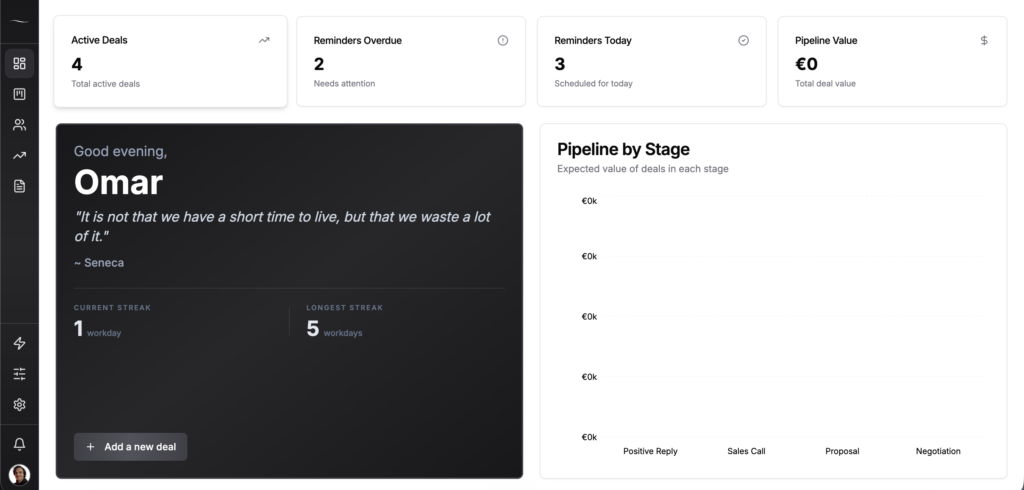
Austin Verner came from Google Sheets to Fluid CRM. His take: “It’s fast as well. I like the hotkeys. I’ve actually been using them.” For a solo founder that detail matters more than it sounds. Every second logging is a second not building the company.
Doland White, who runs Doland White Consulting as a solo executive coach and business consultant, put it another way. “The CRM serves me, not the other way around.” That’s the standard for a founder CRM. Anything that needs more attention than that is the wrong tool.
Best for: Service founders with 15 to 100+ active deals. Hybrid founders integrating cold email or LinkedIn tools. Anyone who wants to spend 10 minutes a day on the CRM, not 2 hours.
Skip if: You’re a pure product founder running entirely on marketing automation. You’d rather use HubSpot Free.
2. OnePageCRM (best for action-list founders)
OnePageCRM is built around an “action list” idea. Every contact has a next action attached. Open the tool and you see your call list for the day, not a pipeline view.
Pricing: $9.95/user/month annual (Professional), $15/user/month monthly. Business plan from $19.95/user/month annual.
Best for: Service founders who think in tasks, not stages. Coaches, consultants, relationship-heavy operators.
Skip if: You want a visual kanban pipeline. The action-list model is great if it matches how you sell. It’s friction if it doesn’t.
3. Pipedrive (best for founders with mid-volume pipelines)
Pipedrive is the standard sales CRM. Visual pipeline, deal tracking, automations, email integration, a deep app marketplace.
Pricing: Lite $24/seat/month monthly ($14 annual). Most founders need Growth at $49/seat/month to unlock automations and full email sync.
Best for: Founders with 40 plus active deals and a real sales motion. Founders who plan to hire a sales person in the next 12 months.
Skip if: Your pipeline is under 30 deals. Pipedrive will feel heavy and most of the features go unused.
4. Salesflare (best for founders who live in Gmail)
Salesflare auto-logs everything from Gmail or Outlook. Emails, meetings, contact data, all pulled in without you typing it. For a solo founder who hates data entry this is the killer feature.
Pricing: Growth $39/seat/month, Pro $64/seat/month (workflows and email sequences gated to Pro).
Best for: Founders running outbound from Gmail. Founders who never want to log a contact by hand again.
Skip if: You’re outside Gmail or Outlook. Salesflare is built around that integration.
The 4 Best CRMs For Product Founders And Network-Heavy Operators
If you’re a product founder or a relationship-heavy operator, your needs are different. You’re not running a 30-deal pipeline. You’re tracking signups, partner intros, occasional enterprise conversations. Here are the four that fit.
1. HubSpot Free (best for product founders wanting marketing automation later)
The free tier of HubSpot CRM. Unlimited contacts, basic deal tracking, email integration, forms. It’s a real product, not a teaser, as long as you stay on the free tier.
Pricing: Free. Starter $20/seat/month. Professional $100/seat/month plus a $1,500 onboarding fee.
Best for: Product founders who think they’ll need marketing automation in 12 to 24 months and want the ecosystem ready when they get there.
Skip if: You’re a service founder. The day you outgrow free, you’re looking at $100/seat plus $1,500 to use the features you actually need. That’s the trap.
2. Bigin by Zoho (best for budget-conscious product founders)
Bigin is Zoho’s lightweight CRM. Free tier for a single user. Paid plans cheap. Mobile-first.
Pricing: Free (single user). Express $9/user/month monthly ($7 annual). Premier $15/user/month ($12 annual).
Best for: Product founders watching every dollar. Founders who want a CRM as a backup to their main funnel, not the main system.
Skip if: You need a serious pipeline. Bigin is light by design.
3. Less Annoying CRM (best for product founders who want one flat price)
Less Annoying CRM is exactly what the name says. One plan, one price, no tiers. Contact management, simple pipeline, calendar, follow-up reminders.
Pricing: $15/user/month flat. No upgrades, no add-ons.
Best for: Product founders who want a CRM that won’t grow into a budget item. Founders allergic to pricing pages with 4 tiers.
Skip if: You need integrations with cold email tools, advanced automations or a power-user feature set. LACRM is deliberately basic.
4. Folk (best for relationship-heavy founders, partnerships, intros, networking)
Folk is a contact-first CRM. Designed for relationship-driven work, not pipeline-driven work. PR, partnerships, intros, investor conversations.
Pricing: Standard $30/seat/month ($24 annual). Premium $60/seat/month ($48 annual).
Best for: Founders whose real currency is intros and relationships. People who track 200 conversations a year, not 30 deals.
Skip if: You actually sell. Folk is built for the “talk to people” part, not the “close them” part.
CRMs To Avoid As A Solo Founder
Some tools come up a lot in CRM lists and Reddit threads and most of them are wrong for a solo founder. Here are the four I’d skip.
Salesforce. Built for sales teams of 20 plus with admins, ops people and processes. The Starter Suite at $25/user/month sounds cheap until you realize you’ll spend a week setting it up and never use 80% of it. Solo founders don’t have a week.
HubSpot Professional and above. The free tier is fine. The trap is when you outgrow it. Professional starts at $100/seat/month plus a $1,500 onboarding fee. For a solo founder paying $1,500 to be allowed to use the software you’re paying for is absurd. For specifically the 2-person team math, this breakdown goes deeper.
Doland White told me he tried HubSpot and bounced off the upsells. “With HubSpot, if you want to do something different, you have to buy more. What starts off small gets bigger, bigger, bigger and bigger.”
GoHighLevel. The Reddit threads on solo founder CRMs have a recurring complaint about GoHighLevel. The pattern: $97/month minimum, designed for marketing agencies running funnels for clients, not for founders running their own business. The “all-in-one” pitch is real but the bloat is real too. Solo founders consistently bounce off it within 60 days.
Monday CRM. Monday is a project management tool with a CRM bolted on. The pipeline view is fine. The data model is built for a different job. Solo founders get pulled into building dashboards instead of closing deals.
And the bigger point most lists won’t say. Austin Verner watches a lot of cold email leads die at the follow-up stage. His observation: “The biggest reason for our churn is they’re getting leads, but they’re not closing.” That pattern repeats for solo founders too. The CRM problem isn’t getting more leads. It’s following up on the ones you have. A bloated CRM that takes 2 hours a day of admin makes that worse, not better. Half the marketing agencies I worked with at Fenixtal tracked deals in Google Sheets. The other half paid for Salesforce and the team didn’t log in. Both broken systems for the same reason. The tool didn’t fit the operator.
How To Pick The Right CRM For Your Type Of Solo Founder Business
Three questions get you to the right pick.
1. Which founder type are you?
Product, service or hybrid? If you’re not sure, look at your revenue. If 80% comes through automated signups, you’re a product founder. But if 80% comes through deals you closed in conversations, you’re a service founder. Everything else is hybrid.
2. How many hours per week do you spend on sales?
Under 5 hours: you want a free or near-free tool with minimal admin. Bigin, HubSpot Free, Less Annoying CRM.
5 to 10 hours: you want a sharp pipeline with reminders. Fluid CRM, OnePageCRM.
10 to 20 hours: you have a real sales motion. Pipedrive, Salesflare, Fluid CRM with automations.
ver 20 hours a week: you’re not a solo founder anymore. You’re a salesperson or you’re running a small agency. Hire help, accept the trade-off or see our best CRM for small agencies for the agency CRM picks.
3. How many active deals do you carry?
Under 10: a spreadsheet still works.
10 to 30: a light CRM (Fluid CRM, OnePageCRM, Less Annoying CRM).
30 to 100: a serious pipeline tool (Fluid CRM, Pipedrive, Salesflare).
Over 100: you need a tool with reporting and automation depth or you need to hire.
Match all three answers and the CRM picks itself.
What To Do After Picking A CRM
The CRM doesn’t fix your sales by itself. Five steps to actually get value out of it in the first month.
Step 1: Import only your active deals
Don’t migrate 6 months of dead leads. Start with the 20 to 40 deals you’re working right now. Get those in clean.
Step 2: Set your stages to match how you actually sell
Most CRMs ship with default stages. Ignore them. Look at your last 10 closed deals and write down the real stages you moved them through. Three to five stages is plenty.
Step 3: Add follow-up reminders on day one
This is the whole reason you’re switching from a spreadsheet. Set a follow-up on every active deal before you do anything else.
Step 4: Block 30 minutes a day for CRM time
Same time every day. Open the tool, review the day’s tasks, send the follow-ups, close it. 30 minutes. If it takes longer, the CRM is wrong or your pipeline is too big for solo founder work.
Step 5: Review weekly, not daily
Once a week, look at your pipeline. Which deals haven’t moved? Which need a different angle? And which are dead? Daily review is a tax. Weekly review is the actual work.
Frequently Asked Questions
The best CRM depends on what you sell. Service and hybrid founders should use Fluid CRM, OnePageCRM, Pipedrive or Salesflare. Product founders and relationship-heavy operators should use HubSpot Free, Bigin, Less Annoying CRM or Folk. No single tool wins for all solo founders because solo founders aren’t one buyer.
If you have more than 10 active deals or you’ve missed a follow-up in the last month, yes. Below that, a spreadsheet works. The signal isn’t deal count alone. It’s whether deals are slipping because you forgot about them. If they are, a CRM pays for itself in the first deal it saves.
Free options exist. Bigin by Zoho has a free tier for single users. HubSpot CRM is free with unlimited contacts on the entry tier. Paid solo founder CRMs start at $9 to $16 per user per month. Fluid CRM at $16/seat/month and Less Annoying CRM at $15/user/month are both feature-complete and won’t push you into upgrades.
For a product founder, often yes. The free tier handles contacts, basic deals and email integration. The trap is when you outgrow it. The next paid tier with the features you’ll actually want starts at $100/seat/month plus a $1,500 onboarding fee. So HubSpot Free works until it doesn’t and the cliff is steep.
Yes. A CRM that works for you as a solo operator might not work when you hire your first salesperson. Look for tools that scale with you without forcing a re-migration. Fluid CRM, Pipedrive and HubSpot all handle the solo-to-small-team transition cleanly. Less Annoying CRM and Bigin are great solo but limited when you grow past 2-3 people.
Conclusion
There’s no single best CRM for solo founders because solo founders aren’t a single buyer. Pick by what you sell, how much time you spend on sales and how many active deals you carry. The right tool will pay for itself in the first deal it saves you. The wrong one will eat your week.
Fluid CRM fits service founders and hybrid founders who want a sharp visual pipeline without daily admin overhead. It’s not built for pure product founders who run entirely on marketing automation or for relationship-only operators who never sell. If you’re a pure product founder, HubSpot Free will beat Fluid. If you’re a relationship operator who just wants to track conversations, Folk or OnePageCRM will beat Fluid. For a full breakdown of Fluid CRM against the other small B2B options, see best CRM for small B2B sales pipelines.
If you’re in the first group though, Fluid CRM gives you a clear pipeline without the bloat of HubSpot or the babysitting of Salesforce.