

Most “HubSpot alternatives” lists send you to tools that are equally bloated. Salesforce, Keap and others with the same problem just with different logos. The real question isn’t which HubSpot alternative is best. It’s whether you need a marketing automation suite at all, or just a way to track deals. Because more isn’t always better if it gets in the way of your actual workflow.
The best HubSpot alternative for small business depends on whether you need marketing automation or just deal tracking. For calm sales pipeline tracking only, use Fluid CRM or Pipedrive. For an all-in-one suite cheaper than HubSpot, try Zoho or Freshsales. Most small businesses only need the first.
Why HubSpot Doesn’t Fit Most Small Businesses
HubSpot is built for the journey, not the destination. You sign up small, then you grow into the modules and that’s the whole pricing model. Each thing you actually want to do lives behind another paywall.
Doland, a 72 year old executive coach, said it cleanest on a demo call with me. Doland’s situation is common among coaches and consultants weighing HubSpot. He’d already tried HubSpot, Salesforce, Capsule and “every CRM there is.” Here’s how he described the HubSpot trap:
“With HubSpot, if you want to do something different, you have to buy more. What starts off small gets bigger, bigger, bigger and bigger.”
“I don’t want to buy nine modules with HubSpot to do that. I don’t want to do that.”
This isn’t a complaint about price. Doland can afford it. It’s a complaint about the structure. The pricing isn’t the problem, but pattern and principle behind is. Every workflow you build pulls in another module.
The pattern looks like this for a 5-person B2B team. Sales Hub Starter at $20/seat/month, so $100/month. You want forecasting, custom objects and AI prospecting, so you upgrade to Sales Hub Professional at $100/seat/month. Now you’re at $500/month. Add Marketing Hub Professional, which starts at $890/month with a 12 month annual commit plus required onboarding fees. You’re at $1,390/month before you’ve sent a single email.
Most small businesses don’t need any of this. They need to track who they talked to, what was said and what happens next. To do this in a fast and clear way, you shouldn’t spend more than $20/month per seat.
The Hidden Cost Of HubSpot’s Free Plan
The Free plan is the bait. It’s how HubSpot wins small businesses before competitors even get a look. And it works, because for the first three months it really does feel free.
The hidden cost isn’t money, but the forced upgrade moment.
Free gives you a hard contact limit. It gives you HubSpot branding on every email. It locks meeting scheduling, sequences, custom reporting and most of the automation behind paid tiers. Your team builds the muscle memory of using HubSpot, then hits a wall and the only way through the wall is a credit card.
In 3 years running B2B outbound at Fenixtal across 50+ clients, I saw the same pattern. Many of the marketing agencies I worked with were paying HubSpot around $890/month and using maybe 15% of the features. Others were on HubSpot Free, hitting the contact limit within 6 months and getting forced into an unplanned upgrade right when cash was tight. Almost nobody hit the sweet spot HubSpot’s marketing promises.
The pattern is always the same. Free gets you in. Then your data is in. Then your team is trained. But then you need to upgrade because moving is painful, not because the paid tier solves a problem you actually have.
If you’re on HubSpot Free right now and you only use it for tracking deals and sending the occasional email, you’re not getting a free CRM. You’re paying with switching cost you haven’t realized yet.
When You Should Stay On HubSpot
Some businesses genuinely need HubSpot. James, who runs a podcast booking agency called Wonderfish, told me on a call that he stays on HubSpot for exactly this reason. He needs heavy automations: documents created when deals hit certain stages, multi-tool integrations across Surf, Kondo and Make.com. For his use case, leaving HubSpot would be a downgrade.
But James isn’t blind about it either:
“Hubspot is a Ferrari, but most people only need a Honda or a Hyundai.”
“Not everyone needs HubSpot.”
For specifically a 2-person team weighing HubSpot, I went deeper on the math separately. So you should stay on HubSpot if any of the following are true.
First, you actually run multi-channel marketing automation. Triggered email sequences based on web behavior, lead scoring and attribution reporting that informs spend. If you log into HubSpot and use these weekly, you’re getting your money’s worth.
Second, you have separate marketing, sales and service teams that need to hand off contacts cleanly. The integration across hubs is HubSpot’s real strength. If your team is one founder doing everything or a small team behind you, you’re paying for a feature you can’t use.
Third, you sell into a long enterprise cycle with multiple stakeholders, custom properties and complex deal stages. HubSpot’s flexibility earns its complexity here.
Finally, you’re already on it, your team is trained and the cost is a rounding error on revenue. Switching costs are real. So don’t switch out of principle alone.
If none of those describe you, keep reading.
When You Should Switch From HubSpot
Switch if any of these are true.
First, you only use HubSpot to track deals and log notes and everything else is dead weight. If HubSpot feels overcomplicated for what you actually need, this breakdown goes deeper. A simple sales pipeline tool like Fluid CRM will do this faster, easier and cheaper.
Second, you have under 5 sales reps and no dedicated marketing person. The handoff feature HubSpot is built around doesn’t apply to you. You’re paying for a coordination problem you don’t have.
Third, you log into HubSpot and look at the same 2 screens every day. The deal board and the contact view. If that’s your workflow, you’re using 5% of the product and paying for 100%.
Fourth, your team doesn’t open HubSpot unless you make them. This is the loudest signal and one of the most common. CRMs that feel like admin get abandoned and your pipeline, deals and revenue will suffer greatly for it.
Finally, you’re paying more than $500/month and your revenue isn’t 20x that minimum. HubSpot is a powerful tool, but it’s not so powerful that you should pay 1/20 of your revenue for it, not even close. The math has to work. HubSpot at scale is a strong tool. HubSpot for a $10-20K MRR business is overkill that eats your margin.
If two or more of these describe your team, you should be looking at the alternatives below. Not all of them are simpler. I’ll tell you which ones are simpler. Most importantly, choose the one that fits how you actually work, not the one anyone tells you to fit yourself into.
The Real HubSpot Alternatives Worth Considering
These HubSpot alternatives are ideal for small businesses. I’m not going to pretend Salesforce belongs on a small business CRM list, so I’m not going to include it. Here are 7 relevant tools, what they actually are and who they’re for.
1. Fluid CRM
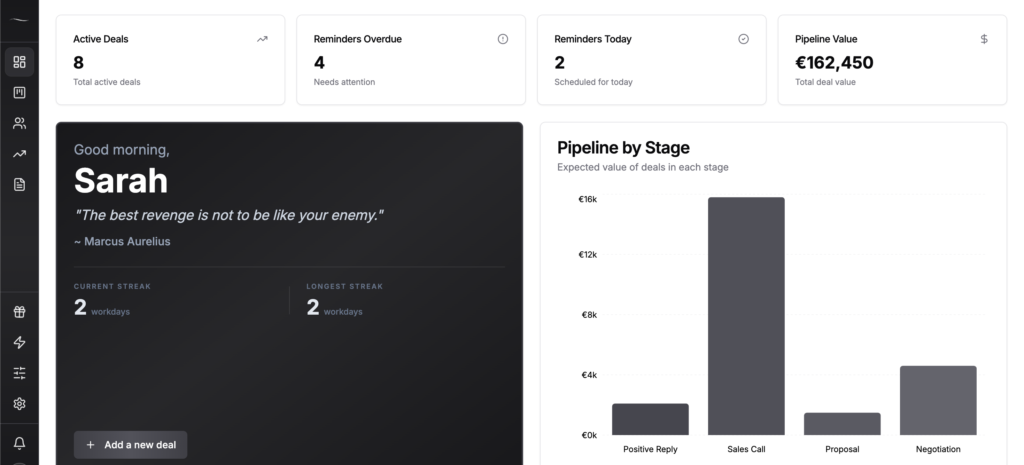
Best for small B2B teams, founders and agencies that need a calm way to track deals and follow-ups without marketing automation.
Fluid CRM is a visual sales pipeline. It has deals, contacts, reminders, keyboard shortcuts and in-app automations for the repetitive stuff. No marketing hub, service hub or endless modules. The pricing is $16/month and includes all the features Fluid CRM has, no upgrade traps. A 5-person team on Fluid CRM costs $80/month. Full side-by-side at Fluid CRM vs HubSpot.
We built Fluid CRM because I watched 50+ small B2B clients underuse HubSpot with a price tag or struggling with messy spreadsheets like Google Sheets and Excel. The gap between those two is the soul behind Fluid CRM.
For a full breakdown of Fluid CRM against the other small B2B options, see best CRM for small B2B sales pipelines.
What it isn’t? Not a marketing automation platform. If you need triggered email sequences based on stage changes or website behavior, Fluid CRM won’t do that.
2. Pipedrive
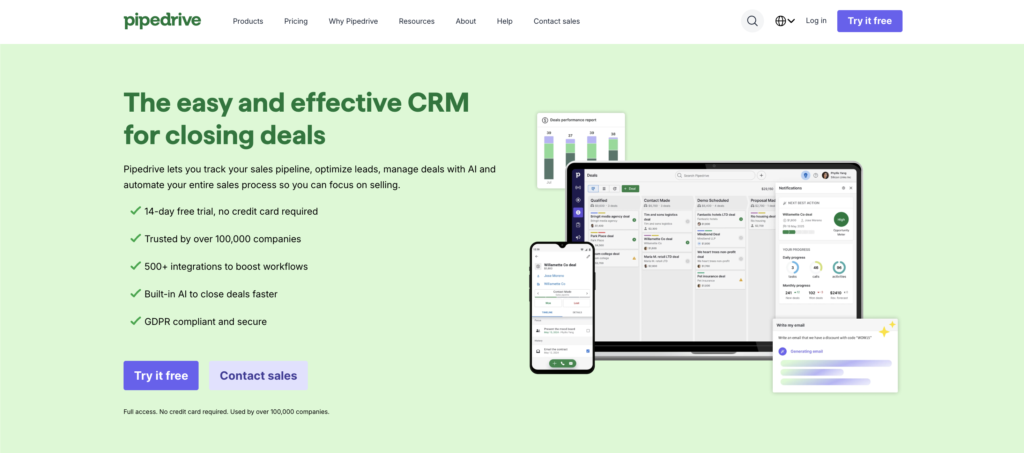
Best for sales-focused teams that have outgrown Sheets and can absorb per-user pricing as they grow.
Pipedrive is the closest alternative to Fluid CRM in style. Sales-first, pipeline-driven and less bloated than HubSpot. Pipedrive renamed its tiers in 2025. The current plans are Lite at $24/user/month, Growth at $49, Premium at $79 and Ultimate at $99. A 5-person team on Growth pays $245/month. Premium for that same team runs $395/month, which is most of the way to HubSpot Sales Hub Pro.
What it isn’t? Not flat-priced and the cheapest path if your team grows.
Full breakdown in Fluid CRM vs Pipedrive.
3. Zoho CRM
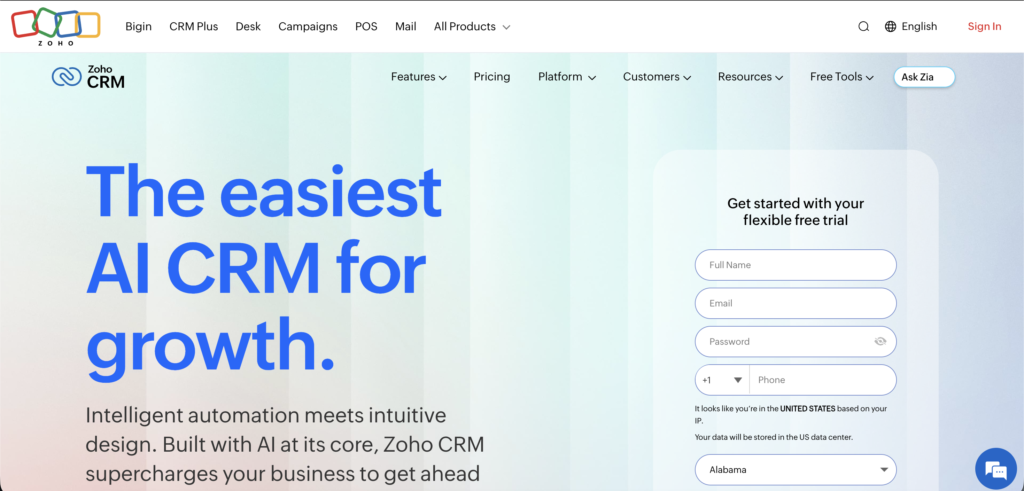
Best for buyers who want HubSpot’s all-in-one scope at a fraction of the price.
Zoho is cheaper than HubSpot, but it’s not simpler. It’s an all-in-one suite with sales, marketing, support, projects and more. If you genuinely use that scope, Zoho gives you 70% of HubSpot for 20% of the cost. Standard at $20/user/month, Professional at $35 and Enterprise at $50. There’s also a free tier for up to 3 users.
What it isn’t? Not anti-bloat. If HubSpot’s complexity is your problem, Zoho will frustrate even more.
4. Freshsales
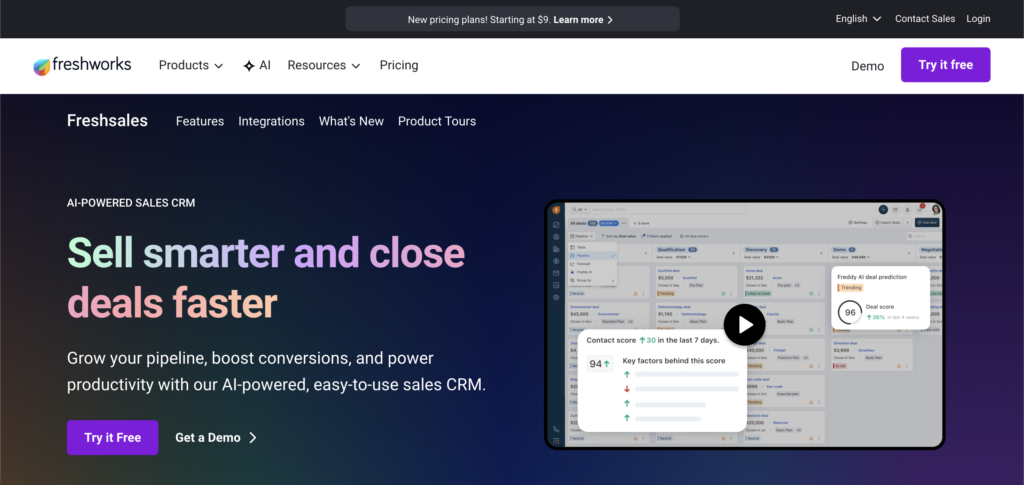
Best for teams that want a freemium starting point and will grow into paid features.
Freshsales has a usable free tier for up to 3 users and reasonable paid pricing. Growth at $11/user/month, Pro at $47 and Enterprise at $71. It has Built-in phone, email and chat. Freshsales is a good middle ground between simple pipeline tools and full suites.
What it isn’t? Not the simplest option. The free tier is genuinely free but the upsell path is real.
5. Capsule CRM
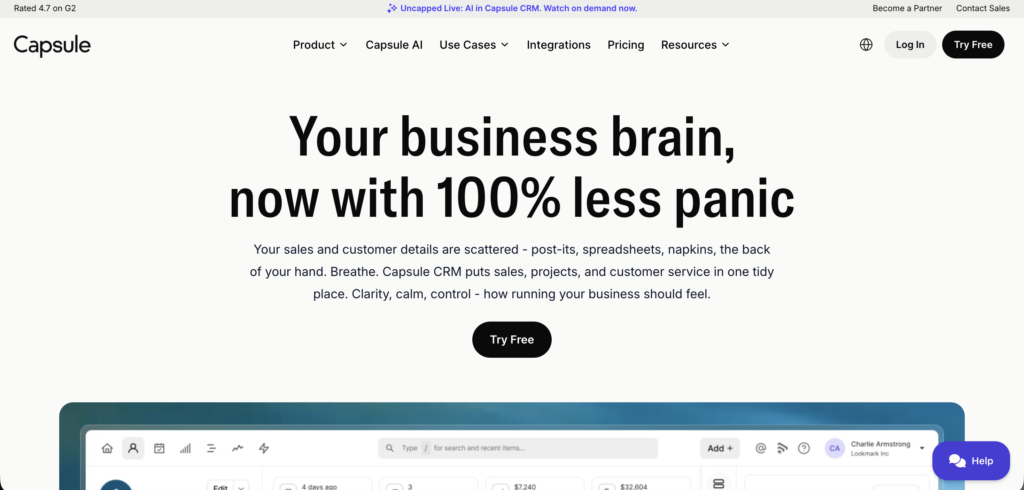
Best for solo operators who think in contacts before they think in deals.
Capsule is genuinely simple. Contact-first, with a deal pipeline attached. Doland tried it before he found Fluid. It didn’t stick for him, but for a different operator it might. Capsule has a free tier for 2 users, 250 contacts and 1 pipeline. After that the next tier is Starter at $18/user/month.
What it isn’t? Not built for serious sales teams that live in the pipeline view.
For the full comparison, see Fluid CRM vs Capsule.
6. Folk
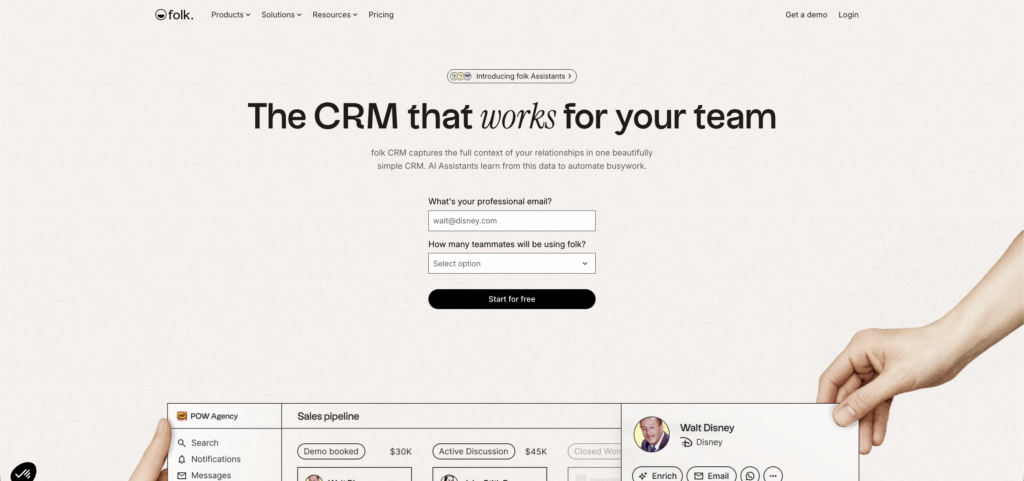
Best for relationship-led businesses where the contact graph matters more than the deal flow.
Folk is newer, built for the multi-channel way modern B2B operators actually work. LinkedIn integration, Gmail integration and contact enrichment. Standard at $30/user/month , Premium at $60 and Custom from $100. The interface feels closer to Notion than to Salesforce, which can be a pleasant way to work.
What it isn’t? Not a deep sales pipeline tool. If you run a structured sales process with stages, forecasts and multiple reps, Folk will feel light.
7. Keap (a warning, not a recommendation)
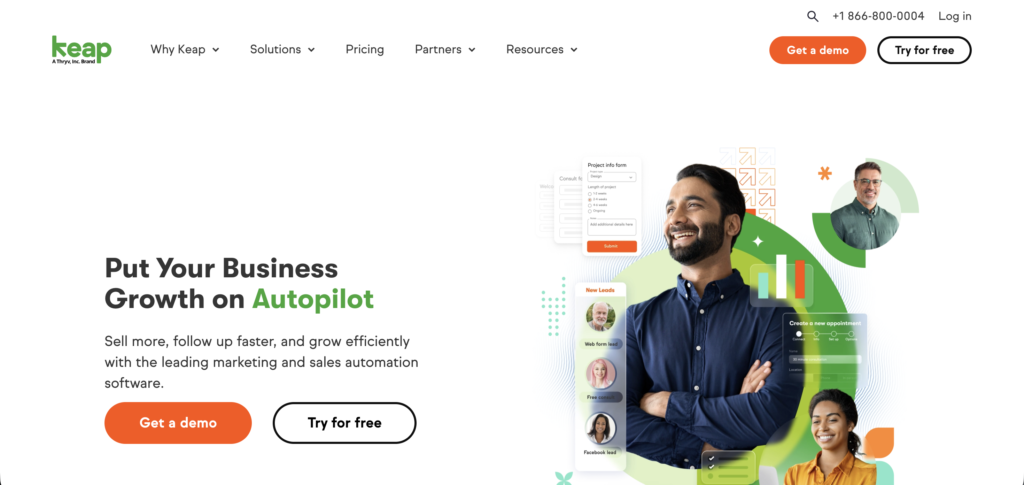
Marketed as a small business alternative, but the pricing tells a different story.
Keap restructured in 2026 to a single plan starting at $299/month with 2 users and 1,500 contacts included. Extra users are $39/month each. There’s also a one-time onboarding fee starting at $500. That’s not a small business CRM. That’s a small business marketing automation platform priced like enterprise software.
If a HubSpot alternative roundup recommends Keap as a budget CRM option, the writer hasn’t checked the pricing in 2 years. Skip it unless you specifically need its email marketing automation, which can be powerful, and have the budget for it.
How To Choose The Right HubSpot Alternative
If you’re still debating which HubSpot alternative to choose for your CRM as a small business, answer these three questions. Each one points to one tool.
Do you actually use marketing automation? If yes, you don’t need a HubSpot alternative. You need a cheaper version of HubSpot. For this, Zoho CRM will serve you well.
How many sales reps will use this? If under 5 reps and you want flat pricing that includes everything, choose Fluid CRM. If you have more than 5 reps and need more sophisticated features and are willing to pay for them, choose Pipedrive.
Are contacts more important than deals to your business? If yes, Capsule for traditional contact management or Folk for modern multi-channel relationship tracking. If deals come first, choose Fluid CRM because contacts are made and stored automatically when creating deals.
That’s the whole framework. Most sales driven small businesses land on Fluid CRM or Pipedrive because most small businesses are tracking deals, not running marketing automations. The other tools are for medium sized companies and highly sophisticated marketing needs.
Frequently Asked Questions
Capsule has a free tier for 2 users and 250 contacts, which is the best free alternative. Zoho CRM and Freshsales also have free tiers for up to 3 users. The cheapest full feature tool with a flat-price is Fluid CRM at $16/month with no upgrade traps. Avoid anything advertised as “free forever” that locks core features behind upgrades, because that’s the HubSpot trap repackaged.
It depends on what you actually use. If you need multi-channel marketing automation, lead scoring and have separate marketing and sales teams, HubSpot is worth it. If you only use it to track deals and log notes, you’re paying for 95% of features you’ll never use. The honest answer is most small businesses don’t need HubSpot, they just feel like they should be using it because it’s the default.
Fluid CRM and Capsule both set up in under 5 minutes. Sign up, add your first deal or contact and you’re done. See the full Fluid CRM feature list here. No complicated setup wizards, onboarding calls or training videos. Pipedrive is close behind but its tier system means you’ll spend time deciding which plan to start on. The general rule is that if a CRM requires a kickoff call or a training session, it’s not built for small business setup speed.
Conclusion
Most small businesses don’t need a HubSpot alternative. They need a calm visual sales pipeline tool and the list above tells you which fits best for your unique situation.
If your CRM feels like a second job, Fluid CRM keeps it simple. Visual pipeline and all the basic CRM features included in one $16/month plan, no upgrade traps. Start free for 7 days, no card needed.