

If you’re Googling “is hubspot too complicated,” you already know the answer. You’re looking for permission to walk away and a list of what to use instead. This post gives you both.
HubSpot is too complicated for most small businesses. It’s built for marketing teams of 50+ with budget for onboarding and a dedicated admin. If you have under 10 people and just want to track deals and follow-ups, HubSpot is overkill. Simpler CRMs like Fluid CRM, Pipedrive or Folk fit better.
Yes, HubSpot Is Too Complicated For Most Small Businesses
Every other post on page one of Google tells you HubSpot is fine and you just need help setting it up. Of course they do. Top-ranking posts are often written by HubSpot agency partners. They make money when you stay on HubSpot and keep paying for “optimization.” The honest verdict doesn’t exist on the first page of Google because nobody on the first page can afford to say it.
So I will. Yes, HubSpot is too complicated for most small businesses. Not because you’re not smart enough to figure it out, but because it wasn’t built for you in the first place.
HubSpot was built for medium to large marketing teams of 20-50+ people or more. Teams with a dedicated CRM admin, a Marketing Hub Pro budget and the time to sit through onboarding calls. If that’s you, then HubSpot is the go-to choice and you should stay. But if you’re a 2-10 person company, a solopreneur or a 5-person sales team trying to track deals and follow-ups, you bought a Boeing 747 to fly across town.
Here’s the pattern I’ve watched at my outbound agency Fenixtal across 50+ B2B clients in 3 years. Most small businesses who sign up for HubSpot, usually are spreadsheet refugees who jumped straight to the biggest name they recognized. Yet they use less than 20% of it within 6 months and naturally pay the full 100%. They paid for the Ferrari and drive it like a Honda anyway. The lead scoring sits unused, marketing automation never gets turned on and the custom reports never get built. They’re paying enterprise prices to do what a $16/month tool like Fluid CRM does in 10 minutes.
Now, the honest carve-out. HubSpot is the right tool for many businesses. If you’re running a content marketing operation with 10K+ monthly visitors, complex nurture sequences and have a marketing ops person who knows what she’s doing, HubSpot earns its price. For everyone else, it’s a tax on confusion.
The 3 Reasons HubSpot Feels Complicated
The HubSpot partners ranking on this keyword love to tell you the problem is your training, your team or your patience. It really isn’t. The tool itself has three structural problems that make it feel complicated for small businesses.
1. The free tier is a bait
The free CRM is generous on purpose. It pulls you in and at first, it’s great. You add your contacts, build a few deals and get used to the interface. Then you hit the wall. Want to add more contacts or remove HubSpot’s branding from your emails? Pay for the next tier. The “free CRM” isn’t a product, it’s a sales funnel for the paid tiers and that’s good business for HubSpot, but you should be aware of it.
2. The UI is built for marketing ops, not sales reps
Every workflow assumes you’re going to set up properties, build an automation, configure pipelines per region and tag contacts with 14 attributes. A small business with less than 10 people doesn’t need to do that. In fact, it’s a massive distraction from what actually matters, which is talking to potential clients and tracking the activities. You should add a deal, set a follow-up reminder and move on. HubSpot makes the simple thing hard because it’s optimized for more sophisticated things.
3. Every feature assumes you have an admin
If you don’t have someone whose main job is HubSpot, you’ll never use 80% of the platform. The reports will sit half-built, automations will fire wrong and the integrations will break and stay broken because nobody owns fixing them.
Take Austin Verner, who runs Cold Emailers, a cold email agency that hyper-niched down to hood cleaners targeting restaurants. Austin’s stack is not amateur hour. He uses Make.com webhooks, Clay enrichment, OpenMart for prospecting, Smartlead for sending outreach and Fluid CRM for tracking. He sets up automation that would intimidate most agency owners. And here’s what he told me about putting his clients on HubSpot:
“The last thing my clients need to learn is a complex CRM, like HubSpot.”
The technical operator running 5 tools in his stack doesn’t think his hood-cleaner clients should touch HubSpot. Why? Because they wouldn’t actually use it. If Austin won’t recommend it to his clients, you should consider if it’s actually the right fit for you.
The HubSpot Upgrade Trap (Real Cost Math)
This is the part the HubSpot partners never write about, because the upgrade trap is exactly how their referral commissions work.
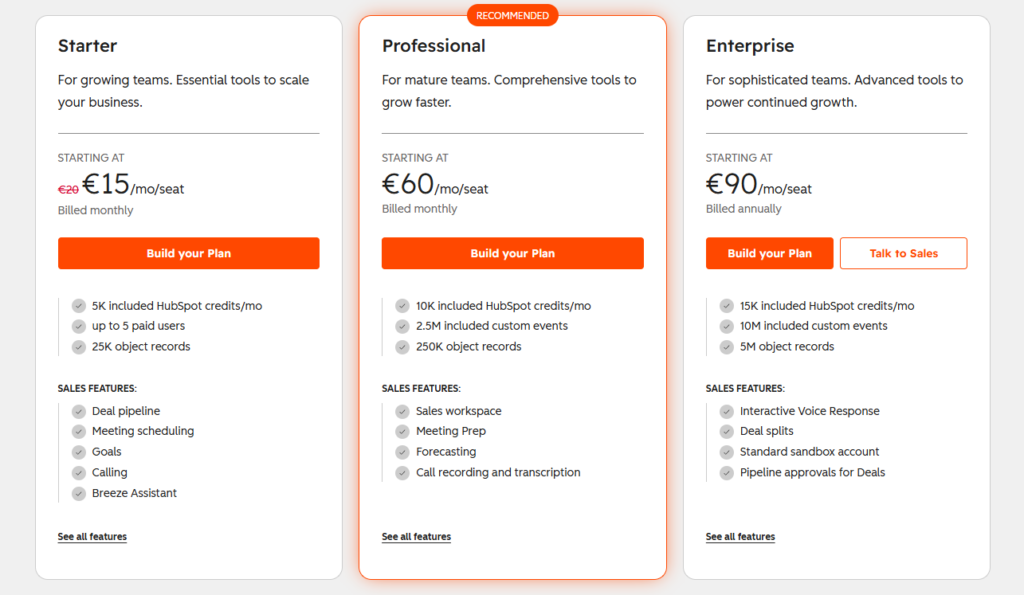
Here’s the trajectory. You sign up for free. You hit a feature wall in the second month. Then you upgrade to Sales Hub Starter at $20/seat/month. Useful, but you can’t see basic forecasts that should be a default in any CRM. So you upgrade to Sales Hub Professional at $100/seat/month. That tier comes with a mandatory $1,500 one-time onboarding fee, non-negotiable even if you’ve used HubSpot before. Then you realize you also need Marketing Hub for landing pages and email automation, so you add Marketing Hub Professional at $890/month. Marketing Hub has its own separate mandatory onboarding fee of $3,000.
Yes, separate onboarding fees per Hub. Most people don’t realize this until they see the invoice.
Let’s do the math on a 5-person team in year one:
- Sales Hub Professional: $100 × 5 seats × 12 months = $6,000
- Sales Hub Professional onboarding fee: $1,500
- Marketing Hub Professional: $890 × 12 months = $10,680
- Marketing Hub Professional onboarding fee: $3,000
- First-year total: $21,180
That’s the real cost. Not the $20/seat/month they show on the pricing page.
Compare to Fluid CRM for the same 5-person team. $16/month per user. All features included, no upgrade traps, onboarding fees or separate hubs. The annual plan brings it down to $12 per user effectively (3 months free). For 5 users on the annual plan: $720 for the entire year.
That’s not a typo. The same team running on Fluid CRM pays $720 for the year while the HubSpot version pays $21,180. You could buy Fluid CRM for the next 29 years and not catch up to one year of HubSpot.
Full side-by-side breakdown at Fluid CRM vs HubSpot.
Yes, that price unlocks HubSpot’s powerful marketing automations. But if you’re a small business focused on basic sales activities, those automations don’t serve you. You’re paying for capability you won’t use.
Doland White from Doland White Consulting saw this pattern coming. For coaches and consultants weighing HubSpot specifically, this breakdown goes deeper. Doland runs an executive coaching mastermind plus a podcast and speaking circuit so he’s not budget-shy. He told me he’d tried HubSpot, Salesforce, Capsule, and “every CRM there is.” Here’s why he walked away from HubSpot:
“With HubSpot, if you want to do something different, you have to buy more. What starts off small gets bigger, bigger, bigger and bigger.”
And then this:
“It’s not a money thing, because I can do that, but it’s really about, it’s not why I want to use your product.”
That last line is the one. Doland can afford HubSpot. He just refuses to be milked for every feature on principle. A man who built a 55-year career knows when he’s being upsold.
Who Should Actually Stay On HubSpot
Three profiles where HubSpot is the right call:
- Marketing teams of 20+ with a dedicated marketing ops person, complex nurture sequences and a real content marketing operation pulling 10K+ monthly visitors.
- Companies with a dedicated CRM admin whose actual job is using HubSpot. Without that person, the platform is mostly wasted.
- Businesses already running Marketing Hub Pro who need the Sales Hub data living in the same system. Switching is painful enough that staying often makes sense.
If you’re not in one of those three buckets, you’re paying for a product that wasn’t designed for you.
James Colistra runs Wonderfish, a podcast booking agency and he stays on HubSpot. He needs the document automation that fires when a deal moves to a certain stage. Real automation that saves serious time. For him this is not a nice-to-have. But here’s how he describes the relationship:
“It’s a Ferrari, but I sometimes feel like I only need a Honda or a Hyundai.”
This is a man who keeps paying for HubSpot and admits it’s overkill even for his advanced use cases. He recommends simpler tools to his agency clients, because it’s all about the person and company.
Simpler CRMs Worth Checking
If you’ve decided HubSpot isn’t the right fit, here’s the short list. One line per tool, then go deeper in the HubSpot Alternatives For Small Business guide for full feature breakdowns and pricing comparisons.
- Fluid CRM. Visual pipeline, $16/month all features included and no upgrade traps. Best for solo founders, small agencies and B2B teams under 10 people who want a CRM that doesn’t feel like admin.
- Pipedrive. Sales-focused, similar simplicity to Fluid but pricing climbs faster at scale and the interface feels more dated. However, it does have more capabilities like automations.
- Folk. Relationship-led multi-channel CRM. Popular with agencies juggling client relationships rather than pure sales pipelines.
- Attio. Newer, flexible and customizable. Strong if you want to build a CRM that bends to your process, less strong if you want to start tracking deals in now and not later.
- Capsule. Longest-lived simple CRM and reliable. Less actively developed than newer options but a safe default.
Pick the one that fits your team type, which is what the next section is about.
How To Pick The Right HubSpot Alternative By Team Type
Generic “best CRM” lists don’t help because your team isn’t generic. Pick by what you actually do.
If you’re a cold email agency or B2B outbound team
You need a CRM that plays well with Smartlead, Instantly or whichever sending tool you’re on. I went deeper on this exact use case in the best CRM for cold email agencies post. In short, you need fast deal entry because volume matters and you probably need keyboard shortcuts because you’re moving through 50+ deals a week.
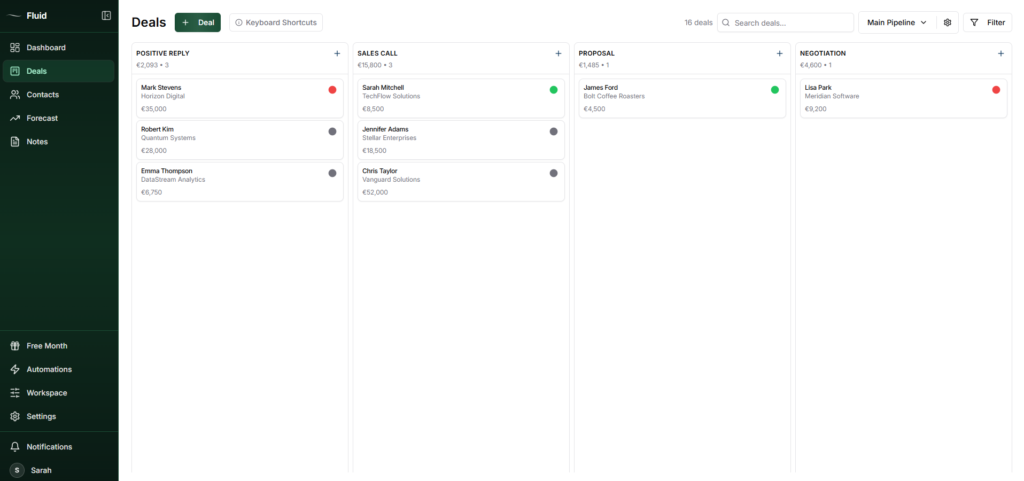
Fluid CRM wins this category. It has an API integration so you can add your positive replies straight from your sequencer to a desired pipeline and stage. Contacts are auto-created from deals and using keyboard shortcuts you can go fast to the conversation, website, social media profile, and more. Austin from Cold Emailers set this up in an afternoon. His Make.com webhook fires when Smartlead flags a positive reply and the deal lands in Fluid CRM, where his team picks it up.
If you’re a solo coach or consultant
You don’t have massive lead volume. You have 5-15 active prospects at any time, each worth $10K+ and the work is remembering context. Who did you talk to last? What did you promise? When are you supposed to follow up?
Fluid CRM or Capsule both work. Fluid if you want a clean visual pipeline you actually don’t hate opening in the morning. Capsule if you want something simpler still and don’t need pipelines at all. Both run circles around HubSpot for this use case because both are designed for low-volume high-value relationships, which is what coaching is. If you’re a coach who hates admin work, read this post for the solutions.
If you’re a marketing or media agency juggling multiple clients
You’re tracking two different things at once. New business pipeline (your sales) and delivery pipeline (each client’s projects). HubSpot bolts these together with custom objects and properties, but the setup is brutal.
Folk is built for this. Each contact lives in multiple “groups” so you can run a client roster and a prospect list side by side. For agencies specifically, I went deeper in best CRM for small agencies. Fluid handles it through multiple pipelines (one for sales, one per client engagement, all included in the $16 flat fee). Either works. Pick by interface preference.
If you’re a sales team of 3-15 people
You want structure without bloat. Defined stages, deal owners, activity tracking and pipeline forecasts. You don’t want a marketing automation suite, lead scoring algorithms or chatbot builders.
Pipedrive or Fluid CRM are the answer here. Pipedrive has been doing sales-only CRM longest and the muscle memory transfers easily from Salesforce. Fluid is newer, cheaper and faster to set up. Fluid has the visual pipeline most teams want without upgrade surprises. If you’ve been burned by HubSpot’s per-seat math, Fluid’s flat pricing is the antidote.
If you’re a niche B2B service business
Specialized work, low volume and high deal value. You’re not looking for a marketing automation suite. You need a tool that respects you already know your process and just want to track who’s where in the pipeline.
If your business is “we do one thing for one type of customer,” you don’t need HubSpot’s flexibility. Most niche B2B operators in this bucket are solo founders or tiny teams. You need speed of setup and clarity of view. Fluid imports a CSV in 10 minutes and you’re tracking from there. No onboarding calls or no admin to hire. Using it is fast so you can spend your time elsewhere, not in data entry.
FAQ
HubSpot was built for mid-market and enterprise marketing teams with dedicated admins. Every workflow assumes someone owns the platform full-time. For small businesses without that role, the same features feel like obstacles. The complexity isn’t user error, it’s a product fit problem.
Usually no. A 5-person team on Sales Hub Pro plus Marketing Hub Pro pays around $21,180 in year one when you include onboarding fees. The same 5-person team can use Fluid CRM for $720/year on the annual plan. Unless you specifically need HubSpot’s marketing automation suite, you’re paying enterprise prices for tools you won’t use. For the specific 2-person team math, I broke it down separately.
Fluid CRM at $16/month is one of the cheapest full CRMs on the market and includes unlimited deals, contacts, pipelines and 8 in-app automations. Capsule has a free tier for under 250 contacts. Both beat HubSpot’s “free” tier because they don’t push you to upgrade for basic functionality.
Yes. HubSpot lets you export contacts, companies, deals and activities as CSV files from the data management section. Most simpler CRMs (Fluid CRM, Pipedrive, Folk and Capsule) have CSV import built in. The migration takes an afternoon for a small team, not a project.
Almost never, even though it’s marketed that way. The free CRM gives you contact and deal management, but has limits and pulls back on reports, forecasts and it has the HubSpot branding on most automations. Within 2-3 months most users hit a feature wall and either upgrade or migrate. The free tier is designed to make you upgrade, not to be your long-term CRM.
Conclusion
HubSpot earns its price for some teams. Most small businesses aren’t one of them. If your CRM feels like a second job, Fluid CRM keeps it simple. Visual pipeline, no upgrade traps and $16/month flat. Try it free for 7 days here, no credit card needed.