

Small agencies face a more complicated CRM decision than most lists admit. The choice isn’t which tool to buy. It’s whether you want one platform that handles CRM, project management and invoicing together, or sharp specialist tools that each do one job well. Picking wrong costs you 18 months of tool sprawl, wasted spend and team adoption fights.
The best CRM for small agencies depends on your team size and tool strategy. For best-of-breed stacks under 10 people, Fluid CRM at $16/seat is the sharpest pipeline pick. For all-in-one needs at 10+ people, Productive starts at $12/seat with CRM, project management and invoicing in one tool.
Why Most “Best CRM For Agencies” Lists Get It Wrong
I ran cold email and LinkedIn outbound for 50+ B2B clients at Fenixtal over 3 years. Most of those were agencies. Marketing agencies, design agencies, dev agencies, AI agencies, automation agencies, etc. Almost all of them had a tool sprawl problem. Slack, Asana, Sheets, ConvertKit, Calendly, six different things that didn’t talk to each other.
The ones that fixed it didn’t all switch to one tool. They picked a sharp CRM and a sharp project management tool and connected them. The ones that tried to consolidate into HubSpot Professional or Productive ended up paying more and using less.
That’s the pattern most lists miss. They line up 15 tools, slap stars next to them and pretend the only decision is which logo to click. The actual decision happens one step earlier. Do you want one tool that does five jobs at a 7/10 each, or two sharp tools that do their one job at a 10/10?
Until you answer that, no CRM list helps you. After you answer it, the list shrinks fast.
All-In-One Or Best-Of-Breed: Which Side Of The Fork Is Your Agency On?
The fork has two sides and almost every small agency sits clearly on one or the other.
All-in-one platforms combine CRM, project management, time tracking, invoicing and sometimes proposals into one tool. Productive, Bonsai, Agency Handy and HubSpot Professional all live here. The pitch is simple. One login, one bill, one place where every client lives. The hidden cost is the per-seat price climbs fast and you usually accept a weaker CRM in exchange for a decent project management module.
Best-of-breed stacks mean you pick a sharp CRM (Fluid CRM, Less Annoying CRM, Pipedrive, Bigin) and pair it with a sharp project management tool (ClickUp, Notion, Trello, Linear) plus a sharp invoicing tool (Stripe, Wave, Invoice Ninja). The pitch is each tool is the sharpest at its job and the stack stays cheap. The hidden cost is you set up the integrations yourself and your team has to log into more than one app.
The real question is whether your agency wants one decent tool or three sharp ones.
Here’s my rough threshold from working with 50+ agencies. Under 5 people, best-of-breed almost always wins. The per-seat math on all-in-one platforms hurts more than the tool sprawl saves. At 10+ people, all-in-one usually wins. You have someone who can own ops, the consolidation actually sticks and the team adoption pain becomes manageable. The 5 to 10 range is the gray zone where it depends on your team’s tolerance for switching tabs.
Austin Verner runs Cold Emailers, a cold email agency. He’s the textbook best-of-breed operator. Fluid CRM for the pipeline, SmartLead for cold email sending, Clay and Make.com for enrichment and automation. Each tool is sharp at its one job and they pass data through APIs. In his own words: “I needed something more visually appealing.” He didn’t want one big platform that tried to do everything. He wanted a clean visual pipeline that handled deals well and got out of his way for the rest.
That’s the move I see across 90% of agencies under 10 people. Pick a sharp pipeline, plug it into your other sharp tools, move on.
The 4 Best Best-Of-Breed CRMs For Small Agencies
If your agency sits on the best-of-breed side of the fork, these are the four CRMs worth your time. Each one is sharp at the pipeline job and gets out of your way for everything else.
1. Fluid CRM (best for cold email agencies and lean operations)
Fluid CRM is the CRM I built after watching 50+ agencies struggle with either Google Sheets or Salesforce. The pitch is a visual pipeline, fast keyboard shortcuts, follow-up reminders that actually work and pricing that doesn’t punish you as you grow. Both plans include every feature. You pay per seat, never for feature unlocks.
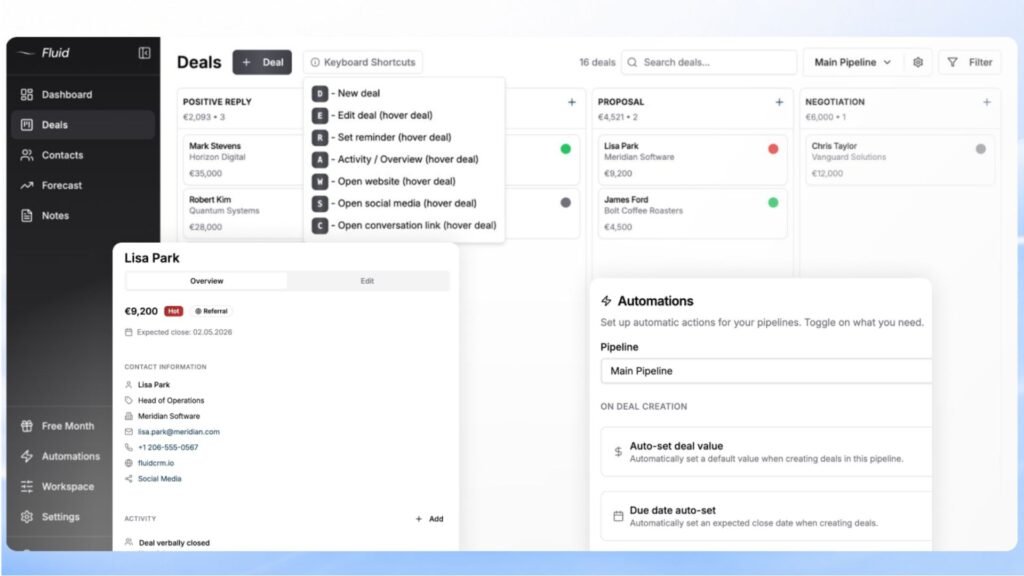
Austin Verner at Cold Emailers came over from Google Sheets. His feedback after a few weeks: “It’s fast as well. I like the hotkeys. I’ve actually been using them.” For a cold email agency logging dozens of positive replies per week, speed of logging is the difference between a clean pipeline and a half-updated one. Keyboard shortcuts (D for new deal, R for reminder, W for website, S for social, E to edit) mean a deal goes in without taking your hands off the keyboard.
What you get on both plans: unlimited deals, unlimited contacts, unlimited pipelines, 8 in-app automations, reminders and alerts, API and webhooks, easy import and export.
Pricing: $16/seat/month monthly or $144/seat/year annual (works out to $12/seat/month with 3 months free).
Best fit: cold email agencies, lean B2B teams under 20 people, agencies wanting a sharp CRM that plugs into SmartLead, Instantly, Clay or any other tool through API.
Not the right fit: agencies wanting CRM plus full project management plus invoicing in one platform. For that, see the all-in-one section.
2. Less Annoying CRM (best for solo agency owners who want $15 flat)
Less Annoying CRM lives up to its name. One plan, one price, no tiers, no upsell modules. $15 per user per month flat. Contacts, calendar, pipelines, custom fields, mobile app, the basics done cleanly without HubSpot’s “buy more to get more” trap.
The interface looks like it was designed in 2014 and the visual pipeline view is weaker than Fluid CRM or Pipedrive. But for solo agency owners who want a CRM that does what it says and costs the same forever, Less Annoying CRM is hard to beat.
Pricing: $15/user/month flat. No contracts.
Best fit: solo agency owners, consultants doubling as agency operators, anyone who wants flat pricing and doesn’t care about a pretty UI.
Not the right fit: teams of 3+ who want a modern pipeline view with strong filtering and keyboard shortcuts.
3. Pipedrive (best for agencies with mid-volume pipelines)
Pipedrive has been the default sales CRM for SMBs for a decade. The visual pipeline is solid, the email integration is decent and the reporting goes deeper than Fluid CRM or Less Annoying CRM. The catch is the cheap plan doesn’t include what most agencies actually need.
The Lite plan at $24/seat/month gives you basic pipeline and contacts. Most agencies need at least Growth at $49/seat/month for automations, full email sync and the reporting features that make Pipedrive worth choosing in the first place. Annual billing brings Lite down to around $14/seat, the biggest annual discount in this list.
Pricing: Lite $24/seat/month monthly ($14 annual), Growth $49/seat/month, Premium $79/seat/month.
Best fit: agencies with 50+ active deals at any time, sales teams of 3 to 10 people, anyone who wants deeper reporting than the simpler tools offer.
Not the right fit: small agencies under 30 active deals where the Lite plan is enough but doesn’t include automations.
4. Bigin by Zoho (best for agencies already in the Zoho ecosystem)
Bigin is Zoho’s “we built a simple CRM” answer to Pipedrive and HubSpot Starter. The free tier is real (single user, 500 records, one pipeline) and the Express plan at $9 per user per month (or $7 on annual) is one of the cheapest paid plans on the market. The catch is the same as with any Zoho product. You’re stepping into the Zoho world and the integrations work best when you stay in it.
Pricing: Free tier (single user), Express $9/user/month ($7 annual), Premier $15/user/month ($12 annual), Bigin 360 $21/user/month ($18 annual).
Best fit: agencies already using Zoho Books, Zoho Mail or other Zoho products, budget-conscious teams that don’t mind the Zoho UI.
Not the right fit: agencies wanting modern UI, sharp keyboard shortcuts or a tool that doesn’t try to upsell you into 40 other Zoho products.
The 4 Best All-In-One Platforms For Small Agencies
If your agency sits on the all-in-one side of the fork, you want one platform that handles CRM, project management, time tracking and usually invoicing in one place. These four are the strongest options for small agencies in 2026.
1. Productive (best for 10+ person agencies wanting CRM, PM and invoicing)
Productive is the agency operating system. CRM, project management, time tracking, resource planning, profitability tracking, invoicing, all in one place. It’s the tool agencies switch to when they hit 10+ people and the Slack-plus-Asana-plus-Sheets stack stops working.
The Essential plan at $12/seat/month (annual: $10) covers CRM, projects, time tracking and basic billing. Professional at $29/seat/month (annual: $25) adds custom fields, reporting and the financial features. Most agencies need Professional within 6 months. The free trial runs 14 days.
One thing the pricing page buries: every Productive plan requires a 3-seat minimum. Solo founders and 2-person agencies can’t buy Productive at the sticker price. Your real entry cost is $36/month on Essential, even if only one person logs in.
Pricing: Essential $12/seat/month monthly ($10 annual), Professional $29/seat/month monthly ($25 annual), Ultimate $40/seat/month monthly ($33 annual). 3-seat minimum on all plans.
Best fit: agencies with 10+ people, dedicated ops or finance team member, billing by the hour or running large retainer engagements.
Not the right fit: agencies under 5 people. You’ll pay for resource planning and profitability tracking you won’t use, and the CRM module is weaker than a sharp standalone pick.
2. Bonsai (best for freelance-style agencies wanting contracts and invoicing)
Bonsai started as a freelancer tool and grew into a small agency platform. The strongest features are proposals, contracts, invoicing and a clean client portal. The CRM module exists but is thinner than what you’d get from a pure CRM. The 2026 pricing shift to per-user billing made Bonsai noticeably more expensive for teams.
The Basic plan at $15/user/month covers projects, time tracking and a basic CRM. Most agencies need Essentials at $25/user/month for proposals, contracts and the client portal that makes Bonsai worth choosing. Premium at $39/user/month adds Hubspot integration and team controls. Bonsai also charges processing fees on client payments.
Pricing: Basic $15/user/month, Essentials $25/user/month, Premium $39/user/month, Elite $59/user/month. 7-day free trial.
Best fit: freelance-style agencies of 2 to 5 people that bill projects with proposals and contracts, agencies wanting a polished client-facing portal.
Not the right fit: pure sales agencies that don’t send proposals or contracts, larger agencies where the per-user cost adds up fast.
3. Agency Handy (best for small agencies wanting workflow automation)
Agency Handy is a newer player aimed at productized service agencies. The pitch is service catalogs, client portals, order management and white-label branding at flat plan pricing instead of per-user. That’s the unusual part. Most all-in-one tools charge per seat, but Agency Handy charges by plan tier instead.
The Freelancer plan at $29/month works for solo operators. Team Starter at $99/month covers small agencies up to 10 users. Business Pro at $199/month adds reseller features and white-label depth for up to 30 users. 7-day free trial, no credit card required.
Pricing: Freelancer $29/month, Team Starter $99/month, Business Pro $199/month.
Best fit: productized service agencies, white-label resellers, agencies that bundle services into clear packages and want clients to order through a portal.
Not the right fit: agencies running custom-quoted engagements where the service catalog model doesn’t apply.
4. HubSpot Professional (best for agencies scaling to 20+ with marketing automation)
HubSpot Sales Hub is the all-in-one that needs the longest disclaimer. The free tier is real but limited and built to funnel you into paid. Starter at $20/seat/month is cheap but missing the automations, forecasting and sales analytics that make HubSpot worth choosing. The features people actually buy HubSpot for start at Professional, which is $100/seat/month plus a required one-time $1,500 onboarding fee.
For a 5-person agency, that’s $7,500 in year one before you’ve used the tool ($6,000 in seats plus $1,500 onboarding). For 20+ person agencies with real marketing automation needs (lead scoring, nurture flows, multi-touch attribution), HubSpot Professional earns its price. But for everyone smaller, it’s a tax you pay for the brand name.
Pricing: Free / Starter $20/seat/month / Professional $100/seat/month plus $1,500 onboarding / Enterprise $150/seat/month plus $3,500 onboarding.
Best fit: agencies scaling past 20 people with dedicated marketing ops, agencies running real nurture campaigns and multi-touch attribution.
Not the right fit: any agency under 10 people. You’ll pay for modules you don’t use and your team won’t log in.
CRMs To Avoid For Small Agencies
Some popular CRMs are wrong for small agencies and the lists won’t tell you. Here’s the honest take.
Salesforce. Salesforce Starter Suite at $25/user/month sounds reasonable until you realize the real Salesforce (Sales Cloud) costs significantly more once you outgrow Starter, and the setup work alone costs more than a year of Fluid CRM. Half the marketing agencies I worked with at Fenixtal paid for Salesforce and the team didn’t log into it. The most expensive CRM in your stack is the one nobody uses. That adoption failure is its own playbook.
Monday CRM. Monday is a great project management tool dressed up as a CRM. The pipeline view feels like a spreadsheet wearing a costume and the per-seat pricing climbs fast once you need the features beyond the basic plan. If you want Monday, use it for project management and pair it with a real CRM.
Keap. Keap (formerly Infusionsoft) tries to be a CRM plus marketing automation plus e-commerce platform for small businesses. The interface is dated, the learning curve is steep and pricing starts at $249/month annual ($299 monthly) for 2 users and 1,500 contacts, plus a mandatory setup fee. For small agencies, it’s overbuilt for what you actually get.
HubSpot Starter alone. I’m not saying never use HubSpot. I’m saying don’t sign up for Starter at $20/seat thinking you’re getting “real HubSpot.” Starter is a sales pitch for Professional. If you want HubSpot’s automations and forecasting, budget for Professional from day one. If you can’t budget for Professional, pick a different tool.
Austin Verner at Cold Emailers put the cold email agency churn pattern simply: “The biggest reason for our churn is they’re getting leads, but they’re not closing.” The same applies to CRM choice. The leads aren’t the problem. The system holding them is. A CRM your team won’t use is worse than a Google Sheet your team will.
How To Pick The Right CRM For Your Small Agency
Run your agency through these three questions before you sign up for anything.
1. How many people will log in daily?
Under 5 people, lean toward best-of-breed (Fluid CRM, Less Annoying CRM, Pipedrive). The per-seat math favors sharp specialists. At 10+ people, lean toward all-in-one (Productive, HubSpot Professional). The consolidation benefit outweighs the per-seat cost. Between 5 and 10, your team’s tolerance for switching tabs decides.
2. Do you bill mostly by the hour or by the project?
Hourly billing pushes you toward Productive or Bonsai where time tracking lives inside the CRM. Project or retainer billing means you don’t need time tracking inside the CRM at all. Most cold email and outbound agencies bill by retainer, which is why best-of-breed wins for them.
3. How much tool sprawl can your team tolerate?
Some teams hate logging into more than one tool. Other teams happily live in 8 different apps because each one is sharp at its job. If your team’s tolerance is low, push toward all-in-one. If your team is technical and already uses 5+ SaaS tools daily, best-of-breed will feel natural.
Add up your answers. If two or three point to all-in-one, pick Productive (Essential or Professional) or Agency Handy. If two or three point to best-of-breed, pick Fluid CRM and pair it with whatever project management tool your team already uses. For a full breakdown of Fluid CRM against the other small B2B options, see best CRM for small B2B sales pipelines.
What To Do After Picking A CRM
Picking the tool is 30% of the work. The other 70% happens in the first two weeks.
Start by defining your pipeline stages. Look at your last 20 closed deals and write down the actual stages they moved through. For most B2B agencies it’s something like: New Lead → Contacted → Meeting Booked → Proposal Sent → Won/Lost. Four or five stages is enough. More than seven and your team stops updating.
Import only your active deals first. Not your entire history. The 20 to 40 deals you’re working right now. Get those in, get the stages right and get yourself comfortable. Bulk-import the historical data once you trust the setup.
Set follow-up reminders on day one. This is the single biggest reason agencies switch from Sheets to a CRM in the first place. Before you do anything else in your new tool, go through every active deal and set a follow-up reminder. If you skip this step, you’ve just bought a more expensive spreadsheet.
Connect your existing tools. If you’re on best-of-breed, plug your CRM into your project management tool, your email and your outbound platform through API or Zapier. If you’re on all-in-one, connect the external tools the platform doesn’t already cover.
Finally, give the tool 30 days before you judge it. The first week always feels weird because you’re learning a new interface. The judgment that matters comes at day 30, when the habits have either stuck or fallen off.
Frequently Asked Questions
For small agencies under 10 people, Fluid CRM is the best CRM at $16/seat/month with every feature included and a sharp visual pipeline. For agencies wanting CRM, project management and invoicing in one tool, Productive at $12/seat/month is the strongest all-in-one (with a 3-seat minimum). The right answer depends on whether you want best-of-breed or all-in-one.
Both, but they serve different jobs. A CRM tracks deals before they close (prospects, follow-ups, pipeline). A project management tool tracks work after deals close (tasks, deadlines, deliverables). Small agencies that only use one or the other usually leak deals on the sales side or miss deadlines on the delivery side. The fix is either an all-in-one platform that handles both, or a best-of-breed stack with one sharp tool for each job.
The cheapest real CRM for small agencies is Bigin by Zoho’s free tier (single user, 500 records, one pipeline). For paid plans, Bigin Express at $7/user/month annual is the cheapest. Fluid CRM at $16/seat/month and Less Annoying CRM at $15/user/month are next, both with every feature included. Watch for starter tiers that hide automations and reporting behind upgrades.
HubSpot Professional is great for agencies past 20 people with real marketing automation needs. For agencies under 10 people, HubSpot is usually wrong. The free tier is limited, Starter at $20/seat is missing the features people sign up for, and Professional jumps to $100/seat plus a $1,500 onboarding fee. For a 5-person agency that’s $7,500 in year one. Most small agencies get more value from a sharp standalone CRM and a separate marketing tool when they need one.
Under 5 people, separate tools (best-of-breed) almost always win on price and sharpness. At 10+ people, all-in-one usually wins because the consolidation benefit pays for the higher per-seat cost. Between 5 and 10 people, it depends on whether your team prefers one tool that does five jobs at a 7/10 each, or sharp tools that each do their one job at a 10/10. Most cold email and outbound agencies stay best-of-breed even at scale because their stack is already best-of-breed on the delivery side.
Conclusion
Fluid CRM fits small agencies that want a sharp visual sales pipeline as part of a best-of-breed stack. It’s the CRM half of your toolkit, not your project management tool. If you want CRM plus project management plus invoicing in one platform, Productive or Bonsai will serve you better. If you want a sharp CRM that connects to your existing PM and delivery tools, Fluid CRM is built for you.
Also if you run a coaching practice alongside your agency work, see our guide on the best CRMs for coaches and consultants. If you’re a pure business consultant rather than an agency, see best CRMs for consultants.
Start your 7-day free trial, no credit card required.