
A direct comparison of Fluid CRM’s and monday CRM’s pricing, features and fit, so you can pick the right CRM for your team. Start a 7 day Fluid CRM free trial here.
Is Fluid CRM or monday CRM Right for You?
| Your situation | Pick |
|---|---|
| Team already running delivery and projects on monday Work Management that wants CRM in the same ecosystem | monday CRM |
| Founder, small B2B team or agency tracking deals to close | Fluid CRM |
| 50+ reps with complex enterprise automations | Neither, look at Salesforce |
monday CRM is a work platform wearing a CRM badge. Boards, columns, workspaces and work items, genuinely excellent at running work. Fluid CRM organizes around deals and what happens next. Pick by what you open the tool to see in the morning: your team’s work, or your pipeline.
There’s a second difference hiding in the pricing pages. monday prices for the team you might become, with a 3-seat minimum and seats sold in set sizes of 5, 10, 15 and up. Annual plans are paid in one upfront payment. Our monday CRM pricing breakdown shows the yearly bill for 3, 5 and 10 sellers. Fluid CRM prices for the people you actually have. Buy 1 seat or buy 4, monthly or annual, same features either way.
Fluid CRM vs monday CRM Comparison
Here’s the short version before we get into the seat math.
| Fluid CRM | monday CRM | |
|---|---|---|
| Starting price | $16/seat/month, from 1 seat | $12/seat annual (3-seat minimum, so the real floor is $36/month) |
| Seat rules | Any number of seats | Minimum 3, then set sizes of 5, 10, 15 and up |
| Billing | Monthly or annual, both feature-complete | Annual paid upfront, monthly runs about 50% higher |
| Contacts and deals | Unlimited on every plan | Capped at 1,000 / 10,000 / 100,000 by tier |
| Automations | 8 in-app included, no monthly action caps | Zero on Basic, 250 actions/month on Standard |
| BCC email sync on every plan | No email sync on Basic, sync from Standard, sequences from Pro | |
| Custom fields | Unlimited | 5 / 15 / 75 columns per board by tier |
| AI | None | Credit-metered on every tier |
| Free trial | 7-day free trial, no credit card required | 14-day Pro trial, no credit card |
| Plans | 2 (monthly or annual, both feature-complete) | 4 tiers plus AI credits |
Fluid CRM vs monday CRM Price Comparison
monday CRM’s per-seat prices look reasonable until you try to buy the number of seats you have. All paid plans start at a 3-seat minimum, and above that seats come in set sizes of 5, 10, 15, 20 and up. A team of 4 buys 5 seats. A team of 6 buys 10. The annual rate that makes the pricing page look good is billed as one upfront payment for the full year.
Here’s what real team sizes actually pay per month. Fluid CRM figures are the monthly plan with no commitment. monday CRM figures are the discounted Standard annual rate, paid upfront.
| Team size | Fluid CRM | monday CRM Standard |
|---|---|---|
| 1 person | $16 | $51 (3-seat minimum) |
| 4 people | $64 | $85 (buys the 5-seat bucket) |
| 6 people | $96 | $170 (buys the 10-seat bucket) |
On monday you pay for the team the pricing page imagines. On Fluid CRM you pay for the team you have.
What You Don’t Get on monday CRM Basic
monday CRM Basic is $12/seat annual ($18 monthly). Here’s what isn’t included until you upgrade:
- Automations (zero on Basic)
- Integrations (zero on Basic)
- Gmail and Outlook email sync
- AI Sidekick and Notetaker
- Mass emails
- Sequences
Then come the caps: 1,000 active contacts and deals total, 5 columns per board, 1 dashboard, 1 workspace and 20 quotes and invoices a month. A CRM that can’t see your email and caps a deal board at 5 fields is a kanban of names. Email sync starts at Standard. A working outbound setup starts at Pro.
Viktor Otterskog is a solo outbound operator in Sweden with a builder background. He evaluated the flexible-database tools before picking a deal-first one. His words: “I looked at HubSpot, Airtable and stuff like that. Glad I came across this one.” What sold him was the opposite of a work platform: “It really has that speed, no bells and whistles, just does what it’s supposed to do.”
Where monday CRM Wins
monday CRM does real things Fluid CRM doesn’t, and if you need them, you need them.
- CRM and work management in one ecosystem. If your delivery already runs on monday boards, keeping the pipeline next to the projects has real value.
- Quotes and invoices built in, capped per tier. Fluid CRM has no invoicing.
- Mass email and sequences inside the CRM at the Pro tier. Fluid CRM has neither by design.
- AI agents, Notetaker and Sidekick if metered AI fits your workflow. Fluid CRM has no AI features.
- Polished iOS and Android apps. Fluid CRM is web-based.
- Deep visual customization. Formula columns, custom boards and 200+ templates for teams that want to build their own views.
If your company runs on monday and the ecosystem is the point, monday CRM is a reasonable addition. Don’t switch on principle if the boards are genuinely carrying your delivery.
Where Fluid CRM Wins
For founders and small B2B teams tracking deals to close, Fluid CRM wins on paying for what exists and nothing counting down.
- Buy the seats you have. 1 seat, 4 seats, 6 seats. No minimum, no buckets, no paying for empty chairs.
- Monthly billing at the same all-features price. No full-year upfront payment to get the real rate.
- Unlimited contacts, deals, pipelines and custom fields on every plan. No 1,000-record ceilings, no column caps.
- 8 in-app automations included with no monthly action meter. Nothing counts down.
- BCC email sync on every plan, including the cheapest one.
- Full REST API and 16 webhooks on every plan. Native compatibility with Smartlead, Instantly, Make.com and Zapier.
- No AI credits, no usage meters, no top-ups. The price on the page is the bill.
Who Should Pick Fluid CRM and Who Should Pick monday CRM
Pick monday CRM if your company already lives on monday Work Management and you want the pipeline inside the same ecosystem, with quotes, invoices and work items on the boards your team knows.
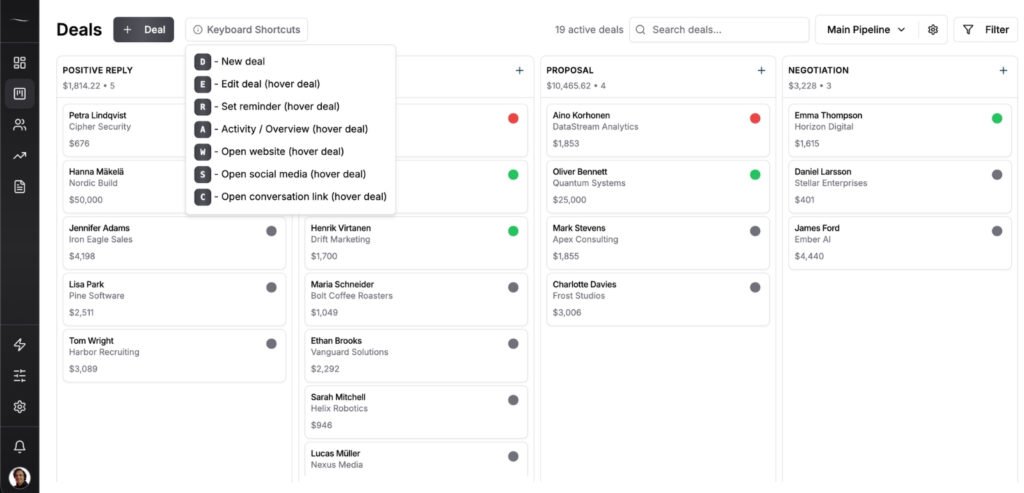
Pick Fluid CRM if you’re a founder, small B2B team or agency moving conversations toward closed, and you want reminders that fire, unlimited records and a bill that matches your headcount. Here’s what that looks like as a CRM for small sales teams.
The split most teams miss: you don’t have to choose one tool for both jobs. Teams that love monday for delivery don’t have to leave it. Keep monday Work Management for running the projects, use Fluid CRM for winning the clients. One tool for the work, one for what happens next.
In 3 years running B2B outbound at Fenixtal across 50+ B2B clients, the teams that ran sales inside a work management tool had beautiful boards and dead deals. The board showed the work. Nothing chased the follow-up.
Pick something else if you’re 50+ reps with complex enterprise automations. Salesforce will serve you better than either. If Pipedrive or HubSpot is also on your shortlist, see Fluid CRM vs Pipedrive and Fluid CRM vs HubSpot.
How To Migrate From monday CRM To Fluid CRM
Export your contacts and deals from monday CRM as a CSV. In Fluid CRM, download the import template, paste your columns across, upload. Deals land in the stages you pick and contacts and companies link automatically.
Board columns will not map one to one, because monday stores everything as flexible columns and Fluid CRM has real deal fields. Map what matters, drop the rest. Most teams find the columns they were maintaining out of habit are the ones they never look at.
Check the export terms before you commit to any CRM, not after. Fluid CRM exports contacts and deals with one click each, in CSV, whenever you want. Your data is yours.
Step by step: Import Your Contacts and Deals Into Fluid CRM In 5 Minutes
Fluid CRM vs monday CRM FAQs
Yes. Export your contacts and deals from monday CRM as a CSV, then import to Fluid CRM. Most teams finish the migration in 15 minutes.
No, and that’s the two-jobs answer. If monday Work Management is carrying your delivery well, keep it there. Fluid CRM handles the pipeline, meaning the deals, follow-ups and what happens next. One tool for the work, one for winning the clients.
Fluid CRM starts at 1 seat. monday CRM’s paid plans start at a 3-seat minimum, then seats ascend in multiples of 5, so a team of 4 buys 5 seats and a team of 6 buys 10.
No. Basic has no email sync, no automations and a 1,000-record cap, which makes it a visual contact list rather than a working pipeline. Standard is the real entry point for sales use, and mass email and sequences only arrive on Pro.
Fluid CRM costs $64/month for 4 people on monthly billing. monday CRM Standard costs $85/month for the 5-seat bucket on annual billing paid upfront, or $125/month on monthly billing. The gap is the 3-seat minimum, the seat buckets and the upfront-annual discount structure.
Try Fluid CRM Free
If your CRM feels like a second job, Fluid CRM keeps it simple. Visual pipeline, no upgrade traps, $16/seat/month with every feature included.
Start your 7-day free trial here, no credit card required.