
Your Salesforce bill is one of the biggest software lines you pay and some of those seats barely get opened. Lists of Salesforce alternatives answer that with countless tools ranging from 5-seat apps to 1,000-seat platforms, then leave you to sort out which is which. This one sorts by why you are leaving.
The best Salesforce alternative for a small business is Fluid CRM at $16/seat/month, or Freshsales at $9/seat annual if price is the only problem. Zoho CRM at $14/seat annual comes closest to a full suite. If you only used Sales Cloud, price Salesforce Starter Suite at $25/seat/month before you migrate.
Why Small Businesses Leave Salesforce (and What Fixes It)
Small businesses leave Salesforce for four reasons, and each one has a different right answer. Pick the wrong fix and you run the same migration again in a year or two with dirtier data than you have now.
I ran outbound at Fenixtal for three years across 50+ B2B clients, booked over 1,000 meetings and generated 12M€+ in pipeline. The tracking split was close to even. One group kept deals in a spreadsheet nobody updated, the other paid for Salesforce and only opened it when I asked them to send me their pipeline. Same outcome from opposite ends of the price range. The tool was never the part that broke.
Open your Salesforce invoice and your login report side by side. How many seats are you paying for that nobody opened last month?
1. The price stopped making sense
Nicolas Virtonis runs cleantech marketing and sales pipeline development. He has worked through Sugar, Zoho, Pipedrive, Salesforce, ActiveCampaign, Vtiger and custom-built systems, and his read on the category is blunt: “It’s unlikely enterprise CRMs are suited for your work and needs, and neither are their subscription fees.”
If price is the whole problem, the fix is seat math, not a feature hunt. Skip to the cost section below and run your own numbers first.
2. Nobody on the team logs in
Doland White, an executive coach, has tried HubSpot and Salesforce. His verdict on all of them: “None of them work for what I’m looking for, and they’re all clunky.”
Low logins are an adoption problem, and adoption problems do not get solved by a bigger platform. The fix is a smaller tool your team opens without being told to.
3. Setup needed a consultant
If getting started took an implementation partner, a discovery call and a project plan, the metric that matters next is how fast you get your first deal into the new tool. Anything that needs another consultant is the same purchase again.
4. You need sales, service and marketing in one place
If your team runs support tickets and email campaigns alongside the pipeline, do not go lightweight. A pipeline CRM will replace one of those jobs and leave you shopping for two more tools. Either stay put or move to another suite.
What Salesforce Costs a 5-Person Team
Salesforce pricing for a 5-person team splits into three very different bills, and the gap between them is the reason most small teams start shopping.
| Plan | Seat price | 5 seats/month | 5 seats/year |
|---|---|---|---|
| Starter Suite | $25/seat/month | $125 | $1,500 |
| Pro Suite | $100/seat/month | $500 | $6,000 |
| Sales Cloud Enterprise | $175/seat/month | $875 | $10,500 |
Pro Suite is annual only with a contract required, so the monthly column there is math, not a billing option you can pick. Add the Premier Success Plan at 30% of net license fees and 5 seats on Pro Suite becomes $7,800 a year. Transaction fees also apply on both Starter Suite and Pro Suite on top of the seat price, which is stated on the Salesforce small business pricing page. The seat price is not the whole price.
The number that carries this whole section is what sits between those tiers. Nothing does. Starter Suite is $25/seat/month and the next step up is $100/seat/month, a 4x jump with no middle option. A small team that outgrows Starter has exactly one upgrade path and it quadruples the bill.
For contrast, 5 seats on Fluid CRM annual is $720 a year. Against Pro Suite for the same 5 people that is 8.3x.
When Staying on Salesforce Beats Switching
Staying on Salesforce is the right answer more often than small teams assume, and it usually comes down to which tier you are sitting on. Free Suite is $0 for two user licenses with no contract and no card. Starter Suite is $25/seat/month with monthly billing available, so you are not locked into a year.
If you are a 4-person team paying $175/seat on Sales Cloud Enterprise because someone bought it three years ago when the plan was to hire 20 people, price the downgrade before you price a migration. Moving to Starter Suite drops that team from $700 a month to $100 a month and you keep your data, your history and your integrations. A tier change takes an afternoon. A migration takes a quarter.
The same logic runs the other way. If you use Service Cloud for support cases or Marketing Cloud for campaigns, none of the eight tools below replaces those. Leaving would mean buying two or three products to cover what one covers now.
8 Salesforce Alternatives for Small Business Compared
Salesforce alternatives for small business fall into two groups, and only one of them is a real fix. Swapping Salesforce for Dynamics 365, SAP, Oracle or another enterprise suite puts a 5-person team in the same category of tool it just left. Same admin work, same setup time, same reason nobody logs in. The tools below are sized for teams under 20 people.
Prices carry their billing cycle and were checked in July 2026. Salesforce Starter Suite sits in the table as a reference row so you can see what you are comparing against.
| Tool | Seat price | Free plan | Best for |
|---|---|---|---|
| Salesforce Starter Suite (reference) | $25/seat/month | Free Suite, 2 users | Staying on Salesforce at the entry tier |
| Fluid CRM | $12/seat annual, $16/seat monthly | None | Small B2B teams that only need a pipeline |
| Freshsales | $9/seat annual, $11/seat monthly | 3 users | The cheapest paid seat here |
| Zoho CRM | $14/seat annual, $20/seat monthly | 3 users | The closest thing to a full suite |
| Pipedrive | $14/seat annual, $24/seat monthly | None | Deal-stage pipeline work |
| HubSpot Sales Hub | $15/seat annual, $20/seat monthly | 2 users, 1,000 contacts | Teams that need marketing too |
| Capsule | $18/seat annual | 2 users, 250 contacts | Sales plus light project tracking |
| Attio | $29/seat annual, $36/seat monthly | 3 seats | Teams that want to build their own CRM |
| Close | $49/seat monthly | None | Teams that need a built-in dialer |
1. Fluid CRM (Best for Small B2B Teams That Only Need a Pipeline)
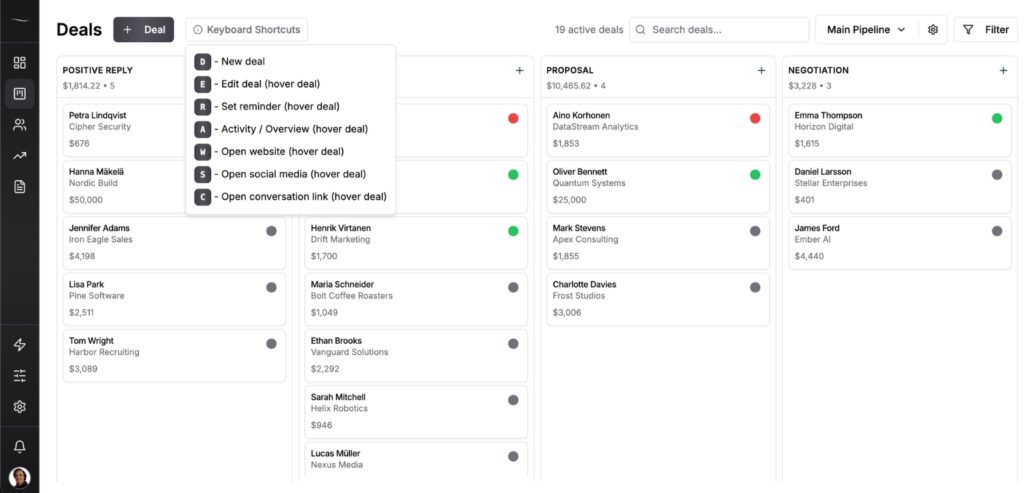
Fluid CRM is a visual sales pipeline with contacts, follow-up reminders, BCC email sync, eight in-app automations, lead capture forms and API access with webhooks. There are no modules to add later and nothing gated behind a higher tier.
Two plans, both feature-complete. Monthly is $16/seat/month and annual is $144/seat/year, which works out to $12 a seat with 3 months free. 7-day free trial, no credit card required.
Nicolas Virtonis, who tried Salesforce before he landed here, put it this way: “Most CRMs are a nightmare to use and maintain, not this one.”
Where it falls short: No marketing automation, no calling, no SMS, no two-way inbox sync and no free plan. If your Salesforce setup included Service Cloud or Marketing Cloud, read the section further down before you decide.
2. Freshsales (Best for the Cheapest Paid Seat)
Freshsales has the lowest paid seat price on this list and a free plan for up to three users. Growth is $9/seat annual or $11/seat monthly, which is roughly a third of Salesforce Starter Suite for a comparable small team.
Read the plan boundaries before that number sells you though. Freddy AI lead scoring, sales sequences and multiple pipelines sit on Pro at $39/seat annual or $47/seat monthly, not on Growth. Enterprise is $59/seat annual or $71/seat monthly.
The Growth to Pro step is 4.3x, so compare Pro against your Salesforce bill rather than the headline $9.
Where it falls short: The entry tier is genuinely entry level. Teams running a real pipeline land on Pro, which puts the true comparison at $39 a seat and not $9.
3. Zoho CRM (Best for Teams That Still Want a Full Suite)
Zoho CRM is the closest like-for-like replacement on this list if what you valued about Salesforce was scope. Standard is $14/seat annual or $20/seat monthly, Professional is $23 or $35, Enterprise is $40 or $50 and Ultimate is $52 or $65. A free plan covers up to three users.
Email and SMS marketing live inside the Zoho ecosystem rather than behind a per-company add-on, so a team leaving Salesforce for cost reasons can keep most of the same jobs in one place at SMB pricing.
Where it falls short: Wide product families mean real setup time. If your Salesforce complaint was that configuration ate a month, Zoho can repeat that experience at a lower price.
4. Pipedrive (Best for Deal-Stage Pipeline Work)
Pipedrive is a sales-first CRM with no service or marketing platform wrapped around it. Lite is $14/seat annual or $24/seat monthly, Growth is $39 or $49, Premium is $59 or $79 and Ultimate is $79 or $99. There is no free plan.
For a team that used Sales Cloud and nothing else, this is a straight swap at a fraction of the seat price. The Fluid CRM vs Pipedrive breakdown covers where the two land against each other.
Check the add-on menu before you sign. LeadBooster and Smart Docs are $32.50 a month each on annual billing and they bill per company rather than per seat, which lands hardest on the smallest teams.
Where it falls short: The add-on structure is why teams look at Pipedrive alternatives in the first place. If you are escaping Salesforce because the bill kept growing, price the add-ons you would actually buy.
5. HubSpot Sales Hub (Best for Teams That Need Marketing Too)
HubSpot Sales Hub is the alternative for teams leaving Salesforce that still need marketing in the same system. Starter is $15/seat annual or $20/seat monthly and the free plan covers two users and 1,000 contacts.
Professional is $90/seat annual plus a required $1,500 onboarding fee, and Enterprise is $150/seat annual plus $3,500 onboarding. The Starter to Professional step is where the features people buy HubSpot for actually live.
Where it falls short: The tier jump plus mandatory onboarding is the same shape as the Salesforce upgrade path, just at a different price point. If cost is your exit reason, the cheaper HubSpot alternatives are a closer fit. If cost is your exit reason, the cheaper HubSpot alternatives are a closer fit, and the Pipedrive vs HubSpot cost comparison runs the 12-month bill for both.
6. Capsule (Best for Sales Plus Light Project Tracking)
Capsule pairs a sales pipeline with kanban project boards, so the tool that tracks the deal also tracks the work after it closes. For a small team doing client delivery, Capsule is the cheapest way on this list to get both jobs in one tool. Pipedrive also has Projects, but it is a $6.67/seat add-on on annual billing or bundled only from Premium at $59/seat.
Starter is $18/seat annual, Growth is $36, Advanced is $54 and Ultimate is $72. Monthly billing runs higher, so the figures above are annual. A free plan covers two users and 250 contacts.
Growth at $36 is the real starting tier, because workflow automations, multiple sales pipelines and the project boards all sit above Starter.
Where it falls short: Starter is thinner than the price suggests, and the project boards you came for are not in it. Price Growth against your Salesforce bill, not the $18 entry number.
7. Attio (Best for Teams That Want to Build Their Own CRM)
Attio suits teams whose sales process never fit a standard pipeline template. Objects, fields and views are yours to shape, which is the closest thing on this list to the custom-build flexibility Salesforce admins are used to.
Plus is $29/seat annual or $36/seat monthly, Pro is $69 or $86 and Enterprise is custom. A free plan covers up to three seats.
A credit system sits on top of seat pricing for AI features and enrichment, so the seat price is not the full bill. Our full Fluid CRM vs Attio comparison covers where that tradeoff lands for a small team.
Where it falls short: Building your own structure takes time, and the credit model means you are still paying separately for things. Both are the habits you left Salesforce to escape.
8. Close (Best for Teams That Need a Built-In Dialer)
Close is the pick for teams that leave Salesforce and still need to make calls all day. Calling, email and SMS are native rather than bolted on with a third-party integration.
Essentials is $49/seat monthly. Growth is $99/seat annual or $109 monthly and Scale is $139 or $149.
Power Dialer, Predictive Dialer and call coaching sit on Growth and above, so Growth is the number to compare if dialing is the job.
Where it falls short: Call minutes, SMS and dialer credits bill separately on top of the seat price. For high-volume teams that becomes its own add-on structure.
Where Fluid CRM Falls Short as a Salesforce Replacement
Fluid CRM replaces one job Salesforce does and leaves the others uncovered. That is worth being plain about before you start a trial, because Salesforce is four clouds and this is one tool.
Fluid CRM has no marketing automation, no calling, no SMS, no two-way inbox sync and no free plan. BCC email sync logs emails to the deal so the history stays with the record, which is not the same as working from inside your inbox.
If you ran Service Cloud for support cases, that is a help desk job and none of the pipeline tools on this list do it. You need a separate help desk product next to whichever CRM you pick.
If you ran Marketing Cloud for campaigns, Zoho CRM and HubSpot are the two tools here that carry marketing inside the CRM. Everything else on the list, Fluid CRM included, expects you to run email marketing somewhere else.
Teams above roughly 20 people with several departments and detailed permission settings are also outside what Fluid CRM is built for.
Frequently Asked Questions
Freshsales Growth at $9/seat annual is the lowest paid seat on this list. Zoho CRM Standard and Pipedrive Lite both sit at $14/seat annual. Price the tier that includes the feature you need though, because entry tiers are thin across all three.
Yes. Freshsales, Zoho CRM and Attio run free plans for three users or seats. HubSpot covers two users with a 1,000 contact cap and Capsule covers two users with a 250 contact cap. Salesforce also has its own Free Suite for two user licenses. Free plans are a starting point, not a plan. I covered whether HubSpot is worth paying for once you outgrow the free tier.
Yes. Free Suite is $0 for two user licenses, Starter Suite is $25/seat/month and Pro Suite is $100/seat/month on an annual contract. Transaction fees apply on both paid plans. If you sit above those on Sales Cloud, price the downgrade before you price a migration.
A pipeline CRM, not another suite. Fluid CRM at $16/seat/month, Pipedrive at $14/seat annual and Capsule at $18/seat annual all handle deals, contacts and reminders without a platform around them. Skip anything selling you service and marketing modules you will not open.
Which Salesforce Alternative Should You Pick?
Sort by why you are leaving rather than by which list ranks a tool highest. Price points you at Freshsales or Zoho CRM. Nobody logging in is an adoption problem, and a smaller tool fixes that faster than a bigger one. If you need service and marketing alongside sales, do not go lightweight at all. If what you actually used was the pipeline, Fluid CRM gives you that at $16/seat/month with every feature included on both plans.
Start your 7-day free trial here, no credit card required.
1 thought on “8 Salesforce Alternatives for Small Business in 2026”
Comments are closed.