

The call went well. They asked about pricing, they nodded at the timeline and then they said they wanted to think it over. That was three weeks ago and you have heard nothing since. The words you needed were not really the problem, and that is the part worth fixing.
Most sales objections fall into four groups: price, timing, competition and trust. Nearly every one is either a missing piece of information or a risk the buyer has not said out loud. Answer the real one, then record why the deal ended in a CRM like Fluid CRM so you can see which objection keeps costing you.
| Objection | What it usually means |
|---|---|
| The price is too high | They are weighing cost against cost, not against return |
| We can’t put money into this right now | Either the cash is genuinely tied up or the offer has not landed |
| Can we do this on a revenue share? | They want you to carry the risk of their own execution |
| I don’t have the bandwidth | Your problem is not yet more urgent than their current list |
| We need to close a big deal first | They see you as an expense rather than something that speeds the deal up |
| Someone else quoted us less | Nobody has explained what the price difference actually buys |
| We’re going to try this ourselves | They think the hard part is knowing what to do |
| Referrals are already keeping us busy | Growth feels handled, so predictability has no value yet |
| I need to run it past my business partner | Either real shared authority or a polite way to end the call |
| Do you have case studies? | They want proof, and often proof of one specific worry |
Price And Budget Objections
Money objections are the ones sellers panic about, and they are usually the least literal thing a buyer says all call. Somebody with no cash at all rarely sits through 40 minutes of discovery. What they are telling you is that the number in front of them is bigger than the value they can picture right now, so the job is to move the comparison rather than move the price.
The price is too high
I agree with them, out loud, before I do anything else. Arguing here just makes the number feel more real.
Honestly, I agree with you. Everything is expensive when you look at what it costs. It stops being expensive the moment you look at what it gives you back instead. So let me ask it the other way around. If you put this money into growing the business today and it brought back roughly ten times that over the next year, would you still call the price high, or would you call it a good trade?
Then I stop selling and walk them through the return, line by line, with their own numbers rather than mine. Their average deal size, their close rate and the number of extra calls this is meant to create. A price only looks big while it is sitting on its own.
We can’t put money into this right now
Sometimes this is true. Often it is the same objection as the last one wearing a different coat, so I test it gently.
That is fair enough, and I would rather know now than chase you for a month. Can I ask what the money is committed to at the moment? I ask because there is a difference between the account being empty and this sitting behind two other things in the queue. If it is the queue, I want to know what it is behind and what would have to happen for it to move up.
Their answer settles it. If something specific is ahead of you in the queue, you now know what you are really competing with and you can argue against that rather than against an imaginary shortage. If the account genuinely is empty, say so plainly and agree a date to revisit. Chasing a business with no cash is how you fill a pipeline with deals that will never close.
Can we do this on a revenue share?
This one sounds flattering and it is usually a trap, so I am direct about it.
I only do revenue share when I own a piece of the business, and there is a reason for that. Most of what happens after I hand you qualified conversations is down to you and your team showing up and selling well. I can put the right people in front of you and I can help you all the way through, but I cannot make sure your reps run the calls properly. My job is to put you in a position to win. Closing is still yours.
If they push, offer split payments instead. That solves the cash-flow worry hiding underneath without asking you to fund somebody else’s execution.
Timing And Urgency Objections
Timing objections almost never mean the calendar. They mean your problem has not yet climbed above the other 30 things on somebody’s list, and no amount of urgency you manufacture will move it. What moves it is showing them the cost of the thing already happening while they wait.
I don’t have the bandwidth
Most people who say this are picturing a project that eats their evenings.
Nearly everyone I work with said exactly that before we started. What most of them found afterwards was that half the work they were protecting turned out to be less important than they thought, and the work we did together made the rest of it faster. If you have someone handling sales or marketing already, put them on the calls with me and you get the output without the hours. How much time were you imagining this would take?
That last question matters. Nine times out of ten their estimate is wildly higher than the real number, and correcting it is the whole objection.
We need to close a big deal first
They are treating you as a cost that comes after revenue, when you are usually the thing that brings the revenue forward.
Let me ask you something. If part of what we did was shorten the cycle on the deals already sitting in your pipeline, would waiting for one of them to land still make sense? Especially if we split the payments so you are not carrying it all up front. That way you are not spending ahead of the revenue, you are spending on the thing that pulls the revenue closer.
Competition And Status Quo Objections
Nothing you sell competes only with rivals. It competes with the buyer carrying on exactly as they are, which costs them nothing today and feels perfectly safe. A cheaper quote and a plan to do it in-house are the same objection underneath, which is that the difference between the options has not been made real yet.
Someone else quoted us less
I never argue with this. I reframe what they are actually choosing between.
No argument from me, they probably are cheaper. Can I ask you something though? When you are buying a specialist service, which of these two do you actually want? The lowest number on the market, or the provider who has priced the work so they can afford to give you exactly what your situation needs? Because the cheap option is not being difficult, they genuinely cannot do the second one at that price. Which of those two do you want to be in a partnership with?
Nobody picks the first option out loud. Once they have said the second one themselves, bring the conversation back to your guarantee and what happens in week one.
We’re going to try this ourselves
The confidence here is usually real, and the thing they are underestimating is not effort.
You can absolutely build this in-house, plenty of people do. The part that catches teams out is not knowing what to do, it is the order you do it in. If you scale outreach before the messaging is properly tested, you burn through your list and your budget finding out. If the targeting is off, you conclude the whole channel is dead when the offer was fine and the list was wrong. What we bring is the sequence, not just the steps.
Say this even when they still decide to do it alone. Being right about the sequence is what brings them back in four months.
Referrals are already keeping us busy
This is the hardest one on the list, because their business genuinely is working.
That is a good problem, and it tells me the offer is strong. People do not refer average work. The bit I would push on is what happens in a quiet quarter, because referrals arrive on their own schedule rather than yours. Right now you have growth. What you do not have yet is a way to turn growth on in a month when it does not show up by itself. Is that worth solving while things are good, or only once they slow down?
Authority And Trust Objections
Authority and trust objections are the two most expensive things a buyer can say, because both of them tend to arrive at the end of a call that felt like it went well. One means the person you have just spent an hour with cannot say yes on their own. The other means they can, and they are not yet convinced you can do it.
I need to run it past my business partner
There is one question that separates a real shared decision from a soft exit, and it takes four seconds to ask.
Completely understandable, but let me ask you one thing. Imagine your partner comes back and says no. Would you still want to do this?
If they say yes, stop talking and close. Do not explain, do not add a reassurance and do not offer to send anything over, because they have just told you the decision is theirs and the partner is not the obstacle.
If they hesitate or say no, the partner is real and your job changes to arming them:
Does your partner know this is costing you at the moment? And would they rather you kept absorbing it, or fixed it? Then what do you think their biggest worry would be if you brought this to them tonight?
Whatever they name is almost always their own worry wearing somebody else’s face. Handle that one, then offer to put a short summary together so they are not walking into that conversation empty-handed.
Do you have case studies?
Before you send anything, find out what they are actually looking for, because “case study” is rarely the real request.
Of course. What would you want to see in it, so that it actually helps you decide?
Their answer tells you which worry is running the call, and now you can aim the whole thing at that. If there is time left, walk them through it live rather than emailing it, because a case study read alone is a case study read without you.
When you do not have one in their exact niche, say so and turn it round:
I have not worked with a company exactly like yours yet, and honestly that is the interesting part. The process is much the same across industries, so what changes is that you would be first in your market to run it. Right now everyone in your space is guessing, and you would not be.
Never invent a client to fill the gap. Being the first in a niche is a genuinely strong position, and it only works if the rest of what you say is true.
The Objection You Hear Is Rarely The One That Kills The Deal
Across more than 1,250 sales calls at my outbound agency, the pattern that surprised me most was how often the reason I wrote down afterwards was not the reason they gave me on the call. Somebody objects to price, you handle it well, they go quiet, and the real reason turns out to be that they never had the authority they implied. The objection you get is the polite one. The one that kills the deal is usually the one they did not want to say to a stranger.
Which brings up the distinction that matters more than any script here. A real concern wants an answer. A brush-off wants out. If you treat the second like the first, you will spend three weeks building a proposal for someone who already decided on the call. The giveaway is specificity. Real concerns get more detailed when you ask a follow-up question, and brush-offs get vaguer.
Stop for a second and think about the last five deals you lost. Can you name the actual reason for each one, or do two or three of them just say “went quiet” in your head? That gap is not a memory problem. It is a recording problem, and it is the reason I built the lost reason into how I use Fluid CRM rather than leaving it to the end of the month.
Learning 50 rebuttals without ever reviewing which objection keeps beating you is like memorizing every chess opening and never once looking back at your own losses. You get better at the first ten moves and keep losing the same way in the middle.
How To Know Which Objection Costs You Most
Recording why each deal actually ended is the only way to find out which objection is costing you most, and almost nobody does it. Add one text field to your deals called lost reason, then fill it in at the moment you mark a deal lost, which is the only moment you still know the answer. Not at the end of the month, when three deals blur into “timing”.
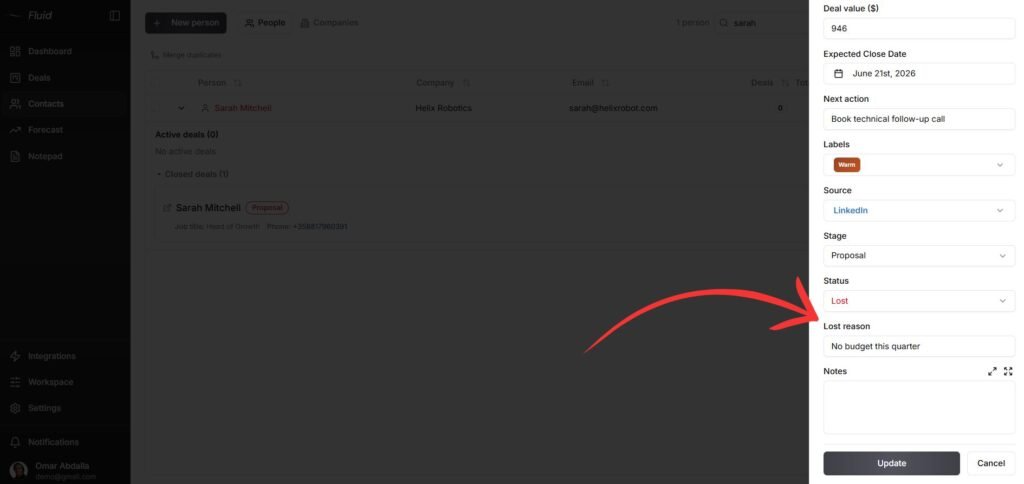
Fluid CRM handles this with a custom text field on the deal. It is a field you tally on export, not a filterable report inside the app, so ten deals is a two-minute job and two hundred is a spreadsheet. It still beats the alternative, which is guessing.
The habit needs somewhere real to live, though. Austin Verner, who runs the cold email agency Cold Emailers, was working out of Google Sheets before this. His interested leads now get created automatically through the API, and his line on it is: “We’re capturing 100% of our interested leads.” You cannot analyze why deals died if half of them never made it into the system in the first place.
Give it a quarter and you get something no script can hand you. You find out that seven of your last twelve losses said partner or board, which means your discovery is not reaching the decision maker, and no amount of price rehearsal will fix that. Or you find price genuinely dominating, and now you know it is a real problem instead of a feeling. That is when the scripts above start earning their keep, because you know which two to practice. If you have not built the stages that make this countable, start with your sales pipeline stages and work back.
When To Walk Away From A Sales Objection
Some objections are a real no, and treating every one as winnable is how you end up with a pipeline full of ghosts. My rule after 50+ clients is simple. If somebody has given me three different objections and every one of them dissolves into a new one when handled, they are not objecting, they are declining politely.
The move I use for information-only prospects is to say it out loud.
Thanks for being straight with me. If what you want is proposals and numbers to compare, I can genuinely point you toward a few other people who will put those together for you. That is not really how I work. If this is not a problem you are trying to solve right now, you are better off with someone else.
That either wakes them up or ends it cleanly, and both outcomes are better than a follow-up sequence into silence. Walking away is a decision, not a failure. It also protects the part of your sales process that deserves the hours.
Common Sales Objections FAQ
Four groups cover almost everything you will hear: price and budget; timing and urgency; competition and the status quo; authority and trust. Price is the loudest and the least literal. Authority and trust objections are the quietest and cause the most damage, because they tend to surface after the call rather than during it.
Send one message that makes it easy to say no, because silence is usually embarrassment rather than disinterest. Something like “I am guessing this has dropped down the list, which is completely fine, just tell me either way and I will stop chasing.” A clean no is worth more than a maybe you carry for two months.
Twice. If the same worry comes back a third time in different words, it is not the real one, so ask directly what is actually holding them back. If that question does not produce a straight answer, the deal is not there and your time is better spent on cold email outreach that brings in fresh conversations.
On a call, every time. Email gives the buyer unlimited time to build a case against you and gives you no tone to read. Use email to book the call, and handle anything that matters while you can hear how they say it.
What To Do Before Your Next Sales Call
Pick the two objections you hear most and write your own version of the scripts above, in your words rather than mine. Then start recording why deals actually end, because the pair you should be practicing is almost never the pair you would guess.
Hanna-Maria Ojala, a sales coach who runs Menestyvä Myynti, described what that feels like once it is running: “I’m not guessing what to do next anymore.” Fluid CRM gives you a pipeline where logging it takes about ten seconds per deal.
Start your 7-day free trial here, no credit card required.