
Put Pipedrive and Capsule CRM side by side on a features table and they look like the same product. Contacts, deals, pipelines, reminders, reports. The tables are useless here, because the two companies charge you for completely different things.
Capsule CRM and Pipedrive are both sales CRMs for small teams, priced on opposite logic. Capsule charges by how many contacts you store. Pipedrive charges by which sales features you unlock, then sells add-ons on top per company. Fluid CRM charges one seat price with every feature included.
What Pipedrive And Capsule CRM Were Each Built To Do
Capsule started as contact management and grew a pipeline onto it. You can see the history in how it is sold: every tier is defined by a contact ceiling, 250 on the free plan, then 30,000, then 60,000, then 120,000.
Pipedrive started as a deal board and grew contact storage onto it. Its tiers are defined by what you are allowed to do, and lead scoring sits two tiers up, on Premium.
Capsule is an address book that learned to sell. Pipedrive is a sales board that learned to store people.
That is the whole decision, and it has almost nothing to do with price. If your business is a long book of relationships you warm up over years, one of these is shaped like your work. If it is a sequence of deals that either close or die, the other one is.
Pipedrive vs Capsule CRM Pricing, Checked In August 2026
Pipedrive pricing
| Plan | Billed annually | Billed monthly |
|---|---|---|
| Lite | $14/seat/month | $24/seat/month |
| Growth | $39/seat/month | $49/seat/month |
| Premium | $59/seat/month | $79/seat/month |
| Ultimate | $79/seat/month | $99/seat/month |
Pipedrive has no free plan, but it gives you a 14-day trial with no credit card.
Capsule CRM pricing
| Plan | Billed annually | Billed monthly | Contact ceiling |
|---|---|---|---|
| Free | $0 | $0 | 250, max 2 users |
| Starter | $18/seat/month | $21/seat/month | 30,000 |
| Growth | $36/seat/month | $38/seat/month | 60,000 |
| Advanced | $54/seat/month | $60/seat/month | 120,000 |
| Ultimate | Custom quote | Custom quote | Custom |
Capsule also runs a 14-day trial with no credit card. Ultimate is no longer a listed price, and is instead a sales conversation for teams of five or more.
Capsule meters your contacts
Every Capsule tier is a contact ceiling first and a feature list second. That sounds generous until you notice which number decides your bill.
A three-person B2B team is not going to store 30,000 contacts, so you are buying a ceiling you will never touch. The thing that actually pushes you up a tier is much smaller than that: workflow automations and more than one pipeline both sit above Starter, on Growth.
The free plan is capped at two users, not three. A third person means you are paying.
Pipedrive’s add-ons bill per company, not per seat
Pipedrive’s $14 Lite is real, and it is also not what most teams end up paying. LeadBooster starts at $32.50 a month, Smart Docs at $32.50, Web Visitors at $41 and Campaigns at $13.33.
Those are company-level charges. A three-person team pays exactly what a thirty-person team pays, so the smallest teams absorb the worst version of that deal. LeadBooster alone is $390 a year on top of your seats.
What three seats cost for a year
| Setup | Annual cost, 3 seats |
|---|---|
| Fluid CRM annual | $432 |
| Pipedrive Lite | $504 |
| Capsule Starter | $648 |
| Capsule Growth | $1,296 |
| Pipedrive Growth | $1,404 |
Capsule Free is not on that list because three people do not fit on it.
Fluid CRM is one plan at $16/seat/month or $144/seat/year, with every feature included and no contact ceiling.
On the tier a small sales team actually needs, Capsule Growth and Pipedrive Growth land within about 8% of each other, $1,296 against $1,404. Add LeadBooster to the Pipedrive side and it goes to $1,794, but on the plans alone this is not a price fight.
So stop shopping these two on price. The money is close enough that it should not be the tiebreaker, and picking the cheaper one by $108 a year is how teams end up with a CRM shaped wrong for their work.
Where Capsule CRM Wins And Where Pipedrive Wins
Each one is genuinely better than the other at something, and the two things are not close to equivalent.
Where Capsule CRM wins
Capsule is better at people. If you track relationships that do not map to a deal, it holds them without you inventing a fake pipeline stage. Think of a referral partner, a supplier, or a past client you check in with twice a year.
It is also the only one of the two with a permanent free plan, which makes it the honest answer for a solo operator with a couple of hundred contacts.
Where Pipedrive wins
Pipedrive is better at deals. Stages exist before you configure anything, and activity reminders are the centre of the product rather than a feature bolted to the side.
A new salesperson can work it on day one without training. Its reporting on deal movement is also the part reps actually use, which is not true of every CRM at this price.
Pipedrive Or Capsule CRM For A Small B2B Team
The choice comes down to one uncomfortable audit of what you are actually storing. So ask it plainly.
How many contacts are in your CRM right now, and how many of them will you ever call again?
Most small B2B teams answer that badly, and the answer reveals which of these two they are really shopping for. If a few dozen matter and the rest are noise, you do not have a contact storage problem, so the ceilings are not the thing to compare.
Peter Duffy runs a small B2B team on Fluid CRM, and he put the actual requirement better than either vendor’s homepage does.
“What I particularly like is that Fluid focuses on the features a small B2B team actually needs, without burying them beneath endless menus, settings and unnecessary complexity. It feels intuitive and quick to use, which makes keeping the CRM up to date far less of a chore.”
That last clause is the one that matters, and no pricing page measures it. A CRM you keep up to date is worth more than a CRM with the better feature list, because a stale pipeline is just a list of names.
I watched this from the supply side for three years. Running an outbound agency, I generated leads for 50+ B2B clients across 1,250+ sales calls and 12M€+ of pipeline. The leads that died were almost never rejected. They died on the weeks nobody opened the CRM, so nothing happened next.
When Neither Pipedrive Nor Capsule CRM Fits
Stay on Capsule if your business really is a relationship book and the free plan covers you. Two users and 250 contacts is a genuine offer, and nothing here beats free.
Stay on Pipedrive if you already pay for LeadBooster or Campaigns and your reps genuinely work the activity list. You have bought into an ecosystem that is doing its job.
Fluid CRM is for the case in between, which is most of the small B2B teams I have dealt with. You want the pipeline visible on one screen, a deal logged in about ten seconds and no tier to think about. Contacts and pipelines are unlimited on either plan.
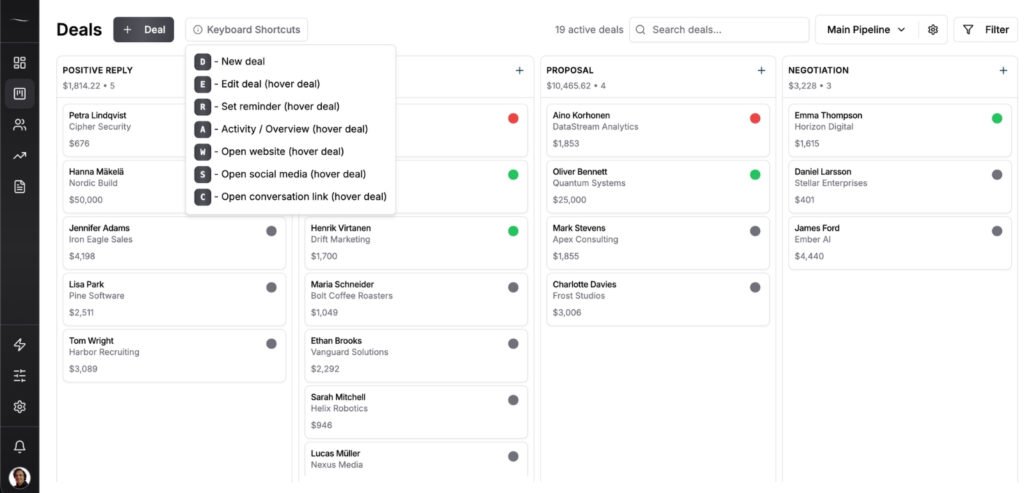
What makes that work is unglamorous: unlimited custom fields, BCC email sync that files a thread against the right deal, lead capture forms that create the deal on submit, 8 in-app automations and a documented API with 16 webhook events.
James, a small business owner with one external salesperson, named the real limitation before I could. He had only had it a few weeks when he wrote it.
“The tool is designed around deals, rather than contacts, but a work-around is to set up deals for contacts that include an on-going relationship step and you can include comments to that stage of the ‘deal’.”
He is right, and it is the same axis this whole post turns on. Fluid CRM is deal-first. If your work is relationship-first, Capsule fits better and I would rather say so than sell you the wrong tool.
The other honest limits: no native dialer, no marketing automation, no two-way inbox sync and no free plan. It is built for teams under 20 people.
If those rule it out, the shortlist in 8 best Pipedrive alternatives covers the rest of the category, and Fluid CRM vs Capsule goes deeper on the Capsule comparison specifically.
Pipedrive vs Capsule CRM FAQ
At the entry tier, no. Pipedrive Lite is $14/seat/month annually against Capsule Starter at $18. At the tier most sales teams need, Capsule Growth at $36 undercuts Pipedrive Growth at $39, and the gap widens if you add Pipedrive’s per-company add-ons.
Yes, and Pipedrive does not. Capsule’s free plan covers 2 users, 250 contacts, 5 custom fields and 1 sales pipeline. The two-user cap is the one that catches teams, because a third person moves you to a paid seat for everybody.
Yes, and it is the main thing separating its tiers: 250 on Free, 30,000 on Starter, 60,000 on Growth and 120,000 on Advanced. Pipedrive gates sales features by tier instead, which is why the two look similar on a table and bill so differently.
Pipedrive if your week is deals moving through stages, Capsule if it is relationships you maintain over years. If it is deals but you do not want tiers or add-ons, that is the gap Fluid CRM was built for, and Attio vs Pipedrive covers the same question against a third option.
Which CRM To Pick For A Small B2B Team
Pick Capsule CRM if you manage relationships and Pipedrive if you push deals. The price difference between them is small enough that it should not decide this, which is the opposite of what both pricing pages want you to conclude.
Fluid CRM is worth a look if you want the deal-first shape without a tier ladder or a contact ceiling, and a week is long enough to tell.
Start your 7-day free trial here, no credit card required.