

You had a real conversation, you sent the next thing and then the thread went silent. Most of the time that silence means the email got lost in a full inbox, not that the answer is no.
A follow-up email after no response works best 3 business days after your last message. Reply in the same thread, add one new thing and ask one question they can answer in a line. Stop after three, mark the deal lost and set a Fluid CRM reminder to check back in 90 days.
This post covers buyers who went quiet after a real exchange. If they did reply and you’re following up on a moment in the deal, such as a demo or a proposal, use these sales follow-up email templates instead. People who never answered your first cold email need a different plan, covered in cold email follow-up.
Forgot to send the second follow-up again?
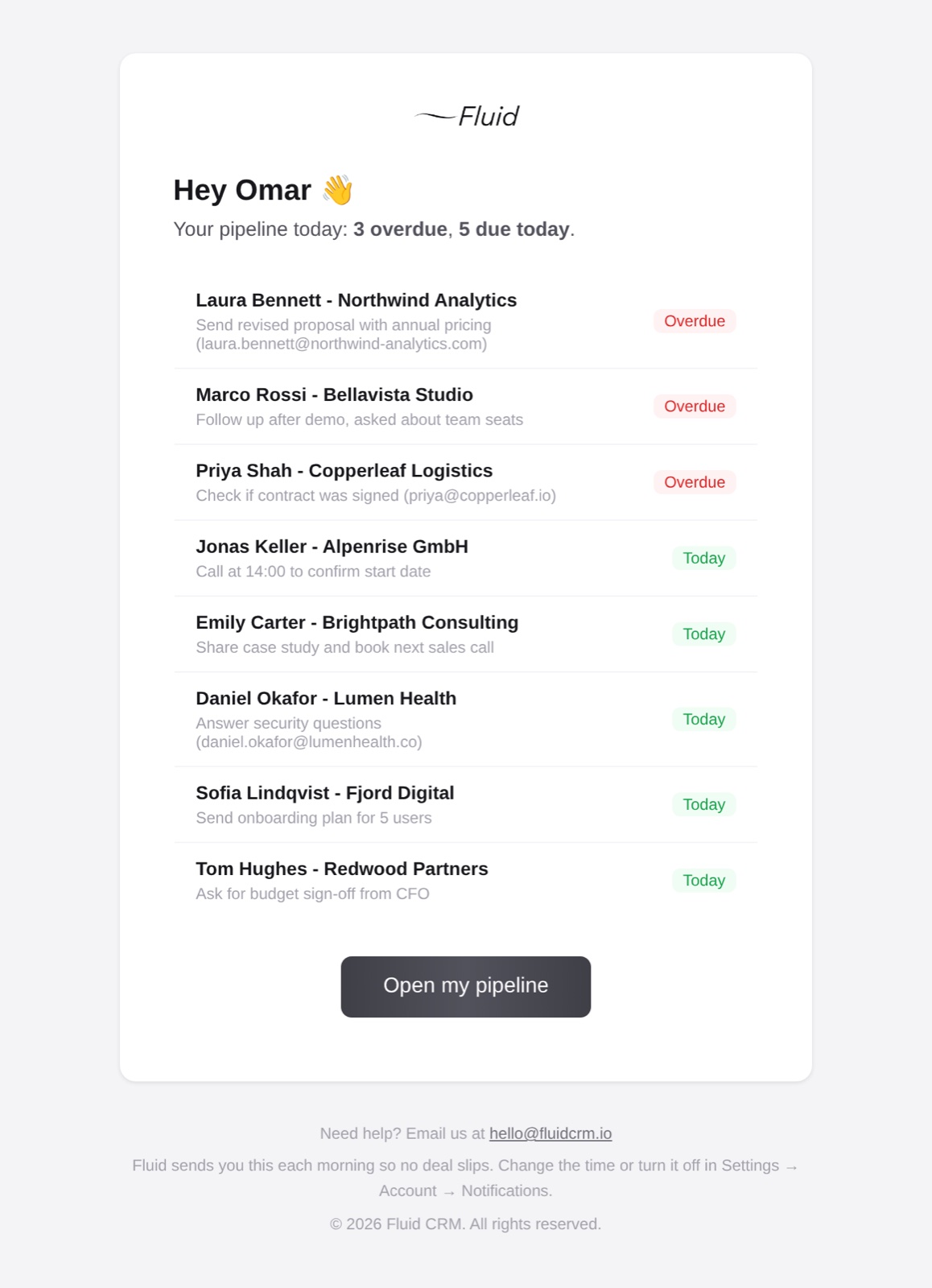
Fluid CRM puts a follow-up date on every deal and emails you each morning with the ones due today. You write the email, it remembers when.
No card needed
How to Write a Follow-Up Email After No Response
A follow-up that gets answered looks like a short reply between two people who already know each other. Five habits get you there, and each one fixes a reason the last email was easy to ignore.
Reply in the same thread
Hit reply on your last email instead of starting a fresh one. The buyer sees the whole history at a glance and doesn’t have to remember who you are, which is the first thing a busy person gives up on.
Open with what you both agreed
Start with the last real thing that happened, in one sentence. “You said you’d show the proposal to Sara on Tuesday” reminds them of a promise they made, which works far better than reminding them you exist.
Add one new thing
Every follow-up needs a reason to exist beyond “you didn’t answer”. That can be a short answer to a question they raised on the call, a customer in their industry or a date that changes the decision.
Ask one easy question
End on something they can answer from their phone in a few seconds. “Is this still on your list for this quarter?” gets a yes or no, while “let me know your thoughts” asks them to write you an essay.
Keep it under 100 words
A follow-up longer than the screen of a phone gets saved for later, and later rarely comes. If you need more words than that, you are writing a new proposal rather than a follow-up.
How Long to Wait Before Each Follow-Up After No Response
Three follow-ups with widening gaps cover almost every warm deal that went quiet. The gaps grow because each email is catching a different situation, from a full inbox on day 3 to a changed priority by day 20. That’s the spacing I’d use on a warm deal today, after 1,250+ sales calls booked at Fenixtal, my outbound agency.
| Follow-up | When | What’s new in it | The ask | Subject line |
|---|---|---|---|---|
| 1 | 3 business days after your last email | One short answer, example or detail they didn’t have | Is this still on your list? | Keep the thread subject |
| 2 | Day 9 | A different angle, such as cost of waiting or a peer customer | A yes or no question | Keep the thread subject |
| 3 | Day 20 | Nothing new. You’re saying this is the last one | Should I close this out? | New, short subject |
| Check-in | 90 days later | Whatever changed on your side or theirs | Is now a better time? | New subject |
Days count from your last email before the silence. The 90-day check-in is a fresh start rather than a fourth follow-up. The re-engagement timing in our cold email follow-up guide covers how often to come back after that.
Subject Lines for a Follow-Up After No Response
Keep the original subject for follow-ups one and two by replying in the thread. A new subject on a warm deal makes the email look like a cold one, and the buyer loses the context you worked to build.
The third email is the one place to change it, because a short, plain subject signals that this is the last message. Here are eight for the close or the 90-day check-in:
- Proposal for [Company]: still on your list?
- [Name], yes or no on [project]
- Closing the file on [project]?
- Back on [project] for [quarter]?
- Should I close this out?
- Moving [project] to next quarter?
- Before I stop following up
- Still the right person for [project]?
Leave out “Following up”, “Checking in” and “Just bumping this”. They tell the buyer nothing about what’s inside.
12 Follow-Up Email Templates After No Response
Each template below goes out 3 business days or more after a real exchange went quiet. Swap the brackets, cut anything that isn’t true for your deal and keep it under 100 words.
1. When a proposal or quote gets no reply
Send it: 3 business days after the proposal.
Subject: Re: Proposal for [Company]
Hi [Name],
On our call you mentioned [their main concern]. I added one line to the proposal on how we’d handle that, under [section].
Is the proposal still on your list for [month], or has something moved?
[Your name]
2. When a warm call goes quiet
Send it: 3 business days after your recap email.
Subject: Re: [Call topic]
Hi [Name],
You said [their words about the problem] on Thursday. One of our customers in [industry] had the same issue, and the fix took them [short concrete result].
Worth a 15-minute follow-up next week?
[Your name]
3. After “sounds interesting” and then nothing
Send it: 3 to 5 business days after their reply.
Subject: Re: [Original subject]
Hi [Name],
“Sounds interesting” can mean a lot of things, so let me make it easy. Is it a timing thing, a budget thing or just not a priority right now?
Any of the three is a fine answer.
[Your name]
4. When a demo is followed by silence
Send it: 4 business days after the demo.
Subject: Re: [Product] demo for [Company]
Hi [Name],
After the demo you asked whether [feature or question]. The answer is [short answer], and here’s a two-minute clip of it: [link].
Is there anyone else on your team who should see it before you decide?
[Your name]
5. When your meeting request gets no answer
Send it: 3 business days after the request.
Subject: Re: [Meeting topic]
Hi [Name],
I may have asked for too much time. Would a 15-minute call on [day] or [day] work better, or should I send the main points by email instead?
[Your name]
6. After an intro from a mutual contact goes nowhere
Send it: 5 business days after the intro email.
Subject: Re: [Mutual contact] intro: [Your name] / [Their name]
Hi [Name],
[Mutual contact] thought we should talk because [the reason they gave]. If the timing’s wrong, no problem at all, and I’ll let [Mutual contact] know we connected.
Is a short call in the next two weeks realistic?
[Your name]
An intro is a referral someone made for you, so it deserves the same care as asking for referrals in the first place.
7. After “let me check with the team”
Send it: 5 business days after they said it.
Subject: Re: [Original subject]
Hi [Name],
You were going to check with [team or person] about [decision]. In case it helps, here’s a one-paragraph summary you can forward as it is.
[Two or three sentences: problem, what you’d do, cost.]
Did the team have any questions I can answer?
[Your name]
8. After a voicemail
Send it: 3 business days after your last email, right after you call and leave a voicemail.
Subject: Re: [Original subject]
Hi [Name],
I left you a voicemail about [topic] a moment ago. In one line, [one sentence].
Is email or phone easier for you this week?
[Your name]
9. When your contact went quiet but a colleague was on the thread
Send it: on day 9, in place of the second follow-up, if your contact still hasn’t answered.
Subject: Re: [Original subject]
Hi [Colleague’s name],
You were on the earlier thread with [Contact]. I haven’t been able to reach them and didn’t want [project] to stall on my side.
Are you the right person to talk to about it now, or should I wait for [Contact]?
[Your name]
Keep the original contact in copy so nothing happens behind their back.
10. After a free trial or sample they never used
Send it: 3 business days after the trial or sample started.
Subject: Re: Your [trial or sample]
Hi [Name],
Most people who try [product] get the most out of it by starting with [one specific first step]. It takes about [time].
Did something get in the way, or is this just a busy week?
[Your name]
11. A polite follow-up for a senior buyer
Send it: 5 business days after your last email. Senior buyers get the widest gaps.
Subject: Re: [Original subject]
Hi [Name],
I know your week is full, so I’ll keep this to one question. Should I keep [project] open for [quarter], or is it better to come back to you later in the year?
Either way, thanks for the time you gave it.
[Your name]
12. The close: the last email before you mark it lost
Send it: day 20, after two follow-ups with no reply.
Subject: Should I close this out?
Hi [Name],
I haven’t heard back, so I’ll assume [project] isn’t a priority right now and stop following up.
If that changes, reply to this email and I’ll pick it up from here.
[Your name]
Write the close without guilt or drama. A buyer who meant to answer often replies to this one, because it’s the first email that asks for nothing.
The Second Follow-Up Email After No Response
The second follow-up has to look different from the first, or the buyer reads it as the same email sent twice. Change the angle, make it shorter and turn the question into a yes or no.
An email that only says you wrote before gives the buyer nothing to react to, so it gets the same silence as the email it follows.
| Don’t write | Write instead |
|---|---|
| Just bumping this to the top of your inbox | You asked whether it works with [tool]. It does, and here’s how |
| Any thoughts on my last email? | Is [project] still planned for [month]? |
| Following up on the below | One of our customers in [industry] just finished the same setup |
Here’s a second follow-up for a proposal that went quiet after the first nudge:
Subject: Re: Proposal for [Company]
Hi [Name],
Different question this time. If [project] waits until next quarter, does that cause any problem on your side?
A yes or no is plenty.
[Your name]
When to Switch to a Text or LinkedIn Message
Switch channels after follow-up two if email gets nothing, and only if you already have that channel with this person. A text from someone who has your number is normal, while a text from a stranger feels like a lot.
A short text works well because it can’t carry much:
Hi [Name], it’s [Your name] from [Company]. Sent you a note about [project] last week. Still on your list, or should I check back later?
On LinkedIn, send one message, not a series. Our cold email follow-up guide explains why LinkedIn takes fewer follow-ups than email.
Set the Next Follow-Up Date Every Time You Send One
The second follow-up rarely gets skipped because someone forgot. It gets skipped because the reminder lives in an inbox flag, a sticky note or a spreadsheet nobody opens on day 9.
Each time you send a follow-up, set the date for the next one before you close the email. On day 3 the reminder for day 9 is already waiting, and on day 9 the one for day 20. The same habit runs a whole sales pipeline in five minutes a day.
The pipeline from this post
Every quiet deal, and when to follow up
- Lead
- Call
- Proposal
- Follow-up
- Won
Meridian website build
Set your stages up like this and add the deals that went quiet. Each morning’s email tells you which follow-up is due.
7 days free, no card
“It solves a visibility issue by surfacing the best actions to take at the right time with minimal effort.”
a G2 reviewer in marketing and advertising
Fluid CRM puts that reminder on the deal itself. Each deal has a next-step date, and a daily email lists the follow-ups due that morning with the contact and the task, so the list reaches you on days you don’t open the app.
Alejandra Andrade, a travel agent who uses Fluid CRM, described the cost of forgetting a follow-up:
“I would find myself quoting so many clients only to forget checking back on them after. Whenever I did remember, I usually would sell the trip.”
Stop at three. A nine-email chase on a warm deal teaches the buyer that ignoring you is free, and it keeps a dead deal counted in your pipeline.
On day 20, mark the deal lost, pick the reason, such as went silent, and set the 90-day check-in. Our guide to win-loss analysis shows what to do with those reasons once you have a few dozen.
Frequently Asked Questions
Wait 3 business days after your last email for the first follow-up. Then give it until day 9 for the second and day 20 for the close. Senior buyers and big decisions can take wider gaps, but never less than 3 business days.
Three follow-ups after a warm conversation is enough. After that, close the deal as lost and check back in 90 days, because more emails rarely change the answer and make the next conversation harder.
Keep the original subject for the first two follow-ups by replying in the thread. Use a short new subject on the third email, the close, so it stands out as the last one.
Not if it’s polite and short. Saying you’ll stop following up respects the buyer’s time, and it often gets a reply, because it’s the one email that doesn’t need a decision.
Add something useful in every email and ask a question that’s easy to answer. Pushy follow-ups demand a reply without giving anything, while a helpful one gives the buyer a reason to answer. If they said “not now”, that’s a different email with its own template in the sales follow-up guide linked at the top.
Send the Next Follow-Up, Then Set the Date for the One After
Before Fluid CRM, I booked 1,250+ sales calls for B2B companies at my outbound agency. Again and again, I saw small businesses struggle with messy spreadsheets and slow, overly expensive CRMs.
So we built Fluid CRM for the part between the emails: every deal with its next follow-up date, and a morning email that tells you which ones are due. One plan, $16 a seat a month, everything in it.
Omar Abdalla, founder of Fluid CRM
Start your free weekPick the template that matches where your deal went quiet and send it today. Then set the date for the next one in your CRM before you close the tab, so the second follow-up doesn’t depend on you remembering it.
If you want those dates on the deal itself, Fluid CRM gives every deal a reminder and emails you the list each morning.
Start your 7-day free trial here, no credit card required.