

You built a sales pipeline on monday, and now the invoice has seats on it that nobody uses. Or the board that felt flexible in week 1 needs a manual by week 40. This post gives you 7 real CRM alternatives, the seat math monday doesn’t show you and an honest verdict on when to stay.
The best monday CRM alternative for small sales teams is Fluid CRM at $16/seat/month with every feature included and no seat buckets. Pipedrive fits structured multi-stage pipelines and Close fits call-heavy outbound teams. Switch when you pay for empty seats or spend more time configuring than selling.
Are You Replacing monday CRM or monday Boards?
People searching for monday alternatives are actually asking 2 different questions, and every list I found answers them both badly by mixing the answers together. The first group used monday CRM or monday boards to track deals and wants a real sales CRM. The second group used monday to run projects and wants a better project tool.
This post is for the first group. If you’re in the second group, jump to the short section near the end where I name 3 project tools without a sales pitch, because a CRM won’t fix a delivery problem.
In 3 years running cold email at Fenixtal, I booked 1,250+ sales calls and saw where each client kept its deals. The pattern I kept walking into was teams tracking deals in a tool built for something else. A board tool holds cards fine. It just never tells you which deal you forgot about.
A solo marketing consultant in the UK who walked me through her setup had been running clients on boards before moving to a pipeline. Her words: “Otherwise it just becomes unworldly. It just becomes a bit of a guessing game. Which is not ideal.” A guessing game is exactly what a board becomes once you have more deals than you can hold in your head.
What monday CRM Actually Does Well
monday CRM is not a weak product, and pretending otherwise would be dishonest. You can customize stages, fields and boards without writing code. It has 2-way Gmail and Outlook sync, automations, email sequences and mass emails, sales dashboards with forecasting, a real mobile app and hundreds of integrations. You can even run pre-sales and post-sales in the same workspace, which very few small CRMs offer.
If your sales process is genuinely custom and someone on your team enjoys building software out of blocks, monday can be a good home.
The catch is that none of this is included at the price you first see. Email sync starts on the Standard plan. Sequences, mass emails, forecasting and sales analytics live on Pro. And whatever plan you pick, you buy seats in fixed buckets, which means most small teams pay for people who don’t exist. That’s the part we need to do math on.
What monday CRM Actually Costs a Small Sales Team
monday CRM pricing looks like a per-seat price, but you can’t buy the exact number of seats you have. Plans start at a 3-seat minimum and then come in set sizes of 5, 10, 15, 20 and up, so a team of 4 buys 5 seats and a team of 7 buys 10. monday’s own support docs confirm this. The per-seat rates on the pricing page, billed annually, are Basic $12, Standard $17 and Pro $28. Monthly billing runs $18, $25 and $41. Our monday seat pricing guide works out the yearly bill for 3, 5 and 10 sellers.
Here’s what that means for real team sizes on annual billing:
| Your team | Seats you pay for | Standard total | Pro total |
|---|---|---|---|
| 1 person | 3 | $51/month | $84/month |
| 4 people | 5 | $85/month | $140/month |
| 7 people | 10 | $170/month | $280/month |
Read the 7-person Pro row again. The sticker says $28/seat, so you’d expect $196. You pay $280, which works out to $40 per actual human. And Pro is the realistic plan for a sales team, because that’s where sequences, forecasting and mass emails live.
Stop for a second and open your monday invoice. How many seats on it have a human attached?
The seat math is only half of it. The other half is what you’re building those seats into. Michal runs Haiku Studio, an advertising agency in Poland with a small cold-calling team. On a demo call he described the workflow he actually needed: “After a call an employee could assign the contact to me with a note such as ‘Send an offer’ or ‘Call back next week’.” That’s a 1-sentence requirement. In a real CRM it’s a built-in feature. On a board platform it’s a build project with automations you configure, test and maintain yourself.
The 7 Best monday CRM Alternatives for Small Sales Teams
I picked these 7 on 4 things that matter for a small sales team: deal tracking and follow-ups out of the box, setup time, real cost at small headcount (no seat buckets) and how little configuring the tool demands before it’s useful. Every entry gets an honest line on who it’s wrong for, including my own product. All prices below are billed annually unless stated.
1. Fluid CRM (best for small B2B teams who want deal tracking without a board)
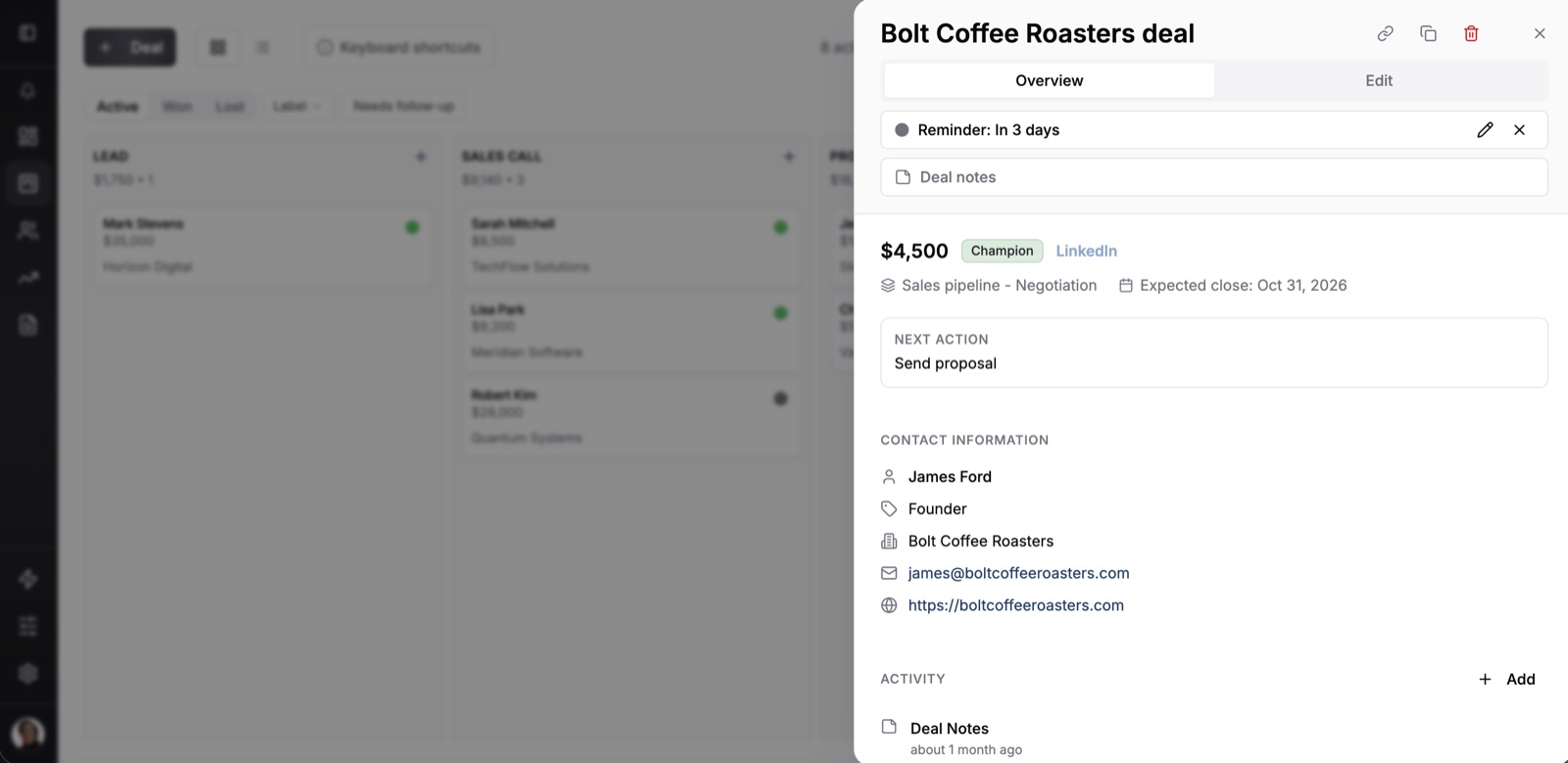
Fluid CRM is a visual pipeline CRM built for the exact job most monday CRM refugees have: track deals, follow up on time, close. You get unlimited deals, contacts and pipelines, follow-up reminders, 8 in-app automations, keyboard shortcuts and API and webhooks on every plan. There are 2 plans, both feature-complete, so nothing you need sits on a higher tier. $16/seat/month or $144/seat/year, which works out to $12/seat with 3 months free. You pay for the seats you have. A 4-person team pays for 4. Here’s how Fluid CRM works as a CRM for small sales teams.
The consultant from earlier described exactly what she was missing on boards: “Something is a bit more intuitive and that can remind me of certain stuff.” Reminders are the whole point. A board shows you cards, a pipeline tells you who to contact today.
Not for you if you need time tracking, project boards or invoicing. Fluid does the sales side and nothing else, and there’s no native marketing automation either. You can try it out with 7-day free trial, no credit card required.
2. Pipedrive (best for structured multi-stage pipelines)
Pipedrive is the most established pipeline-first CRM and a natural landing spot if your sales process has 5+ stages and clear handoffs. Lite starts at $14/seat annual ($24 monthly), but most sales teams need Growth at $39/seat annual ($49 monthly), because that’s where full email sync, automations and sequences unlock. Note the plan names changed in late 2025, so ignore any list still quoting Essential or Advanced tiers.
Not for you if you’re price-sensitive and need automation, since the Lite-to-Growth jump nearly triples the cost, and add-ons like LeadBooster stack on top. 14-day free trial.
Full breakdown between Fluid CRM vs Pipedrive.
3. HubSpot (best if sales and marketing need one system)
HubSpot makes sense when the real requirement is sales plus marketing in one place: forms, landing pages, email marketing and a CRM sharing one contact database. The free tier is genuinely usable for basic deal tracking, and Sales Hub Starter runs $15/seat annual ($20 monthly). The trap is the middle. Sequences, deeper automation and real reporting sit on Professional at $90/seat annual plus a required $1,500 onboarding fee.
Not for you if you only need pipeline management, because you’d be funding a marketing platform to get a deal tracker. I’ve watched several Fenixtal clients start on the free tier and end up paying for modules they opened twice. The free CRM is the front door of a much bigger building.
Full breakdown between Fluid CRM vs HubSpot.
4. Capsule (best for contact-heavy relationship tracking)
Capsule is a simple, contact-first CRM that suits businesses where the relationship outlasts any single deal. Starter runs $18/seat annual ($21 monthly) with 30,000 contacts, and Growth at $36/seat annual ($38 monthly) adds workflow automations, multiple pipelines and reporting dashboards. There’s a free plan for 2 users and 250 contacts, which is honest but tiny.
Not for you if you run outbound, since email sequences need a separate add-on, and the features most sales teams want start at Growth, doubling the price. 14-day free trial.
Full breakdown between Fluid CRM vs Capsule.
5. Zoho CRM (best on a tight budget with time to configure)
Zoho CRM gives you the most features per dollar of anything on this list. Standard is $14/seat annual ($20 monthly) and Professional at $23/seat annual ($35 monthly) adds blueprint process automation that competitors charge 3x for. There’s also a free plan for up to 3 users.
Not for you if nobody on the team wants to spend evenings in settings menus. Zoho is famously fiddly to set up well, and if you’re leaving monday because you’re tired of building your own tool, you’d be trading one configuration project for another. 15-day free trial.
Full breakdown between Fluid CRM vs Zoho CRM.
6. Attio (best if you actually liked building your own structure in monday)
Attio is the one alternative for people whose favorite part of monday was designing the system. It’s a flexible, data-model-first CRM where you build objects, lists and views the way you think. Plus runs $29/seat annual ($36 monthly), and Pro at $69/seat annual ($86 monthly) unlocks sequences and call intelligence. The free plan covers 3 seats.
Not for you if you want out of configuration work, which is most people reading this post. Also budget for the credit system, since automations and AI enrichment burn a metered monthly allowance on top of the seat price.
Full breakdown between Fluid CRM vs Attio.
7. Close (best for call-heavy outbound teams)
Close is built around the phone. Calling, SMS and email live inside the CRM, so a cold-calling team works from one screen all day. Solo is $9/seat annual ($19 monthly) but caps at 1 user. Essentials runs $35/seat annual ($49 monthly), and the Power Dialer that makes Close famous needs Growth at $99/seat annual ($109 monthly).
Not for you if your outreach is mostly email, because you’d pay a calling premium for a dialer you don’t use, and calling credits and premium numbers add real cost on top.
Full breakdown between Fluid CRM vs Close.
When You Should Stay on monday CRM
Some readers should close this tab and keep their monday account, and no listicle selling you a CRM will say that. Stay on monday when all 3 of these are true. Your sales process is genuinely custom, with steps and data that a standard pipeline can’t model. Someone on your team enjoys building and maintaining the setup, because the setup is a permanent job, not a one-time task. And you already use monday boards for delivery or projects, so sales living in the same workspace saves you a second tool.
If that’s you, the platform tax is worth paying. You’re not buying a CRM, you’re buying a system you shaped to your business, and switching would mean rebuilding something that works.
If your process is track deals, follow up, close, you’re paying platform prices for a pipeline. That’s the group the 7 tools above are for.
If You Were Using monday for Projects, Not Deals
Readers who used monday for tasks and client delivery need a project tool, not a CRM, and the alternatives are different. Asana is the strongest for structured task and project management across teams. ClickUp packs the most features per dollar if your team tolerates a busier interface. Trello is the simplest board tool if boards are all you need. Pick from those 3, and ignore everything above this section.
Frequently Asked Questions
Yes. monday CRM has contact and deal management, email sync, sequences, forecasting and a mobile app, which covers what most teams mean by a full CRM. The difference is that it’s built on a customizable board platform, so you assemble your CRM from blocks and pay in seat buckets rather than getting a fixed sales tool out of the box.
Yes. Paid monday plans start at a 3-seat minimum and then come in set sizes of 5, 10, 15, 20 and up, per monday’s own support documentation. A solo user pays for 3 seats, a 4-person team pays for 5 and a 7-person team pays for 10. Factor the bucket, not the sticker price, into any cost comparison.
On sticker price, Zoho CRM Standard and Pipedrive Lite are both $14/seat/month billed annually. On real cost for a sales team, Fluid CRM at $16/seat/month is often cheaper in practice, because every feature is included and there are no seat minimums, while Zoho and Pipedrive gate automation features behind higher tiers.
Yes. monday boards export to Excel or CSV, and every CRM on this list imports CSV files. Export your deals board and contacts board, clean up the columns, map them to the new CRM’s deal fields and import. For a small team the whole move usually fits in an afternoon, and the cleanup takes longer than the import.
Fluid CRM at $16/seat/month with every feature included, or Close Solo at $9/month annual if your day is built around calls. Both charge you for 1 seat. On monday, a solo user pays for 3 seats minimum, which makes almost any alternative cheaper before you compare a single feature.
Conclusion
monday CRM is a configuration platform that prices like one. If you love building your own system and your team fills the seat buckets, stay. If you built a deal board just to track who to follow up with, you’re paying a platform tax for a pipeline. If you want deal tracking without the build project, Fluid CRM gives you a clear visual pipeline with every feature included at $16/seat/month and no seat buckets.
Start your 7-day free trial here, no credit card required.