

The price on a CRM roundup is usually a price you will never pay. The advertised number tends to be the annual prepay rate, and the cheap plan often locks the features you came for one tier up. This list fixes both problems with 10 CRMs you can genuinely run for under $20 per seat.
The best affordable CRM under $20/month is Fluid CRM at $16/seat/month, because the entry price is the full price with every feature included. Less Annoying CRM ($15 flat) is the best pure-simplicity pick and Bigin by Zoho ($9) is the cheapest credible option.
How We Priced This List
Every CRM roundup uses different pricing rules, and most never tell you what they are. Here are ours, applied to every tool below.
First, prices quoted are monthly billing. Annual prices appear in parentheses. Most advertised CRM prices are the annual prepay rate, which means the number you see is not the number on your first invoice. Our guide to CRM pricing puts 21 CRMs in one table with the year-one bill.
Second, the tool must have a genuinely usable plan under $20 per seat per month. Usable means you can track a pipeline and your contacts without hitting a gate that forces an upgrade.
Third, minimum-seat tricks count against the tool. If the cheapest real way in the door is $45 per month, it is not a $12 CRM.
I run Fenixtal, a B2B outbound agency, and I’ve watched this movie across 50+ clients. A team signs up for the cheap tier, hits the feature gate within weeks, and pays triple by month three. The honest question is never “what is the cheapest plan.” It’s “what does the cheapest plan actually let you do.”
Every price below was verified on the vendor’s own pricing page in July 2026, monthly billing toggle.
The 10 Best Affordable CRMs Under $20/Month
1. Fluid CRM ($16/seat/month, every feature included)
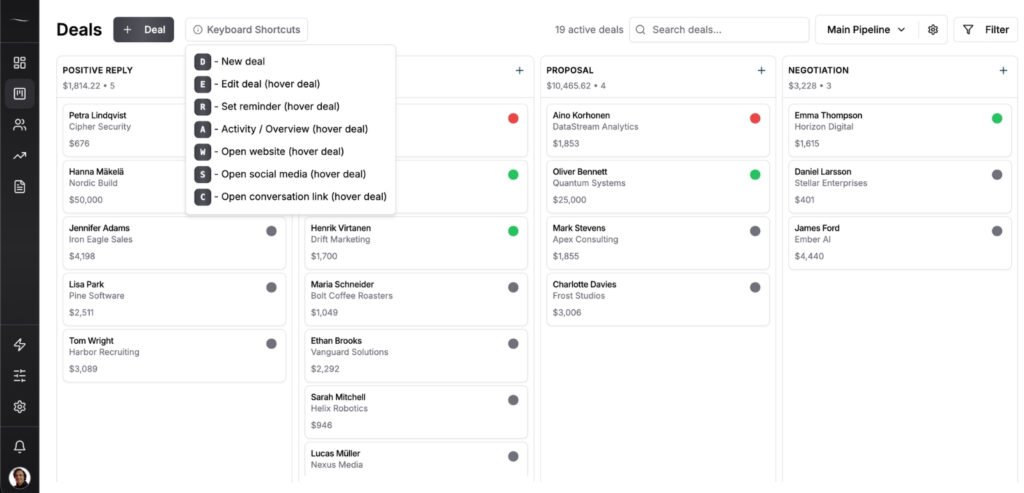
Fluid CRM has two plans, monthly and annual, both feature-complete. You pay $16/seat/month or $144/seat/year, which works out to $12/seat/month. Every feature is on both plans: unlimited deals and contacts, unlimited pipelines, 8 in-app automations, follow-up reminders, keyboard shortcuts, API and webhooks. The only thing the annual plan changes is the price.
That makes Fluid CRM the only tool on this list where the entry price is the full price. There is no gate waiting for you at deal number 101 and no feature you’ll discover lives one tier up. If you work alone, here’s how Fluid CRM fits as a CRM for solopreneurs.
Viktor, a solo B2B outbound operator in Sweden, put it this way: “I looked at HubSpot, Airtable and stuff like that. Glad I came across this one.” He also called out the speed: “It really has that speed, no bells and whistles, just does what it’s supposed to do.”
Moving in takes about 5 minutes whether you’re coming from a spreadsheet or another CRM.
Where it falls short: No native dialer, no marketing automation and no free plan, only a 7-day free trial, no credit card required. Teams over 20 people who need department-level permissions should look elsewhere.
2. Less Annoying CRM ($15 flat, the best pure-simplicity option)
Less Annoying CRM charges $15 per user per month. That’s the whole pricing page. No tiers, no annual discount, no feature unlocks and a 30-day free trial that’s twice as long as anyone else’s. If you want the simplest possible CRM with the simplest possible bill, this is it.
You get contacts, one flexible pipeline tool, a shared calendar and a daily agenda email. The support team answers the phone, which at $15 is rare.
Matthew, a solo operator, said: “Was on Less Annoying CRM for years, now on Attio. Attio is great, but 10-second tasks take 5 minutes.” If you’re weighing that same tradeoff, here’s how Fluid CRM compares to Attio.
Where it falls short: No workflow automation and no native two-way email sync, so you’ll log emails through BCC or connect other tools. Reporting is a lead list, not a dashboard. I compared the two directly in Fluid CRM vs Less Annoying CRM.
3. Bigin by Zoho ($9/month, the cheapest credible option)
Bigin is Zoho’s stripped-down pipeline CRM, and at $9/seat/month for Express ($7 annual) it’s the cheapest credible paid CRM you can buy. The free tier is real too: one user, one pipeline and 500 records with no expiry. We price Bigin for teams of 3, 5 and 10 against Zoho CRM in our Bigin pricing comparison.
Express covers team pipelines, workflows, email integration and mass email. For a solo founder or a two-person team on a tight budget, the value is hard to argue with.
Where it falls short: The caps are the price. Express limits records and workflows, and Zoho designed Bigin as a feeder into full Zoho CRM, so fast-growing teams face a migration within a year or two. Premier ($15 monthly, $12 annual) buys headroom but the ceiling stays.
4. OnePageCRM ($15/month, best action-based workflow)
OnePageCRM costs $15/seat/month for Professional ($9.95 annual) with unlimited contacts, deals and notes. Its whole design is one idea. Every contact must have a next action with a date. Your database becomes a to-do list sorted by what’s due.
That sounds small but it kills the most common CRM failure, which is a database full of contacts nobody touches. If your problem is follow-up discipline, this design fixes it at the tool level. I compared the two directly in Fluid CRM vs OnePageCRM.
Where it falls short: No free plan, only a 21-day trial. Reporting is thin, and email sequences are capped on the entry plan. Teams that want dashboards will feel the ceiling.
5. HubSpot Free and Starter ($0 to $20/month, with a cliff behind it)
HubSpot‘s free CRM is real. Two users get contact management, deals, one pipeline, email tracking and forms with HubSpot branding. For a solo founder testing whether they even need a CRM, free HubSpot is a fair answer.
Starter costs $20/seat/month ($15 annual), which sits right at this list’s cap rather than under it. It removes branding and raises the limits.
The reason HubSpot is at number five and not number one is what’s behind Starter. Sales automation, sequences and real reporting start at Professional: $100/seat/month plus a required $1,500 onboarding fee. That’s not an upgrade, it’s a 5x price jump with a cover charge. Know where the cliff is before you build your sales process on the free tier.
Where it falls short: Everything you’ll eventually want lives at Professional. Budget for the jump or plan to leave before it.
6. Zoho CRM ($20/month, cheapest full suite)
Zoho CRM Standard costs $20/seat/month ($14 annual), which puts monthly billing exactly at the cap. For that you get the most complete feature set on this list: multiple pipelines, workflow automation, forecasting, mass email and a free tier for up to 3 users.
The hidden price is admin time. Zoho is deep, and depth means setup, configuration and a learning curve that reviewers consistently measure in weeks, not hours. If you have the patience, it’s the most CRM you can buy at this price. If you don’t, here’s Fluid CRM vs Zoho.
Where it falls short: You will spend real hours configuring it, and the Zoho ecosystem nudges you toward add-on products (Campaigns, Analytics, Desk) that each carry their own bill.
7. Freshsales ($11/month, thin at the entry)
Freshsales Growth costs $11/seat/month ($9 annual) and includes kanban pipeline views, built-in phone and chat, email templates and basic workflows. There’s also a real free plan for up to 3 users.
The catch is what Growth leaves out. You get one pipeline, no custom reports and capped sequences. Multiple pipelines and the AI features Freshsales advertises sit at Pro, which is $47/seat/month ($39 annual). That’s a 4x jump, and it’s the plan most B2B teams actually end up needing.
Where it falls short: Growth passes the usability test for a simple single-pipeline operation and fails it for anyone running more than one sales motion. Price the Pro jump before you commit.
8. Nutshell ($19/month, unlimited contacts with a lead cap)
Nutshell Foundation costs $19/seat/month ($13 annual) with unlimited contacts and storage, email and calendar sync, one customizable pipeline and live support on every plan. Onboarding help is free, which is unusual at this price.
Read the fine print on Foundation before you buy. Nutshell’s own pricing page caps it at 100 open leads. For a low-volume consultant that’s plenty. For an outbound operation pushing hundreds of active conversations, it’s a wall, and sales automation plus multiple pipelines sit at Pro ($49 monthly, $42 annual).
Where it falls short: The 100 open lead cap, single pipeline and no automation on Foundation. Nutshell looks cheap at the door and gets mid-priced the moment you scale.
9. EngageBay ($14.99/month, the all-in-one budget play)
EngageBay Basic costs $14.99/seat/month ($13.79 annual, and the $12.74 they advertise requires a two-year prepay) and bundles CRM, email marketing, a helpdesk and live chat into one tool. Basic covers deals, tasks, email tracking and appointment scheduling, so the entry plan passes the pipeline test. The free plan is genuinely generous: 250 contacts with CRM, email sequences, landing pages and chat included, no time limit.
For a solo founder who wants one login for sales and marketing instead of four subscriptions, the math works.
Where it falls short: Basic caps you at 500 contacts, which growing teams burn through fast, and automation workflows sit at Growth ($64.99 monthly). Reviewers also flag a dated interface and occasional bugs. It’s a lot of tool for the money, emphasis on a lot.
10. Bitrix24 (free for unlimited users, flat-rate paid plans)
Bitrix24 is the odd one out because it doesn’t charge per seat. The free plan supports unlimited users with basic CRM, tasks and chat, though only 1,000 leads are searchable and forms carry Bitrix24 branding. As a free entry for a whole team, nothing else here matches it.
The paid math depends entirely on headcount. Basic costs a flat $61/month ($49 annual) for up to 5 users. Fill all 5 seats and that’s $12.20 per person, comfortably under the cap. Sit alone on it and you’re paying $61 for one seat. Cheap and expensive are the same plan here, decided by your team size.
Where it falls short: The free tier’s collaboration limits push real teams to paid, the interface is dense and a solo founder has no sensible paid entry point.
Sticker Price vs Real Price
The table below shows the number each vendor advertises next to what monthly billing costs and what the cheap plan locks out. This is the comparison the pricing pages don’t print.
| CRM | Advertised price | Real monthly price | What the entry plan locks out |
|---|---|---|---|
| Fluid CRM | $16 | $16 | Nothing, every feature included |
| Less Annoying CRM | $15 | $15 | Automation, native email sync |
| Bigin by Zoho | $7 | $9 | Record and workflow caps |
| OnePageCRM | $9.95 | $15 | Reporting depth, sequence limits |
| HubSpot | $0 | $0 to $20 | Automation and sequences ($100 Professional) |
| Zoho CRM | $14 | $20 | Your time, plus paid add-on suite |
| Freshsales | $9 | $11 | Multiple pipelines, custom reports ($47 Pro) |
| Nutshell | $13 | $19 | 100 open leads, automation ($49 Pro) |
| EngageBay | $12.74 | $14.99 | 500-contact cap, workflows ($64.99 Growth) |
| Bitrix24 | $49 flat | $61 flat (5 users) | Solo pricing that makes sense |
Two patterns jump out. The advertised column is almost always the annual prepay number, and the tools that look cheapest at the door tend to have the tallest gates behind it.
Popular “Cheap” CRMs That Don’t Fit Under $20
Affordable CRM roundups keep listing tools whose real entry cost breaks the $20 cap once you check the monthly billing toggle or the seat rules. Here’s the arithmetic on the big names.
monday CRM
On monthly billing monday’s entry plan is $18/seat with a 3-seat minimum, which makes the real walk-in cost $54/month ($36 annual). Seats then come in set sizes of 5, 10, 15 and up, so a 7-person team buys 10. monday’s advertised $12 is the annual price with a 3-seat minimum. On annual billing Fluid CRM works out to $12/seat with no minimum and no seat buckets. Same number, opposite fine print. The Fluid CRM vs monday CRM page runs the full math.
Pipedrive
Pipedrive’s famous $14 is the annual prepay rate. Monthly billing on Lite is $24/seat, which busts the cap, and Lite ships without two-way email sync. Most teams that want automation land on Growth at $49 monthly. Here’s the full Fluid CRM vs Pipedrive breakdown.
Capsule
Capsule shows both pricing layers in one tool. The advertised $18 Starter is the annual price; monthly billing is $21. And Starter carries a single pipeline, with workflow automation, multiple pipelines and reporting dashboards at Growth, $38 monthly. A fine product, just not an under-$20 one. See the full Fluid CRM vs Capsule comparison.
folk
folk Standard costs $30/seat monthly ($24 annual), and deals live behind the Premium plan at $60 monthly. A $30 CRM that can’t track a deal is a contact book with good design. Full comparison: Fluid CRM vs folk.
Copper
Copper’s $12 Starter ($9 annual) looks like it belongs on this list until you read the plan grid. Starter doesn’t include sales opportunities or leads at all, and real deal tracking starts at Professional, $69 monthly. The lowest price on the pricing page and the lowest price for a working sales CRM are $57 apart.
Insightly
Insightly Plus starts at $29/seat on annual billing, already over the cap, and workflow automation waits at Professional for $49. There’s no version of the math that lands under $20.
One more name you’ll still see on older roundups: Streak’s free CRM tier is gone, and its cheapest plan is now $59/month. What remains free is the email tools, not the CRM.
Replacing HubSpot Without Losing What You Use
The most common affordable-CRM search isn’t really about finding a CRM. It’s about leaving HubSpot without losing the four things you actually use: the pipeline, email tracking, lead forms and the dashboard. Here’s how each one replaces under $20.
The pipeline is the easy part. Every tool in the top 10 covers visual deal tracking, and Fluid CRM gives you unlimited pipelines at $16 where HubSpot’s free tier caps you at one.
Email tracking comes standard in Fluid CRM, Nutshell and Freshsales at their entry prices. Lead capture forms are covered by Fluid CRM’s embedded forms, EngageBay and Bigin. Dashboards are the one place to check carefully, since entry plans at Freshsales and Nutshell keep reporting thin.
Andy, a freelance web designer, described the pattern that fills this search result: “Those of us that got a Hubspot account and then got a huge headache and went back to pen and paper or Excel.” He’d tried every CRM he could find and kept hitting the same two walls, tools priced for companies with thousands of staff or tools too complicated to justify either way.
And sometimes staying is right. If you’re solo, under HubSpot’s free limits and not touching automation, the free tier costs nothing and works. The time to move is the day you catch yourself pricing the Professional tier, because $100/seat plus $1,500 onboarding buys a lot of $16 seats.
Frequently Asked Questions
Bigin by Zoho at $9/seat/month is the cheapest paid CRM with a genuinely usable entry plan. If you want a cheap price that never changes as you grow into features, Fluid CRM at $16/seat/month and Less Annoying CRM at $15 include everything on the entry plan.
Budget CRMs usually price the entry plan below cost and gate the features teams actually need one or two tiers up. You buy at $9, hit the automation or pipeline gate within weeks and land at $39 to $69. It’s the same pattern I’ve watched across 50+ clients at Fenixtal, and it holds regardless of which cheap tier the team started on.
Monthly billing costs 15% to 40% more but lets you leave a tool that isn’t working. Annual makes sense once you’ve run the CRM for two or three months and know it fits. Never judge a CRM by its annual price if you plan to pay monthly, since the gap can be $10 per seat.
Yes, three real ones. HubSpot’s free tier covers 2 users with a pipeline and email tracking. Bigin’s free plan covers 1 user and 500 records. Bitrix24’s free plan covers unlimited users with basic CRM. All three are built to convert you to paid, so check what the first paid tier costs before you commit your data.
Conclusion
The cheapest CRM is the one whose entry price you’re still paying six months in. Check the monthly billing toggle, check the seat rules and check what the cheap plan actually lets you do before you import a single contact. If you want a CRM where the price on the pricing page is the whole story, Fluid CRM gives you every feature at $16/seat/month.
Start your 7-day free trial here, no credit card required.