

Every “best CRM for recruiters” list reviews the same thing: software for tracking candidates. Useful, except candidates are only half your desk. The other half is winning the client companies that pay your fees, and that pipeline usually rots in a spreadsheet while the ATS gets the whole budget.
Most recruiters need two pipelines, not one tool. For candidate tracking, Loxo’s free tier or Manatal at $15/user covers sourcing to placement. For winning client companies, a sales CRM does the job better: Fluid CRM at $16/seat/month runs the client side that recruiting software isn’t built for.
Why CRM for Recruiters Means Two Different Tools
The word “CRM” means something different in recruiting than it does everywhere else. A recruiting CRM manages your relationships with candidates: sourcing, resume parsing, interview stages, placement. A sales CRM manages your relationships with buyers, which for a recruiter means the hiring companies you invoice.
Those are different jobs with different shapes. A candidate moves through screening stages measured in days. A client account moves through business development stages measured in weeks, from first cold email to signed terms, and it needs follow-up discipline more than it needs parsing.
I ran a B2B outbound agency before building Fluid CRM. Across 1,250+ sales calls booked for 50+ clients, the pattern repeated in almost every service business I worked with. The delivery side had proper tooling and the new-business side lived in a spreadsheet nobody opened. Recruiting desks get the worst version of that split, because the ATS is genuinely demanding software and it absorbs all the attention.
If you run a 360 desk, you are one person operating both pipelines. That is the reader this post is for. If you run a temp or contract staffing company with separate sales and delivery teams, the tool mix changes, and I cover that in best CRM for staffing agencies.
The 5 Best Recruiting CRMs for Candidate Pipelines
These five handle the candidate side. Prices were checked on the vendor pages on 2026-08-09, and where a vendor hides numbers behind a demo form I say so instead of guessing.
1. Loxo, the free start for a solo desk
Loxo‘s free plan is a real ATS and recruiting CRM for one user, with unlimited jobs. For a solo recruiter deciding whether they even need this category of software, free is the right price to find out.
The catch is the cliff. The first paid plan, Basic, is $169 per user per month, and the sourcing database and AI features sit above that on quote-only plans. You are either on the free tier or spending serious money, there is nothing in between.
Not for: teams that want predictable mid-range pricing, or anyone who resents demo calls to learn a price.
2. Manatal, the cheapest full ATS
Manatal‘s Professional plan is $15/user/month billed annually ($19 monthly), and it includes the things solo recruiters actually use: candidate sourcing, resume parsing and a kanban pipeline. It is the lowest verified price in this list for a real ATS.
Watch the caps. Professional is limited to 15 open jobs and 10,000 candidates, and workflow automation only arrives on the $35/user Enterprise plan. A busy perm desk can outgrow 15 open jobs faster than expected.
Not for: desks that need automation on the entry tier, or high-volume contract recruiting.
3. Recruit CRM, the boutique agency default
Recruit CRM built its name on boutique perm agencies, and its kanban workflow is the closest thing the candidate side has to a sales pipeline view. Pro is €79 per user per month on annual billing, Business is €109 and Enterprise is €189. Email sequencing sits on Business, not on the entry Pro plan.
Watch the add-ons. On Pro and Business the enterprise features are billed separately on top, each with its own monthly cap: workflow automation from €41 a month, job board posting from €20, AI credits from €250 a year. Only Enterprise bundles them into the seat price, which is how a €79 plan quietly becomes a €150 one.
Not for: solo recruiters watching costs. Pro is five times Manatal’s entry price before a single add-on.
4. Zoho Recruit, the budget pick if you live in Zoho
Zoho Recruit‘s staffing agency edition has a genuinely free tier with 1 active job per license, then Standard at €25 per recruiter per month and Enterprise at €50, both billed annually. Standard raises you to 10 active jobs, Enterprise to 20. Add-ons run €6 to €12 a month and none of them work on the free edition.
It also has the widest integration surface here if your business already runs on Zoho apps. The trade is the usual Zoho one. It takes real setup time before it feels like your tool.
Not for: anyone who wants the tool working on day one.
5. Recruiterflow, for search firms with budget
Recruiterflow‘s Platform plan is $149/user/month billed monthly, and it earns it with recruiting-specific automation, multichannel sequences and client access controls in one place. Executive search firms with retained clients are who it is priced for.
Not for: solo desks or new agencies. At $149 per user, the question is not whether it is good, it is whether your fee volume justifies it yet.
The 3 Best CRMs for Winning Recruiting Clients
Recruiting CRMs handle candidates. None of them is built for the other pipeline, the one where you cold email a VP of Engineering, follow up four times and sign a fee agreement that typically runs around 20% of first-year salary. That is sales, and sales CRMs do it for a tenth of the price.
Alejandra Andrade, a solo travel agent, described the leak this pipeline springs better than any recruiter I could quote: “I would find myself quoting so many clients only to forget checking back on them after. Whenever I did remember, I usually would sell the trip.” Swap trips for searches and that is a recruiting desk.
Can you name the three client companies most likely to sign with you this month, without opening a tab? If not, this is the pipeline leaking money, not the candidate one.
6. Fluid CRM, the client pipeline without the ATS tax
Fluid CRM is a visual sales pipeline at $16/seat/month, or $144/seat/year, with every feature on the one plan: unlimited deals and contacts, unlimited pipelines, reminders, automations, API and webhooks. You set up a client pipeline with your own BD stages and the reminders keep every open conversation moving.
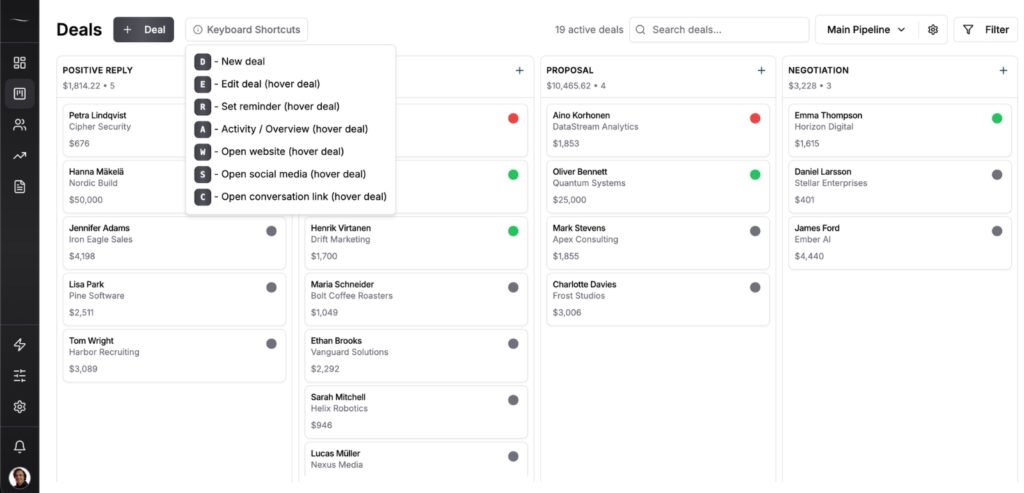
Tim Chorlton runs exactly the setup a 360 desk needs. “I am a ‘one-man-band’ but I have an external sales person and also handle my own enquiries. I have used Fluid to pull the ‘warm leads’ out of the spreadsheet swamp so I can focus on them.” And one mechanism he uses is the one recruiters should steal: “You can set up multiple pipelines and move a ‘deal’ between them.” One pipeline for live client deals, one for parked accounts, and a deal card moves between them in a click.
Viktor Otterskog, an outbound operator, put the daily feel of it plainly a few days into moving his outreach follow-up in: “It really has that speed, no bells and whistles, just does what it’s supposed to do.”
Honest limits: Fluid CRM has no ATS features at all. No resume parsing, no candidate portal, no dialer, and email is BCC logging that files a message to the deal rather than two-way inbox sync. It runs your client side next to a candidate tool, it does not replace one.
7. Pipedrive, more process and more add-ons
Pipedrive is the biggest name in pipeline CRMs and the depth is real: strong reporting, a large marketplace and automation on every paid tier. Lite starts at $14/seat/month billed annually ($24 monthly), verified on 2026-08-09.
The structure to understand before buying is that features arrive as add-ons billed per company, not per seat. LeadBooster alone is $32.50/month on annual billing, which lands hardest on the smallest teams.
Not for: a solo desk that just needs follow-up discipline. You will pay for process you never touch.
8. Close, for desks that live on the phone
Close rebuilt its pricing in 2026 and the entry point is now genuinely cheap. Solo is $9 per user per month with the full CRM plus calling, email and SMS built in. Essentials is $35 and adds pipelines and team visibility, Growth is $99, and Scale is $139 with predictive dialing for teams that need maximum call throughput.
The number that catches people is telephony. Calling is included as a feature, but phone lines are billed on top at $19 per line per month, plus usage. A four-person desk on Solo is $36 in seats and another $76 in lines before anyone picks up.
Not for: email-first desks. The dialing infrastructure is the whole reason to be here, and at $9 a seat you are buying a phone system with a CRM attached rather than the other way round.
Why Recruiting CRMs Cost 10x More Than Sales CRMs
Put the two columns side by side and the gap is hard to unsee.
| Tool | Side | Verified price |
|---|---|---|
| Loxo Basic | Candidates | $169/user/month |
| Recruiterflow Platform | Candidates | $149/user/month |
| Manatal Professional | Candidates | $15/user/month annual |
| Pipedrive Lite | Clients | $14/seat/month annual |
| Fluid CRM | Clients | $16/seat/month, or $144/seat/year |
The gap is not greed, it is anchoring. Recruiting software prices against your placement fees, because when a single perm placement can bill $20,000, $169 a month reads as a rounding error. Sales CRMs price against a crowded seat-price market, so the same pipeline mechanics cost a tenth as much.
Which is exactly why the two-tool setup wins for small desks. Run candidates on a free or cheap ATS, run clients on a cheap sales CRM, and you get both pipelines for under $35 a month instead of paying placement-fee prices for the half that is really just deals and follow-ups.
How to Pick by Desk Type
Three desk shapes cover most recruiting businesses, and each one has a different right answer.
Solo 360 desk
Start with Loxo free for candidates and Fluid CRM at $16/seat/month for clients. Total software bill: $16 a month for both pipelines. Upgrade the ATS side only when free stops fitting.
Boutique perm firm, 2 to 10 people
Manatal or Recruit CRM for the candidate side, plus a sales CRM seat for whoever owns new business. This is also the size where it is worth reading how to choose a CRM before committing, because switching costs start to bite at this headcount.
Temp and contract desks
Different problem, different list. High-volume contract staffing needs shift scheduling, compliance and pay-bill workflows this post does not cover. Go read best CRM for staffing agencies instead.
One opinion to close the section, from my experience rather than a study: under about ten open searches, a solo recruiter does not need an ATS at all. LinkedIn plus a lead tracker template holds the candidate side at that volume. The client pipeline is the one that cannot live in a spreadsheet, because that is where untracked follow-ups turn directly into lost fees.
Frequently Asked Questions
At low volume, yes, and plenty of solo headhunters do. A sales CRM handles companies, contacts and staged deals, which maps onto clients, candidates and searches. The moment you need resume parsing, a careers page or interview scheduling, you have outgrown the workaround and it is time for a real ATS on the candidate side.
Under about ten open searches, in my view, no. LinkedIn and a spreadsheet hold the candidate side at that scale. What solo recruiters skip far more often, and pay far more for skipping, is a tracked client pipeline with follow-up reminders.
An ATS tracks applicants through the hiring stages of specific jobs. A recruiting CRM manages ongoing candidate relationships before and between jobs, the talent-pool side. Most modern tools for agencies, including Loxo, Manatal and Recruit CRM, bundle both into one product.
For the candidate side, $0 to $19/user/month covers a solo or small desk on Loxo’s free tier or Manatal. For the client side, $14 to $16 per seat buys a full sales pipeline from Pipedrive or Fluid CRM. Treat anything at $149 and up as a scale decision that your fee volume has to justify, not a starting point.
Which CRM Should Run Your Desk
A solo 360 desk runs on Loxo free plus Fluid CRM. A boutique perm firm adds Manatal or Recruit CRM, with one sales CRM seat for whoever owns new business. A call-heavy sales floor takes Close, and retained search at scale takes Recruiterflow.
The candidate side has plenty of good software fighting for it. The client side is where recruiting desks actually bleed, quietly, one unfollowed-up hiring manager at a time. Track it like the revenue it is.
Start your 7-day free trial here, no credit card required.