

Search for the best recruiting CRM and the lists all assume your only job is managing candidates. If your applicant tracking system already handles that, and your client-winning side lives in a spreadsheet, you have a different problem. This guide splits nine tools by the two jobs a staffing agency actually runs.
The best CRM for a staffing agency depends on which side you are working. Bullhorn and Recruiterflow manage candidates, and Fluid CRM tracks the client companies you are trying to win, at $16 per seat per month. Most agencies end up needing one of each.
What a Staffing Agency CRM Actually Needs to Do
A staffing agency runs two jobs at once, and one CRM rarely does both well. The first job is the candidate side. Sourcing people, parsing resumes, moving them through interview stages and tracking placements. The second job is the client side. Finding new companies to staff for, chasing those deals and following up until they sign.
The recruiting software lists you find on Google answer the first job. They review applicant tracking systems and call them recruiting CRMs. That is fine if your problem is candidates. It misses the second job almost completely.
Here is the part nobody on the first page of Google says out loud. Most staffing agencies already have a tool for candidates. What they do not have is a clean system for winning new clients. That work usually sits in a Google Sheet that goes stale by Friday.
I saw this pattern for three years. In 3 years running cold email at Fenixtal I booked 1,250+ sales calls, and many of my clients were recruitment agencies. The pattern barely changed. They won new client companies through outbound and tracked that work in a spreadsheet, while the system they used to deliver the work sat somewhere else entirely. The candidate side was handled. The client side was a mess.
So before you shop, answer one question. Which job is actually broken? If your candidate side is the problem, you need a recruiting CRM or an ATS. If your candidate side is fine and your new-business tracking is the problem, you need a sales pipeline CRM. Those are different tools for different jobs, and buying the wrong one is how agencies waste a year.
What Belongs in a Recruiting CRM vs a Sales CRM
The cleanest way to pick is to sort your needs into two buckets before you look at any pricing page. A recruiting CRM or ATS owns everything to do with candidates. A sales pipeline CRM owns everything to do with winning client companies. Here is the split.
| Belongs in your candidate system | Belongs in your client pipeline |
|---|---|
| Sourcing and Boolean search | New client companies you are chasing |
| Resume parsing and profiles | Deal stage for each prospect |
| Job orders and open reqs | Follow-up reminders for business development |
| Candidate pipeline stages | Pipeline value and revenue forecast |
| Interview scheduling | Notes on every client conversation |
| Placement and fee tracking | Won and lost client deals |
Some recruiting platforms bolt a “client CRM” tab onto the candidate side. That works for some agencies. The catch is you are paying for a full candidate operating system and using one corner of it to track your sales. If your candidate side is already handled by another tool, that second platform is mostly dead weight.
The reverse is also true. A sales pipeline CRM will never source a candidate, parse a resume or track a placement. It is not built for that and it should not pretend to be. Ask a sales CRM to run your candidate database and you will be back in a spreadsheet within a month.
Match the tool to the job and the choice gets simple. The next two sections name the real options for each side.
The Best Recruiting CRMs for Managing Candidates
A recruiting CRM (often sold as an ATS) is the right tool when your job is candidates. Sourcing, parsing resumes, moving people through stages and tracking who got placed. These are the names worth shortlisting if that is the side you need to fix. All pricing below was checked live in June 2026.
1. Bullhorn (best for high-volume staffing at scale)
Bullhorn is the established platform for larger staffing firms. It handles candidates, client accounts, job orders and placements, plus back-office pieces like payroll and compliance for temp staffing. If you place dozens of people a month across many clients, this is the heavyweight built for that load.
Pricing is quote-only with no public rate and no free trial. Third-party reports put the entry around $99 per seat, and small-agency annual contracts often start near $20,000 once you add setup and the modules you actually need.
Use Bullhorn, not a lighter tool, if you are a mid-size or large agency running high-volume placements and you need deep staffing-specific workflows. Skip it if you are a lean team of three. You will pay enterprise prices for capacity you never touch.
2. Recruiterflow (best for modern boutique agencies)
Recruiterflow is a cleaner, newer ATS and recruiting CRM built for boutique and growing agencies. It combines candidate tracking with email and SMS sequences, sourcing through a Chrome extension and recruiting automation. Agencies running heavy candidate outreach tend to like the email engine.
It runs at $119 per seat per month, billed per user, with a free trial but no permanent free tier.
Use Recruiterflow if you want a modern candidate platform with strong outreach automation and you are happy paying per recruiter. It is the wrong shape for in-house corporate hiring teams, since it is built around clients and placements.
3. Recruit CRM (best all-in-one for small agencies)
Recruit CRM is a combined ATS and CRM aimed at small and mid-size recruitment firms. It covers candidate pipelines, resume parsing, client contacts, job posting and light invoicing in one place. Agencies that want candidate and client records under one roof rate it well for value.
Pricing starts at about $85 per seat per month on the entry tier with annual billing and climbs with higher tiers. It offers a trial before you commit.
Use Recruit CRM if you are a small agency that wants candidates and clients in a single tool and does not want to run two systems. If your candidate side already lives in another platform, you do not need its full feature set just to track sales.
4. Loxo (best for sourcing and AI-assisted recruiting)
Loxo leans hard into sourcing. It bundles an ATS, a recruiting CRM and a large candidate database with AI search into one workflow, and pitches itself as a way to replace a whole stack of separate sourcing tools. Recruiters who live in candidate search are its core audience.
There is a free tier for one user. The Basic plan is $169 per seat per month, and the Professional and Enterprise tiers that unlock the AI sourcing are custom quotes.
Use Loxo if sourcing is your bottleneck and you want AI search plus a database in the same tool. Skip it if 90 percent of your sourcing is already on LinkedIn, because you would be paying for a database you barely use.
5. Manatal (best budget candidate OS)
Manatal is the affordable end of the candidate market. It gives you applicant tracking, a candidate pipeline, resume parsing and basic CRM features at a price that undercuts most of this list. For a small team that mainly needs to organize applicants, it is hard to beat on raw cost.
The Professional plan is $15 per seat per month on annual billing, with Enterprise tiers at $35 and $55. It includes a 14-day free trial with no card required.
Use Manatal if you are a lean team that mostly processes inbound applicants and wants a cheap, clean ATS. It is not built for heavy outbound sourcing or automated multi-channel candidate outreach, so high-volume agencies will outgrow it.
6. Crelate (best for staffing plus light client tracking in one tool)
Crelate is a staffing and recruiting platform that pairs a solid ATS with a client and business-development layer in the same product. Agencies that want candidate tracking and some client tracking under one login often land here. The customization is a common reason people pick it.
The Business plan is $119 per seat per month, billed annually with a five-seat minimum, which puts the real floor around $595 a month. Higher tiers are custom and there is no free trial.
Use Crelate if you want candidate management and client tracking in one tool and you have at least five seats to fill. If you only need the client-tracking half, you are buying a full recruiting platform for a job a sales CRM does cheaper.
The Best Sales Pipeline CRMs for Winning New Clients
A sales pipeline CRM is the right tool when your candidate side is handled and your problem is winning new client companies. These tools track deals, not candidates. No sourcing, no resume parsing, no placements. Just the client-winning pipeline that usually lives in a spreadsheet at a staffing agency.
If you’re curious on how to find new business with cold email outreach or LinkedIn outreach, read the guides next. Now, let’s see the best sales pipeline CRMs.
7. Fluid CRM (best for agencies tracking new business without bloat)
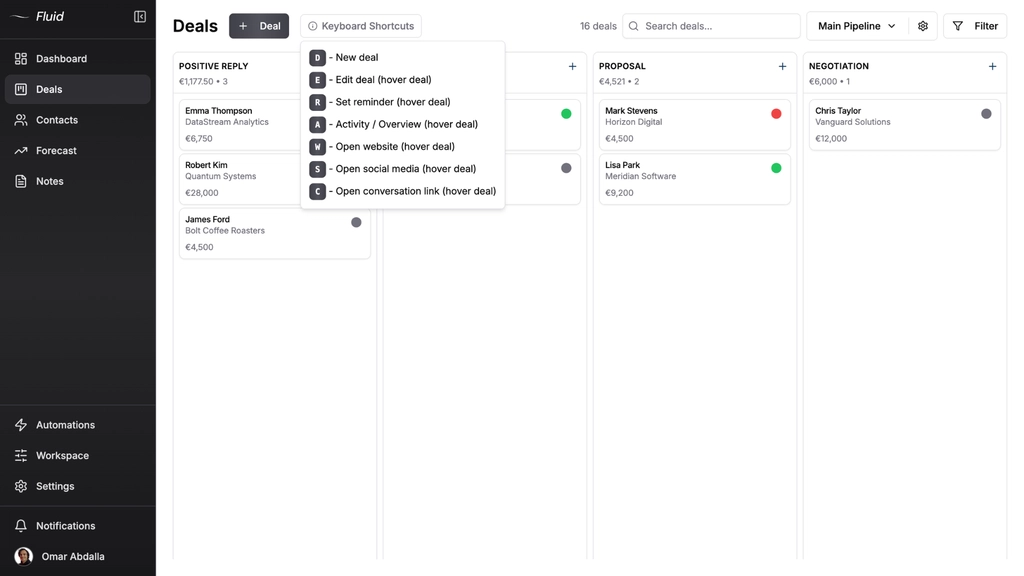
Fluid CRM is a visual sales pipeline built for small B2B teams, founders and agencies that have outgrown spreadsheets but do not want the weight of a full platform. For a staffing agency, it does one job and does it well. It tracks the client companies you are chasing, the stage each deal is in, the follow-ups you owe and the value sitting in your pipeline. Your candidate system keeps doing the candidate work. Fluid handles the side that wins the contracts. Here’s how agencies use it as an agency CRM.
You see your whole client pipeline on one screen, get reminders so deals stop slipping and add notes on every conversation. Lead capture forms let you take inbound client inquiries straight into the pipeline. Keyboard shortcuts make data entry fast enough that your team will actually keep it current, which is the whole problem with the spreadsheet.
Pricing is $16 per seat per month, or $144 per seat per year, which works out to $12 per seat per month with three months free. Every feature is included on both plans. There are no upgrade traps and no feature unlocks. The only difference between the two plans is billing cadence. You get a 7-day free trial, no credit card required.
Nicolas Virtsonis runs marketing and sales pipeline development for cleantech B2B companies. He is not in staffing, but he tried Sugar, Zoho, Pipedrive, Salesforce and more before landing on Fluid for the same reason a staffing agency would. He told me Fluid “removes all the clutter” so he could work faster and focus on the job instead of the software.
Use Fluid CRM if your candidate side is already handled and your client-winning pipeline is a spreadsheet you keep forgetting to update. It does not source candidates, parse resumes or track placements, so it is not a replacement for your ATS. It is the tool for the other job.
8. Pipedrive (best if you need built-in sales automation)
Pipedrive is a sales pipeline CRM with deeper automation and reporting than most lightweight tools. For a staffing agency tracking new business, it gives you a visual deal pipeline plus workflow automation, email sync and forecasting once you get past the entry tier. It is a fair step up if your business development is high-volume and you want the software to nudge deals along for you.
The Lite plan is $14 per seat per month on annual billing, but automation only starts on the Growth plan at $39 per seat. Add-ons like lead capture and document tools are billed separately on top. There is a 14-day free trial with no card required.
Use Pipedrive instead of Fluid CRM if you need built-in sales automation and workflow rules for your client outreach and you are fine paying for the Growth tier and add-ons to get them. If you just want a clean pipeline with follow-up reminders and no add-on math, it is more than you need.
9. Close (best for outbound-heavy BD with built-in calling)
Close is a sales pipeline CRM built around a phone. It has a native dialer, two-way SMS and email sequencing baked in, so a team that wins clients mostly by calling can run the whole motion in one tool. For staffing agencies whose business development is heavy outbound calling, that built-in dialer is the draw.
The Essentials plan is $35 per seat per month on annual billing and is the first tier with calling and unlimited contacts. The Power Dialer and automation sit on the Growth plan at $99 per seat. Calling and SMS minutes are billed separately as usage. A free trial is available.
Use Close instead of Fluid CRM if your client-winning is phone-first and you want the dialer inside the CRM. If your business development runs on email, LinkedIn and meetings rather than cold calls, you would be paying for a phone system you do not use.
Here is the quick version of all nine, sorted by the job they do.
| CRM | Job | Starting price |
|---|---|---|
| Manatal | Candidates | $15/seat (annual) |
| Recruit CRM | Candidates | ~$85/seat (annual) |
| Bullhorn | Candidates | Quote only, ~$99/seat reported |
| Recruiterflow | Candidates | $119/seat |
| Crelate | Candidates | $119/seat (5-seat min) |
| Loxo | Candidates | Free for 1 user, $169/seat Basic |
| Fluid CRM | Client pipeline | $16/seat |
| Pipedrive | Client pipeline | $14/seat, automation from $39 |
| Close | Client pipeline | $35/seat with calling |
How to Choose the Right CRM for Your Staffing Agency
The right choice for a staffing agency comes down to which job is broken, not which tool has the longest feature list. Run yourself through three setups and the answer falls out fast.
You already have an ATS and your sales live in a spreadsheet. This is the most common setup and the easiest call. Your candidate side works, so do not replace it. You need a sales pipeline CRM for the client-winning side. Fluid CRM, Pipedrive or Close depending on whether you want simple (Fluid), automated (Pipedrive) or phone-first (Close).
Picture the spreadsheet most agencies actually run. A tab of company names, a stage column nobody updates, a notes cell that turns into a wall of text and no reminder when a warm client goes quiet for three weeks. The deal does not die because the lead was bad. It dies because nothing told you to follow up. A visual pipeline with built-in reminders fixes that one problem, which is the whole reason the spreadsheet was failing in the first place.
You have no candidate system at all. Start there first. A sales CRM will not source or parse resumes, so you need a recruiting CRM or ATS before anything else. Recruit CRM and Crelate give you candidates and light client tracking together, which can carry a small agency for a while on one tool.
You are tiny and the candidate work is light. If you place a handful of people and most of your effort goes into landing clients, you may not need a heavy recruiting platform yet. A budget ATS like Manatal for candidates plus a lean pipeline tool for clients can cost less than one seat of an all-in-one platform.
Now the opinion you will not find on most recruiting software lists. Buying a second full recruiting platform just to track your sales is overkill. If a sales rep already lives in your ATS for candidates, you do not need to pay $119 a seat for another candidate operating system to log client deals. A $16 sales pipeline does that job and your team will actually keep it updated. The tools are not interchangeable and the price gap is not the point. A sales pipeline CRM is a different tool for a different job, not a cheaper version of your ATS.
When you pick the sales side, keep the bar low on purpose. You want a visual pipeline you can read at a glance, follow-up reminders so deals stop slipping and notes on every client conversation. You do not want marketing automation, lead scoring or nine modules you will never open. For the client-winning job at a staffing agency, the strength of the right tool is what it leaves out.
Frequently Asked Questions
Often yes. Most recruiting platforms are built around candidates, and their client-tracking features are an afterthought bolted onto the side. If your business development runs on a Google Sheet while your ATS handles candidates, a dedicated sales pipeline CRM keeps your client deals and follow-ups in one place without you paying for a second candidate system.
In practice the line is blurry and most tools do both. An applicant tracking system focuses on managing candidates through the hiring stages for open jobs. A recruiting CRM adds relationship features for nurturing candidates and tracking client contacts over time. Most modern platforms for agencies, like Bullhorn and Recruit CRM, combine the two.
Some can, like Recruit CRM and Crelate, which build a client layer into the candidate platform. The trade-off is cost and weight. You pay for a full recruiting operating system and use one part of it for sales. If your candidate side already lives elsewhere, running both jobs in one heavy tool rarely makes sense.
For the client-winning pipeline alone, Fluid CRM at $16 per seat per month is among the lowest with every feature included and no upgrade traps. Pipedrive starts at $14 per seat on annual billing, though sales automation only unlocks at $39. Recruiting platforms run higher because they include candidate features you would not use for sales.
Conclusion
The best CRM for a staffing agency is the one that fixes the job that is actually broken. Keep your ATS for candidates. If your client-winning side is a spreadsheet you keep forgetting to update, that is a sales pipeline problem, not a reason to buy a second recruiting platform. Fluid CRM gives you a clear visual pipeline for new business without the bloat.
Start your 7-day free trial, no credit card required.