

Your startup doesn’t need the CRM a funded Series A team needs. It needs the one that still makes sense when you’re paying full price in year three. The best CRM for startups is the one that survives that math, so this post prices 9 of them by real annual cost, seat minimums and what the cheap tier actually locks out.
The best CRM for a startup depends on funding. Bootstrapped teams do well with Fluid CRM at $16/seat/month, every feature included. Funded teams that need marketing automation should pick HubSpot. Zoho, Freshsales and Attio all have free plans for 3 users.
When a Startup Actually Needs a CRM
Startups buy a CRM at two wrong moments. Some buy on day one because a founder read that real companies use Salesforce, and some wait until they’ve lost a deal they can’t even name.
After 1,000+ meetings booked across 50+ B2B clients at Fenixtal, I saw the same two failure modes. Either the company tracked leads nowhere at all, or it paid for Salesforce and nobody on the team opened it. The tool was almost never the problem. The habit was.
You need a CRM when a follow-up slips every week, or when a second person needs to see the same pipeline. If neither has happened yet, a spreadsheet is fine and cheaper than anything on this list. When you do start buying, a CRM is one piece of a wider 12 tool startup sales stack.
Austin Verner runs Cold Emailers, a cold email agency. When he described why clients leave him, he pointed at what happens after the lead arrives: “they’re getting leads, but they’re not closing.” That gap is what a CRM closes, and it isn’t a lead problem.
Funded and Bootstrapped Startups Need Different CRMs
“Startup” covers two buyers with opposite budgets, and every CRM list treats them as one. A funded team and a bootstrapped team can look at the same tool and get opposite answers.
A funded startup has access to discount programs, and those programs usually require an approved investor or accelerator behind you. Your next hires probably already know HubSpot or Salesforce, so training cost drops. You also plan for a marketing team that doesn’t exist yet, which makes a bigger platform easier to justify.
A bootstrapped startup gets none of that. Discount programs mostly lock you out, seat minimums hurt when you’re 2 people, and every dollar comes out of revenue instead of a round. You need something you can set up this afternoon at a price that doesn’t change when you add a fourth person.
Same tool, different verdict. Every entry below says which of the two it fits.
Startup CRM Pricing Compared
Startup CRM pricing splits into annual and monthly rates, and the gap between them is bigger than most buyers expect. The table below sorts by annual seat price, with the monthly rate beside it so you can see what paying month to month costs you.
| CRM | Entry plan | Annual billing, $/seat/month | Monthly billing | Free plan | Seat minimum |
|---|---|---|---|---|---|
| Freshsales | Growth | $9 | $11 | 3 users | None |
| Fluid CRM | Annual plan | $12 | $16 | None | None |
| monday CRM | Basic | $12 | Not verified | None | 3 seats |
| Pipedrive | Lite | $14 | $24 | None | None |
| Zoho CRM | Standard | $14 | $20 | 3 users | None |
| HubSpot Sales Hub | Starter | $15 | $20 | 2 users, 1,000 contacts | None |
| Capsule | Starter | $18 | Not verified | 2 users, 250 contacts | None |
| Salesforce | Starter Suite | $25 | $25 | 2 users | None |
| Attio | Plus | $29 | $36 | 3 seats | None |
Two of the cheapest seats don’t include what a startup needs. Freshsales keeps sequences, multiple pipelines and Freddy AI scoring on Pro at $39/seat annual, and Capsule keeps workflow automations and multiple pipelines above Starter, which makes Growth at $36/seat annual the real entry.
What CRM Startup Discounts Cost by Year Three
CRM startup discounts look like free money in year one and turn into your biggest software bill by year three. HubSpot for Startups is the program most founders find first, so it makes the clearest example.
The terms are up to 90% off year one, 50% off year two and 25% off after that. It applies to Professional or Enterprise only, never the Starter tier, and you need an approved VC, accelerator, incubator or Solutions Partner behind you, plus funding at pre-seed, seed or Series A under $20 million, and not Series B or later. You also can’t switch tiers in the middle of a contract term.
Run Sales Hub Professional at $90/seat annual through those three years.
| Year | Discount | Cost per seat, per month |
|---|---|---|
| Year 1 | 90% off | $9 |
| Year 2 | 50% off | $45 |
| Year 3 | 25% off | $67.50 |
Add the $1,500 onboarding fee that Professional requires in year one.
Can your startup pay $67.50 a seat in year three? That’s the price you’re actually signing up for. By then two years of deals, contacts and email history live in the tool, and moving out costs a week nobody has. The discount is real and the math is fine if you plan for the third number instead of the first.
There is a smaller tier at 30% year one and 15% year two for startups tied to an approved entrepreneurial organization. Bootstrapped founders with no affiliation at all still don’t qualify, which makes this whole section moot and the sticker prices in the table above your real menu.
1. Fluid CRM (Best for Bootstrapped Startups)
Best for
Solo founders and small B2B teams doing founder-led sales who want a visual pipeline today, not a platform to grow into. Fluid CRM is built for the startup that needs to know who to follow up with, not one that needs a marketing engine.
Pricing
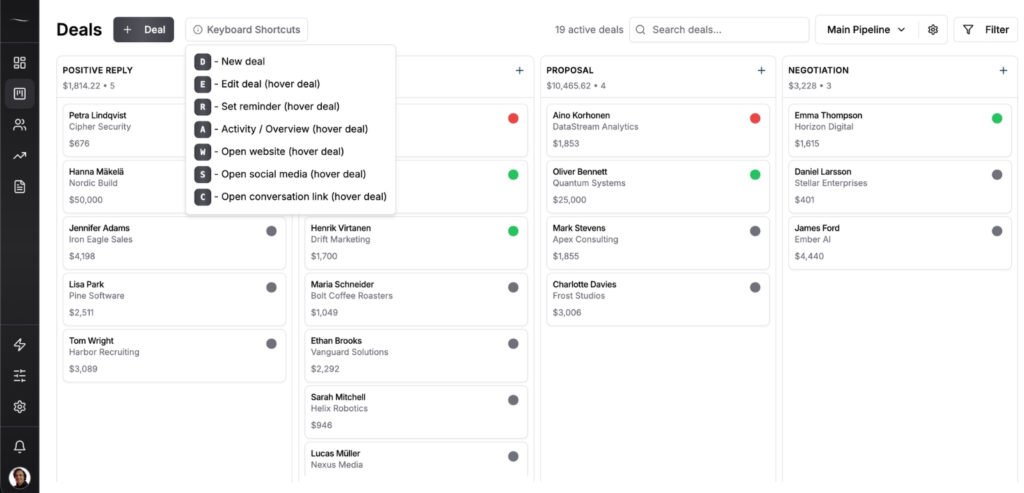
$16/seat/month or $144/seat/year, which works out to $12/seat/month with 3 months free. Two plans, both feature-complete, so you pay per seat and never for feature unlocks. That includes unlimited deals, contacts and pipelines, 8 in-app automations, reminders, keyboard shortcuts plus API and webhooks. There is a 7-day free trial, no credit card required. Full plan details are on the Fluid CRM pricing section.
Viktor Otterskog is a solo B2B outbound operator in Sweden who checked the two tools most startup lists push before picking this one: “I looked at HubSpot, Airtable and stuff like that.”
Where it falls short
No marketing automation, no calling, no SMS and no two-way inbox sync. BCC email sync logs emails to the deal, which is not the same as syncing your inbox both ways. There is no free plan either. A startup that wants forms, email campaigns and a CRM in one system should skip this and read the HubSpot entry.
2. HubSpot Sales Hub (Best for Marketing-Led Startups)
Best for
Funded startups that run marketing and sales in one system. If you need forms, email campaigns, landing pages and a CRM under one login, HubSpot is the entry that fits.
James Colistra, who runs the podcast booking agency Wonderfish, stays on HubSpot for his automation needs and still says it plainly: “Not everyone needs HubSpot.” He is right on both counts. When you do need it, nothing on this list replaces it.
Pricing
Free plan for 2 users and 1,000 contacts. Starter is $15/seat annual or $20 monthly and includes calling. Professional is $90/seat annual or $100 monthly, plus a required $1,500 onboarding fee.
Where it falls short
The features people buy HubSpot for live at Professional, not Starter, so the real entry price for a marketing-led startup is $90/seat plus onboarding. The 12-month cost of HubSpot against Pipedrive shows what that looks like at 1, 3 and 10 seats.
The free plan is a funnel into paid rather than a place to stay. Bootstrapped teams without an investor or accelerator behind them rarely qualify for the startup discount that makes the Professional price work.
If you don’t qualify, the HubSpot alternatives list is the cheaper shortlist.
3. Pipedrive (Best for Startups That Want a Classic Sales Pipeline)
Best for
Startups with a repeatable outbound process and a sales-first mindset. Pipedrive has been doing visual pipelines longer than almost anyone and it shows in the deal management.
Pricing
Lite is $14/seat annual or $24 monthly. Growth is $39/seat annual or $49 monthly. No free plan, trial only.
Where it falls short
The add-ons are where the bill grows. LeadBooster and Smart Docs bill per company rather than per seat, so a 2-person startup pays the same add-on price as a 20-person team. Lead scoring sits on Premium at $59/seat annual, two tiers above Lite. The monthly rate is 71% above annual on Lite, which is the widest gap in this table. That structure is the reason most small teams start reading Pipedrive alternatives.
4. Attio (Best for Startups Building a Custom Data Model)
Best for
Technical founders who want to shape the CRM around their own objects and relationships instead of accepting someone else’s deal stages. Attio is closer to a flexible database than a classic pipeline tool.
Pricing
Free for up to 3 seats. Plus is $29/seat annual or $36 monthly. Pro is $69/seat annual or $86 monthly.
Where it falls short
The seat price is not the whole price, because a credit system sits on top of it for AI features and enrichment. The flexibility that makes Attio good also means real setup time, and a 2-person startup that needs a pipeline by Friday will spend that week configuring instead of selling. The free plan is the most useful one on this list if you stay under 3 seats.
5. Zoho CRM (Best for Startups Already Using Zoho Apps)
Best for
Startups that already run Zoho Books, Zoho Desk or Zoho Campaigns. Staying inside one product family removes integration work you would otherwise pay for or build.
Pricing
Free for up to 3 users. Standard is $14/seat annual or $20 monthly. Professional is $23/seat annual or $35 monthly.
Where it falls short
The product family that makes Zoho CRM a good fit is also the reason setup takes real time. You are not learning one tool, you are learning where things live across several. Email and SMS marketing sit inside the wider ecosystem rather than in the CRM itself, so plan for more than one subscription if that is why you came.
6. Salesforce Starter Suite (Best for Startups Planning to Grow Into Salesforce)
Best for
Startups that expect to hire experienced sales people who already know Salesforce, and funded teams who would rather learn the platform now than migrate into it later.
Pricing
Free Suite is $0 for 2 users. Starter Suite is $25/user/month, billed monthly or annually, with no user maximum. Pro Suite is $100/user/month on an annual contract.
Where it falls short
Starter Suite is a simplified product, not the Salesforce your future sales hire is picturing. Growing into the real thing means another migration and a bigger bill. Pro Suite requires an annual contract, so the flexibility you have at $25 disappears at $100. For a 2-person bootstrapped team, annual billing brings no discount here, so $25 a seat is the price either way.
I covered where teams land instead in Salesforce alternatives for small business.
7. monday CRM (Best for Teams Already Using monday)
Best for
Startups already running projects in monday who want their sales pipeline in the same place. The board-based interface is familiar if your team lives there.
Pricing
Basic is $12/seat annual, Standard is $17 and Pro is $28. Every paid monday CRM plan has a 3-seat minimum, which puts the smallest real spend at $432/year.
Where it falls short
monday CRM and monday Work Management are different products. The free 2-seat plan belongs to Work Management, so there is no free monday CRM plan, and a 2-person startup pays for a third seat it does not use. Seat minimums are worth checking on any tool you shortlist, since Salesflare applies a 5-user minimum on its Enterprise plan for the same reason.
8. Freshsales (Best for Startups With No Budget)
Best for
Startups that need something better than a spreadsheet this week and cannot spend anything yet. The free Freshsales plan covers 3 users and the paid entry is the cheapest seat on this list.
Pricing
Free for up to 3 users. Growth is $9/seat annual or $11 monthly. Pro is $39/seat annual or $47 monthly.
Where it falls short
Growth gets you calling and email, then stops. Sequences, multiple pipelines and Freddy AI lead scoring all sit on Pro, which is a 4.3x jump from Growth. Compare Freshsales on the Pro price if you plan to run any kind of outbound cadence, because Growth will not do it and the $9 headline is not the number you end up paying.
9. Capsule (Best for Startups That Want Simple Contact Management)
Best for
Startups with a relationship-led sales process and low deal volume. Capsule keeps contacts and deals tidy without asking you to configure much.
Pricing
Starter is $18/seat annual and Growth is $36/seat annual. Monthly billing runs higher, though I could not verify those figures to a publishable number, so treat the annual rates as the reliable ones. The free plan covers 2 users and 250 contacts.
Where it falls short
Workflow automations and multiple pipelines sit above Starter, so Growth at $36/seat annual is the honest starting price for a startup that wants both. Free-tier users usually hit the 250 contact cap well before the 2 user cap, which turns the free plan into a short trial in practice.
Frequently Asked Questions
Freshsales Growth is the cheapest paid seat at $9/seat annual, and Freshsales, Zoho and Attio all have free plans for 3 users. The cheapest seat is rarely the cheapest outcome though, since Freshsales gates sequences and multiple pipelines to Pro at $39/seat annual. Compare the tier that includes what you need, not the entry tier.
No. monday CRM has no free plan, and every paid plan carries a 3-seat minimum starting at $12/seat annual. The free 2-seat plan people find belongs to monday Work Management, which is a different product. A 2-person startup pays $432/year minimum for 3 seats.
Some do. HubSpot for Startups offers up to 90% off year one, 50% year two and 25% after that, on Professional or Enterprise only. It requires an approved VC, accelerator, incubator or Solutions Partner affiliation plus funding under their caps, so bootstrapped founders with no partner behind them usually pay list price.
A free plan is a reasonable place to start if you stay inside its limits. Attio covers 3 seats free, Zoho and Freshsales cover 3 users, and Capsule covers 2 users and 250 contacts. Check the cap that will hit you first, because contact limits usually bite before seat limits do.
How to Pick the Right Startup CRM
Pick the CRM you can still afford when the discount ends and the free tier runs out. For funded startups running marketing and sales together, HubSpot earns its price. If you’re bootstrapped and want a clear visual pipeline without the bloat of a traditional CRM, Fluid CRM is $16/seat/month with every feature included.
Start your 7-day free trial here, no credit card required.