

You started a company to build a product, and now the product needs customers and nobody else is going to find them. Most advice on founder-led sales tells you why it matters and then stops before the part where you have to fit it into a week.
Founder-led sales is when the founder personally finds prospects, holds the sales calls and closes the first customers instead of hiring a sales team. To do it well, hold a set number of conversations a week, write down what each buyer said and keep every deal in a pipeline like Fluid CRM, with a next step and a date.
I did the selling myself at my outbound agency Fenixtal that booked 1,250+ sales calls for its clients. This guide is for a B2B service or product sold by conversation, and I recommend starting with 20 new people contacted and 5 conversations a week.
What Founder-Led Sales Is (and What It Is Not)
Founder-led sales means you are the sales team. You do four jobs yourself.
- Finding people. You decide who has the problem and you write to them.
- Holding the conversations. You take the first call and the demo, and you answer the hard questions.
- Asking for money. You name the price and you ask for the decision.
- Writing down what you learned. You keep a record of what buyers said, so the next call starts further ahead.
The purpose of selling yourself is to learn what people will pay for, and revenue is the proof that you learned it.
Founder-led sales is not a personal brand project, because a LinkedIn post cannot tell you why a buyer paused at the price. It is also not a chore to get rid of as soon as possible. Steve Walsh, a Techstars mentor, writes that “In many cases, founder-led sales should last one to two years.”
Why the Founder Has To Sell First
A founder hears things on a sales call that a hired salesperson would not pass back. A salesperson is paid to close the deal, so the odd remark that should change your product never reaches you.
On the call yourself, you hear the buyer’s own words for the problem, the tool they use today, the real objection behind the polite one and the moment they went quiet when you said the price.
Paul Graham put the time cost plainly in Do Things that Don’t Scale: “at least one founder (usually the CEO) will have to spend a lot of time on sales and marketing.”
You are also the only person who can act on it the same day. Kyler Thompson of Knight Theory, a solo creative studio, emailed us with questions during his trial and described what happened next in his review.
“What I didn’t expect was that when he realized the platform didn’t have the features I was asking about, he’d actually ship the features I mentioned within hours. No, he didn’t just add to the roadmap. He and his team shipped it same day.”
With a hired salesperson, the person who hears the request and the person who can change the product are two different people.
A Weekly Founder-Led Sales Routine You Can Keep Next to Building
The routine has to hold in a week when the product breaks, so it is built from two fixed blocks and one short review.
We recommend 20 new people contacted and 5 conversations a week as a starting point, and you should change both after a month of your own results.
| Block | What you do | What you write down |
|---|---|---|
| Outreach block, 90 minutes, same day each week | Contact 20 new people who have the problem and answer every reply | Who replied and the words they used for the problem |
| Conversation block, about 5 slots across the week | Hold 5 conversations, which are first calls, demos or pilot check-ins | The six-line note, within 5 minutes of hanging up |
| Friday review, 15 minutes | Open every deal and give it a next step with a date | One sentence on what you learned this week |
In the first month, week one is for the list and the first messages, weeks two and three are for first calls and by week four you should have asked at least one person to pay.
Our guide to the sales pipeline review has the questions to ask of each deal.
Where the conversations come from at a product startup
A product startup has no past clients to call, so the conversations come from three other places.
- People who signed up. Write yourself to everyone who started a trial, joined a waitlist or filled in your form.
- One narrow outbound list. Write to a short list of companies that share one trait, such as the tool they use today.
- Introductions from your first customers. Ask every happy customer for one name.
If you sell a service and not a product, the sources are different, and our guide on how to get clients covers them.
Open the call by saying what it is for. Something like “I’m the founder, and I’d like to learn how you handle [problem] today. I’ll only show you the product if it fits what you tell me.”
What to write down after each conversation
Our discovery call guide covers the call itself and the four lines to write during it. A founder keeps two of those and adds four more in the five minutes afterwards.
Copy these six lines into the note on the deal and fill them in before you open anything else.
Their wordsfor the problem, as close to a quote as you can getUses today, which is the tool or habit you would replaceObjection, the real one, even if they said it kindlyPrice reaction, what they said or did when they heard the numberSurprised me, the one thing you did not expectNext stepand its date
If you cannot say, without opening your inbox, how the last five buyers reacted to your price, the notes are the first thing to fix, and a CRM for startups is only useful once you are writing them.
A Five-Stage Pipeline for Founder-Led Sales
A pipeline is the list of your open deals, sorted by how far each one has come. A founder selling alone needs four open stages plus Won.
| Stage | A deal moves here when |
|---|---|
| Lead | A real person at a real company has replied or signed up |
| Discovery call | A first call is booked with a date |
| Demo | They have agreed that the problem is worth solving and asked to see the product |
| Pilot | They are using the product with their own data and you have agreed an end date |
| Won | They have paid |
Each rule is something the buyer did. Our post on sales pipeline stages explains how to write rules like these for your own sale.
A deal that ends without a sale is marked as lost, and you write the reason in its note first.
Two more habits make the pipeline usable by someone other than you. Every open deal has one next step with a date, and every deal has three fields filled in, which are Source, Company size and Uses today.
A spreadsheet can hold all of this for your first deals. Fluid CRM is for the point where the notes and dates no longer fit in it. Each deal is a card on a board, and the deal holds its notes, its activity history and a reminder with a date.
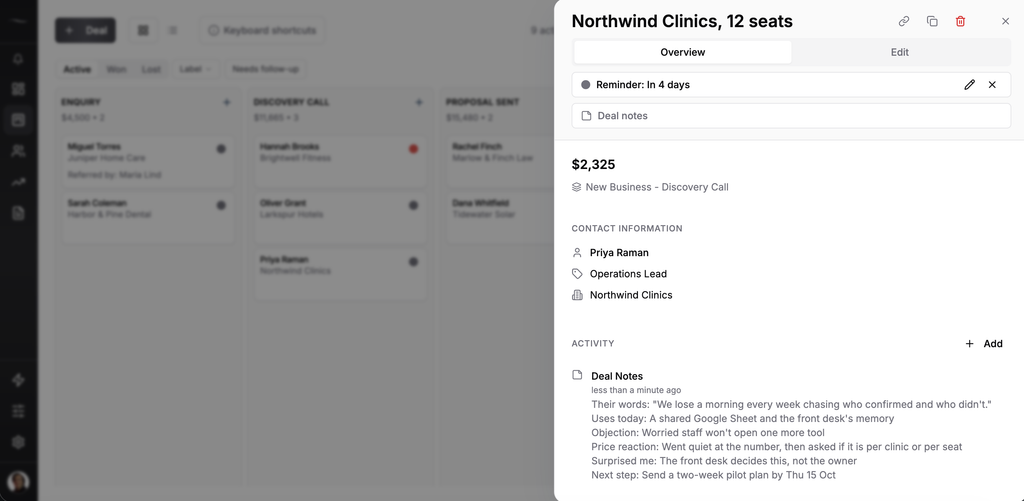
A deal like this one is what a new salesperson would read on day one.
Fluid CRM has limits a founder should know. A deal holds one contact and one reminder at a time, email is logged by BCC with no automatic sync and Fluid CRM sends nothing to your prospects.
If you are still choosing a tool, we compared the options in the best CRMs for startups and in the best CRM for solo founders. If you are also raising money, keep investors in their own investor pipeline.
When To Stop Founder-Led Sales and Make Your First Sales Hire
A founder should stop doing all the sales themselves when strangers have bought the same offer more than once, the way you sell it is written down and there are more good conversations than hours to hold them.
Many guides say to close your first 10 to 20 customers yourself. Treat that as a rule of thumb and not a measured result, because five customers on large annual contracts can teach you more than fifty on a cheap monthly plan.
I would not hire at a revenue number at all, because revenue shows that people buy and only the written record shows a new person how.
Steve Walsh of Techstars gives a simple test for hiring a first sales leader. You should be able to say four things: “This is who we sell to.” “This is the problem we solve.” “This is how the conversation goes.” “This is why customers buy.”
Signals that you are ready
| Signal | What it looks like | How to check it |
|---|---|---|
| Strangers buy | Customers who did not know you before the first message | Read the Source field on your won deals |
| The offer repeats | The same product at the same price, sold several times | Compare your last five won deals |
| The objections repeat | You hear the same three or four and you have an answer for each | Read the Objection line in your notes |
| Time is the limit | Good leads wait because your week is full | Count the deals with an overdue next step |
The ready-to-hire checklist
Copy this list and check each line honestly. We recommend at least 10 paying customers before you start, and that number is ours.
- 10 or more customers closed by me, and most of them were strangers
- The four sentences are written down
- Each pipeline stage has a written rule for moving a deal
- The common objections are listed with the answer that worked
- One standard offer and one price are written down
- Every open deal has notes, a next step and a date
How the handover works
In our view the first hire should be someone who closes deals themselves, not someone who manages a team that does not exist yet. Jason Lemkin of SaaStr goes further and says to hire two, because “If your first rep does poorly, you’ll have no idea why.”
We suggest a three-month handover. You sell together in month one, they lead the calls while you listen in month two and they sell alone in month three.
In Fluid CRM you invite the new person to the same pipeline, where they can read the notes and history of each deal. You pay $16 per seat a month or $144 per seat a year, and every seat has every feature.
To turn your notes into written steps before that day, see our guide on how to build a sales process.
When Founder-Led Sales Is the Wrong Model
This routine is for a B2B product that is sold by conversation. It is the wrong model in one case.
That case is a low-priced product that people buy on their own with a card. Five sales calls a week will not pay for themselves at $10 a month, so talk to customers to learn and not to close.
Founder-Led Sales FAQ
Founder-led sales is when the founder personally finds prospects, holds the sales calls and closes the first customers instead of hiring a sales team. Its main purpose is to learn what buyers will pay for and to write that down.
When strangers have bought the same offer more than once, the way you sell it is written down and there are more good conversations than you have hours for. We recommend at least 10 paying customers first, and that number is our own rule of thumb.
Yes. A first sales conversation is mostly questions about a problem you already understand. We recommend starting with 20 new people contacted and 5 conversations a week, and writing a short note after each one.
Not at the start. A spreadsheet works for your first deals if every deal has a next step and a date. A CRM helps once a date gets missed.
What To Have Written Down Before Your First Sales Hire
Before you hire, have these five things in writing, so a new person can read how you sell.
- Who you sell to and the problem you solve, in the buyer’s own words
- The stages of your pipeline and the rule for moving a deal to each one
- The objections you hear and the answer that worked
- One standard offer with one price
- Every open deal, with its notes, its next step and a date
Until then, keep the week simple. We recommend 20 new people contacted, 5 conversations and a six-line note after each one.
We built Fluid CRM as a CRM for startups where the founder is still the one selling, with one board, notes on every deal and nothing to configure first.
Start your 7-day free trial here, no credit card required.