

Most sales prospecting advice assumes someone’s whole job is prospecting. On a small team, that person also runs sales calls and answers clients, so prospecting is the first thing dropped in a busy week. A smaller routine you keep beats a bigger one you quit by week three.
Sales prospecting is finding people who fit what you sell and starting a conversation with them. A small team can run it in four hours a week: build a short list, contact each person several times and log every interested reply as a deal in Fluid CRM.
What Is Sales Prospecting on a Small Team?
Sales prospecting is the work of finding potential buyers and contacting them before they contact you. They may not know you exist or may not be looking yet, so you go first and give them a reason to answer.
A bigger company hands this to a sales development rep (SDR), a person whose whole job is prospecting. A team of four has no such person, and advice built around daily call quotas and a stack of paid tools falls apart in a normal week.
We built Fluid CRM as a sales team CRM for that size of team, so this post assumes two to five people, full calendars and no new hire coming. If it’s only you, read how to get clients when you work alone. For the longer plan around this work, see our pipeline generation strategy.
Inbound vs outbound prospecting
Inbound starts with someone who contacted you first through a form or a question, and your job is to decide who deserves a fast answer. Outbound starts with you choosing the person and writing first.
Inbound brings warmer people but takes months to build, while outbound can start this week and its quality varies more. A team of four should answer every inbound lead first, since those people asked, then spend the rest of the time on outbound.
Who should do the prospecting
Give it to one named person, even when three people could do it. A shared job gets dropped, because everybody assumes somebody else did it this week. That person is usually the owner or the most senior seller, and other people can still take the calls it produces.
How to prospect in five steps
- Decide who you’re looking for, based on your best recent customers. Point 1 of the checklist below covers this.
- Build a short list of named people who pass the 8-point checklist.
- Find one true reason to write to each of them this month, which is what points 4 and 5 of the checklist test.
- Contact each person several times across two channels, using the five-touch table below.
- Turn every interested reply into a tracked deal the day it arrives, as the section on tracking replies explains.
The 4-Hour Weekly Sales Prospecting Routine
The routine takes four hours spread across the week, and one person runs it. Put each block in the calendar as a meeting, with the same respect you’d give a client call.
| When | Who | Job | Minutes |
|---|---|---|---|
| Every morning | Prospecting owner | Answer replies and log the interested ones | 10 a day |
| Monday | Prospecting owner | Add 15 names that pass the checklist, each with one true sentence | 60 |
| Tuesday | Prospecting owner | Send the first message to this week’s 15 | 30 |
| Wednesday | Prospecting owner | Make the second touch on a second channel | 30 |
| Thursday | Prospecting owner | Send every follow-up due from earlier weeks | 50 |
| Friday | Prospecting owner plus whoever took calls | Count names, people contacted, interested replies and calls booked, then change one thing | 20 |
We recommend 15 new names a week as a starting point, and it’s our judgment rather than a benchmark.
Monday’s hour also covers the names you reject, so if half fail you have about two minutes per name, and this is the block most likely to overrun. When it does, add fewer names that week and keep the hour. Raise the number only after Thursday has finished on time for a month.
Thursday starts almost empty, and that fools people into thinking the routine is lighter than it is. Week two brings 15 follow-ups, week three 30 and week four as many as 45, less anyone who has replied. It levels off there, so each follow-up gets about a minute and has to be short.
Now look back at your last three weeks. Can you name who prospected in each of them, and how many people they contacted?
When a week goes wrong, cut Monday’s new names before you cut Thursday. The people on Thursday’s list have already heard from you, so that’s where the earlier work pays off.
What 15 names a week can add up to
These numbers are made up, to show the math. Fifteen names a week is about 60 a month. If one in 20 replies with interest, half of those book a call and you win one call in three, that’s three interested people and about 1.5 calls a month, or one new customer every two months.
Your rates will differ, so run your own through our lead generation calculator. That example works out at about 35 hours of prospecting per customer, so check whether one customer pays for that. If it clearly doesn’t, look at a better offer or a larger deal, since more hours won’t change the answer.
When Friday’s count shows people aren’t replying, look at the list and the reason for writing before you rewrite the message.
Build a Prospect List That Passes This 8-Point Checklist
A name goes on your prospect list only with eight yeses. If you need help with the first point, our ideal customer profile template walks you through it.
- The company looks like your best recent customers in size, type of business and problem.
- You have a named person who can say yes, or who can get you to the person who can. A general inbox fails.
- You have a working way to reach that person, such as a verified email address or a profile they use.
- Something changed at the company or in its market this month that gives you a reason to write.
- You can write one true sentence about them that wouldn’t fit the next company on the list.
- They aren’t already a customer or an open deal. Search your CRM before you add them.
- Nobody on your team has contacted them in the last 90 days. Two people writing to the same buyer looks careless.
- You can say where the name came from and get more from the same place.
Rejecting names is the point of this list. If fewer than half of the names from one source pass, change the source and leave the checklist alone.
Keep the list in a spreadsheet or your sending tool with six columns: person, company, reason to write, source, last touch and next touch date. It only has to last until someone replies.
Prospecting Techniques Worth Running on a Small Team
Most lists of prospecting techniques run well past ten items, and many of them need time you don’t have. These six cover nearly all of what a small team can actually do.
| Technique | Fits when | Time per person | How it usually fails |
|---|---|---|---|
| Warm introductions | Happy customers know people like them | Low | A vague “let me know if you hear of anyone” with no name attached |
| Past customers and old lost deals | You’ve been selling for a year or more | Low | Nobody wrote down why they left, so the message says nothing |
| Cold email | You can state your value in two sentences | Medium, plus sending setup | Sending before anyone has checked the list |
| LinkedIn messages | Your buyers read them and a deal is worth a personal note | Medium | Pitching inside the connection request |
| Cold calling | Your buyers pick up and the first sale is simple | High | Calling with no reason and giving up after one dial |
| Events and communities | Your buyers gather in a few known places | High | Collecting names and writing to none of them |
Pick two, one warm and one cold, and run them for a full quarter before you judge either. Each cold channel has its own setup, covered in our cold email outreach playbook and our guide to finding clients on LinkedIn.
Skip paid intent data and four-channel automated sequences until this routine has run for a quarter, since they help a team with no routine reach the wrong people faster. Posting on social media is also worth doing, but it isn’t prospecting, because no specific person has been asked anything.
How to Prospect One Person From First Message to Reply
RAIN Group’s prospecting research puts the average at 8 touches to get an initial meeting or other conversion with a new prospect, and at 5 for its top performers. Five is a fair target for a team with a day job. This cadence is for cold names, and it uses the Tuesday, Wednesday and Thursday blocks of the weekly routine.
| Touch | Day | Channel | What it adds |
|---|---|---|---|
| 1 | 1 | Main channel | Your reason for writing and one easy question |
| 2 | 2 | Second channel | A short note or call on the same reason, with no pitch |
| 3 | 10 | Main channel | A result from a customer like them |
| 4 | 17 | Second channel | A different problem you’ve seen at companies like theirs |
| 5 | 24 | Main channel | A polite last note that makes it easy to say “not now” |
Backlinko’s study of 12 million outreach emails found that one follow-up raised replies by 65.8%. It measured link-building outreach rather than sales, so treat it as a direction rather than a number to expect.
Each touch still has to add something, because “just checking in” gives a busy person nothing to answer.
Here’s the shape of a first message, using a made-up buyer:
“Hi Dana, I saw Northwind just opened a Denver office. We handle payroll for firms in that spot, and the first multi-state filing is usually the hard part. Is that on your plate right now?”
Warm introductions and past customers don’t get this cadence. They get one or two personal messages, because they already know you and five touches would feel odd.
After touch 5 with no answer, stop and let the name rest for at least 90 days. A clear no ends it the same day, and anyone who asks to be left alone comes off the list for good.
B2B Prospecting: What Changes When a Company Buys
Selling to a company means several people can stop the deal, and none of them owes you an answer. So prospect the company as well as the person.
Two people is the sensible start for a small team: the one who feels the problem and the one who owns the budget. Give each a message written for their job, because a copy of the same note makes you look like a mailing list.
Timing also changes. A company’s “no” often means “not this quarter”, since budgets and priorities move on a calendar you can’t see, so ask when it would make sense to talk again and write the date down.
In Fluid CRM a deal holds one contact, so add the other people to the company record and name their roles in the deal notes. If every deal you work has a large buying committee to manage, Fluid CRM is not the tool for it.
How to Track Prospect Replies So Leads Don’t Die
Prospecting has done its job the moment someone answers. Leads die after that point, on the days nobody opens the CRM, and the buyer never tells you why they stopped hearing from you.
Alejandra Andrade, a travel agent, describes what that costs:
“I would find myself quoting so many clients only to forget checking back on them after… whenever I did remember, I usually would sell the trip.”
A team adds a second way to lose them. The reply lands in the prospecting owner’s inbox, someone else is meant to take the call and each assumes the other has it.
So use one rule: the list stays in your sheet or sending tool, and a person becomes a deal when an interested reply arrives. A CRM full of cold names hides the ten people who actually answered. A “no thanks” gets a note on the list and no deal.
Whoever receives the reply logs it that morning, before passing it on:
- Create the deal, which creates the contact and company for you.
- Paste the reply into the deal notes.
- Write the next action with a name in it, such as “Priya calls about the Denver office”.
- Set the reminder for the day that should happen.
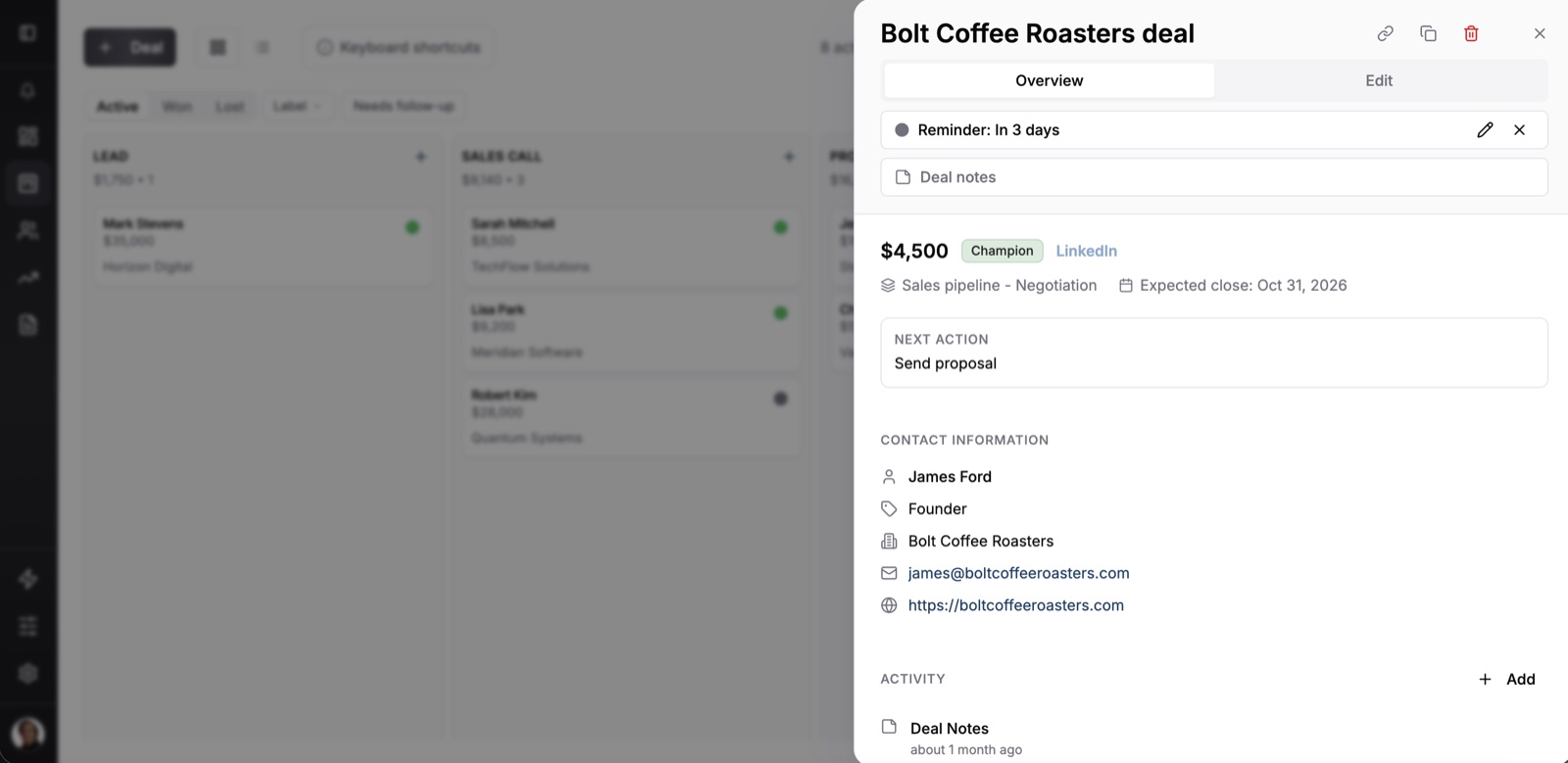
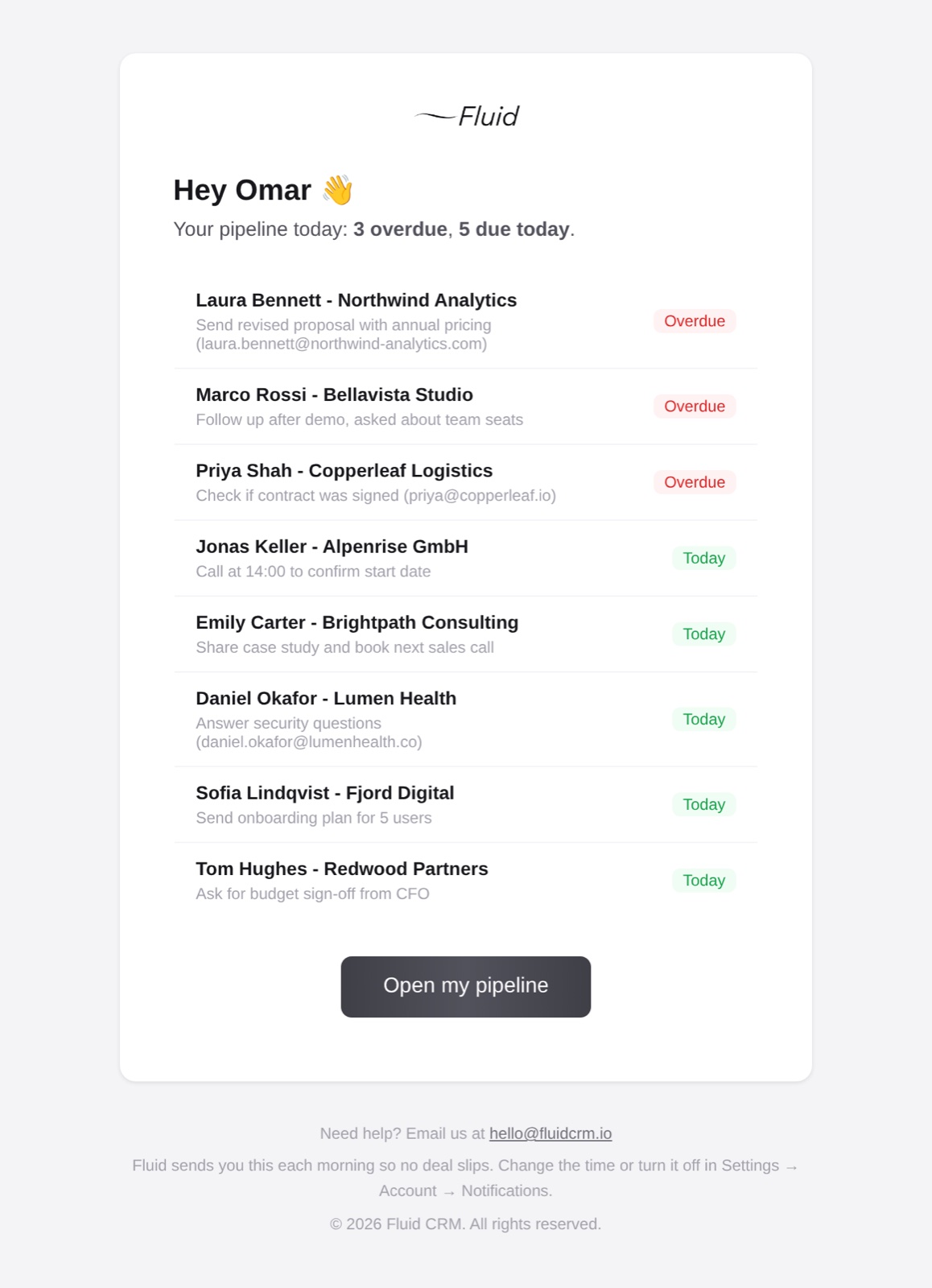
To log your emails on the deal, BCC your Fluid CRM logging address when you write to them. Create the deal first with their email address on the contact, because the email is matched to its contact by exact address. On the morning the reminder is due, Fluid CRM’s digest email lists it with anything overdue, so you see it even if you never opened the app.
“Not now” replies get the same treatment. Keep them open in a stage called Not now, with the reminder set to the date they named. James, a small business owner who works with one outside salesperson, describes the same idea for ongoing contacts:
“a work-around is to set up deals for contacts that include an on-going relationship step”
When a reply turns into a booked call, our discovery call structure covers the next 30 minutes.
Fluid CRM finds no prospects and sends no sequences, so your list source and sending tool stay where they are. It starts at the moment someone answers.
Sales Prospecting FAQ
Start with 15 new names a week, handled by one person. That number is our suggestion for a team with other work to do, not an industry standard. Raise it once Thursday’s follow-ups have finished on time for a month.
No. Keep cold names in a spreadsheet or sending tool and create a deal when someone replies with interest. Your pipeline then shows only people who have actually answered, which makes it easier to read every day.
Stop after five touches with no answer, then wait at least 90 days before trying again with a new reason. Stop the same day if someone says no. If they ask not to be contacted again, remove them for good.
Lead generation brings in people who may be interested, usually through marketing such as content, ads or forms. Prospecting is sales choosing specific people and contacting them directly. Most small teams need both, and prospecting is the one you can start this week with no budget.
Book Four Hours for Prospecting This Week
Name the person who owns prospecting, put the blocks in their calendar and check 15 names against the list on Monday. Run it for a full quarter before you judge the channels.
When the first interested reply lands, log it in Fluid CRM, the sales team CRM we built for small teams. It costs $16 per seat per month or $144 per seat per year, with every feature in the one plan.
Start your 7-day free trial here, no credit card required.