

You picked Trello because it’s simple, and now every “Trello alternative” list wants to sell you something heavier. Even Atlassian is steering Trello toward personal to-do lists. If your boards hold a sales pipeline, this post gives you 7 tools that keep the kanban feel and add the CRM layer Trello never had.
The best Trello CRM alternative is Fluid CRM at $16/seat/month, keeping the drag-and-drop board while adding contacts, reminders and email sync. Pipedrive and Capsule work for structured pipelines. Stay on Trello with Crmble if you only need a light layer on top.
Are You Replacing Trello for Projects or Trello as a CRM?
People searching for Trello alternatives are asking 2 different questions, and the ranking lists answer both badly by mixing them together. The first group runs project delivery on Trello boards and wants a better project tool. The second group runs a sales pipeline on Trello cards and wants a real CRM.
If you’re in the first group, this isn’t your post. Stay on Trello or look at ClickUp, and don’t let anyone sell you a CRM to fix a delivery problem. One thing before you settle in though. Atlassian has repositioned Trello as a personal task manager, and Trello’s head of product told Computerworld the company is “redirecting the focus on an individual task management” while Atlassian points teams toward Jira for project work. The tool you’re standing on is being aimed at individuals, not teams.
If you’re in the second group, the sales group, the rest of this post is yours. In 3 years running outbound at Fenixtal I booked 1,250+ sales calls into client pipelines, and the teams tracking sales in project tools lost deals the exact same way the Google Sheets crowd did. Follow-ups had no owner and no reminder, so nobody chased the warm reply from 2 weeks ago. A board holds cards fine. It just never tells you which deal you forgot.
That points at the real problem with most Trello alternative advice. It pushes you toward more software. You left complexity on purpose when you picked Trello. If your problem is a sales pipeline, the answer is a smaller tool built for that one job, not a bigger platform with a pipeline buried in it somewhere.
The 7 Best Trello CRM Alternatives for Sales Pipelines
Every tool below keeps the kanban board as the main view. Billing terms are named on each entry. Each entry gets an honest line on where it falls short, including our own tool.
1. Fluid CRM (keeps the board, adds the CRM underneath)
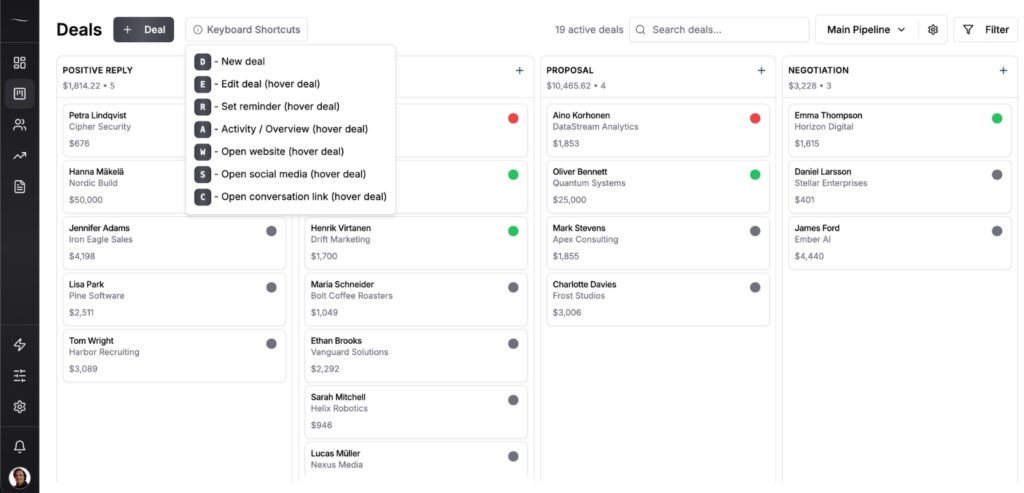
Fluid CRM is the closest thing to Trello for sales without the gaps. You get the same drag-and-drop board feel, and every card is a real deal. Add a deal and the contact is created and linked automatically. Reminders turn green or red so you see this morning’s follow-ups the moment you log in. BCC email sync attaches conversations to deals, the forecast view shows pipeline value and expected revenue, and lead capture forms push new inquiries straight onto the board. For builders there’s a full API with 16 webhooks.
Nathan Shooter runs a speaking and branding business, and when he signed up for Fluid CRM, he described the pipeline he wanted like this: “I want to be able to track someone who’s interested, then moves to a warm lead, then a hot lead, then converts, and then I deliver the presentation at their conference, which then leads to after work.” Read that again. It’s a Trello board described in words. That’s how sales buyers who love Trello actually think, and it’s exactly what a kanban CRM should hold, stage by stage, without you rebuilding it from labels and checklists. Here’s how teams use Fluid CRM as a simple CRM.
Where it falls short: Fluid CRM is built for sales pipelines only. If your boards run project delivery, it won’t replace Trello for that job, and there’s no native marketing automation.
Pricing: $16/seat/month or $144/seat/year (3 months free with annual), every feature included on both plans. 7-day free trial, no credit card required.
2. Pipedrive (the known name, priced by the feature gate)
Pipedrive is the tool most people find first, and the kanban pipeline view is genuinely good. Deals move stage to stage, rotting deals get flagged and the reporting is deep once you grow into it.
The catch is the plan ladder. Lite at $24/seat/month ($14 annual) has no email sync and no automations, so the plan that looks cheap can’t do the work you’re switching for. Real sales work starts at Growth, $49/seat/month ($39 annual). Budget for that number, not the sticker.
Where it falls short: You pay twice the entry price before the tool does what a sales team needs, and the interface carries more menus than a Trello refugee will enjoy.
Pricing: Lite $24/seat/month ($14 annual). Growth $49/seat/month ($39 annual).
3. Capsule (solid and traditional, gates the good parts)
Capsule is a clean, traditional CRM with a kanban pipeline and a calm interface. Contact management is strong and the learning curve is gentle, which makes it a fair landing spot for board people.
The gate sits at the second tier. Starter at $21/seat/month ($18 annual) covers one pipeline and the basics. Multi-pipeline, workflow automations and reporting dashboards start at Growth, $38/seat/month ($36 annual).
Where it falls short: If you run more than one pipeline or want any automation, the real price is Growth, and at that number you’re paying more than double some full-featured options.
Pricing: Starter $21/seat/month ($18 annual). Growth $38/seat/month ($36 annual).
4. folk (relationship-first, lighter on hard pipeline)
folk looks great and treats contacts as the center of the world, which suits PR, partnerships and influencer work where the relationship matters more than the stage. The board view exists, but the product’s heart is the contact list.
For a sales pipeline the gating hurts. Deals, email sequences and API access are Premium-only at $60/seat/month ($48 annual). Standard at $30/seat/month ($24 annual) is a pretty contact manager without the sales machinery.
Where it falls short: The features a pipeline actually needs live on the $60 plan, and the deal mechanics stay lighter than a dedicated sales CRM even there.
Pricing: Standard $30/seat/month ($24 annual). Premium $60/seat/month ($48 annual).
5. monday CRM (visual, then it becomes a config project)
monday CRM is the most board-like tool on this list at first glance. Everything is colorful, drag-and-drop and customizable. That customization is also the trap, because someone on your team becomes the person who builds and maintains the setup instead of selling.
Then there’s the seat math nobody in the ranking posts mentions. monday sells seats in set sizes of 3, 5, 10, 15 and up, so a 4-person team pays for 5 seats. Our guide to what monday CRM costs has the yearly bill by team size. Add the plan ladder, where the core sales features climb tier by tier, and the advertised per-seat price stops meaning much.
Where it falls short: Bucket seat pricing means small teams pay for people who don’t exist, and the setup work never really ends.
Pricing: Basic $12/seat/month and Standard $17/seat/month billed annually, sold in seat buckets from 3.
6. Attio (powerful, overkill for small teams)
Attio is the power user’s CRM. Flexible data model, fast interface, kanban views on anything and real depth for teams that want to build their CRM like a product. If you have someone technical who enjoys that, it rewards them.
For a small team leaving Trello it’s a lot. Plus runs $36/seat/month ($29 annual), sequences and call features sit on Pro at $86/seat/month ($69 annual), and a credit system for AI features and enrichment stacks on top of the seat price. The setup time is the longest on this list.
Where it falls short: You’re buying flexibility you’ll spend weeks configuring, and the credit system makes the monthly bill harder to predict than a flat seat price.
Pricing: Plus $36/seat/month ($29 annual). Pro $86/seat/month ($69 annual), plus usage credits.
7. Trello + Crmble (the honest duct-tape option)
Crmble is a power-up that bolts CRM fields, contact syncing and basic reporting onto your existing Trello board. If you genuinely only need a light layer and refuse to leave Trello, this is the honest version of staying.
Do the math before you commit. Crmble lists 9.99€/seat/month on its pricing page (yearly billing gives 2 months free), one plan, 10-day free trial with no card. That’s a CRM subscription on top of a to-do tool, and it’s already more than half the price of a full Fluid CRM seat for a duct-taped setup. Their own terms spell out one more detail. Cancel, and your Crmble data is stored for 3 months, then it’s gone for good.
Where it falls short: You’re renting CRM features inside a power-up, your sales data lives on a 3-month timer after cancellation and Trello itself is being pointed away from team use.
Pricing: 9.99€/seat/month, single plan, 10-day free trial. Works on Trello’s free plan.
What Trello Is Missing as a CRM
Trello was never dishonest about this. It’s a board tool, and a CRM needs 4 things a board doesn’t have. There are no contact records, so the person behind a card is a name in a description field. There are no reminders tied to deals, so follow-ups depend on your memory or a due-date hack. There’s no pipeline value, so you can’t see what this month is worth without counting cards by hand. And there’s no email sync, so every conversation lives in your inbox, disconnected from the deal.
Stop for a second and test it on your own board. Can you tell which 3 deals are overdue for a follow-up without opening the cards one by one? If the answer is no, the board isn’t tracking your pipeline. You are, and you’re doing it from memory.
When to Stay on Trello
Not everyone reading this should switch, and the ranking posts never say that out loud. Stay on Trello if all 3 of these are true. You’re solo with under 15 active deals, so the whole pipeline fits in your head anyway. Your sales cycle is 1 or 2 touches, so there’s nothing to forget between contact and close. And you’re not sharing the board with anyone who needs to know deal status without asking you.
Check all 3 boxes and Trello plus discipline beats a CRM you won’t maintain. Break even one and the board starts leaking. The leak never announces itself either. It just shows up as a prospect replying “did you forget about us?” 3 weeks after you meant to follow up.
How to Migrate From Trello to a Kanban CRM
The move is smaller than it sounds because your board already did the hard part. Your lists are your pipeline stages, so a Trello board with Interested, Warm, Proposal and Won columns maps straight onto a CRM pipeline.
The order matters more than the tools. First, archive the dead cards so you only move deals you’re actually working, which for most solo operators is 20 to 40 cards. Second, rebuild your Trello lists as pipeline stages in the CRM, keeping the same names so nothing feels foreign on day one. Third, bring the cards over and let the CRM create and link the contacts as you go. In Fluid CRM the import takes about 5 minutes with the import guide.
Then the step that pays for the whole move. Set a follow-up reminder on every deal you brought in before you do anything else. The reminders are the entire reason you’re switching, so make them work for you from the first morning.
Frequently Asked Questions
No. Trello is a kanban board tool, and Atlassian has repositioned it as a personal task manager. You can mimic a pipeline with lists and labels, but there are no contact records, deal values, reminders or email sync. It holds cards, not customer relationships.
Fluid CRM is the best kanban CRM for small B2B teams at $16/seat/month with every feature included. Pipedrive and Capsule are solid kanban-first options if you don’t mind their plan ladders. All three keep the drag-and-drop board as the main view.
Yes, several. Fluid CRM, Pipedrive, Capsule and monday CRM all use a drag-and-drop kanban pipeline as the core view. The difference from Trello is what sits under the cards: contacts, reminders, deal values and email history instead of a description field.
Crmble lists 9.99€ per seat per month on its single plan, with 2 months free on yearly billing and a 10-day free trial. It works on Trello’s free plan. After you cancel, your Crmble data is stored for 3 months and then deleted.
The Bottom Line
You left complexity on purpose when you picked Trello. Don’t buy it back because a listicle told you to upgrade to a project platform. If your boards hold deals, get a tool built for deals that respects why you loved the board in the first place. Fluid CRM gives you the same drag-and-drop feel with a real CRM underneath: auto-linked contacts, reminders that chase the follow-ups for you and a pipeline value you can trust.
Start your 7-day free trial here, no credit card required.