

Two products end up on the same shortlist and one of them starts at zero while the other starts at $2,000 per seat per year. That is not a pricing disagreement. It is a sign the two companies think they are selling different things, and both of them are right.
Affinity maps who at your firm already knows whom, from $2,000 per seat per year. Attio is a CRM database you build yourself, from $35 per seat per month billed annually. Fluid CRM suits small B2B teams who need deals moving this week, not a platform to build.
What Affinity And Attio Actually Are
Affinity reads your team’s email and calendar and builds a map of who knows whom. Every contact gets a relationship score and every company shows you the shortest warm path in. The pipeline sits on top of that map rather than next to it.
You are buying the map. The deal tracking comes along with it.
Attio starts from the other end. You get objects, records and connections between them, and you decide what a deal is, what a company record holds and how the two relate. Enrichment fills the gaps once you have said what the gaps are.
So this is not really a feature-by-feature fight. One product arrives already knowing something about your network, and the other arrives knowing nothing and waiting for instructions.
That difference explains the price gap better than any table does. Affinity has to sit inside every inbox at your firm and process years of history before it is worth anything, and that work happens whether you have three seats or thirty.
Which of those two were you actually shopping for? Most people who type both names into Google want a place to track deals, and only one of these two is primarily that.
What Affinity And Attio Each Charge You For
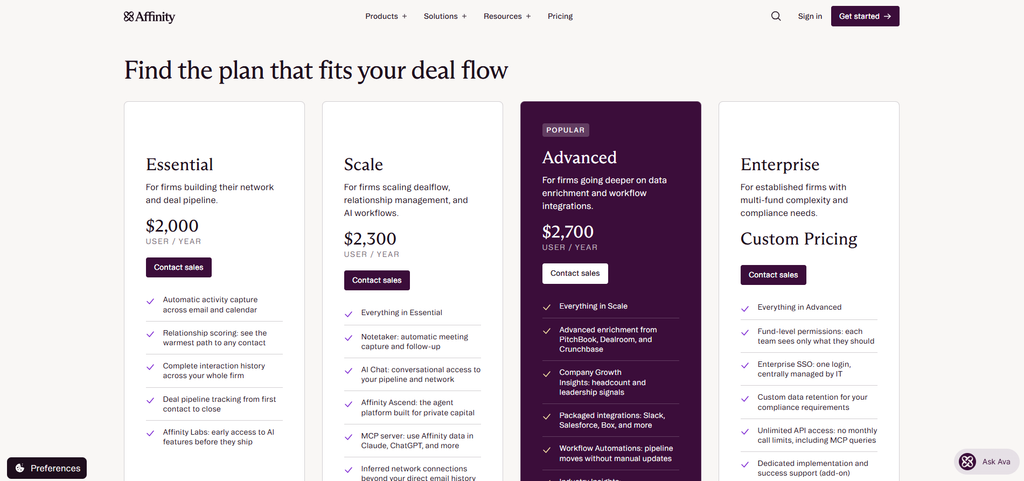
Affinity publishes its pricing on affinity.co/pricing now. Write-ups older than that describe it as quote-only, which is where the “thousands per seat, ask sales” reputation comes from.
Affinity pricing
| Plan | Price | Billing |
|---|---|---|
| Essential | $2,000/user/year | Annual |
| Scale | $2,300/user/year | Annual |
| Advanced | $2,700/user/year | Annual |
| Enterprise | Custom | Annual |
Essential covers activity capture, relationship scoring, interaction history and pipeline tracking. Scale adds the AI layer, including an MCP server.
Advanced brings in third-party data from PitchBook, Dealroom and Crunchbase plus workflow automations. Enterprise adds fund-level permissions and unlimited API calls, against the 100,000 a month that Scale and Advanced get.
Attio pricing
| Plan | Billed annually | Billed monthly |
|---|---|---|
| Free | $0, up to 3 seats | $0, up to 3 seats |
| Plus | $35/seat/month | $44/seat/month |
| Pro | $79/seat/month | $99/seat/month |
| Enterprise | Custom | Custom |
The meters are where the two models separate
Affinity meters almost nothing. You buy seats, and the graph is the graph.
Attio meters plenty on top of the seat price. Credits run 100 per user per month on Free, 500 on Plus and 1,000 on Pro, with a separate workspace pool of 250, 1,500 and 10,000.
Reports cap at three, then fifteen, then a hundred. Email sending caps at 200 a month on Free and 1,000 on Plus before Pro removes the limit.
The Plus plan also stops at ten seats. Hire an eleventh person and the $79 tier is chosen for you, which more than doubles the bill in a single month.
I worked through the credit maths behind Attio’s seat price separately.
Three seats for a year
| Setup | Annual cost, 3 seats |
|---|---|
| Attio Free | $0, inside the caps above |
| Fluid CRM annual | $432 |
| Attio Plus | $1,260 |
| Attio Pro | $2,844 |
| Affinity Essential | $6,000 |
| Affinity Advanced | $8,100 |
Fluid CRM charges $16/seat/month or $144/seat/year for one plan with every feature in it.
Put that table next to what a lost deal costs you and it changes shape. A fund that closes one more investment because it found the warm intro has paid for Affinity several times over, and an agency that lost two proposals to silence spent more than three years of Fluid CRM without noticing.
Where Affinity Wins
Nothing else in this price bracket finds you a warm introduction. Affinity looks across every inbox at the firm, works out that your partner has emailed the target’s CFO nineteen times since 2023, and tells you before you send a cold note to someone your colleague knows well.
That is the product. Relationship scoring, intro paths and automatic capture of every interaction without anyone logging anything.
If your deals come from your network rather than from outbound, that is not a nice extra, it is the reason the software exists. Venture funds, private equity firms and investment banks buy Affinity because the alternative is a partner’s memory, and a partner’s memory does not survive them leaving.
The auto-capture matters more than it sounds. Nobody at a busy firm logs interactions by hand, so a graph that builds itself is the only version of this that stays true.
Affinity has no free plan and no self-serve trial, so evaluating it means booking a call. That is a fair signal of who it is built for.
Where Attio Wins
Attio does the ordinary CRM job well at about a fifth of Affinity’s entry price, and you can start this afternoon without talking to anyone. The free tier runs up to three seats with no time limit, so a small team can test it properly on real deals.
Custom objects are the real draw. If you track something that is not a deal, like a portfolio company, a candidate or a property, Attio lets you model it properly instead of bending a contact record into the wrong shape.
The API and integration story is modern and clean, which matters if the CRM has to sit in the middle of other tools. Views and filters go deep enough that most teams stop asking for reports and just build the view they wanted.
The catch is that all of that flexibility is a project, and somebody on your team owns it. Not for a week, but for as long as you use the thing.
Affinity Or Attio For A Small B2B Team
Affinity and Attio both assume the CRM is somebody’s job. Affinity assumes a firm with an operations person who reviews the graph, and Attio assumes someone who enjoys deciding what every field is and what connects to what.
A three-person agency has neither. The work still happens, it just happens badly at 9pm on a Thursday when someone remembers a proposal went quiet.
Here is my contrarian read. Affinity is not overpriced, and if you are price-comparing these two, you have probably misread one of them.
A relationship map built from your firm’s whole email history is a different product from a database with pipeline views on it. Comparing them by seat price is like choosing between a lawyer and a legal template by the hour.
At Fenixtal I watched agencies buy tools to fix relationships that were not actually broken. The contacts were fine. Leads died because the CRM sat closed for a week, and no relationship graph reaches a deal that nobody looked at.
Doland White runs an executive coaching business and tracks prospects, clients and podcast guests in one pipeline. Before Fluid CRM he had them spread across Google Contacts, LinkedIn, spreadsheets and marketing platforms, which is the same scatter problem both products on this page are sold to solve.
“The CRM serves me, not the other way around.”
Doland White, founder of DWC
That is the test I would apply to all three products here. Affinity’s model has the fund serving the graph, feeding it inboxes and reviewing what it surfaces, and that trade is worth making when intros are how you source deals.
Fluid CRM takes the other side. One plan at $16/seat/month or $144/seat/year, every feature included, and a setup that takes about five minutes because there is nothing to design.
Be honest about the fit. A fund that lives on warm intros should buy Affinity and stop reading comparison posts, and a sales team with someone who likes building systems will be happy in Attio.
Frequently Asked Questions
Yes, that is the published Essential price on affinity.co, charged per user per year. Scale is $2,300 and Advanced is $2,700, and Enterprise is quoted individually.
Attio enriches records and captures email activity, but it does not build the cross-team map or the intro paths that Affinity is built around. If warm-path discovery is the thing you are buying, the two are not substitutes.
Technically yes, and the question is whether three inboxes make a map worth $2,000 a seat. Affinity earns its price by covering a whole firm’s history, so a small team pays platform money for a thin map unless intros are its main deal source.
Attio has a free plan for up to three seats with no time limit. Affinity publishes no free plan and no self-serve trial, so evaluating it starts with a sales conversation.
If your deals come from a network you need mapped, Affinity. If you have someone who will own the build, Attio. If you want deals moving by Friday, a simple pipeline like Fluid CRM does that job for $432 a year across the three of you.
Affinity Or Attio: Which To Actually Buy
Pick by the job, not by the price tag. Affinity is for firms whose next deal is hiding in a colleague’s inbox, Attio is for teams who want to shape their own system and have time to do it, and neither is aimed at three people who mostly need to see which proposals went quiet.
We built Fluid CRM for that third group after watching them get sold the first two. If you want more on how the build-it-yourself approach compares, I wrote about it in Fluid CRM vs Attio.
Start your 7-day free trial here, no credit card required.