

Close is very good at one thing, which is putting a phone inside your CRM. The trouble starts when most of your meetings come from email replies and LinkedIn messages, and you still pay for the plan built around a dialer. That is when leaving makes sense, and the right replacement depends on how your team really books meetings.
The best Close CRM alternative depends on where your meetings come from. If they start as email or LinkedIn replies, pick Fluid CRM at $16/seat/month or Pipedrive. If you call daily, pick Freshsales, Salesmate or Apollo, HubSpot for marketing too, and stay on Close if your reps spend most of the day in its dialer.
| Tool | Best for | Starts at, per seat a month | Built-in calling |
|---|---|---|---|
| Fluid CRM | Teams that book meetings from email and LinkedIn replies | $16/seat/month or $144/seat/year | No |
| Pipedrive | A structured pipeline where every deal has a next step | $14 billed annually, $24 billed monthly | No, through marketplace apps |
| Freshsales | The cheapest plan with a phone in it | $9 billed annually | Yes, from the first plan |
| Salesmate | A power dialer for less than Close Growth | $23 billed annually, $29 billed monthly | Yes, as an add-on |
| Apollo | Lead data, sequences and a dialer in one tool | Free plan, then $49 billed annually | Yes, US dialer from Basic |
| HubSpot | Sales and marketing on one database | $20 billed monthly on Starter | Yes, on paid plans |
Why Small Teams Leave Close CRM
Small teams rarely leave Close because it does its job badly. They leave because the plans are built around calling, and a team that mostly emails ends up paying for the phone side.
- The features outbound teams buy it for start on Growth. The power dialer, workflows (Close’s automated sequences of emails, texts and call tasks) and bulk email all start on Growth, at $99 a seat billed annually or $109 monthly. Essentials at $35 has calling, but every call is dialed by hand.
- Usage is billed on top of the seat. Most outbound calls cost around $0.02 a minute, phone numbers start at about $1 a month and SMS is billed at cost. Call Assistant adds $50 a month per organization plus $0.02 a minute.
- It is built phone-first. If your reps rarely call, you are paying for the part of Close they open least.
- Marketing lives somewhere else. Close is built for selling, so a marketing team running newsletters and campaigns works in a separate tool.
Our breakdown of Close CRM pricing prices a calling team on Growth with minutes included. This post starts one step earlier, with the question that decides the whole list.
Pull up the last 20 meetings on your team’s calendar and write the source next to each one. Was it a dial, a cold email reply or a LinkedIn conversation?
| Where your meetings start | What the CRM has to do | Look at |
|---|---|---|
| Replies to cold email | Turn every interested reply into a deal with a next step | Fluid CRM |
| LinkedIn messages | Track people and conversations that never touch your inbox | Fluid CRM, Pipedrive |
| Calling down lists | Dial fast and log every call on its own | Close, Salesmate, Freshsales |
| Calls plus sequences plus fresh leads | Find the lead, email it and call it from one place | Apollo |
| Inbound marketing plus sales | Share one database with a marketing team | HubSpot |
If you are choosing a CRM for a team of 3 to 10 and want to see what that team needs from day one, our page on a sales team CRM lays it out.
When You Should Stay on Close
Switching takes setup time and some history stays behind, so check this list first. If two of these describe your team, Close is probably the right tool and the plan is the thing to look at.
Your reps dial for hours every day
The power dialer calls down a list with no clicking between calls. For a rep who spends two or three hours a day on the phone, Growth at $99 a seat is a fair price for that time, and none of the email-first tools below can do it.
You text prospects as much as you email them
Calling and SMS live inside the lead record in Close, so a text, a call and an email show in one timeline. Salesmate is the closest match below, with calling and texting sold as an add-on.
Your managers listen in on live calls
Scale, at $139 a seat billed annually, adds the predictive dialer, live call coaching and call recordings that are kept with no time limit. That is a manager’s toolkit, built for a sales floor with someone coaching it.
Close CRM Alternatives for Teams That Book Meetings by Email
Fluid CRM and Pipedrive do less than Close on purpose. Neither has a phone built in, and both are built around a pipeline where every deal shows what happens next.
1. Fluid CRM, best for teams whose meetings start as email or LinkedIn replies
Fluid CRM is a visual sales pipeline for small B2B teams. An interested reply becomes a deal in a stage like “Positive reply”, you set one reminder on it and the deal shows up in your daily digest email when the reminder is due. The digest is why a reply still gets an answer on the days nobody opens the app.
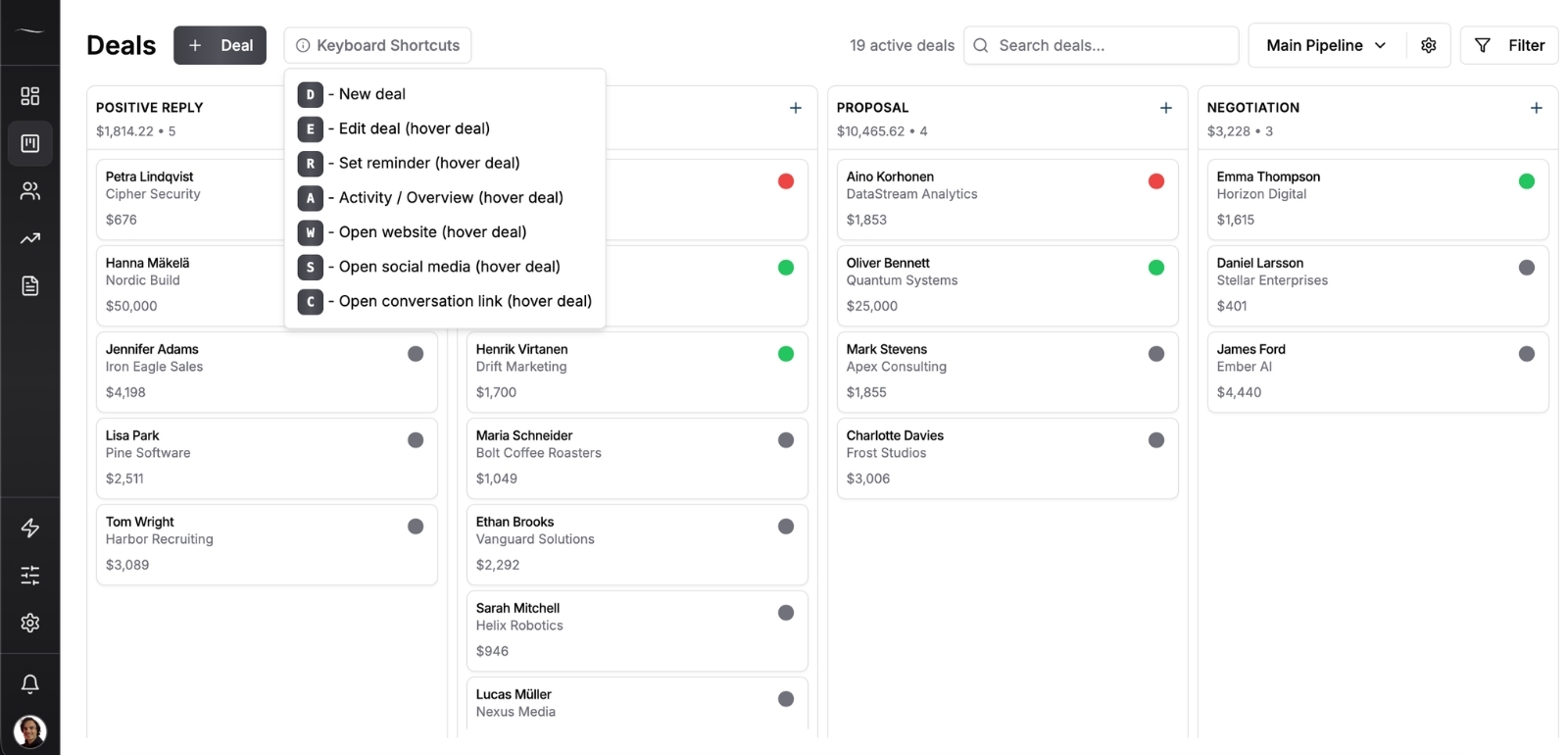
Nothing is metered, so no call minutes, numbers or texts are billed on top of the seat. There is one plan at $16/seat/month or $144/seat/year, with lead capture forms, 8 in-app automations, the API, webhooks and an MCP connector for Claude and ChatGPT all in it. Replies can come in from your sending tool through the API, and Claude can read and update deals for you.
Viktor Otterskog sells B2B by outreach and looked at HubSpot and Airtable before he picked Fluid CRM. Early on he wrote this.
“I’ve been using it for outreach for a few days… I really think this is going to work for me.”
Austin Verner of Cold Emailers moved his agency’s pipeline over from a spreadsheet, and his review explains why.
“We were using Google Sheets previously but managing pipeline was getting too difficult.”
- Best for: teams of 1 to 10 whose booked meetings start as replies, not dials
- Not for: teams that spend most of the day on the phone
- Cost for 5 seats: $80 a month billed monthly, or $720 a year
Coming from Close, you give up two things. There is no phone of any kind in Fluid CRM, and your inbox does not sync both ways, because emails reach the deal when you BCC a logging address. The side-by-side comparison is in Fluid CRM vs Close.
2. Pipedrive, best for a structured pipeline where every deal has a next step
Pipedrive is built around activity-based selling. Every deal on the board should have a next activity, and the app makes it obvious when one does not.
A Close Essentials user moving here gives up calling and gains a stricter pipeline. Pipedrive has four plans, plus add-ons like LeadBooster and Smart Docs that are charged per company rather than per seat.
Lite is $14 a seat billed annually or $24 monthly, and Growth is $39 or $49. Full email sync starts on Growth, so that is the plan to compare against Close Essentials.
Pipedrive has no built-in calling. Calls go through phone apps from its marketplace, which works fine for a team that calls a few prospects a day and badly for one that dials for hours.
Pick it if your process has clear stages and you want the tool to keep everyone to them. There is a longer list in Pipedrive alternatives if Pipedrive is already on your shortlist.
Close CRM Alternatives for Teams That Call or Need Marketing
Freshsales, Salesmate, Apollo and HubSpot keep a phone in the CRM or add marketing on top. Each one charges for calling in a different way, which matters more than the seat price.
3. Freshsales, best for the cheapest plan with a phone built in
Freshsales puts chat, email and phone on its first paid plan, which is unusual at its price. Growth is $9 a seat billed annually and includes the kanban pipeline, email templates and basic workflows.
Sales sequences and contact scoring are on Pro at $39 a seat billed annually, and Enterprise is $59. A Close Growth user who wants calling plus sequences should compare against Pro, not Growth.
Pick it if you want a phone in the CRM for the lowest seat price. There is a 21-day free trial.
4. Salesmate, best for a power dialer below Close Growth’s price
Salesmate is a sales CRM with calling, texting and automation, priced in three published plans. Basic is $23 a seat billed annually or $29 monthly, Pro is $39 or $49 and Business is $63 or $79.
Sequences start on Pro. The power dialer and voicemail drop are on Business, while calling and texting are sold as an add-on with phone numbers from $1.1 a month.
At $63 a seat billed annually, Business is the closest match to what a team uses Close Growth for. Salesmate offers a 15-day free trial.
5. Apollo, best when you also need the lead data
Apollo is built the other way round. It is a prospect database first, with email sequences, a deal pipeline and a dialer added around it.
There is a free plan, then Basic at $49 a seat billed annually or $65 monthly and Professional at $79 or $99. Organization is $119 a seat, billed annually only, with a 3-seat minimum.
A US dialer comes with Basic and up, with credits applied to calls, and the power and parallel dialers are an Advanced Dialer add-on at $119 per team a month billed annually.
Pick it if your team spends as much time finding leads as calling them. The pipeline side is lighter than Close’s, so treat Apollo as a prospecting tool with a CRM attached.
6. HubSpot, best when sales and marketing share one database
HubSpot is a platform, with sales, marketing and service tools on one set of contacts. Its free tools cover up to 2 users, and Sales Hub Starter is $20 a seat billed monthly.
Sales Hub Professional is $90 a seat billed annually or $100 monthly, plus a required one-time onboarding fee of $1,500. Calling minutes and sequences come with every paid plan, and Professional is where fully customizable workflows start.
Pick it if a marketing team needs the same data your salespeople use. For a 3-person outbound team it is more setup than the job needs.
Close alternatives we left off, and why
- Salesforce fits teams that need custom builds and have someone to own them.
- Zoho CRM covers a lot of ground, and setting it up takes real time.
- Attio suits teams that want to design their own data model.
- Salesflare fills the CRM from your inbox, which helps email-heavy teams but does not replace a dialer.
What 5 Reps Pay for the Plan They Would Actually Use
Entry prices make every tool look cheap. The table below prices 5 seats on the plan that has the feature a Close user is likely to want, billed annually unless noted. It covers seats only, so call minutes and texts come on top wherever a tool dials.
| Tool and plan | Why this plan | 5 seats a month |
|---|---|---|
| Close Growth | Power dialer and workflows | $495 |
| Fluid CRM | One plan with every feature | $60 ($720 a year), or $80 billed monthly |
| Pipedrive Growth | Full email sync | $195 |
| Freshsales Pro | Phone plus sales sequences | $195 |
| Salesmate Business | Power dialer and sequences | $315 |
| Apollo Basic plus Advanced Dialer | Data, sequences and a power dialer | $364 |
| HubSpot Sales Professional | Customizable workflows and calling | $450, plus $1,500 once |
The cheapest row is not the answer for a team that dials all day. For those reps the dialer is the job, so a calling team should compare Close against Salesmate and Freshsales, not against tools with no phone.
For a team that books by email, the cost comparison flips. My outbound agency Fenixtal booked more than 1,250 sales calls from cold email and LinkedIn replies, and not one of them needed a dialer to get on the calendar.
What each client did need was a place where an interested reply became a deal with an owner and a date the same day. If you book meetings for clients rather than for yourself, the best CRM for outbound agencies list is sorted for that job.
Close CRM Alternatives FAQ
It depends on how your team books meetings. Teams whose meetings start as email or LinkedIn replies do well on a pipeline tool like Fluid CRM or Pipedrive. Teams that call all day should look at Salesmate or Freshsales, and teams that also run marketing should look at HubSpot.
Salesmate puts a power dialer and voicemail drop on its Business plan at $63 a seat billed annually, against $99 for Close Growth. Freshsales includes phone calling from its $9 Growth plan, though sequences need Pro at $39. Apollo sells its power dialer as a team add-on.
Fluid CRM and Pipedrive both work without a built-in phone. Fluid CRM turns replies into deals with a reminder and a daily digest email, and Pipedrive keeps a next activity on every deal. Both suit teams that book meetings by email and LinkedIn.
Small teams usually switch because the power dialer and workflows start on Growth and their reps rarely call. Others need marketing tools in the same place or want lead data built in. Teams that dial for hours a day often find nothing that replaces Close well.
Yes. Close exports leads, contacts and opportunities as CSV files, or as JSON when you need the activity history, and every tool on this list imports CSV. Workflows do not travel in an export, so rebuild your sequences in the new tool before you cancel.
How to Pick the Right Close CRM Alternative
Count where your last 20 meetings started, then pick from that row. If most came from the phone, stay on Close or compare it with Salesmate and Freshsales. If most came from email and LinkedIn replies, a simpler sales team CRM like Fluid CRM gives you the pipeline, the reminders and the daily digest without paying for a dialer.
Start your 7-day free trial here, no credit card required.