
You run a small B2B team in Europe. A client asks where your CRM keeps their data and you realize you have no clear answer. Search for a fix and you land on enterprise suites or open-source projects that need a developer. This post gives you the simpler answer and a way to check any vendor’s claim.
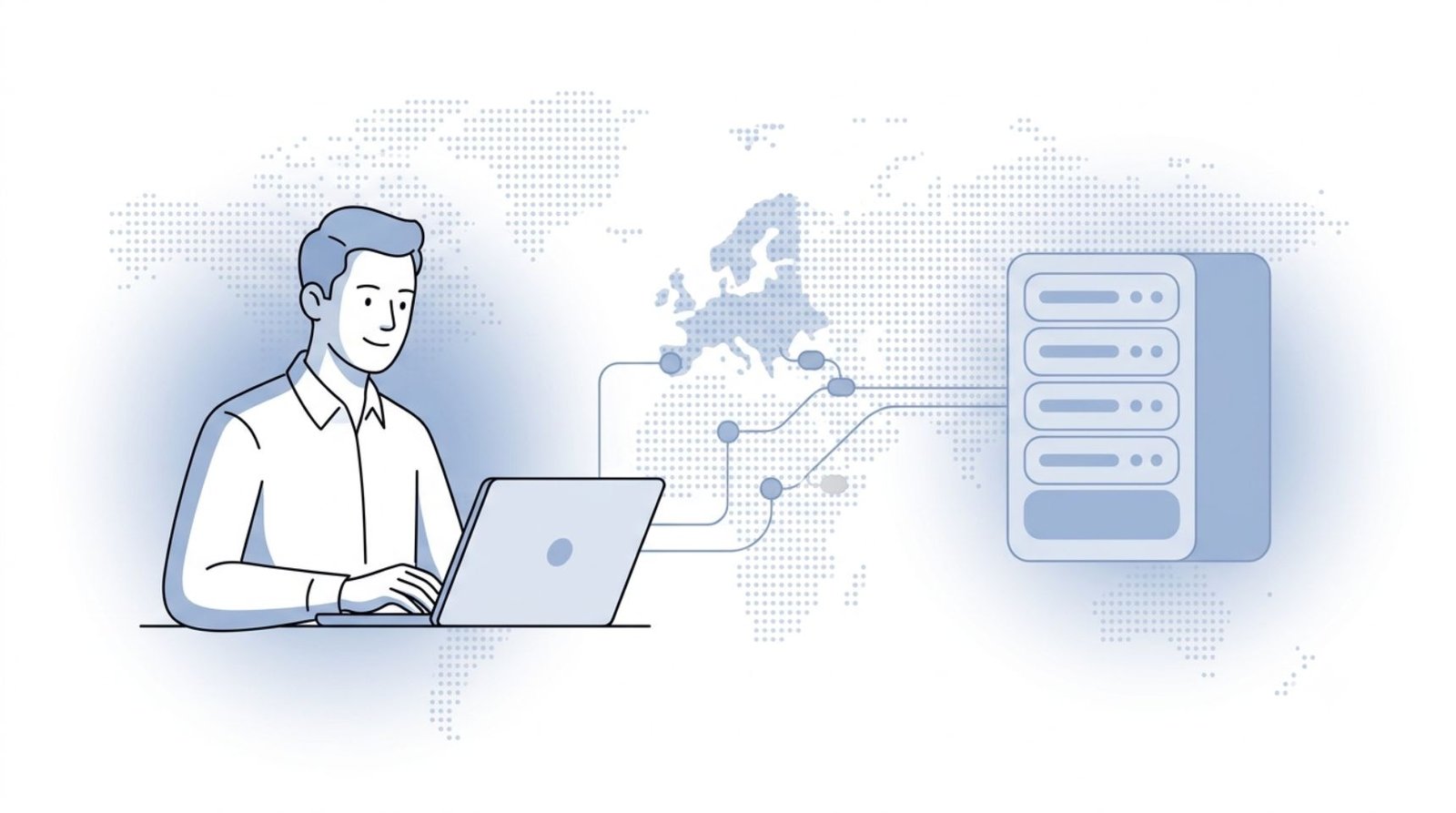
EU data hosting means a CRM stores your core workspace data on servers inside the European Union. Fluid CRM hosts your CRM data in the EU on AWS in Stockholm, backed by a data processing addendum you can read at fluidcrm.io/dpa.
What EU Data Hosting Actually Means for a CRM
EU data hosting sounds like a simple promise. Your data sits on servers inside the European Union. The reality has more layers, and the blogs that sell you a “European CRM” tend to skip them.
Two things live under that one phrase. First, your core workspace data: your deals, contacts, notes and the personal data of the people you sell to. That is what “EU hosted” should mean, and it is the part you most need inside the EU. Second, the sub-processors a CRM uses to actually run, like the service that sends your transactional emails, the payment processor that bills your card and the error-logging tool that keeps the app from breaking. Some of those run globally.
So when a vendor says “EU hosting,” the honest version is usually this. The core data sits in the EU, and a handful of supporting services may process small slices of data outside it under Standard Contractual Clauses (SCCs), the legal mechanism the EU approved for those transfers.
Even the CRMs that market themselves hardest on being European carry this nuance. The ones with core servers inside the EU still lean on global services for things like document storage, email delivery or analytics. That is not a flaw in any single tool. It is how almost every modern SaaS product is built. The front door is European and a few rooms in the back are not.
None of this makes EU hosting meaningless. It makes the claim worth reading closely. “Our core data is in the EU” is a real, checkable statement. “Your data never leaves the EU” almost never survives contact with a sub-processor list.
Why CRM Data Hosting Location Matters for GDPR
CRM data hosting matters more than hosting for most other tools you use, because of what a CRM holds. Your project management board stores tasks. Your CRM stores people. Names, emails, phone numbers, job titles and notes about prospects and customers who never signed up for your software. Under GDPR that is personal data, and you are the one responsible for it.
When your CRM sits on US servers, that personal data crosses a border. GDPR allows the transfer, but it adds conditions: a lawful basis, the right contracts and a transfer mechanism like SCCs. Keep the data in the EU and that whole category of questions gets smaller. You are not removing your GDPR duties. You are removing one of the harder ones to explain to a worried client or a regulator.
This question comes up more than founders expect. Across 50+ B2B clients I ran outbound for at Fenixtal, mostly in European markets, the same thing kept happening. A founder would get a procurement form or a nervous email from a customer asking where the data physically lived. For most of the simple, cheap CRMs they used, the honest answer was “a US data center.” That answer is not illegal. It is just harder to defend, and it spooks European buyers who would rather see EU hosting on the page.
One thing to be clear about. EU hosting is one piece of GDPR, not the whole thing. You still need your own lawful basis for processing, your own privacy notice and your own DPA with each vendor. A CRM hosting your data in Stockholm does not hand you compliance. It removes the international-transfer headache and gives you a cleaner story to tell.
How to Verify a CRM’s EU Data Hosting Claim
Any CRM can put “EU hosting” on a landing page. Three checks tell you whether the claim holds up, and none of them takes more than ten minutes. Run these before you trust any vendor with your contacts, not just the ones in this post.
Check where the core data is hosted
Find the exact location, not the marketing word. “European servers” is a start. “AWS eu-north-1 in Stockholm” or “a data center in Frankfurt” is an answer. The vendor should name the cloud provider and the region. If the only place “EU” appears is the homepage headline and never the legal pages, treat the claim as unconfirmed until you see it written down somewhere binding. It’s also worth it to read the privacy policy page.
Read the sub-processor list
Every real SaaS vendor publishes a list of the third parties that touch your data: email senders, payment processors, hosting and analytics. Read it. You are looking for which ones operate outside the EU and whether SCCs cover them. A vendor that hides this list, or does not have one, is telling you something. A vendor that publishes it, even with a few non-EU names on it, is being straight with you. The honest list beats the clean-looking page every time.
Look for a Data Processing Addendum (DPA)
A DPA is the contract that makes the vendor your data processor in writing. It spells out what they do with the data, who their sub-processors are and what happens if there is a breach. Under GDPR you need one with every tool that processes personal data on your behalf. If a CRM doesn’t show you a DPA, the EU hosting claim does not matter, because you have no contract holding them to it. You can read Fluid CRM’s DPA here.
Where Fluid CRM Hosts Your Data
Fluid CRM runs those same three checks on itself, so here are the answers in plain terms.
Your core workspace data, the deals, contacts and notes, is hosted in the EU on AWS in Stockholm, through Supabase as the database layer. That is the eu-north-1 region, physically inside the European Union. Sub-processing stays within the EU for the core service, and the supporting services that operate more widely are covered the standard way, under SCCs. You can read who touches the data and sign the agreement at fluidcrm.io/dpa, which also sets a 72-hour window for breach notification.
To be precise, and not to oversell it: this does not mean your data never leaves the EU under any condition. It means your CRM data is hosted in the EU, the DPA proves it in writing and the sub-processor nuance is documented rather than hidden. That is the honest version, and it is the one a careful European buyer actually wants.
Jaakko Sahimaa, a Finnish business psychologist, came to Fluid for the same reason a lot of European operators do. He wanted something simple and based close to home, not an enterprise suite with a setup project attached. In his words: “What I especially like is the simplicity and clarity of the system, it gives me what I need without feeling complicated or overwhelming.”
On price, Fluid CRM keeps it as plain as the hosting story. It is $16/seat/month, or $144/seat/year if you pay annually, which works out to three months free. Every feature is included on both plans, so there are no upgrade traps and nothing important hidden behind a higher tier. You can try it on a 7-day free trial, no credit card required.
When You Need a Self-Hosted or Enterprise European CRM Instead
Fluid CRM is not the right EU-hosted CRM for everyone. If your situation is bigger or stricter than a small B2B team, here are the honest alternatives and when to pick them.
If you need to host the data on your own servers, in a country you choose, look at open-source. EspoCRM and Odoo both let you run the CRM on your own infrastructure, which keeps the data wherever you put it. The trade is real work: a server to maintain, updates to apply and backups to test. That is a project with an owner and a budget, not a signup. Worth it if data control is a hard legal requirement. Overkill if you just want your contacts in the EU.
If you are a mid-market or enterprise team that needs deep configuration, multi-language rollouts and a vendor with regional offices, the European suites fit better. SuperOffice, founded in Oslo, serves B2B teams across the Nordics and the DACH region and hosts in Europe. Efficy, based in Brussels, covers mid-market and enterprise across Benelux, France and the Nordics. Both usually involve an implementation partner and a heavier setup than a small team wants or needs.
The “European CRM” lists miss one thing. Keeping your CRM data in the EU does not require an enterprise suite or a self-host project. Those lists are stacked with mid-market tools built for 50-person sales orgs, so a two-person agency reads them and finds no real answer. If you are a small B2B team that wants EU-hosted data, a signed DPA and a tool you can use the same afternoon, that is exactly the gap Fluid CRM fills.
Frequently Asked Questions
Yes. Fluid CRM hosts your core CRM data in the EU, on AWS in Stockholm, through Supabase. The signed DPA at fluidcrm.io/dpa documents the hosting and the sub-processors. A few supporting services operate more widely under SCCs, which is normal for SaaS, so the accurate phrasing is “core data in the EU,” not “never leaves the EU.”
No, and any vendor who says it does is overselling. EU hosting removes the international-transfer problem, which is one piece of GDPR. You still need your own lawful basis for processing, a privacy notice and a signed DPA with each tool. Hosting location helps your compliance. It does not hand it to you.
An EU-hosted CRM keeps your core data in the EU by default. A US CRM with EU servers stores the data in the EU but is run by a US company, which can bring it under US law such as the CLOUD Act even when the servers sit in Frankfurt. For some buyers that legal reach is the real concern, not the server location. Check both where the data lives and who controls the company.
Yes, if the CRM processes personal data on your behalf, and it does. Under GDPR a DPA is required between you, the controller, and any processor handling your data. Most reputable CRMs publish one you can sign. If a vendor cannot provide a DPA, that is a reason to walk away, EU hosting or not.
Yes. Open-source CRMs like EspoCRM and Odoo let you run the software on your own server in any EU country you choose. You get full control of the data and full responsibility for the server, the updates and the backups. It is the strongest option for data control and the heaviest in maintenance, so it fits teams with technical support, not a solo founder who wants to start this week.
Conclusion
Where your CRM keeps its data is a fair question, and most small B2B teams never get a straight answer to it. You do not need an enterprise European suite or a self-host project to fix that. If you want your CRM data hosted in the EU, a signed DPA you can actually read and a tool simple enough to use the same day, Fluid CRM gives you that.
Start your 7-day free trial here, no credit card required.