

You quote a family on Tuesday. They say they want to think about it, you get busy with a claim call, and three weeks later you find out they bound with someone else. Most CRM lists for insurance agents answer that problem with a policy system, which is the wrong tool for it.
The best CRM for insurance agents depends on what you track. Policies, renewals and commissions belong in an agency management system (AMS) like HawkSoft, with AgencyZoom as a sales layer for P&C agencies. For an independent producer’s quotes and referrals, Fluid CRM tracks the pipeline at $16 per seat per month.
AMS vs CRM for Insurance Agents: What Each One Tracks
An agency management system is the record of the business you have already written. It holds the policy, the carrier, the premium, the commission and the servicing history. HawkSoft, EZLynx, Applied Epic and NowCerts all live in this category, and a P&C agency with a real book can’t work without one.
A sales CRM tracks everything before the bind. That means the lead you bought, the quote you sent, the prospect whose current policy renews in March and the client who promised to send you her brother. None of that is a policy yet, so most AMS tools handle it as an afterthought.
Think of the AMS as the filing cabinet for signed contracts. The CRM is the desk where open quotes sit, and the desk is where the money gets lost, because a quote with no next step on it dies quietly.
That is the part Fluid CRM was built for. If you sell on your own and want the setup explained from scratch, our page on the solopreneur CRM shows what one seat covers.
I generated leads for more than 50 B2B clients at Fenixtal, my outbound agency, and the deals I saw die were rarely lost on price. They died in someone’s inbox after the first quote, because nobody had written down when to call back.
An insurance quote often comes with an X-date attached, which makes the callback easier to plan than most B2B follow-ups.
Which CRM Fits Captive, P&C and Life and Health Agents?
Three very different jobs sit behind the title “insurance agent”. The right first purchase changes with each one, so sort yourself before you compare prices.
The captive agent
You sell one carrier’s products and that carrier usually hands you its own agency system. Start there. Read your agency agreement before you add an outside tool that stores client data, because some carriers limit what you can keep elsewhere.
A separate pipeline can still help with prospecting that the carrier system handles badly. Keep it to leads and open quotes, and keep policy data where the carrier wants it.
The independent P&C agency with a book to service
You write home, auto and commercial lines across several carriers, and most of your week goes to servicing, renewals and endorsements. An AMS is your first purchase. Carrier downloads and rating integrations save more hours than any pipeline will.
Once the AMS is in place and you have several producers, a sales layer like AgencyZoom is worth adding on top.
The independent life, health and Medicare producer
You work bought leads, referrals and enrollment seasons. Your income depends on how many quotes turn into applications, and your book is often managed partly by carriers or your upline.
This is the agent a light sales pipeline helps most, and the main reader of this post. Be honest with yourself here. How many quotes did you send last month that never got a yes or a no, and could you name them without opening your email?
The 6 Best CRMs for Insurance Agents Compared
| Tool | What it is | Starting price | Best for |
|---|---|---|---|
| Fluid CRM | Sales pipeline | $16 per seat per month | Independent producers tracking quotes and referrals |
| AgencyZoom | Sales layer on an AMS | $149 per month for up to 7 users | P&C agencies with several producers |
| AgencyBloc AMS+ | AMS with built-in CRM | On request | Life, health and benefits agencies |
| HawkSoft | AMS | On request | Independent P&C agencies servicing a book |
| Less Annoying CRM | General simple CRM | $15 per user per month | Solo agents who want policy notes next to each client |
| HubSpot | General CRM and marketing suite | Free for up to 2 users | Agents who want free email to a client list |
1. Fluid CRM
Fluid CRM is a visual pipeline for people who sell alone or in a team of a few. Each quote is a deal card with its own reminder, so the board shows which quotes are waiting on you today.
Custom date fields hold a prospect’s X-date, lead capture forms turn a web inquiry into a deal and a daily digest email lists what is due each morning.
It also connects to Claude and ChatGPT through an MCP connector. You can ask the assistant which quoted deals have had no activity this week, or tell it to log a call you just made, without opening the app.
Peter Duffy, who works in a small B2B team, put it this way in his review.
“Fluid CRM is a refreshingly simple and well-designed alternative to the overly complicated CRMs on the market.”
- Best for: independent producers who sell off leads, quotes and referrals
- Not for: agencies that need policy servicing and commission tracking in the same tool
- Cost for 5 seats: $80 a month, or $720 a year
Fluid CRM holds no policy or commission records, so a producer with a book to service still needs an AMS beside it. It is not a compliance archive either, so Medicare and carrier records stay in the tools your carriers require.
2. AgencyZoom
AgencyZoom sits on top of your AMS and handles the sales side of a P&C agency. It covers lead tracking, renewal automation, referral tracking and producer goals. The Pro plan adds two-way email and text, click to call and an activity tracker.
Pricing is per agency rather than per seat. Essential is $149 a month, Growth $199 and Pro $349, each with up to 7 users, and annual billing takes 20% off. Split across five people, Essential comes to about $30 a head.
Pick this instead if you already run an AMS and want producers measured against goals. A solo life agent with no AMS is paying for integrations they won’t use.
3. AgencyBloc AMS+
AgencyBloc is an AMS with a CRM built in, aimed at life, health and employee benefits agencies. It handles policies, commissions processing and quoting add-ons in one place. Pricing is on request, and the commission and quoting modules are priced by volume.
Radius, the CRM many solo life and health agents used to recommend, is no longer sold on its own. Its sales tools now live inside AMS+, according to radiusbob.com.
Pick this instead if commissions and policy records are your daily work. If all you need is a list of open quotes, it is far more system than the job requires.
4. HawkSoft
HawkSoft is an AMS for independent P&C agencies, and it has been around since 1995. Carrier downloads, a rater, retention alerts and cross-sell reports are the core of it. It also includes lead management and a sales pipeline, so a small agency may not need a second tool at all.
HawkSoft prices on request and has no minimum contract length or early termination fee. Pick this instead if your week is servicing an existing P&C book. Its strength is the policy record, and a lead-driven life producer would use a fraction of it.
5. Less Annoying CRM
Less Annoying CRM is the closest thing on this list to Fluid CRM in spirit. It is $15 per user per month with every feature included, a 30-day free trial and no credit card. It markets an insurance setup for logging policies, appointments and renewal reminders next to each client.
Pick this instead if you want one simple tool that holds both your clients’ policy notes and your follow-ups, and you don’t need a carrier integration. It leans toward contacts and long relationships more than a board of open quotes.
6. HubSpot
HubSpot has a free plan for up to 2 users with contacts, deals and email tracking. Starter is $20 per seat per month, and the sequences and workflows most agencies want sit on Professional at $100 per seat per month, or $90 billed annually. Professional also has a required one-time onboarding fee of $1,500.
Pick this instead if email marketing to your existing clients matters more than quote follow-up. Expect to spend real setup time, because HubSpot has no insurance structure out of the box.
A Quote Follow-Up Pipeline for an Independent Producer
An independent producer’s pipeline needs four features and about seven stages, set up as below.
What to look for in an insurance agent CRM
Four things matter more than any feature grid for a producer:
- A date field for X-dates, so a “not now” becomes a callback date
- A reminder on every open quote, so the board shows who to call today
- A referral source on each deal, so you know which clients send business
- A web form that creates the deal for you, so internet leads land in the right column
The seven stages
A pipeline for an independent agent needs fewer stages than you think. Seven columns cover most life, health and personal lines selling:
- New lead: bought, referred or from your website form
- Contacted: you reached them and qualified the need
- Quoted: the quote is out, and a reminder is set for the callback
- Waiting on decision: they have the numbers and asked for time
- X-date nurture: happy with their current policy for now, renewal date recorded
- Bound: the application is in (mark the deal as won)
- Lost: with a reason, so you can see why quotes fail
Alejandra Andrade is a solo travel agent, not an insurance agent, and her review describes the same leak. She quoted so many clients that she forgot to check back with them afterward.
When she did remember to check back, she usually made the sale. Swap trips for policies and that is the Quoted column without reminders.
Every deal card should hold the few facts you need on the callback. Here is what to record and where it goes in Fluid CRM:
| What to record | Where it goes | Why it matters |
|---|---|---|
| Line of business (term life, Medicare Advantage, auto) | Label | Filter the board by product |
| Quoted premium or expected commission | Deal value | The forecast shows what open quotes are worth |
| Current carrier | Text custom field | Your opening line on the callback |
| X-date | Date custom field | Tells you when to come back |
| Referral source | Text custom field | Shows which clients send you business |
| Next step | Reminder | Puts the deal in today’s list |
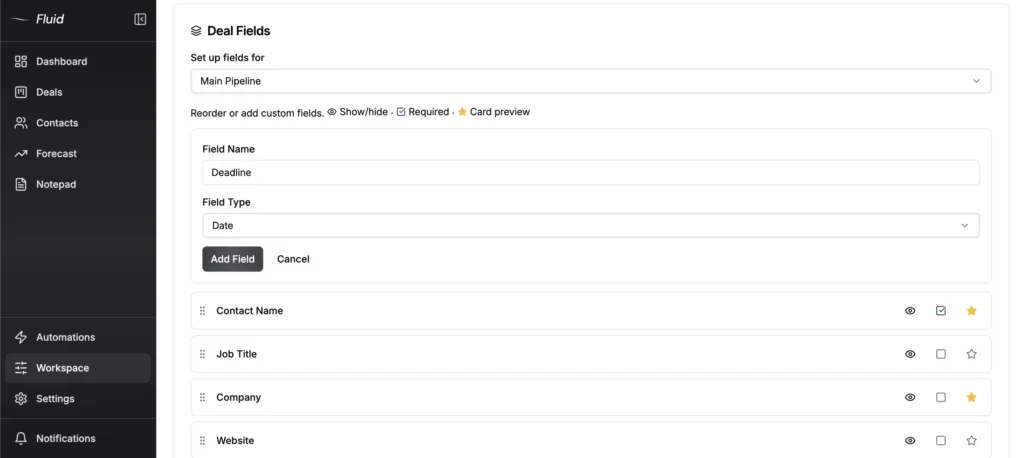
Keep it to six fields. Twenty fields is how a record ends up half empty, and a half-empty record is one you stop trusting.
X-Dates, Referrals and Bought Leads in One Board
A Fluid CRM pipeline helps most with three kinds of lead that independent agents lose easily. Each one needs a slightly different habit.
X-dates
An X-date is the day a prospect’s current policy expires. When someone tells you they are happy until March, that is not a lost deal, it is a deal with a date on it. Put it in the X-date nurture column, fill in the date field and set a reminder.
My suggestion is two touches. Set the first reminder about 60 days before the X-date to check in, and when it comes up, set the next one about 30 days out to send a fresh quote. A deal holds one reminder at a time, so you set the second when the first fires.
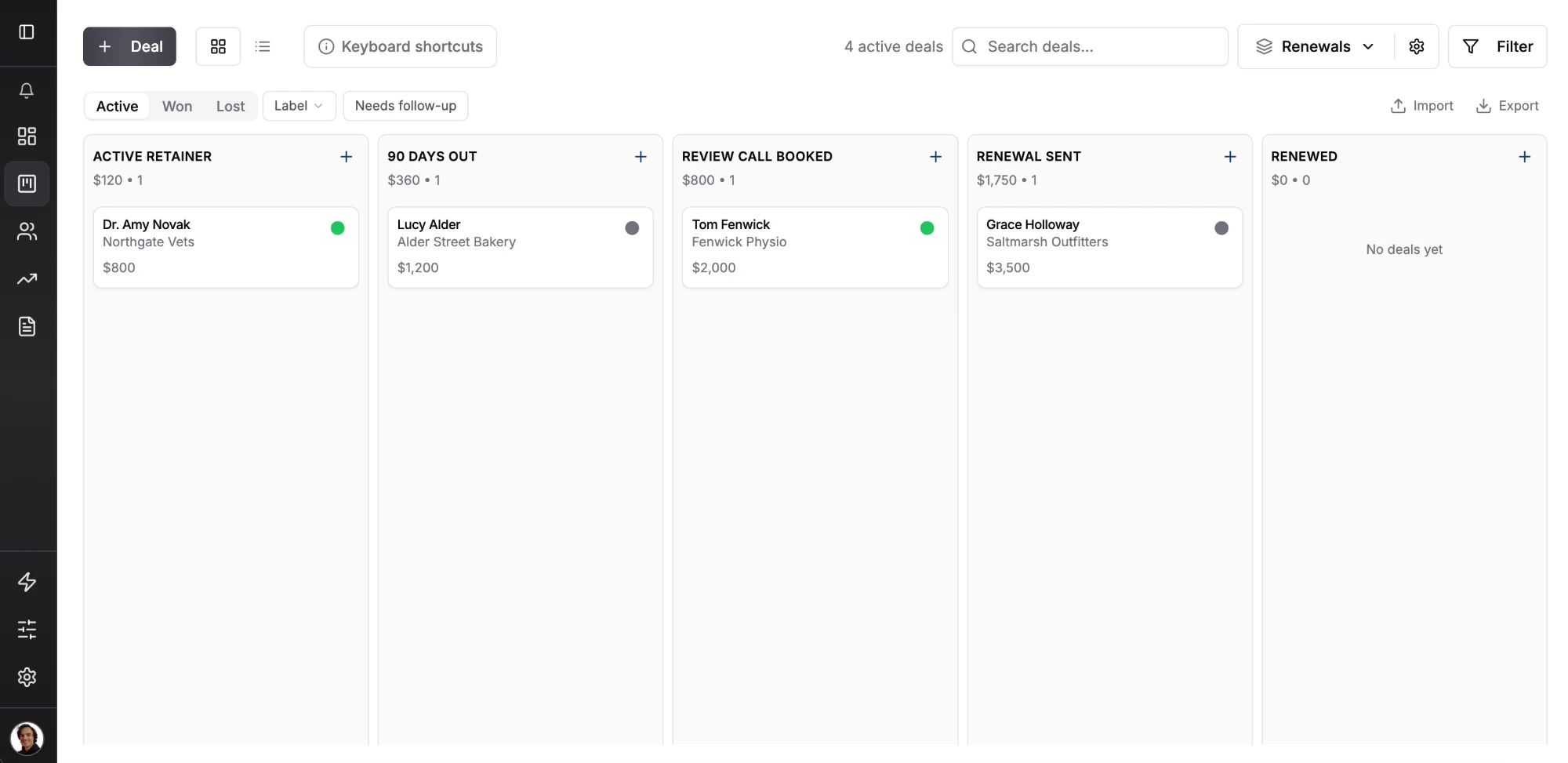
If you track a lot of X-dates, give them their own pipeline with columns for how far out each renewal is.
Referrals
Referrals close better than bought leads, and the source is easy to lose once the policy is written. Record the source on every referred deal, then thank that client when the policy binds. Our guide on how to ask for referrals has the exact wording, and staying in touch between renewals is covered in how to keep in touch with clients.
Bought and internet leads
A shared internet lead goes to several agents at once, so the first one to call usually gets the conversation. Embed a Fluid CRM lead capture form on your website and every inquiry lands as a new deal in the first column.
Leads from a vendor can come in through the API or a CSV import. The full setup for answering fast is in our speed to lead guide.
If most of your work looks less like insurance and more like general solo selling, the best CRM for independent sales reps list compares tools for that job.
Frequently Asked Questions
Not always. If your AMS has a sales pipeline you actually use, a second tool adds work. If open quotes and X-dates live in your head or your inbox, a separate pipeline pays for itself the first time it saves one policy.
An X-date is the expiration date of a prospect’s current policy. Agents record it so they can come back with a quote before the renewal, when the prospect is most willing to switch.
It ranges widely. General CRMs like Fluid CRM or Less Annoying CRM cost $15 to $16 per seat per month. AgencyZoom starts at $149 a month for up to 7 users, and a full AMS is usually priced on request.
Yes, for the sales pipeline. Track leads, quotes and follow-ups there, and keep call recordings, consent records and any compliance archive in the tools your carriers or upline require.
Which CRM an Independent Agent Should Pick
If your days are spent servicing a P&C book, start with an AMS and add AgencyZoom when you have several producers. If you sell life, health or Medicare off leads and referrals, start with a pipeline that tells you which quotes need a call today.
That is what Fluid CRM does, and our solopreneur CRM page shows how one seat is set up.
Start your 7-day free trial here, no credit card required.