

The project ended well and the client said to stay in touch. You meant to, then two busy months went by and writing now feels awkward. The same thing happens with the person who said “not this year” and the one you met who isn’t a prospect yet.
To keep in touch with clients, put every past client and not-ready-yet contact on one list, give each a date to check in and send a short message that asks for nothing. In Fluid CRM that list is a separate pipeline where each person is a card with a reminder.
Why Keeping in Touch With Clients Stops After a Busy Month
Keeping in touch stops because nobody on your list has a date next to their name.
An open proposal has a deadline, so it gets your attention. A past client has none, which leaves your memory to do the job while it is busy with paid work.
Most advice on this topic is a list of channels, which doesn’t tell you who to write to this week.
This is one of the jobs a consulting CRM should do for anyone who sells their own expertise, and the method below also works on paper.
At Fenixtal we built 12M€+ in pipeline for 50+ B2B clients, business consultants and sales coaches among them. Almost none of them had a CRM they liked, and the usual setup was Google Sheets that got messy fast.
Who Belongs on Your Keep-in-Touch List
Your keep-in-touch list holds the people who could hire you or send you work in the next two years and who have no open deal with you today. For a consultant, coach or freelancer the list is usually short enough to handle by hand.
Can you name the last three clients you finished work for, and the date you last wrote to each of them?
Past clients
Start with every client whose project went well and ended, along with the date it ended.
People who are not ready to buy yet
These people said “not now”, “next quarter” or “once the budget is approved”. Write down what was in the way and when they said it might change. Our guide to lead nurturing for small business sets a schedule for each of those reasons.
People who are not prospects yet
Most people have no place for this group. You met them at an event or a client introduced you, and there has been no sales conversation.
Coaches meet a lot of these people, and if that is you, our guide to the best CRMs for coaches compares twelve options.
Referral sources and partners
Add the handful of people who send you work, such as an accountant or another consultant. Our guide on how to ask for referrals covers what to say to them.
How Often to Keep in Touch With Each Type of Contact
Check in with recent past clients and referral partners about every three months, and with everyone else about every six months unless they gave you a date. That is our recommendation, and the count starts the day the project ends.
| Type of contact | How often | How | A reason to write |
|---|---|---|---|
| Past client, project ended in the last year | Every 3 months | Email or a short call | Ask how the result is holding up |
| Past client, project ended over a year ago | Every 6 months | Email or a LinkedIn message | Share something useful for their business |
| Not ready yet | On the date they gave you, or in 3 months | Pick up the thing they said was in the way | |
| Not a prospect yet | Every 6 months | LinkedIn comment or message, coffee if you are nearby | React to something they did or posted |
| Referral partner | Every 3 months | Call or coffee | Tell them what kind of work you are doing now |
Pick the same week each time. Entrepreneur’s advice on staying in touch with clients gives the first week of every quarter as its example.
A newsletter does not count as keeping in touch, because a past client can read twelve issues and still feel that you never asked how they were doing.
What to Say in a Keep in Touch Email When You Have Nothing to Sell
A good keep in touch email is three or four sentences about them with no pitch. None of the four messages below asks for a meeting, a referral or a sale.
1. The useful thing
“Hi Dana, I read this piece on pricing workshops this week (link below) and thought of the question your team raised in March. The part on page two is the bit I’d look at. No need to reply, I just thought it would be useful.”
Name the reason you thought of them, or it reads like a mass email.
2. The result check
“Hi Dana, it’s been about three months since we finished the sales training. How are the new call scripts holding up now that the team has used them for a while? I’d like to hear what stuck and what didn’t.”
This one is for a past client in the first year, and it tells you whether your work lasted.
3. The “saw your news” note
“Hi Dana, I saw that you opened the second office in Denver. Congratulations, that was the plan you described when we first spoke. How has the first month been?”
Use it when they hire, launch or win something, including people who are not prospects yet.
4. The honest “is this still relevant?” note
“Hi Dana, when we spoke in the spring you said the budget would be clearer after the summer. Is the onboarding project still something you’re thinking about, or has it moved down the list? Either answer is fine, I’d just like to know where it stands.”
This is for the person who was not ready, and it leaves them room to say no.
A proposal that got no answer is a different job with a tighter schedule, and our templates for a follow-up email after no response cover it.
A Staying in Touch Pipeline You Can Copy
A staying in touch pipeline is a board with four columns, where each person is a card with a date to check in. Keep it separate from your sales pipeline.
These are the four stages we use on the consulting page of Fluid CRM.
- Past client. Everyone on your list waits here, each with a reminder date.
- Check-in due. The date has arrived and you owe this person a message.
- In conversation. They replied and you are talking.
- New project. The talk turned into real work.
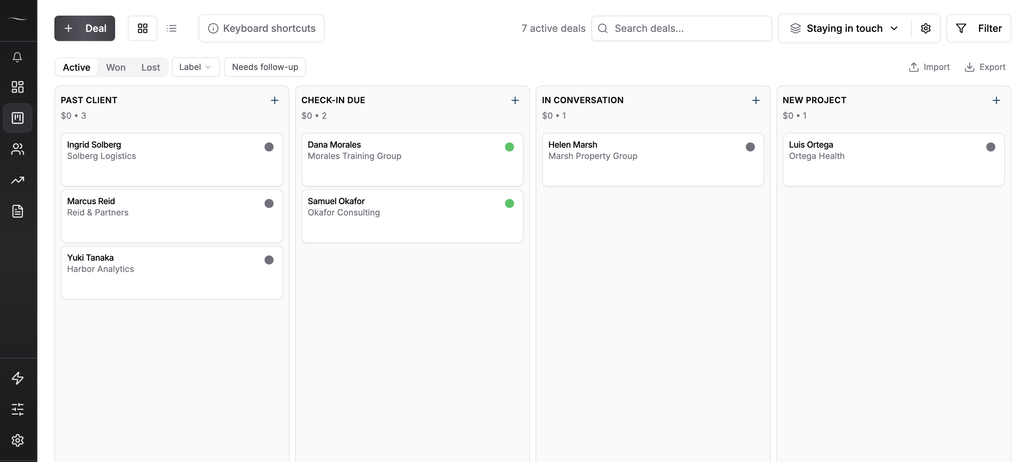
How a card moves through the four stages
Nothing on this board moves or sends by itself, and you do every step by hand. Fluid CRM shows the reminder in your daily email digest on the day it is due, and you drag that card to Check-in due.
Then you send the message from your own inbox, add a note with the date, set the next reminder and drag the card back to Past client.
When someone replies, drag their card to In conversation and write one line in the deal’s notes about what they said. If they want to talk about new work, treat that conversation as a discovery call. When the talk turns into paid work, move the card to New project and open a deal in your sales pipeline.
Name each card after the person and note which type of contact they are, because the type sets the next date.
A verified customer who looks after existing client relationships described this job in a review. “What I was really after was seeing if the tool could handle the full cycle, the ongoing communications and touch points with existing clients after the sale… As it stands, you have to think outside the box to make that work, but you can.”
If you are still choosing a tool, our list of the best CRMs for consultants compares nine of them.
When to take someone off the list
Take a person off after three check-ins in a row with no reply, or sooner if they move to a role that would never hire you.
What Fluid CRM Does Not Do for Keeping in Touch
Fluid CRM is built around deals, so four limits matter for this job.
- Reminders live on deals. You cannot set a reminder on a bare contact, so each person you want to stay in touch with gets a card in a pipeline.
- One reminder per deal at a time. When you finish a check-in, you set the next date yourself.
- One contact per deal. A client with three people you know is three cards.
- It does not send your email. You write from your own inbox, and you can log the message to the deal by adding a BCC address. There are no newsletters or email campaigns.
Unlimited pipelines are included on the one plan, so the extra board costs nothing more.
FAQ
About every three months in the first year after a project ends, and about every six months after that.
Write three or four sentences about them. Share something useful, ask how the result of your work is holding up or react to their news. Leave out the pitch, the meeting request and the referral request.
No. A notebook or Google Sheets works for ten or fifteen people if you look at it every week. A CRM helps once the list is longer than you can hold in your head.
A 10-Minute Weekly Routine for Staying in Touch With Clients
The whole method comes down to ten minutes on the same day every week, in five steps.
- Open the board and look at the reminders due this week.
- Drag each of those cards to Check-in due.
- Send each person one of the four messages from your own inbox.
- Add a note with the date, set the next reminder and drag the card back to Past client.
- Move anyone who has replied since last week to In conversation and add one line of notes.
Doland White, an executive coach and the founder of DWC, tracks prospects, clients and podcast guests in Fluid CRM. “I go faster, and I can plan my client actions with clarity.”
If your list is still ten names, a notebook will do, and our post on whether you need a CRM helps you decide. Once it grows, a consulting CRM with a staying in touch pipeline keeps every date in one place. Fluid CRM costs $16 per seat a month or $144 per seat a year.
Start your 7-day free trial here, no credit card required.