

Most of your work already comes from people who know you. Yet you probably ask for an introduction about once a year, and you could not say for sure who sent you your last three clients.
Asking feels awkward because the usual ask is vague, and a vague ask leaves the other person to work out who you mean.
To ask for referrals, pick a moment when the client has just seen a result, name the exact kind of person you help and ask for one introduction. Then make it easy with a short blurb they can forward. Record who referred whom in a tool like Fluid CRM, so you can thank them and ask again.
When to Ask for a Referral: 5 Moments That Work
Timing matters more than wording, because a client who has just seen your work pay off already wants to talk about it.
1. Right after a visible result
The report landed, the launch went well or the numbers moved. Ask within a few days, while the result is still the thing they mention to other people.
2. When they pay you a compliment
A client who writes “this was exactly what we needed” has made the ask easy for you. Thank them, then ask who else they know with the same problem.
3. At the end of a project
A wrap-up call is a natural place for it, because you are already talking about what worked. Ask after you have gone through the results and before you say goodbye.
4. When they renew or come back for more
Repeat work is the clearest sign a client is happy. Ask in the same conversation where you agree the new work.
5. When a past client gets in touch
An old client who writes to say hello or to ask a quick question is thinking about you today. Help them first and ask second.
Never ask in the middle of a problem, with an invoice attached or before the client has seen any result from you.
Who to Ask for Referrals (It Is Not Only Clients)
Referrals for a small practice come from a handful of people, so the job is to know who they are. Write down ten names from these four groups.
- Past clients who got a clear result and still answer your emails.
- Current clients who have renewed or said something kind about the work.
- Peers who sell to the same buyer. A brand designer and a copywriter share clients without competing, and so do a bookkeeper and a tax adviser.
- People who said “not now”. They liked you enough to take the call, and they often know someone whose timing is better.
Can you name the three people who sent you the most work last year, and say when you last thanked them?
A list of ten names kept in your head is easy to forget. Put it somewhere you look every week, whether that is a spreadsheet or a consulting CRM with a pipeline for the people who send you work. Finding clients on LinkedIn is a good way to add peers to a short list.
What to Say When You Ask in Person or on a Call
The ask that fails is “do you know anyone who might need my help?” It is too wide, so the client searches their whole memory, finds nobody and says they will think about it.
A good ask has three parts. It names the result you just got them, it describes one kind of person and it asks for one introduction.
After a result
“I’m really glad the new onboarding cut your support tickets. Who else do you know who leads a small software team and is fighting the same problem? I’d love an introduction to one person.”
At the end of a project
“Before we wrap up, can I ask a favour? Most of my work comes from introductions. If one person comes to mind who is about to rebuild their website, would you be open to connecting us?”
If no name comes, say “no rush, I’ll send you two lines you can forward if someone comes up” and move on.
Fenixtal, my outbound agency, booked 1,250+ sales calls for clients, and every one of them started with a stranger. An introduction from someone the buyer trusts skips most of that work, which is why I think a consultant should ask before they ever send a cold email.
3 Referral Email Templates You Can Copy
Email works well right after you deliver something. Keep it short, make one ask and add a blurb they can forward. Each template below is the full body of the email, and a plain subject line such as “A quick favour” is enough.
Template 1 for a client who just saw a result
Hi [Name], I’m glad [result, in their words] worked out.
I’m taking on [one or two] new clients this quarter. Do you know one [type of person, such as the founder of a small agency] who is dealing with [problem]?
If someone comes to mind, I’ve put two lines below that you can forward. Thanks either way.
Template 2 for a past client
Hi [Name], it has been a while since we finished [project]. How is [the thing you built or fixed] holding up?
Most of my work comes from people like you, so if you know one person facing [problem] this year, I’d be grateful for an introduction.
I’ve added two lines below that you can forward, and no pressure at all if nobody comes to mind.
Template 3 for a referral partner
Hi [Name], I’m [your name] and I do [my service] for [type of client]. You do [their service] for the same clients, so we don’t compete.
I often get asked about [their service] and I’d like to send those people to you. When a client of yours needs [my service], I’d be glad to take the call.
Do you have 20 minutes next week to compare notes on who we each help best?
The blurb they can forward
Add this under your signature in templates 1 and 2. The person referring you should never have to explain what you do in their own words.
[Your name] helps [type of client] with [problem]. They recently helped us [result]. Happy to introduce you if it is useful.
Three more things make referring you easy.
- Say who you help in one sentence. “I help small law firms fix their intake process” is easy to repeat, and “I do operations consulting” is not.
- Ask them to check first. The best introduction is one where your client has already asked the other person if they want it, so nobody gets a surprise email.
- Reply within a day. A slow reply to an introduction makes the person who vouched for you look bad.
If the new contact does not answer your first message, wait a few days and send one polite follow-up. These follow-up email templates work for warm introductions too. When they reply and want to talk, our guide to the discovery call covers that first conversation.
How to Track Who Referred Whom
Most people skip writing down who sent whom, and without that record you cannot thank anyone properly or know who to ask again. You need two things and both fit in a spreadsheet or a CRM.
1. A “Referred by” field on every new deal
Every time a new lead arrives, write down the name of the person who sent them.
| What to record | Example |
|---|---|
| Referred by | Maria Lind |
| How they know each other | Former colleague |
| Date of the introduction | 12 March |
| Outcome | Proposal sent |
| Thanked | Yes, on 13 March |
In Fluid CRM this is a custom field called “Referred by” on the deal. It is a plain text field with no dropdown, so type the name the same way every time. Keep the other four rows in the deal’s notes, and count the names every few months to see who sends you the most work.
You can star up to 4 fields to show them on the deal card and mark the field as required so it is never left blank.
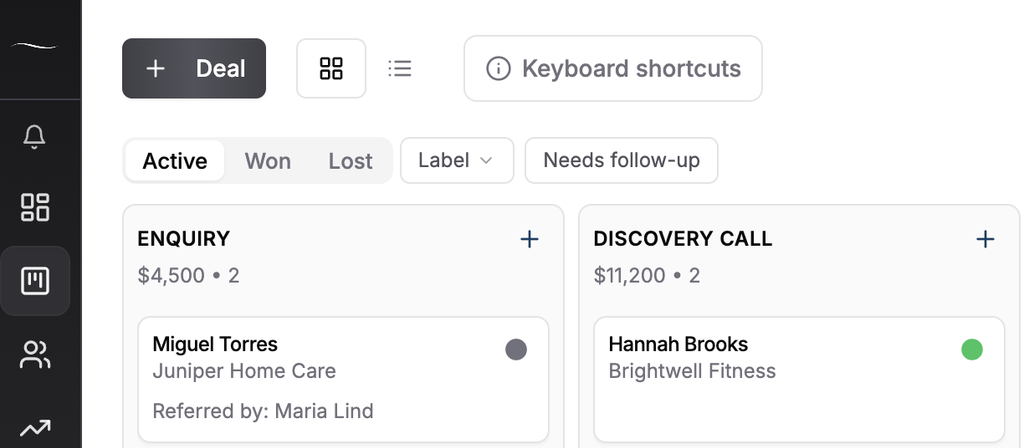
A label does the same job if you prefer tags. A verified customer who coordinates a European coaching network uses labels to record which city hub sent each new registration.
2. A separate pipeline for the people who refer you
The peers on your list get their own pipeline, apart from your sales pipeline. Each person is a card, and the stages show how far the relationship has come.
| Stage | What it means |
|---|---|
| Introduced | You have met or been connected, and nothing has happened yet |
| Contacted | You have told them who you help and asked who they help |
| In talks | You are comparing notes and the first name has been mentioned |
| Working together | Introductions have gone at least one way |
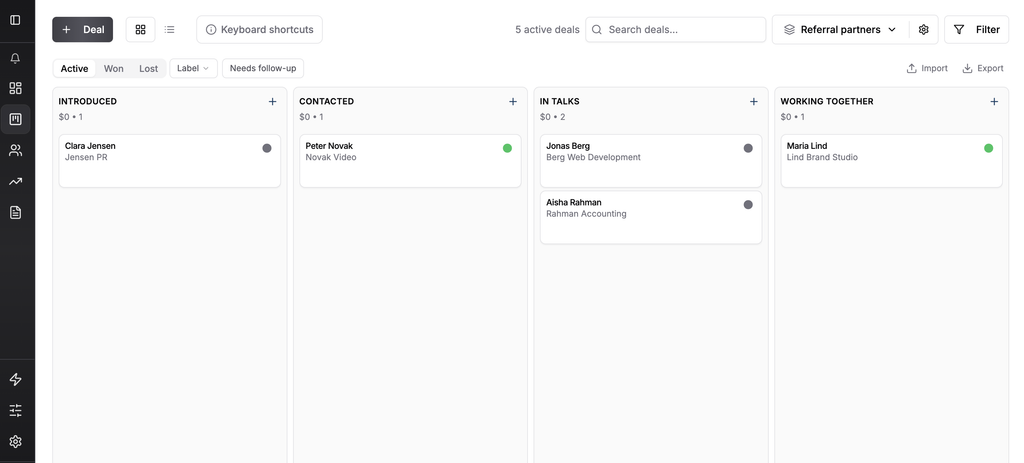
Past clients can sit in a second pipeline of their own, with a check-in date on each card. That board is laid out in our guide on how to keep in touch with clients. This guide to sales pipeline stages explains how to choose stage names.
What Fluid CRM does and does not do here
Fluid CRM is built around deals, so a reminder lives on a deal and each deal has one reminder at a time. That is why each referrer needs a card of their own in the partner pipeline, with the date you plan to get in touch next.
A deal holds one contact, and notes from each conversation are kept on the deal. There is no referral reward, payout or referral link feature. You send emails from your own inbox, and adding your Fluid CRM address in BCC logs them.
Jaakko Sahimaa, a business psychologist, described what a simple setup gave him. “I’ve only been using Fluid CRM for a short time, but it has already helped me bring more structure to my growing business.”
How to Thank Someone for a Referral
Thank the person twice. The first thanks goes out on the day of the introduction, before you know if it leads anywhere, because they took a risk by vouching for you.
The second one matters more and almost nobody sends it. Tell them what happened, whether the lead became a client or not.
Hi [Name], a quick update on [person you introduced]. We spoke last week and [we start working together in May / the timing was not right, but it was a good conversation].
Thank you for thinking of me. If I can return the favour, tell me who you would like to meet.
Set a reminder on their card for about six months later, and when it comes up, check in before you ask for anything.
Should You Pay for Referrals?
For most consultants, coaches and freelancers the answer is no. Your referrers are clients and peers who send people because they trust you, and a fee can make a favour feel like a transaction.
A thank-you, an update and an introduction in return do more for those relationships than a commission.
A paid programme fits a narrower case, when you sell a fixed-price offer many times a year, the people referring you are not close contacts and you have a clear way to record and pay each one.
If that is you, write the terms down, tell the new client about the fee and check your professional rules first if you work in law, finance or health.
FAQ
Name the result you just delivered, describe one kind of person you help and ask for one introduction. Give them an easy way out by saying there is no pressure if nobody comes to mind.
Ask within a few days of a visible result, a compliment, the end of a project or a renewal. Avoid asking during a problem or in the same message as an invoice.
Keep it to a few lines that mention the result, say who you are looking for and ask for one introduction. Add a two-line blurb under your signature that the client can forward without rewriting it.
Record who referred each new lead in a “Referred by” field on the deal, and keep the people who refer you in a separate pipeline. Fluid CRM does this with a custom field or a label and a card for each referrer. It has no referral reward or payout feature.
Your Referral Routine for the Next 30 Days
Referred clients tend to be good clients. A Journal of Marketing study followed about 10,000 customers of a German bank for almost three years. The bank paid a reward for each referral, and the referred customers were worth at least 16% more than similar ones and about 18% less likely to leave.
A bank is not a consultancy, so treat those numbers as a rough guide. Here is a routine you can finish in four short sittings.
- Week 1. Write down ten people who have sent you work or could, and give each one a card.
- Week 2. Ask three of them, using a script or a template from this guide.
- Week 3. Add a “Referred by” field to every open deal and fill it in.
- Week 4. Send an update to everyone who introduced someone, and set a date to check in again.
When you want reminders and a board you can update in seconds, Fluid CRM is a simple consulting CRM with a pipeline for each group of people you track. Our guide to the best CRM for consultants compares the other options.
Start your 7-day free trial here, no credit card required.