

If you’re searching for a CRM for your law firm, the field is confusing for a reason. Half the tools recommended in search results are practice management platforms with a CRM feature bolted on. The other half are general CRMs that don’t know what IOLTA means. This post sorts the nine best options into the two groups they actually belong in and tells you which one fits your firm.
The best CRM for a law firm depends on whether you need case management bundled in. Bundled legal CRMs like MyCase, Clio and Lawmatics combine case management, IOLTA trust accounting and intake at $89-$150/seat. Pure CRMs like Fluid CRM, Pipedrive and Monday track the sales pipeline only at $12-$25/seat and pair with separate billing software.
Pure CRMs vs Bundled Legal CRMs Explained
A CRM does one job. It tracks the people you’re talking to, the deals in progress and when to follow up. Lead capture form to signed engagement is the CRM’s territory and that’s where it stops.
A practice management platform does all of that plus a stack of things only a law firm needs:
- Conflict checks before you take a matter
- IOLTA trust accounting that keeps you out of trouble with your bar association
- Court-rules calendaring that adjusts deadlines when a court holiday moves
- Legal document automation for retainers and pleadings
- Matter management once the client is signed
Bundled legal CRMs like MyCase, Clio, Lawmatics, Litify and PracticePanther do both jobs. They charge for both, which is why they start at $39-$150 per seat per month and climb fast once you add users and modules.
Pure CRMs like Fluid CRM, Pipedrive, monday and HubSpot do CRM only. They charge for that one job, which is why they start at $12-$30 per seat per month. After a client signs, the work moves into whatever billing or case management software you already use.
This is the split most law firm CRM comparison posts skip. Nicolas Virtsonis runs marketing and sales pipeline development for cleantech B2B companies. He’s tried Sugar, Zoho, Pipedrive, Salesforce, ActiveCampaign, Vtiger and custom-built systems. In his words, “most CRMs are a nightmare to use and maintain, not this one.” The legal segment has the same trap as the rest of B2B, just with bar association compliance baked into the premium tier.
Stop for a second and look at your current setup. Do you already have billing software handling time entries, invoicing and trust accounts? If yes, paying $89-$150 a seat for a bundled legal CRM means buying that billing layer twice. If no, the bundle saves you stitching tools together.
5 Best Bundled Legal CRMs For Law Firms
If you don’t have legal billing software in place and you handle client trust funds, bundled legal CRMs save you the integration work. These five are the most credible options in the bundled category. Solo lawyers on r/LawFirm hit the same wall. They feel priced out at the bundled tiers, and the marketing-heavy options like Lawmatics get complex fast.
1. MyCase (best for small firms wanting one tool for everything)
MyCase runs $39 per user per month on the Basic plan, $89 on Pro and $109 on Advanced (annual billing). The Basic tier covers time tracking, billing, trust accounting, client portal and document management. The intake and CRM features sit at Pro and above, which is the jump from $39 to $89 per seat once you actually need the CRM half.
Best fit: small firms (5-15 attorneys) wanting one tool covering intake, matters, billing and client portal. The CRM half is fine, not best in class. If most clients come from referrals and you’re not running paid lead acquisition, MyCase’s CRM layer is enough.
2. Clio Grow + Clio Manage (best for firms already in the Clio ecosystem)
Clio Grow is Clio’s standalone CRM at $59 per user per month, designed to pair with Clio Manage ($49 EasyStart, $89 Essentials, $119 Advanced, $149 Complete on annual billing). The Complete tier at $149/user bundles Clio Grow into Clio Manage. That’s the sticker shock most solo lawyers hit on Clio.
Best fit: firms already running Clio Manage who want intake feeding directly into the case management side. If you’re starting from zero, the integrated ecosystem is real but the price climbs fast. A 5-person firm on Clio Complete is $745 per month before payment processing or add-ons.
3. Lawmatics (best for high-volume intake firms)
Lawmatics is the most specialized intake CRM in the bundled category. Public pricing isn’t published on the site, but third-party sources put the starting tier around $199 per month per firm (not per user) with a 3-user minimum. Most firms running serious lead volume land at $299+ per month at the Pro tier.
Lawmatics is not a practice management replacement. You still need Clio Manage, MyCase or another billing system underneath. What Lawmatics offers is a CRM and intake layer with email drip sequences, SMS campaigns, lead scoring and full marketing attribution.
Best fit: PI firms, family law firms or any practice spending $5,000+ a month on lead acquisition where intake automation pays back faster than a paralegal.
4. Litify (best for mid-market personal injury and mass tort)
Litify is built on Salesforce, which is the source of both its power and its price. Public pricing starts at $150/user/month, with Salesforce platform fees and implementation costs stacked on top. Implementation runs $50,000-$200,000 and takes 3-9 months.
This is enterprise territory. Litify is built for 20+ attorney PI firms, mass tort operations and any practice that thinks about itself as a business with departments rather than a small operation with cases.
Best fit: PI and mass tort firms above 20 attorneys with budget for implementation consultants and a Salesforce administrator on staff. If that sentence doesn’t describe your firm, Litify is the wrong tool.
5. PracticePanther (best for solo and small firms wanting bundled at lower cost)
PracticePanther runs $49 (Solo), $69 (Essential) and $89 (Business) per user per month on annual billing. Solo is limited to one user and lacks trust accounting, which makes it unworkable for most lawyers handling client funds. Essential at $69 is the realistic starting tier.
PracticePanther covers the same ground as MyCase: case management, time tracking, billing, trust accounting, document automation, client portal and basic intake. The workflow automations are stronger at the Essential and Business tiers than MyCase’s equivalent tiers.
Best fit: solo lawyers and 2-5 attorney firms who want bundled at a lower price than Clio but don’t want to commit to MyCase. PracticePanther Essential at $69 is the most direct cheaper alternative to Clio.
4 Best Pure CRMs For Law Firms
If you already have legal billing software (Clio Manage, TimeSolv, PCLaw, CosmoLex) or you handle no client trust funds at all, a pure CRM saves you 70-90% on monthly software cost while doing the CRM job better than the bundled tools’ CRM half. These four are the most credible pure CRM options.
1. Fluid CRM (best for small firms who already have billing software)
Fluid CRM runs $16 per seat per month or $144 per seat per year (3 months free with annual). That works out to $12 per seat per month on annual billing. Both plans include every feature. Unlimited deals, unlimited contacts, unlimited pipelines, 8 in-app automations, reminders, keyboard shortcuts, API and webhooks. No upgrade traps, no module unlocks, no setup fees.
The product is built for solo founders, small B2B teams and agencies who outgrew spreadsheets but don’t want HubSpot. The fit for solo lawyers maps directly. You need a clean visual pipeline showing leads, follow-ups and the deals you’re closing this month. You don’t need conflict checks (that’s your billing software’s job) or matter management (that’s after the lead becomes a client).
Kyler Thompson runs Knight Theory, a solo creative studio. She’s tried more CRMs than she cares to admit. Her review of Fluid CRM: “incredible, calming, no-junk platform.” Her use case maps closely to a solo lawyer’s intake workflow. She uses embedded lead capture forms with custom fields (budget, timeline, project type) on her website. Replace those fields with practice area, case type and timeline, and you have a solo lawyer’s intake form.
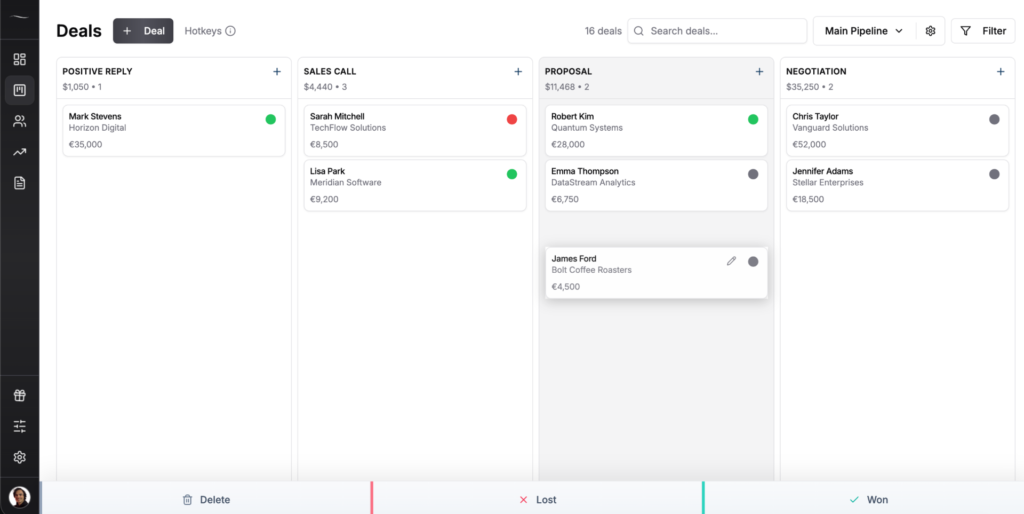
Best fit: solo lawyers and 2-5 attorney firms who already use Clio Manage, MyCase Billing, TimeSolv or any standalone billing software, and need a clean pipeline for tracking leads through to signed engagement. See full pricing page here for full plan details. 7-day free trial, no credit card required.
2. Pipedrive (best for small firms with experienced sales operations)
Pipedrive runs $24 (Lite), $49 (Growth), $79 (Premium) and $99 (Ultimate) per user per month, with up to 42% off on annual billing dropping Lite to around $14 and Growth to $29.
If you’re looking for the strongest sales-discipline CRM in the pure category, Pipedrive is the strongest option. ts pipeline view, deal stages and reporting are built for sales teams who want to track conversion rates by stage, run pipeline forecasts and manage rep activity quotas. For law firms, that depth helps when multiple attorneys run their own intake conversations and you want to compare conversion by attorney or by lead source.
Best fit: 3-10 attorney firms with sales discipline, multiple intake conversations running in parallel and budget for one of the more sales-engineered pure CRMs.
3. Monday CRM (best for multi-pipeline firms juggling intake and matter delivery)
Monday CRM runs $12 (Basic), $17 (Standard) and $28 (Pro) per user per month on annual billing. There’s a 3-user minimum, so the real entry price on Basic is $36/month total, not $12.
The differentiator versus other pure CRMs is multi-pipeline flexibility. Law firms running both an intake pipeline (lead → consult → signed engagement) and a matter pipeline (open → in progress → wrap-up → closed) on the same platform get more value from monday than from a CRM locked to a single sales pipeline shape.
Best fit: 3-10 attorney firms wanting to track intake and matter delivery on the same platform without paying for full practice management.
4. HubSpot (best for marketing-led firms running paid acquisition)
HubSpot Sales Hub runs $20/seat on Starter, $100/seat on Professional with a one-time $1,500 onboarding fee and $150/seat on Enterprise with $3,500 onboarding. Starter doesn’t include the features people actually buy HubSpot for. Workflow automation, sales analytics and forecasting all start at Professional.
For law firms doing serious content marketing and paid ads, HubSpot’s Marketing Hub (separate product line) integrates with Sales Hub cleanly, which is why marketing-led firms sometimes default to HubSpot.
Doland White is an executive coach who runs a mastermind, executive coaching and a podcast. He’s tried HubSpot, Salesforce and Capsule. On HubSpot specifically: “With HubSpot, if you want to do something different, you have to buy more.” Doland stayed off it for the same reason most solo lawyers should stay off it. He doesn’t need nine modules, lead scoring AI or marketing automation. He needs to know who he’s calling back next Tuesday.
Best fit: 10+ attorney firms with a dedicated marketing function, paid ad budget of $10,000+ per month and someone on staff who can administer HubSpot. For solo or small firms, HubSpot at Professional and above is paying for capacity that won’t be used.
Bundled vs Pure CRM Pricing Math For Solo Lawyers
Take a solo lawyer with one assistant (2 seats). The year-one cost across the nine options is below. Figures use annual billing where available.
| Tool | $/seat/month | Year-one cost (2 seats) |
|---|---|---|
| Fluid CRM (annual) | $12 | $288 |
| monday CRM Standard (3-user min) | $17 | $612 |
| Pipedrive Growth (annual) | $29 | $696 |
| HubSpot Sales Hub Starter | $20 | $480 |
| PracticePanther Essential | $69 | $1,656 |
| MyCase Pro | $89 | $2,136 |
| Clio Complete (includes Grow) | $149 | $3,576 |
| HubSpot Sales Hub Professional | $100 + $1,500 onboarding | $3,900 |
| Litify (plus Salesforce + implementation) | $150+ | $3,600+ |
The gap between cheapest pure CRM and cheapest bundled legal CRM is roughly $1,400 in year one. The gap between Fluid CRM and Clio Complete is $3,300. That’s the difference in software spend between two stacks that both let you track leads and follow up.
If you already pay $39-$149 for billing software (Clio Manage, MyCase Billing, TimeSolv, CosmoLex), adding a pure CRM at $12-$30/seat to handle pipeline is the cheaper move. Adding Clio Grow at $59/seat or upgrading to Clio Complete at $149/seat is paying twice for billing infrastructure you already have.
What Pure CRMs Don’t Do For Law Firms
Pure CRMs handle CRM. The five legal-specific jobs they don’t do are below, so you can decide whether the bundled tier earns its premium for your firm.
No conflict checks
Pure CRMs don’t cross-reference your contact list to flag a potential conflict with an existing client or matter. You’ll need a separate conflict check process, either manual or via your billing software if it includes the feature.
No IOLTA trust accounting
Pure CRMs don’t track client trust funds, run three-way reconciliations or generate the reports your bar association expects. You need separate trust accounting software (LawPay, CosmoLex or whatever your billing software offers).
No court-rules calendaring
Pure CRMs have basic calendar features, but they don’t auto-calculate deadlines based on jurisdiction-specific court rules or adjust when a court holiday moves a deadline. LawToolBox, Rocket Matter or similar tools handle this.
No legal document automation
Pure CRMs can store documents and pull merge fields, but they don’t generate retainer agreements, demand letters or pleadings from templates the way Clio Draft or Documate does.
No matter management
Once a lead becomes a client, the work moves out of the CRM into whatever case management software you use. The pure CRM is for the lead-to-engagement workflow only.
If you don’t currently have software handling these jobs and you need them, the bundled price tag earns itself back through saved tool stitching. If you already have billing and case management in place, a pure CRM at $12-$30/seat is the missing piece, not the whole stack.
How To Choose A CRM For Your Law Firm (3-Question Framework)
The decision between bundled and pure comes down to three questions about your existing setup.
1. Do you already have legal billing software?
If yes (Clio Manage, MyCase Billing, TimeSolv, PCLaw, CosmoLex), you already have the legal-specific infrastructure that bundled CRMs charge for as part of their stack. Adding Clio Grow at $59/seat or upgrading to Clio Complete at $149/seat duplicates what you have. A pure CRM at $12-$30/seat is the cheaper, more honest fit.
If no, decide whether you need that infrastructure (trust accounting, time tracking, invoicing). If yes, a bundled tier earns its keep. But if not (most contingency-fee or flat-fee practices), a pure CRM works.
2. Do you need conflict checks and IOLTA inside the CRM?
Conflict checks and IOLTA trust accounting are the two features that genuinely separate bundled legal CRMs from pure ones. If you handle client trust funds and run conflict checks before taking matters, you need this functionality somewhere in your stack.
Whether “somewhere” means the CRM specifically or a separate billing tool is the choice. Most solo lawyers already have a billing tool. Most multi-attorney firms either have one or want one. If conflict checks and IOLTA already live elsewhere, the CRM doesn’t need to duplicate them.
3. Is most of your intake from referrals or paid leads?
Referral-driven practices have low intake volume per month (5-20 leads). The CRM job is simple. Track the lead, schedule the consult, follow up if they ghost and close the engagement. Any pure CRM handles this at $12-$30/seat.
Paid-acquisition practices have high intake volume (50-500+ leads per month) and need lead scoring, drip sequences, attribution by campaign and same-hour response automation. That’s Lawmatics territory, or Clio Grow at the volume floor. Pure CRMs don’t have the marketing automation depth for this profile.
Frequently Asked Questions
If you handle more than 10 active leads at any time and you’ve missed at least one follow-up this month, yes. If your intake is referral-only with 1-3 leads per month and your memory holds them all, a CRM is overkill. The threshold isn’t firm size, it’s lead volume divided by follow-up reliability.
Fluid CRM at $144/year, which works out to $12/month on annual billing, is the cheapest pure CRM with no upgrade traps. Pipedrive Lite at around $14/seat annual is comparable. monday CRM Basic at $12/seat has a 3-user minimum, so the real entry cost is $36/month. On the bundled side, PracticePanther Solo at $49/seat is the cheapest, but only supports 1 user and lacks trust accounting.
Yes, for the lead-to-engagement workflow. A pure CRM tracks the lead from first contact through consult, proposal and signed engagement. It does not handle conflict checks, retainer generation or trust deposit. Those happen in your billing or case management software after the engagement is signed.
Clio Manage is practice management (case management, billing, trust accounting, document management). Clio Grow is the CRM half (intake, lead tracking, automated follow-up, conversion analytics). They’re sold separately or bundled in the Clio Complete tier at $149/seat. Posts that say “Clio is a legal CRM” are usually talking about Clio Grow specifically, not Clio Manage.
A legal CRM (Lawmatics, Clio Grow, LeadDocket) is built for law firm intake workflows. It understands consultation booking, intake forms with legal fields and integrations with legal billing software. A general CRM (Fluid CRM, Pipedrive, monday, HubSpot) is built for any sales pipeline and doesn’t include legal-specific automations. General CRMs cost $12-$30/seat. Legal CRMs cost $59-$300/seat. The trade-off is whether the legal-specific automations earn back the gap for your intake volume.
Conclusion
Bundled fits firms that need case management baked in. Pure fits firms that already have billing software or only need lead capture and pipeline. Pick the column that matches your stack, not the longest feature list.
If you already have Clio Manage, MyCase Billing or TimeSolv handling the legal-specific work, Fluid CRM gives you a clean visual pipeline at $16 per seat with every feature included.