

Most mortgage CRM lists rank tools on how well they track a loan from application to closing. Your loan origination system already tracks the file. The pipeline nobody tracks is the real estate agents, builders and past clients who send you the next borrower.
For the loan file, pick a mortgage-built CRM that syncs with your loan origination system (LOS), such as Jungo from $96 per user per month billed annually or BNTouch at $95 per user for teams. For referral partners and new leads, Fluid CRM at $16 per seat per month covers the sales pipeline.
What a Mortgage CRM Does That a Sales CRM Can’t
A mortgage broker works two pipelines at once. One is the loan file, with its conditions, rate locks and closing date. The other is the business that feeds it, which means agents, builders, CPAs and past clients who refer borrowers.
Mortgage-built CRMs are designed around the first pipeline, and they do things a general sales CRM simply does not. Here is the split, job by job.
| Job | Mortgage-built CRM | General sales CRM (Fluid CRM, Pipedrive, HubSpot) |
|---|---|---|
| Sync loan status from your LOS | Yes on Jungo Bundle and Bonzo, set up for you on BNTouch Enterprise | No |
| Prebuilt campaigns for purchase, refinance and past clients | Yes | No, you write your own follow-ups |
| Business texting to borrowers and agents | Yes (Jungo Bundle, Bonzo, BNTouch) | No |
| Communication logs kept for audits | Yes, a stated feature on Bonzo and BNTouch | No |
| Rate drop and refinance alerts on past clients | Yes (Jungo, BNTouch, Bonzo) | No |
| A pipeline of referral partners | Often included, built around mortgage campaigns | Yes, as an ordinary pipeline you shape yourself |
| Price for one seat | $95 to $165 a month | $14 to $100 a month |
If you need LOS sync and borrower texting, a mortgage-built CRM is the better fit, and none of the three sales CRMs further down will do that job. If your LOS or point-of-sale portal already keeps borrowers updated, read on, because the referral half is where a broker’s next quarter gets decided.
4 Mortgage CRMs Built Around the Loan File
These four are made for loan officers and mortgage teams, with mortgage campaigns and compliance tools built in. Three of them sync with an LOS on at least one plan. They differ mostly in who they are sized for.
1. Jungo, for loan officers who want Salesforce underneath
Jungo is a mortgage CRM built on Salesforce, with drip campaigns for leads and past clients, refinance opportunity alerts and an agent portal that lets referral partners see the deals they sent you. Jungo Lite is $96 per user per month billed annually or $119 billed monthly on the same one-year contract. Jungo Bundle adds LOS Sync, round-robin lead distribution and Jungo SMS at $125 per user per month billed annually or $149 monthly.
Jungo SMS handles opt-outs automatically. Every Jungo contract is annual for at least one year, and there is a one-time setup fee of $249 to $299 depending on the plan. Budget for the full year before you sign.
Best for: loan officers who want LOS sync, texting and partner co-marketing in one Salesforce-based tool.
Not for: anyone who wants to test a CRM for a month before committing.
Cost for 5 users: $7,500 a year on Bundle billed annually, plus the $299 setup fee.
2. BNTouch, for small teams that want everything prebuilt
BNTouch packs mortgage, partner and recruiting pipelines into one plan, along with email and SMS automation, a point-of-sale system with an online 1003 and more than 400 prebuilt mortgage campaigns. It is $95 per user per month for 2 to 10 users, or $165 per month for a single user. Plans up to 10 users are month to month with no contract, and the Enterprise plan for 10+ users adds LOS integrations set up for you.
Each user gets 5,000 records, with more at $5 per extra 1,000, and texting includes 100 segments a month before usage fees start. There is no free trial, so you see it in a demo first.
Best for: teams of 2 to 10 who want campaigns and a borrower portal working on day one.
Not for: solo brokers on a tight budget, since a single seat costs more than a team seat.
Cost for 5 users: $475 a month, or $5,700 a year.
3. Bonzo, for brokers who live on their phone
Bonzo is built around communication first. Calling, texting, MMS, video and voicemail drops are all in one inbox, with drip campaigns for purchase, refinance and agent relationships. It also logs communications for audit readiness and connects to past loan data so refinance-ready borrowers show up on their own.
The Solo plan is $150 per seat per month, and team and enterprise plans are priced on request.
Best for: a loan officer who sells by text and phone and wants that history in one place.
Not for: brokers who mostly work by email and in-person meetings.
Cost for a solo broker: $1,800 a year.
4. Total Expert, for lenders with a marketing team
Total Expert calls itself a customer operating system for financial services, and its customers are mortgage lenders, banks and credit unions. It combines customer data, automated marketing across email, text and other channels, consent management and a sales workspace for loan officers. It is sold by demo, with no public price.
Best for: a lender or bank with central marketing and compliance teams.
Not for: an independent broker or a team of five. It is sized for institutions, not for one office.
The Referral Pipeline Most Brokers Keep in Their Phone
A broker’s agent relationships usually slip away after a good first coffee, with nothing on anyone’s calendar after it.
Mortgage CRMs do offer partner features, but they are mostly built around campaigns, the newsletter that goes to every agent on the list. What a broker actually needs to see is which agent is warm, which one sent a borrower last month and which one hasn’t heard from you since spring. That is a sales pipeline, and it is the job a small solopreneur CRM does well.
Which three agents sent you a borrower last quarter, and when did you last talk to each of them? If the answer means scrolling through your texts, the pipeline is living in your phone.
Doland White, an executive coach, had the same scatter before he moved into Fluid CRM. His prospects, clients and podcast guests were split between Google Contacts, LinkedIn, spreadsheets and marketing tools, and putting them in one pipeline, as he put it, “ended the wasted effort.”
What to record for each referral partner
Keep the record short enough that you will fill it in after every call. These six fields cover what a broker needs.
| Field | Example | Why it matters |
|---|---|---|
| Partner type | Listing agent, builder, CPA, past client | Each type refers differently and needs a different touch |
| Brokerage or company | The agent’s office | Lets you see every agent at one office together |
| Last referral date | The date their last borrower came in | Shows who is active and who has gone quiet |
| Loans closed together | 3 | Tells you who to protect first |
| Next touch date | A reminder on the card | The one field that keeps the relationship moving |
| How they like to hear from you | Text, call, email or in person | Saves you guessing every time |
For the scripts that get an agent to send that first borrower, see how to ask for referrals.
A 14-day plan for a new real estate agent introduction
The first two weeks after you meet an agent decide whether you become their go-to lender or one more card in their wallet. Put each step on the calendar the day you meet them.
| Day | What you do | What you log |
|---|---|---|
| Day 0 | Meet for coffee or a call, ask about their buyers | Create the partner card and set the next reminder |
| Day 1 | Send a short thank-you that mentions one thing they said | Note what they care about |
| Day 3 | Send one useful thing for their buyers, such as a first-time buyer program you work with | Log it as an activity |
| Day 7 | Ask whether any of their buyers are stuck before pre-approval | Move the card to “Talking” if they reply |
| Day 14 | Offer a fast pre-approval for their next buyer, or a set time each month to talk | Set the reminder for the following month |
Past clients belong on a slower cadence, with a check-in around the loan anniversary and when rates move. The schedule for that is in how to keep in touch with clients.
3 Sales CRMs for Referral Partners and New Leads
These three are general sales CRMs. None of them touches the loan file. They are here for the other job, tracking the people who send you borrowers and the borrower leads who haven’t applied yet.
5. Fluid CRM, for the partner and lead pipeline of an independent broker
Fluid CRM is a visual sales pipeline at $16 per seat per month, or $144 per seat per year, with every feature in the one plan. A broker sets up two pipelines. The first is “Referral partners”, where each agent or builder is a card moving through stages such as Met, Talking, First borrower sent and Steady partner.
The second pipeline is for new borrower leads. A lead capture form on your website creates the lead and its card for you, and each card has a reminder with a colored dot, so you can see who is waiting on you.
Custom date and number fields hold the last referral date and loans closed together, and a daily email lists every reminder due today. How fast you answer a new borrower matters as much as where you log them, and speed to lead covers that setup.
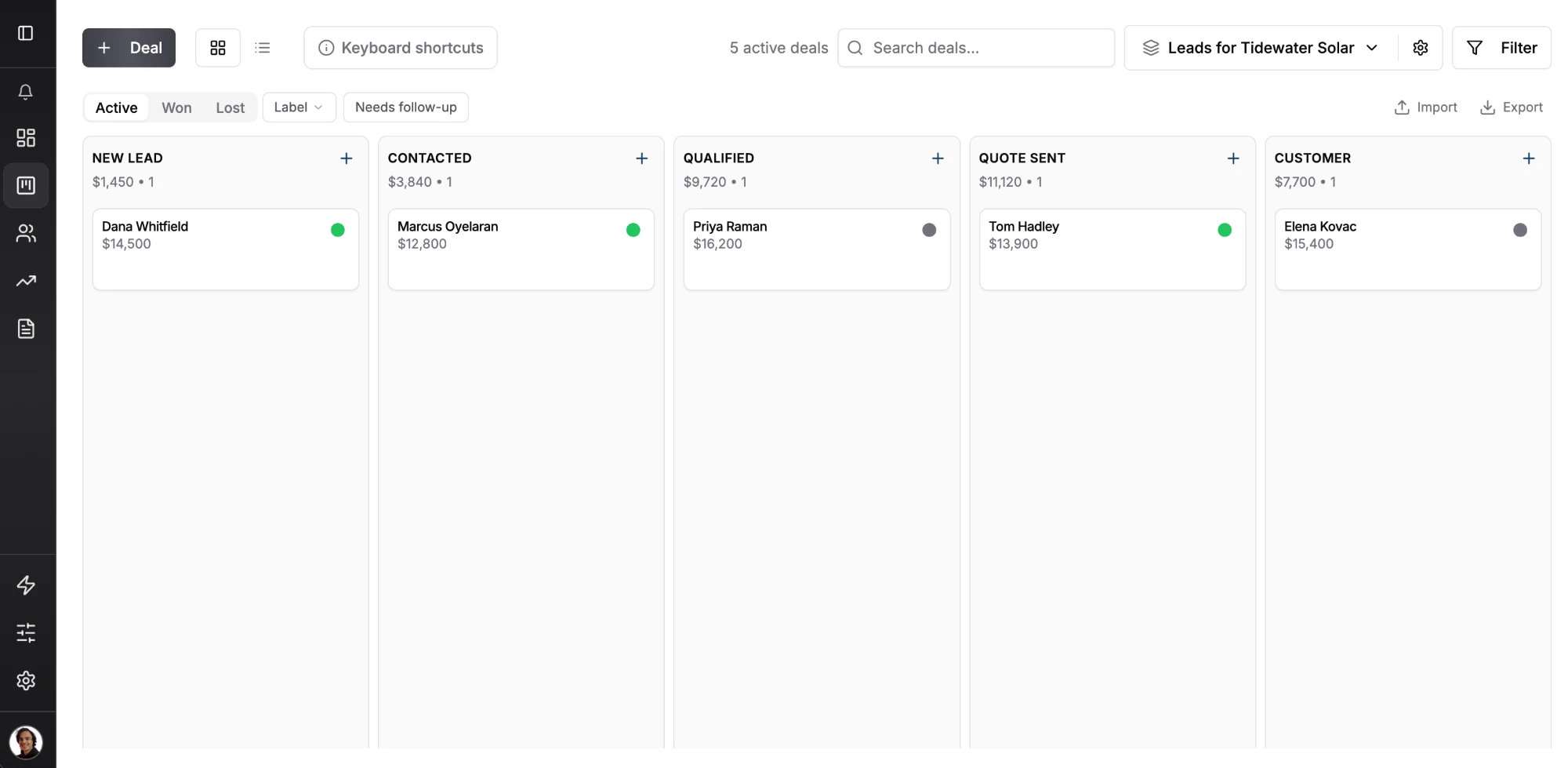
If you use Claude or ChatGPT, the MCP connector lets the assistant log the notes from a coffee meeting straight onto the partner’s card, so the record stays current even on days you don’t open the app. Hanna-Maria Ojala, CEO of the sales coaching firm Menestyvä Myynti, came to Fluid CRM from Pipedrive and summed up what a next step on every card changed for her. “I’m not guessing what to do next anymore.”
Fluid CRM has no LOS integration, so loan status never flows in from Encompass or any other origination system. It also has no texting, which matters for brokers who reach agents by text first.
Best for: an independent broker or a team of up to five tracking agents, builders, past clients and inbound borrower leads.
Not for: managing the loan file or borrower milestone texts.
Cost for 5 seats: $80 a month, or $720 a year.
6. Pipedrive, for teams that want deeper reporting
Pipedrive is a well-known pipeline CRM with strong reporting and a large app marketplace. Lite is $14 per seat per month billed annually or $24 monthly. Growth, which adds full email sync, is $39 per seat per month billed annually or $49 monthly.
Extras such as lead capture tools are add-ons billed on top, so price the version you will actually use. It does the partner pipeline well, but a solo broker gets more reporting than a one-person office tends to use.
Best for: a team of five or more that wants email sync and detailed reports on partner activity.
Not for: a solo broker who just needs the next touch date on every agent.
Cost for 5 seats: $2,340 a year on Growth billed annually.
7. HubSpot, for brokers who may grow into marketing
HubSpot has a free CRM for up to 2 users, and Sales Hub Starter is $20 per seat per month. Professional is $90 per seat per month billed annually or $100 monthly, with a required one-time onboarding fee of $1,500.
HubSpot makes sense when you expect to add HubSpot’s separate marketing tools later and want them in the same account as the pipeline.
Best for: a broker who wants to start free with two users and stay in one ecosystem as the business grows.
Not for: a small team that only needs a partner pipeline and reminders.
Cost for 5 seats: $1,200 a year on Starter billed monthly, or $6,900 in year one on Professional billed annually with onboarding.
What a solo broker and a team of five pay in year one
| Tool | Solo broker, year one | Team of 5, year one |
|---|---|---|
| Jungo Lite, billed annually | $1,401 with setup | $6,009 with setup |
| Jungo Bundle, billed annually | $1,799 with setup | $7,799 with setup |
| BNTouch | $1,980 | $5,700 |
| Bonzo Solo | $1,800 | Priced on request |
| Pipedrive Growth, billed annually | $468 | $2,340 |
| HubSpot Starter, billed monthly | $240 | $1,200 |
| Fluid CRM, billed annually | $144 | $720 |
A team that needs both jobs covered can pair them. BNTouch for five users plus Fluid CRM for five seats comes to $6,420 a year, which is $1,379 less than Jungo Bundle alone in year one. That split only pays off if the partner pipeline actually gets used, so put your top ten agents into it in the first week.
Frequently Asked Questions
You need one if you want loan status from your LOS, milestone texts to borrowers and logged communications in the same tool. If your LOS or point-of-sale portal already handles borrower updates, a general sales CRM can cover leads and referral partners for much less. Many brokers end up using one of each.
Yes. The LOS keeps the file and the sales CRM keeps the people who send you files, such as agents, builders and past clients. The two don’t need to connect for this to work, as long as each one has a clear job.
Give each agent a card in a separate partner pipeline with stages that show how warm the relationship is. Record the last referral date, loans closed together and a next touch date. Check the reminders every morning.
Mortgage-built CRMs for five users cost about $5,700 to $7,800 a year, based on BNTouch and Jungo’s published prices. General sales CRMs cost $720 to $2,340 a year for five seats. The right number depends on whether you need LOS sync or only a partner and lead pipeline.
Which Mortgage CRM to Set Up First
Put the loan file in a mortgage-built CRM if you need LOS sync and borrower texting, and pick Jungo, BNTouch or Bonzo by team size and how you talk to borrowers. Put your referral partners and new leads in Fluid CRM, where every agent has a next touch date and nothing else gets in the way. For more on keeping a one-person sales operation organized, see our solopreneur CRM page and the best CRMs for independent sales reps.
Start your 7-day free trial here, no credit card required.