

A landlord fills in your rental analysis form on Tuesday. You send the numbers on Wednesday, they thank you and say their tenant’s lease runs until June. Nobody calls them in May, and a leasing CRM would not help either, because it tracks renters, not owners.
Keep units, leases and tenants in your property management software, such as Buildium or AppFolio. To win new owners, add a sales CRM: LeadSimple if you want pipelines built for property managers, or Fluid CRM at $16 per seat per month for a plain owner pipeline.
Where Property Management Companies Lose New Owners
The phrase “CRM for property management” means two different things. A leasing CRM tracks renters and applicants inside your property management software. An owner CRM tracks the landlords and investors you want to sign as clients, and that second kind is what this post covers.
Winning an owner follows the same few steps almost every time. An inquiry comes in, you send a rental analysis, you walk the property, you send a management agreement and the owner signs. Then the doors get set up in your property management software and the real work starts.
Your property management software is very good at everything after the signature. Its prospect tools are not built for the steps before it. Buildium lists Prospect Management under Leasing, next to listing syndication and applicant management, because those prospects are future tenants.
So owner leads end up in a spreadsheet, an inbox folder or the owner’s head. Three kinds of lead die there most often:
- The owner who says “not yet” because a lease, a renovation or a sale is still in the way
- The realtor who sends you an investor client and never hears what happened
- The accidental landlord who reads your rental analysis and goes quiet
None of those leads gets turned down. They die on the days nobody opens the list. If that list is still a spreadsheet, a simple CRM is the first fix, because it reminds you when a lead is due and a spreadsheet never does.
Try this before you read on. How many owners told you “not yet” this year, and do you know the date each one’s lease ends?
In my outbound work at Fenixtal, my old agency, I saw the same split again and again. Delivery got the proper software and all the care, while new-business leads sat in the owner’s memory until they were forgotten. If you send out field crews instead of managing doors, the CRM for service business guide fits you better.
6 CRMs for Property Management Companies, Compared
Two of these six run your doors and four win you new ones. Mixing the two jobs is how owner leads end up in software built to track renters.
| Tool | Job it does | Starting price | Best for |
|---|---|---|---|
| Fluid CRM | Owner and landlord pipeline | $16 per seat per month, or $144 per seat per year | Small offices that want a plain owner pipeline |
| LeadSimple | Owner pipeline plus office workflows | $199 a month, or $169 a month on a 12-month commitment, 50 doors included | Firms that want sales tied to their property management software |
| Pipedrive | General sales pipeline | $14 per seat per month on annual billing | Owner leads and realtor partners in separate pipelines |
| HubSpot | General sales CRM with marketing tools | Free for up to 2 users, Starter $20 per seat per month | Two-person offices that want to start free |
| Buildium | Property management software | From $62 a month | Running units, leases, tenants and owner statements |
| AppFolio | Property management software | From $1.49 per unit per month, 50-unit minimum | Larger portfolios that need one system for every door |
Questions to ask before you pick a property management CRM
These six questions sort the list faster than any feature table.
- Does it sync with the property management software you already use, or will someone copy owners across by hand?
- Does the price follow your door count or your number of seats, and which of the two grows faster at your company?
- Can one deal hold every owner on a property, such as a married couple or the partners in an LLC?
- Can you store a lease-end date on an owner lead and get reminded before it arrives?
- Will a form on your website create the lead for you, so a landlord who fills it in at 10 pm is waiting for you in the morning?
- How many pipelines do you get, for example one for owner leads and one for realtor partners?
1. Fluid CRM, for a small office that wants a plain owner pipeline
Fluid CRM costs $16 per seat per month, or $144 per seat per year, and every feature sits in that one plan. You build an owner pipeline with your own stages and add custom number and date fields for doors, rent and lease end. Each deal can hold a reminder, and a daily email lists what is due.
For a property manager, the most useful part is the lead capture form. Put it on your “free rental analysis” page and each landlord who fills it in becomes a contact and a deal in Fluid CRM.
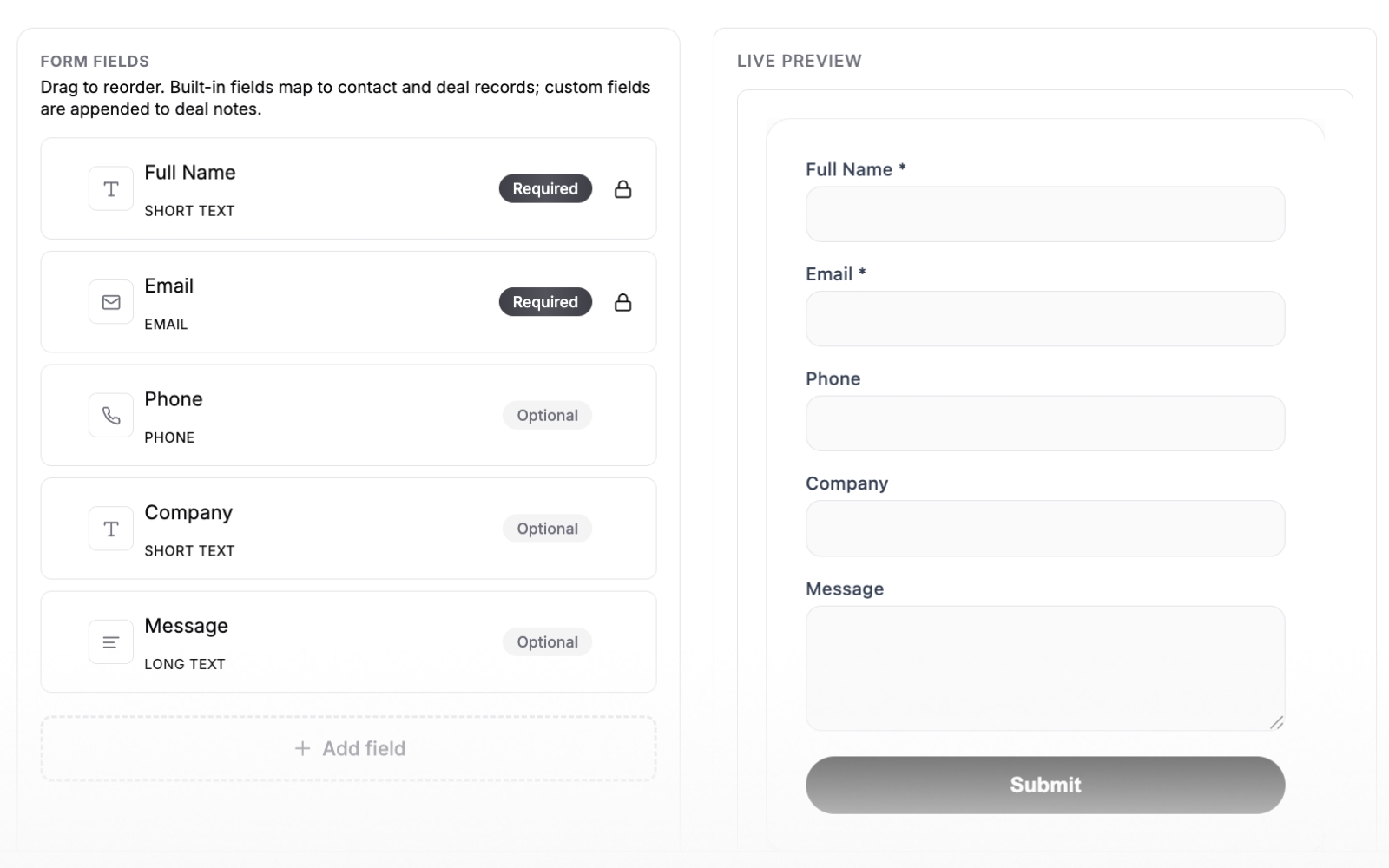
Two limits matter for this reader. A deal holds one contact, so a second co-owner goes in the notes or as a separate contact. Fluid CRM also has nothing for leases, rent or owner statements, which is why your property management software stays.
Best for: offices of one to five people that sign a few new owners a month and want them in one board.
Not for: firms that want calling, texting and office workflows in the same tool as the owner pipeline.
Cost for 3 seats: $48 a month, or $432 a year on annual billing.
2. LeadSimple, built for property managers
LeadSimple is the one tool here made for property management companies. It combines owner sales pipelines with process workflows for the office, and it connects to AppFolio, Buildium, Rentvine, Propertyware and Rent Manager.
The One plan is $199 a month month to month, or $169 a month on a 12-month commitment. It includes 50 doors, then each extra door is $2.49 a month, or $1.99 with the commitment, until you pass 250 doors.
One comes with 2 CRM sales pipelines, $30 a month for each extra one, and a monthly allowance of calling minutes and text credits. One Max is $499 a month, or $429 on a commitment, with 100 doors and unlimited pipelines.
Best for: firms that want owner leads, office workflows and calls in one tool that reads from their property management software.
Not for: a small office that only needs a pipeline and would rather not have the bill grow with every door it signs.
3. Pipedrive, for owner leads and realtor partners in separate pipelines
Pipedrive is a general sales CRM with deep reporting and a large app marketplace. A property manager can keep owner leads in one pipeline and realtor partners in another, then see which lead source signs the most doors.
Lite is $14 per seat per month and Growth is $39, both on annual billing, or $24 and $49 billed monthly. It has nothing built for property management, so leases and doors stay in your other software.
Best for: an office with a dedicated business development person who wants reports on every source.
Not for: a one-person office that will never open the reports.
4. HubSpot, for a two-person office that wants to start free
HubSpot‘s free CRM covers up to 2 users with no end date. That is enough for an owner and a leasing manager to log landlords and send emails from one place.
The third person is where it starts costing money. Sales Hub Starter is $20 per seat per month on monthly billing, and Professional is $90 per seat per month on annual billing with a required $1,500 onboarding fee.
Best for: a two-person office that may later send email newsletters to its landlord list.
Not for: teams of three or more that want every feature without moving up a plan.
5. Buildium, for running the doors you already manage
Buildium is property management software, not a sales CRM. It handles accounting, leasing, maintenance and an owner portal.
Essential starts at $62 a month, Growth at $192 and Premium at $400. Its prospect and applicant tools are for renters, so owner leads still need a home somewhere else.
Best for: small and mid-sized portfolios that need one system for units, leases, tenants and owner statements.
Not for: tracking which landlords to call back.
6. AppFolio, for larger portfolios
AppFolio prices per unit. Core starts at $1.49 per unit per month with a 50-unit minimum and a minimum spend, Plus starts at $3.20 and Max at $5.00.
Max adds a leasing CRM, which follows renters from inquiry to signed lease. Like Buildium, AppFolio is the right place for your doors and the wrong place to chase a landlord who said “maybe next spring”.
Best for: portfolios large enough that one system for every door saves real staff hours.
Not for: a new firm with a few dozen doors that cannot meet the minimum.
An Owner Acquisition Pipeline From Inquiry to Handover
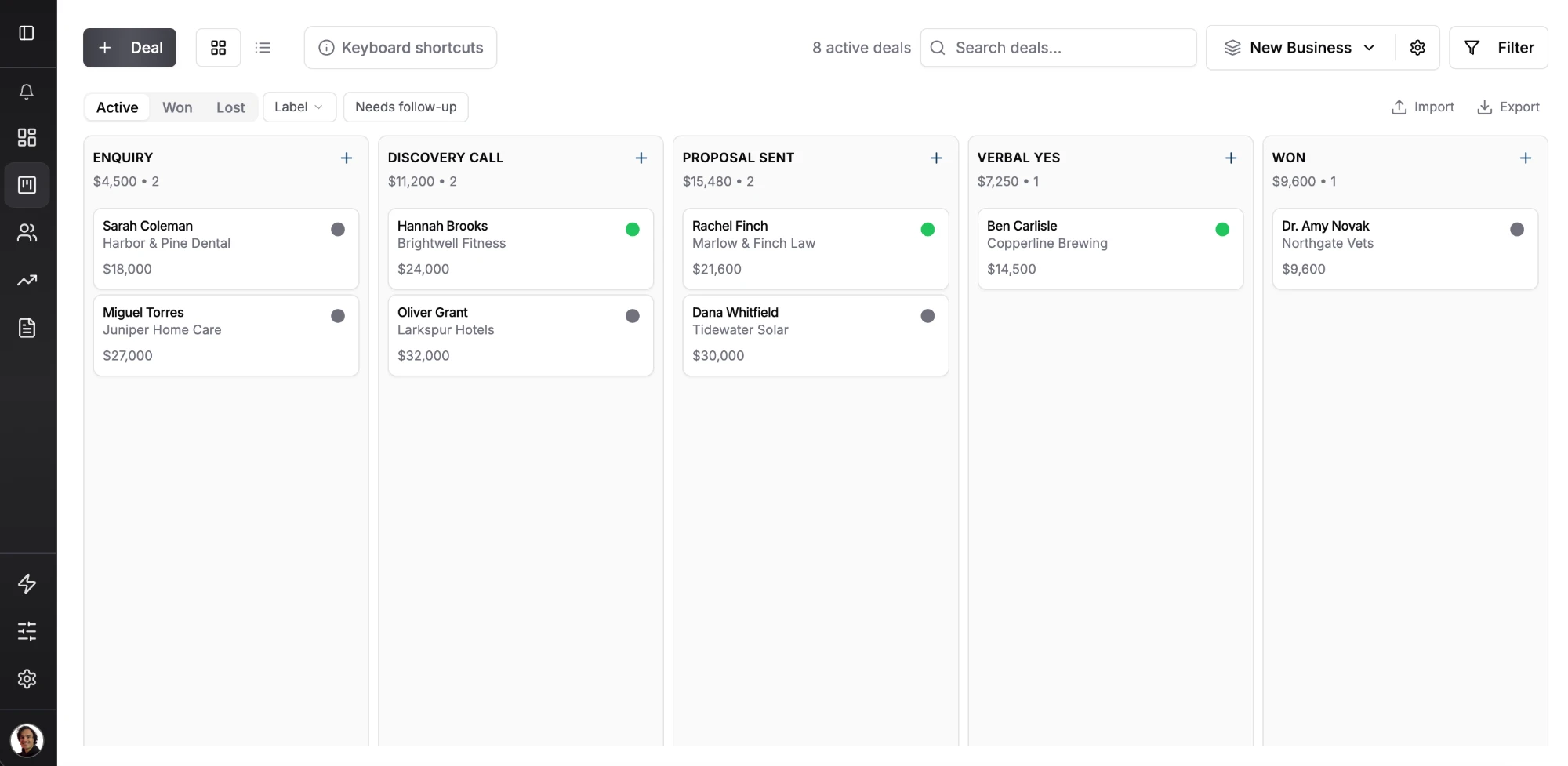
A pipeline only works if its stages match the way an owner actually decides. These six stages fit most small property management companies.
Six stages for an owner pipeline
- Inquiry. A form, a call or a referral came in. Reply the same day, because a landlord who asked three companies for numbers is reading all three replies. The speed to lead guide covers the first five minutes.
- Rental analysis sent. Your rent estimate and fee are with the owner.
- Walkthrough booked. You are seeing the property in person.
- Agreement sent. The management agreement is waiting for a signature.
- Not yet. The owner wants you, but a lease, a sale or a renovation is in the way.
- Signed. The owner is now a client and the doors move into your property management software.
Lost deals get marked as lost rather than kept as a stage, so the board shows only owners you can still win.
What to record on each owner deal
| Field | Type | Why it matters |
|---|---|---|
| Doors | Number | Tells you the size of the deal at a glance |
| Current rent per door | Number | Lets you work out your fee |
| Lease-end date | Date | Tells you when a “not yet” owner becomes a “now” |
| Managed today by | Text | Self-managed, another company or nobody yet |
| Lead source | Label | Realtor, website form, investor, past client |
| Deal value | The deal amount | Your yearly fee if they sign |
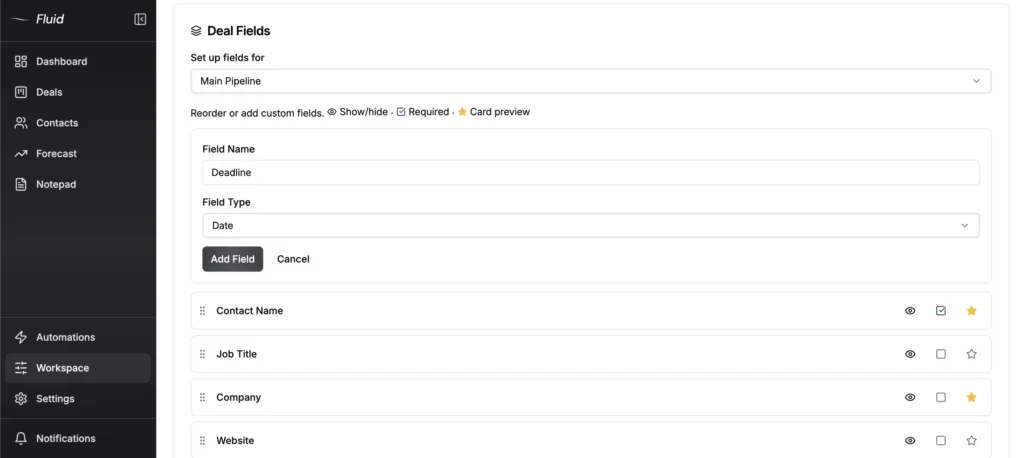
For deal value, use your own fee. As an example, four doors at $1,600 rent with an 8% fee come to about $512 a month, or $6,144 a year. The deal value on each card shows which owners are worth the extra call.
Record the lead source with a label.
A verified customer who coordinates a European coaching network wrote that “the label system is surprisingly powerful”, and he uses labels to record where each sign-up came from: “Labels track the referral route.” For a property manager that becomes Source:Realtor or Source:Website, and a filter shows which source signs.
Lease-End Dates Bring Back the “Not Yet” Owners
An owner rarely switches property managers in the middle of a lease. The moment comes at turnover, when the unit sits empty, the old manager is slow to re-let it and the owner pays for a month with no rent.
The self-managing landlord follows the same calendar. Plenty of them handle a quiet tenant fine and give up at the first vacancy, when they suddenly need photos, listings, showings and screening in the same two weeks.
Here is the setup in Fluid CRM. Move the owner to the Not yet stage, type the lease-end date into the date field and set the deal’s reminder for about 60 days before that date. The date field itself does not trigger anything; the reminder does, and the daily email puts that owner in your inbox on the right morning.
When the reminder comes up, ask whether the tenant is renewing and how much notice the current management agreement needs. If they are leaving another company, that notice period decides your real start date, so set the next reminder to match it.
Two other sources deserve the same habit. In my view, realtors who sell rentals to investors are the best referral partners a property manager can have, and the how to ask for referrals guide gives you the words. Your current owners buy more property too, so a light check-in every quarter keeps you the first company they call, as the keep in touch with clients post explains.
If you use Claude or ChatGPT, the MCP connector can log your walkthrough notes onto the owner’s deal from your phone before you leave the property. The record stays current even on days nobody opens the app.
What a 3-Person Office Pays in Year One
Every price below sits on top of the property management software you already pay for. Only the LeadSimple rows change with the door count, because LeadSimple also bills by the door.
| Tool | 150 doors, 3 seats | 250 doors, 3 seats |
|---|---|---|
| Fluid CRM, annual billing | $432 | $432 |
| Fluid CRM, monthly billing | $576 | $576 |
| HubSpot Sales Hub Starter, monthly billing | $720 | $720 |
| Pipedrive Lite, annual billing | $504 | $504 |
| Pipedrive Growth, annual billing | $1,404 | $1,404 |
| LeadSimple One, 12-month commitment | $4,416 | $6,804 |
| LeadSimple One, month to month | $5,376 | $8,364 |
The LeadSimple figures add the extra doors above the 50 included at $1.99 a door on the commitment and $2.49 month to month. LeadSimple’s published plans charge by the door, with no per-seat price, and calling or texting beyond the included allowance would come on top.
That is a fair trade for some firms, because LeadSimple does more than a pipeline. It is a poor one for a small office that only wants a list of owners to call, because the cost of that list rises with every client you sign.
Frequently Asked Questions
A leasing CRM tracks renters from inquiry to signed lease, and it usually sits inside property management software such as Buildium or AppFolio. An owner CRM tracks the landlords and investors you want as clients. Most small property management companies need the second one and already have the first.
Follow up about 60 days before their tenant’s lease ends, because turnover is when owners most often switch managers. Ask whether the tenant is renewing and how much notice their current management agreement needs. Then set the next reminder to match that notice period.
Both have prospect or leasing tools, but those are built for renters and applicants. Buildium lists Prospect Management under Leasing, and AppFolio’s leasing CRM sits on its Max plan. For owner leads, most firms add a separate sales CRM such as LeadSimple, Fluid CRM or Pipedrive.
For a three-person office, a general sales CRM costs about $432 to $1,404 a year. LeadSimple, which is built for property managers, runs about $4,400 to $8,400 a year at 150 to 250 doors because it also bills by the door. Your property management software is a separate cost on top.
Put Owner Leads in a CRM and Keep Leases Where They Are
Your property management software should keep the units, the leases and the owner statements. The owners you have not signed yet need their own pipeline, with a lease-end date and a reminder on every “not yet”. If that list still lives in a spreadsheet, a simple CRM like Fluid CRM puts every owner lead on one board with a reminder attached.
Start your 7-day free trial here, no credit card required.