
HoneyBook’s pricing page opens at $29 a month, and that figure is real. It is also the smaller part of the bill for anyone taking more than about $20,000 a year by card, because every client who pays through it pays a processing fee on the way in. This post prices a full year for a one-person photo studio, then walks through each plan and fee.
HoneyBook costs $29, $49 or $109 a month billed yearly, or $36, $59 or $129 billed monthly. Online card payments add 2.9% + 25¢ each and bank transfers 1.5%, so a year with $48,000 in card payments costs more in fees than any plan billed yearly. If you only track leads in it, Fluid CRM covers that job for $16 per seat per month.
Using HoneyBook mostly to keep track of inquiries?
Fluid CRM puts every inquiry on one pipeline and tells you each morning who needs a reply or a follow-up. Simple enough to check between shoots.
No card needed
What a Year of HoneyBook Costs Once Clients Pay Through It
Picture a solo portrait photographer who books 32 sessions a year at $1,500 each, so $48,000 goes through HoneyBook. She pays for Essentials at $588 a year, because she needs the scheduler for session bookings and automations to send prep emails without typing them each time.
The plan price stays the same all year. What changes is how her clients pay and whether she wants the money in minutes instead of days.
| How clients pay | Processing fees for the year | With the Essentials plan |
|---|---|---|
| Every invoice by online card | $1,400 | $1,988 |
| Card, plus instant deposit on every payment | $1,880 | $2,468 |
| Every invoice by bank transfer (ACH) | $720 | $1,308 |
The card row is 2.9% of $48,000 plus 25¢ on each of the 32 payments. Instant deposit adds 1% on each card payment, which is $15 on a $1,500 invoice and $480 over the year. Bank transfer is a flat 1.5%, with no per-payment charge.
One session invoice, three ways to get paid
On a single $1,500 invoice, a card payment costs her $43.75 and a bank transfer costs $22.50. Take the card money through instant deposit and the same invoice costs $58.75.
If she ran the card year on Starter instead, at $348 a year, her total would be $1,748, still four times the plan in fees. Card fees pass the $588 Essentials year at about $20,000 of card payments, so a studio billing more than that by card pays more in fees than for the Essentials plan.
What share of last year’s invoices did your clients pay by card? That one number decides most of your HoneyBook bill, far more than the plan you pick.
Some people pay that bill only to keep a list of inquiries. If that is you, a solopreneur CRM does the tracking part without payment tools you never use.
HoneyBook Plans and Prices, Billed Monthly or Yearly
HoneyBook sells three plans. Each one includes unlimited clients and projects, and HoneyBook says it never charges more for adding leads, projects or clients.
| Plan | Billed yearly, per month | Billed yearly, per year | Billed monthly | Monthly billing over 12 months | What it adds |
|---|---|---|---|---|---|
| Starter | $29 | $348 | $36 | $432 | Invoices, payments, proposals, contracts, client portal, up to 2 live lead forms |
| Essentials | $49 | $588 | $59 | $708 | Scheduler, automations, QuickBooks Online, up to 2 team members, up to 10 live lead forms, SMS reminders |
| Premium | $109 | $1,308 | $129 | $1,548 | Unlimited team members, multiple companies, priority support, unlimited live lead forms |
Yearly billing saves $84 on Starter, $120 on Essentials and $240 on Premium. HoneyBook describes it as two months free, and you pay the whole year up front.
Every plan starts with a 30-day free trial and no credit card. After you subscribe there is a 60-day money-back guarantee, and you can move up or down a plan whenever you like.
HoneyBook Transaction Fees on Every Payment
HoneyBook’s processing fee comes out of each payment before the money reaches your bank. Its pricing page leads with “Card fees start at 2.7% + 10¢”, but that rate is for tap to pay in person, and an invoice paid online by card costs more.
| Payment type | Fee | On a $1,500 payment |
|---|---|---|
| Card, paid online | 2.9% + 25¢ | $43.75 |
| Tap to pay, in person | 2.7% + 10¢ | $40.60 |
| Bank transfer (ACH) | 1.5% | $22.50 |
| Instant deposit, eligible card payments up to $5,000 | 1% extra, $5 minimum | $15.00 extra |
There is one more card rule at the top end. Premium accounts that process more than $500,000 a year may qualify for lower card fees, which matters mainly to a busy event business.
Who pays the fee, you or the client
You do, unless you switch it on. HoneyBook has a setting, for US members only, that adds the processing fee to the client’s total at checkout on eligible payments. Card surcharges are limited or banned in some states, so check your state’s rules before you turn it on.
The fee follows the card, not the app
Any tool that takes card payments pays a processor, so leaving HoneyBook does not make that line disappear. What lowers it is asking for bank transfer on your larger invoices, which nearly halves the fee in the table above.
Which HoneyBook Plan Fits, by the Limit You Hit First
Each HoneyBook plan has one limit that pushes people to the next. Find the limit you hit first and you have your plan.
Starter, for one person with a simple booking process
Starter has everything needed to send a proposal, get a contract signed and collect payment. Its limits are 2 live lead forms, a scheduler capped at one session with email-only reminders, and no automations.
A web designer who quotes each project by hand and never books calls through a calendar can live on Starter for a long time. Our best CRM for web designers comparison shows how studios like that track quotes.
Essentials, when clients book sessions or a second person joins
Essentials is where unlimited scheduling, automations, SMS reminders and the QuickBooks Online link live, and it allows up to 2 team members. If clients book sessions with you, this is the realistic plan. Coaches who sell session packages can compare other tools in our CRM list for coaches.
It also removes the “Powered by HoneyBook” line from what clients see. For a studio that cares how its client pages look, that alone can justify the extra $240 a year over Starter.
Premium, for a bigger team or a second company
Premium makes sense when your team outgrows the 2 team members Essentials allows, or when you run two businesses from one account. At $1,308 a year it costs more than twice Essentials, so check that one of those two is true before you pay for it.
Is HoneyBook Worth It for How You Actually Work?
HoneyBook is worth it when a client signs and pays in one place. One link holds the proposal, the contract and the first invoice, and that saves real back-and-forth on every booking.
It is a poor deal when the pipeline is the only screen you open. You pay $348 to $588 a year for a pipeline board and 2 to 10 lead forms, while your contracts go out from another app and your invoices come from your accounting software.
What a pipeline-only user is really buying
Kyler Thompson runs Knight Theory, a solo creative studio, and tried a long list of CRMs before landing on Fluid CRM.
“Other CRMs force so many unneeded features onto me in the name of being an all-in-one.”
What he wanted was a way to track leads, plus forms that made intake easy.
Fenixtal, my outbound agency, booked 1,250+ sales calls, and getting a prospect to agree to a call was the part clients paid for. The leads they lost afterwards were rarely weak ones. They were the ones left in a tool nobody opened that week.
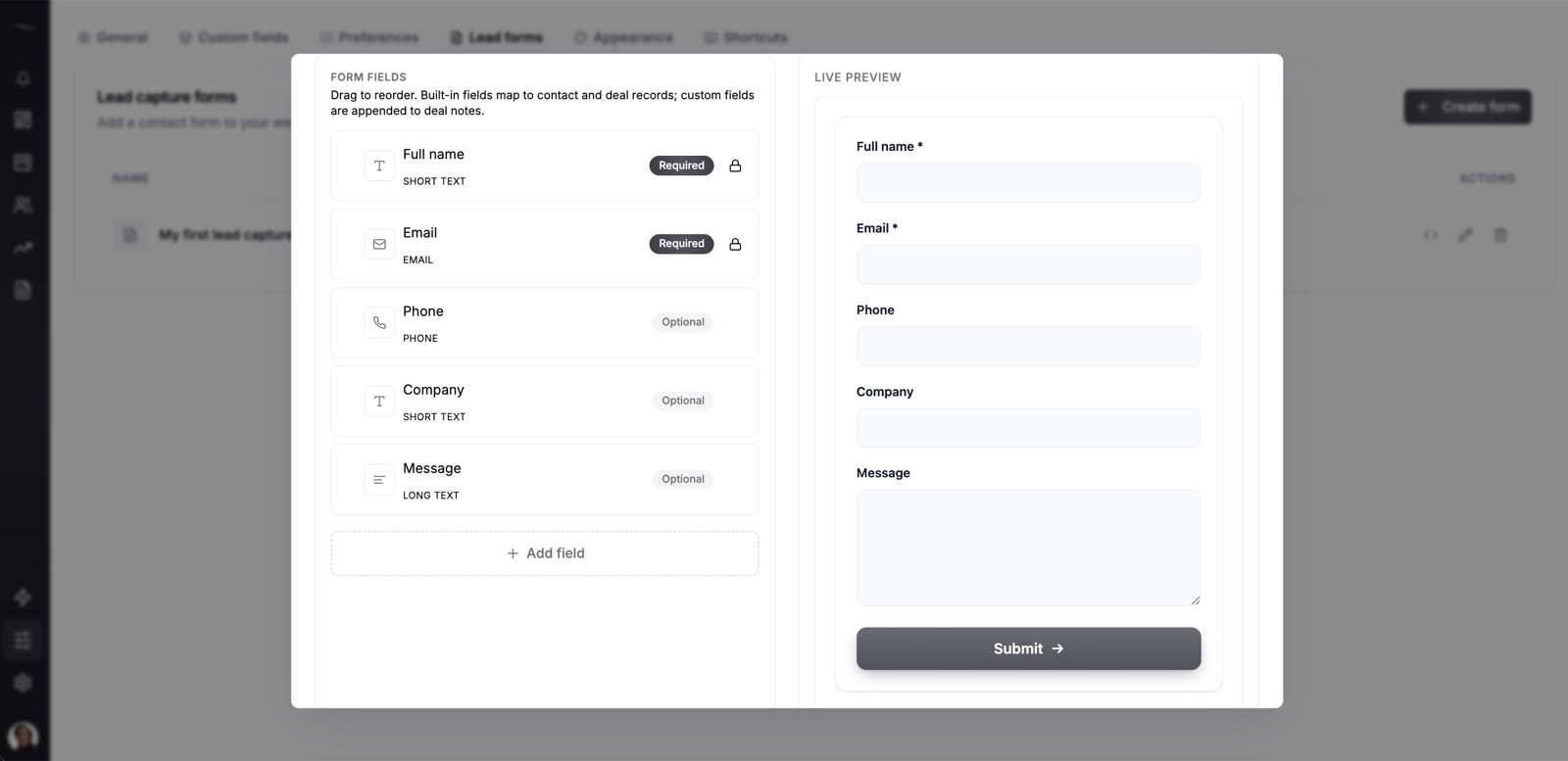
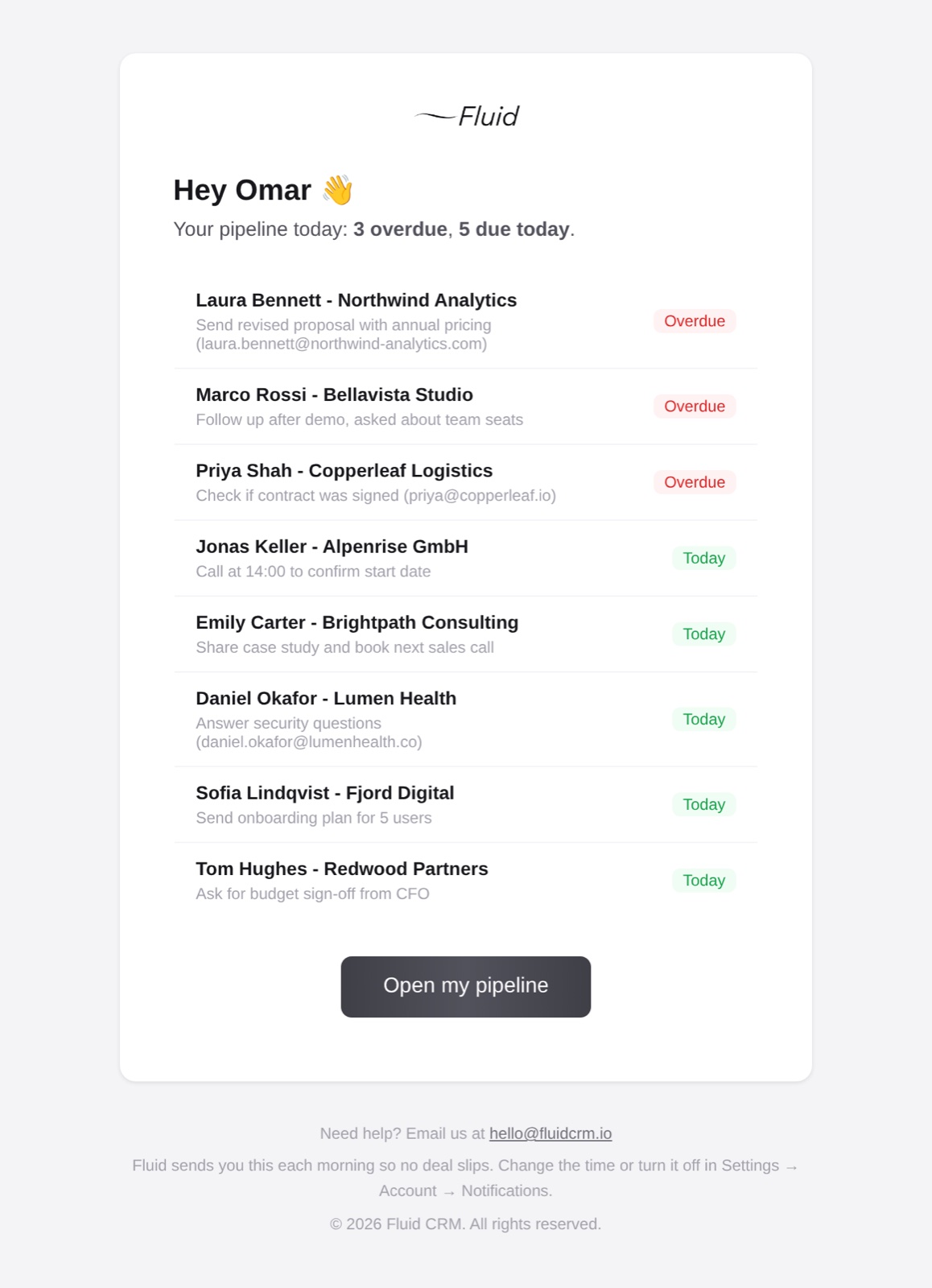
Fluid CRM is built for that pipeline part only. A lead capture form puts each inquiry on a visual pipeline as a deal, each deal holds a reminder date you set, and a daily email lists what is overdue and due today.
The morning email matters most for a studio owner who is out shooting all day. You see which inquiries need an answer before you open any app.
The pipeline from this post
Every inquiry, and when to follow up
- Inquiry
- Consult
- Proposal
- Follow-up
- Booked
Rivera family session
Set your stages up like this and let your lead form add each inquiry. Each morning’s email tells you which ones need an answer.
7 days free, no card
“I had been looking for an easy to use, intuitive CRM that would help me organize my leads.”
Alejandra Andrade, a travel agent who sends a lot of quotes
Fluid CRM costs $16 per seat per month or $144 per seat per year, with every feature in one plan and a 7-day free trial, no credit card required. For one person that is $144 a year for the pipeline part alone.
Two limits matter here. Fluid CRM has no contracts, invoices or payments, so if your clients sign and pay through HoneyBook, it is not the tool for that job. There is also no free plan.
If you are weighing a full move, our post on HoneyBook alternatives sorts the options by the job each one does. The wider market for solo sellers is covered in our best CRMs for freelancers list. If Dubsado is the swap you are weighing, see what Dubsado costs over a full year.
HoneyBook Pricing FAQ
HoneyBook has no free plan. Every plan starts with a 30-day free trial with no credit card, and paid plans come with a 60-day money-back guarantee.
Starter costs $36 a month billed monthly or $29 a month billed yearly. Essentials costs $59 or $49 and Premium costs $129 or $109. The yearly price is paid up front for the whole year.
Online card payments cost 2.9% + 25¢, tap to pay in person costs 2.7% + 10¢ and bank transfers cost 1.5%. Instant deposit adds 1% on eligible card payments up to $5,000, with a $5 minimum.
Yes, if you are in the US. HoneyBook has a setting that adds the processing fee to the client’s total at checkout on eligible payments. Card surcharges are restricted in some states, so check the rules where you work first.
If clients book sessions or calls, Essentials, because unlimited scheduling and automations start there. If you send proposals and invoices by hand and need two lead forms or fewer, Starter covers it.
Price Your Own HoneyBook Year Before You Subscribe
Before Fluid CRM, I booked 1,250+ sales calls for B2B companies at my outbound agency. Again and again, I saw small businesses struggle with messy spreadsheets and slow, overly expensive CRMs.
So we built Fluid CRM for the part before a client signs: every inquiry in one place, and a morning email that tells you who to follow up. One plan, $16 a month, everything in it.
Omar Abdalla, founder of Fluid CRM
Start your free weekPull three numbers from last year: what you billed, what share clients paid by card and how many people need a login. Those three set your real HoneyBook cost, and for a studio paid mostly by card the plan is the smaller part of it.
If the answer shows you mostly use HoneyBook to track inquiries, Fluid CRM is a solopreneur CRM that does that one job and leaves payments to the tools you already have.
Start your 7-day free trial here, no credit card required.