

You have two tabs open and both pricing pages look reasonable. The problem is that neither number is the number you will actually pay. One vendor charges you again for tools that sit outside the seat, and the other decides how long you are staying before you know whether anyone opens it.
Pipedrive costs $14 to $79 per seat per month on annual billing and sells a monthly option at every tier. Salesforce starts free, then runs $25 to $550 per user per month, and is billed annually above the entry plan. Fluid CRM is the one to look at when a team under 20 wants one plan with everything already in it.
Most comparisons of these two put the features side by side and stop. I want to do the boring version instead, because the feature grid is not what decides this. What decides it is what each vendor charges on top of the seat, and whether you can still leave next month once you are past the entry plan.
We run Fluid CRM and before that I ran Fenixtal, a B2B outbound agency with 50+ clients and 12M€+ pipeline. Marketing agencies, web design studios, consultants, construction firms. Almost none of them had a CRM anyone actually opened, and the ones paying the most were often the worst offenders.
What Pipedrive Costs In 2026
Pipedrive runs four tiers and prices them per seat. Annual billing gets you Lite at $14, Growth at $39, Premium at $59 and Ultimate at $79 per seat per month.
Pay monthly and the same four tiers cost $24, $49, $79 and $99 per seat. The entry plan is about 70% more expensive if you want the freedom to cancel, which is a real trade rather than a rounding error.
There is no free plan. The trial is 14 days and takes no credit card.
The part that catches people is what sits outside those tiers. LeadBooster and Smart Docs are $32.50 a month each on annual billing, and both are billed per company rather than per seat.
Web Visitors is $41 a month and Campaigns starts at $13.33, both on annual billing. Pipedrive also sells a Projects add-on, priced separately.
Two of those never come bundled at any tier, no matter how much you spend. Campaigns and Web Visitors stay separate line items forever. LeadBooster and Smart Docs do get folded into Premium and Ultimate, which is where the upgrade maths starts to matter.
Here is the crossover. On annual billing, LeadBooster plus Smart Docs is $65 a month against a $20 per seat gap between Growth and Premium. Below four seats you are better off upgrading, and at four or more the add-ons win.
If HubSpot is the other tab you have open rather than Salesforce, I ran the same exercise in the Pipedrive vs HubSpot cost comparison.
What Salesforce Costs In 2026
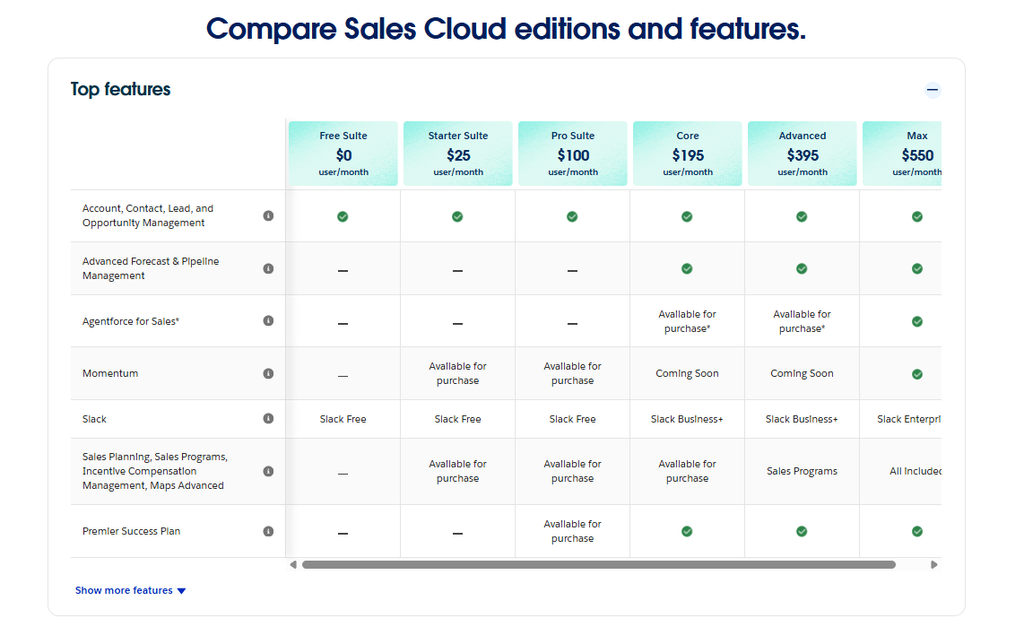
Salesforce runs six steps and the ladder is steeper than most people expect.
Free Suite is $0. Starter Suite is $25 per user per month, Pro Suite is $100, Core is $195, Advanced is $395 and Max is $550.
Salesforce Starter and Pro are Suite products, while Core, Advanced and Max are Sales Cloud editions. The pricing page shows them as a single ladder, which is not quite what they are.
The billing terms decide more than the price does for a small team. Starter Suite can be billed monthly or annually, and every tier above it is billed annually, in advance.
Pipedrive and Salesforce both sell annual contracts, and the difference between them is not the one most comparisons name. Pipedrive annual is also a one-year commitment.
What Pipedrive gives you is a monthly option at every single tier, where Salesforce offers one only at the $25 entry level. A team that wants a proper CRM and wants to stay month to month has four ways to do that with one vendor and one way with the other.
Pipedrive vs Salesforce: What 5 Seats Actually Cost
Two seat ladders side by side tell you very little. So here is the same team, five people, over twelve months.
| Setup | Year one |
|---|---|
| Fluid CRM, annual | $720 |
| Salesforce Starter Suite | $1,500 |
| Pipedrive Growth, annual | $2,340 |
| Pipedrive Growth plus LeadBooster and Smart Docs | $3,120 |
| Pipedrive Premium, annual | $3,540 |
| Salesforce Pro Suite | $6,000 |
What separates those rows is almost entirely what sits outside the seat. Two Pipedrive rows are the same product with two add-ons attached, and the Salesforce rows buy configurability and a permissions model rather than a better pipeline.
None of it changes whether anyone opens the thing on a Tuesday morning. That is the part worth sitting with, because the licence is rarely the expensive line.
A quote that never gets chased, a warm reply that goes unanswered for nine days, a deal that stalls because nobody could see it had stalled. Those cost more in a quarter than the gap between any two rows in that table costs in a year.
Who Should Buy Pipedrive And Who Should Buy Salesforce
Pipedrive and Salesforce are both good products. They are built for different companies and the mistake is buying the wrong one for your size, not buying a bad one.
Buy Pipedrive if
You are running a genuine multi-stage pipeline with handoffs and you want workflow automation without hiring anyone to configure it. You have also looked at the add-on list and decided you can live with the ones you need.
Pipedrive is a sales tool built by people who understand sales, and at Growth on annual billing it is fairly priced for what it does.
Buy Salesforce if
You have a real sales organisation rather than a sales team. You need custom objects, deep reporting and a permissions model that survives an audit. You have somebody whose actual job includes administering it, and a twelve-month commitment is not a risk you are carrying personally.
If that describes you, buy Salesforce and do not let anyone talk you into something lighter. I would not put a 30-person sales floor on a simple CRM. The migration when it breaks costs more than the licences you saved.
For the middle ground, I went through the 8 Salesforce alternatives for small business separately.
When Pipedrive And Salesforce Both Miss For A Small Team
Some teams do not need either Pipedrive or Salesforce, and no comparison post says so. You are four people, you need to know what happens next on twenty deals, and both of these are solving a problem you do not have yet.
A CRM only earns anything on the days it gets opened, and signing a longer contract has never once made a team open something. How many of the deals you have open right now are waiting on you, and would you know without asking someone?
Fluid CRM is one plan at $16 per seat per month, or $144 per seat per year if you pay annually. Every feature is in it. There are no tiers to climb and nothing sitting outside the seat price waiting to be added later.
Hanna-Maria Ojala runs Menestyvä Myynti, a Finnish sales coaching business, and came to Fluid CRM from Pipedrive.
“I previously used Pipedrive. What I like most about Fluid is how clear and structured everything feels. It’s simple to see where each deal stands and what needs to happen next.”
I would rather you not buy this than buy it and churn, so here is where it stops.
Fluid CRM is not a small Salesforce. Lead scoring, marketing automation, multi-touch attribution and a built-in dialer are all missing.
Email is logged by BCC, not synced two ways. There is no free plan either, and it fits teams under about 20 people.
It is also the wrong shape for some work entirely. Anton Salmi, a verified customer, uses it for project-based work rather than sales and has asked to rename Deals to Projects.
That request tells you exactly where the edge is. If your pipeline is really a delivery board, a CRM is not what you are shopping for.
Pipedrive vs Salesforce: Common Questions
At the entry level, no. Salesforce Starter Suite is $25 per user per month against Pipedrive Lite at $14 on annual billing, but Starter includes service and marketing tools that Lite does not. Above entry level Pipedrive is far cheaper, with Ultimate at $79 per seat against Salesforce Pro Suite at $100.
Only on Starter Suite, which can be billed monthly or annually. Pro Suite, Core, Advanced and Max are all billed annually in advance.
LeadBooster and Smart Docs are $32.50 a month each on annual billing, Web Visitors is $41 and Campaigns starts at $13.33. All four are billed per company rather than per seat. Premium and Ultimate include LeadBooster and Smart Docs, while Campaigns and Web Visitors stay separate at every tier.
Under about ten people, usually not. You pay for configurability you will not use and an admin burden you will feel immediately. Starter Suite at $25 is genuinely reasonable if you want service and marketing in the same place, but Pro Suite at $100 per user is priced for a company with a sales operations function.
Choosing Between Pipedrive And Salesforce
Pick Salesforce if you have a sales organisation and someone to run it. Pick Pipedrive if you have a real pipeline, a few people working it and no appetite for an admin.
If both feel like buying a delivery van to do the weekly shop, that is worth listening to, and the 8 best Pipedrive alternatives for small teams covers the lighter end properly. Fluid CRM exists for the team that wants to open something on Monday morning and see what needs doing, without a project to set it up first.
Start your 7-day free trial here, no credit card required.