

Most small teams set a sales quota at the start of the quarter and look at it again when the quarter is over. By then the number is history and nothing can change it. Quota attainment is worth tracking while there is still time to act on it.
Quota attainment is closed revenue divided by quota, times 100. Bridge Group found 48% of account executives reach quota. Track it per person each month, check pace mid-quarter and set quota at a ratio to on-target earnings (OTE) your margins can pay, with the deals kept in a CRM like Fluid CRM.
This guide covers the formula with a worked example, the benchmarks worth trusting, a mid-quarter pace check and how to pick a quota-to-OTE ratio for a team of 1 to 10 sellers.
How to Calculate Quota Attainment (Rep, Team and Share at Quota)
Quota attainment is the share of a sales target that a person or a team has closed in a set period, usually a month or a quarter.
Quota attainment = closed-won revenue in the period ÷ quota for the period × 100
Three different numbers go by the same name. Rep attainment is one seller’s closed revenue against their own quota. Team attainment is everyone’s closed revenue against the team’s total quota, and the share of reps at quota is how many people reached 100% out of everyone who carries one.
Here is a made-up team of three sellers, each with a quarterly quota of $60,000.
| Seller | Quarterly quota | Closed-won revenue | Attainment |
|---|---|---|---|
| Ana | $60,000 | $90,000 | 150% |
| Ben | $60,000 | $48,000 | 80% |
| Cleo | $60,000 | $35,000 | 58% |
| Team | $180,000 | $173,000 | 96% |
Team attainment is $173,000 divided by $180,000, which is 96%. Now count heads. Only Ana reached 100%, so the share of reps at quota is one in three, or 33%.
The same quarter reads as nearly on target or as a failure, depending on which number you report. Neither is wrong. The team total tells you whether the business hit its plan, and the per-person rows tell you that one seller carried the quarter.
Decide once what counts as closed and write it down. Our rule is the date the client signs, not the date the invoice is paid, because a seller controls the signature and not the client’s accounts team. Every deal also needs an owner, a value and a close date in one place, which is the job of a CRM for small sales teams.
If you would rather not do the sums by hand, our free quota attainment calculator works them out per seller.
Quota Attainment Benchmarks: What a Good Rate Looks Like
The figure most guides give as a good quota attainment rate is 80% of sellers at quota. QuotaPath recommends exactly that. The measured number is closer to half.
| Source | Who was studied | What they found |
|---|---|---|
| Bridge Group AE report | Sales leaders at 158 B2B companies | 48% of account executives reached quota |
| Salesforce State of Sales, sixth edition | 5,500 sales professionals | 67% did not expect to meet quota and 84% missed it the year before |
| Ebsta B2B Sales Benchmarks, mid-year update | 1.2 million+ opportunities | 75% of reps missed quota in the quarter studied and 16% of reps brought in 83% of revenue |
The numbers differ because they measure different things. Bridge Group asks sales leaders what share of their reps reached quota, Ebsta counts reps in a single quarter and the figure of about a quarter in our list of verified sales statistics counts reps who say they hit it consistently.
The common rule is that if 90% or more of your sellers hit quota every period, the quota is too low and you are paying commission on revenue that would have come anyway. That line only works for bigger teams, though. With three sellers, the share at quota can only be 0%, 33%, 67% or 100%, so one seller missing by a single deal moves the share by a full third.
My rule for a small team is simpler. Track attainment per person over four quarters and look at the average. If nobody hits quota two quarters running, the quota is wrong and not the people.
How to Tell Mid-Quarter If You Will Hit Quota
Checking attainment only at the end of the quarter is like reading the fuel gauge after the car has stopped. A pace check halfway through gives you weeks to do something about it.
Pace = attainment so far ÷ share of the quarter gone
Say a team with a $180,000 quarterly quota is at the end of week 6 of a 13-week quarter, so 46% of the quarter is gone. It has closed $70,000, which is 39% attainment. Divide 39 by 46 and the team is on pace for about 84% if nothing changes.
Pace assumes deals arrive evenly, and they rarely do. So add the open deals you expect to close before the quarter ends, weighted by their chance of closing. If those come to $60,000, the expected quarter is $130,000, or 72% of quota, and the team knows it needs $50,000 more.
Our guide to sales forecasting for small teams shows how to weight each deal. Whether the whole pipeline is big enough to cover next quarter’s quota is a separate check, and it belongs before the quarter starts rather than in week 6.
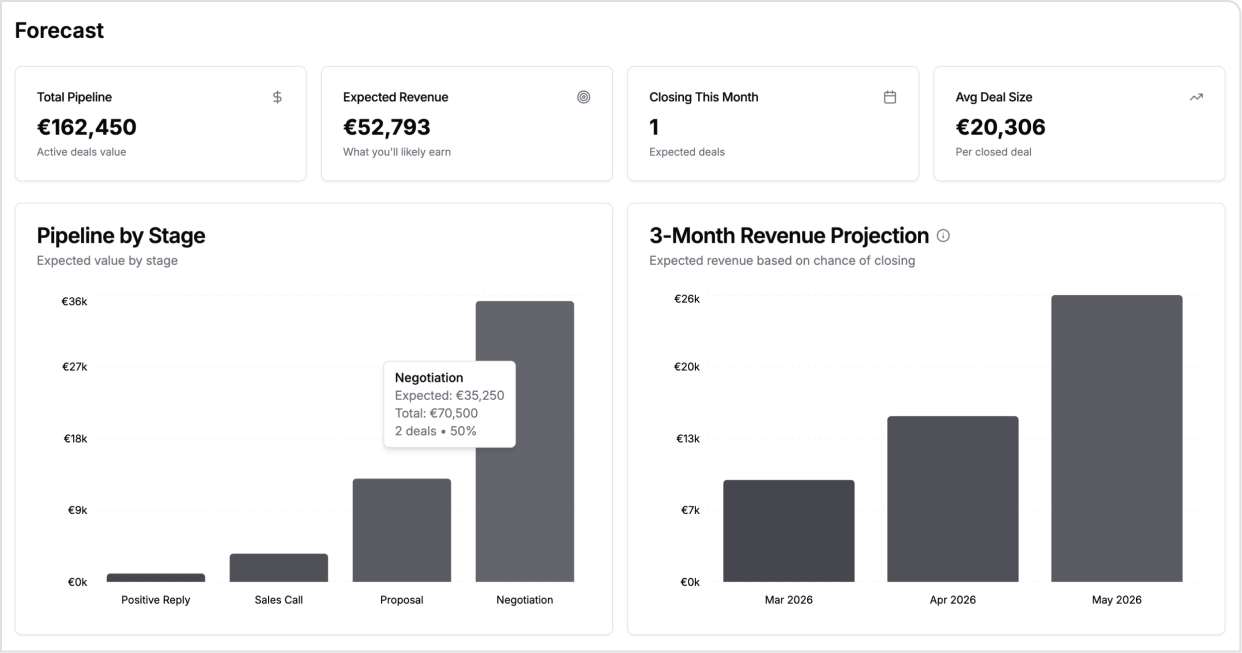
Can you name the three open deals that decide this quarter without looking them up? If you can’t, start there. The weekly sales pipeline review is the 30-minute meeting where a small team looks at pace and those deals together.
The Quota-to-OTE Ratio: How Much Quota a Salary Should Carry
OTE means on-target earnings, the base salary plus the commission a seller earns at exactly 100% of quota. The quota-to-OTE ratio says how many dollars of revenue the seller should close for every dollar of that pay.
Quota-to-OTE ratio = annual quota ÷ OTE
Bridge Group’s AE report puts the median quota-to-OTE ratio for account executives at 4.6 times, and its median OTE is $200,000.
Here is the problem with copying it. A ratio of 4.6 means paying about 22% of new revenue to the person who closed it, which works for a software company with little cost of delivery. An agency or consultancy that spends half of each contract delivering the work cannot afford the same share.
So work it out from the other end. Decide what share of new revenue you can spend on the seller’s pay, then divide 1 by that share.
| Share of new revenue paid as OTE | Quota-to-OTE ratio | Annual quota on a $90,000 OTE |
|---|---|---|
| 10% | 10x | $900,000 |
| 15% | 6.7x | $600,000 |
| 20% | 5x | $450,000 |
| 25% | 4x | $360,000 |
| 33% | 3x | $270,000 |
A founder hiring a first salesperson at $90,000 OTE who can spend 20% of new revenue on sales pay sets an annual quota of $450,000, or $112,500 a quarter. If that looks impossible next to last year’s sales, the hire is too early or the OTE is too high, and it is cheaper to find out on paper.
The free OTE calculator splits OTE into base and commission. If you are setting a quota from scratch, the sales quota calculator starts from the deals you can actually close.
Why Low Attainment Is Usually a Pipeline Problem
When attainment drops, the easy story is that the sellers got worse. My experience says otherwise. At Fenixtal we booked 1,250+ sales calls for B2B clients, and when a client missed its numbers the cause was rarely the person on the call.
It was the leads afterwards, sitting in a spreadsheet or a CRM nobody opened, with no next step and no date. A seller cannot close a deal they forgot about. Attainment is the last number in a chain that starts with how many deals move each week, and our post on pipeline velocity breaks that chain into its four inputs.
We built Fluid CRM for that part of the job. Every deal sits on one shared board with an owner, a value and a reminder. Reports and a revenue forecast come with the one plan, at $16 per seat per month or $144 per seat per year.
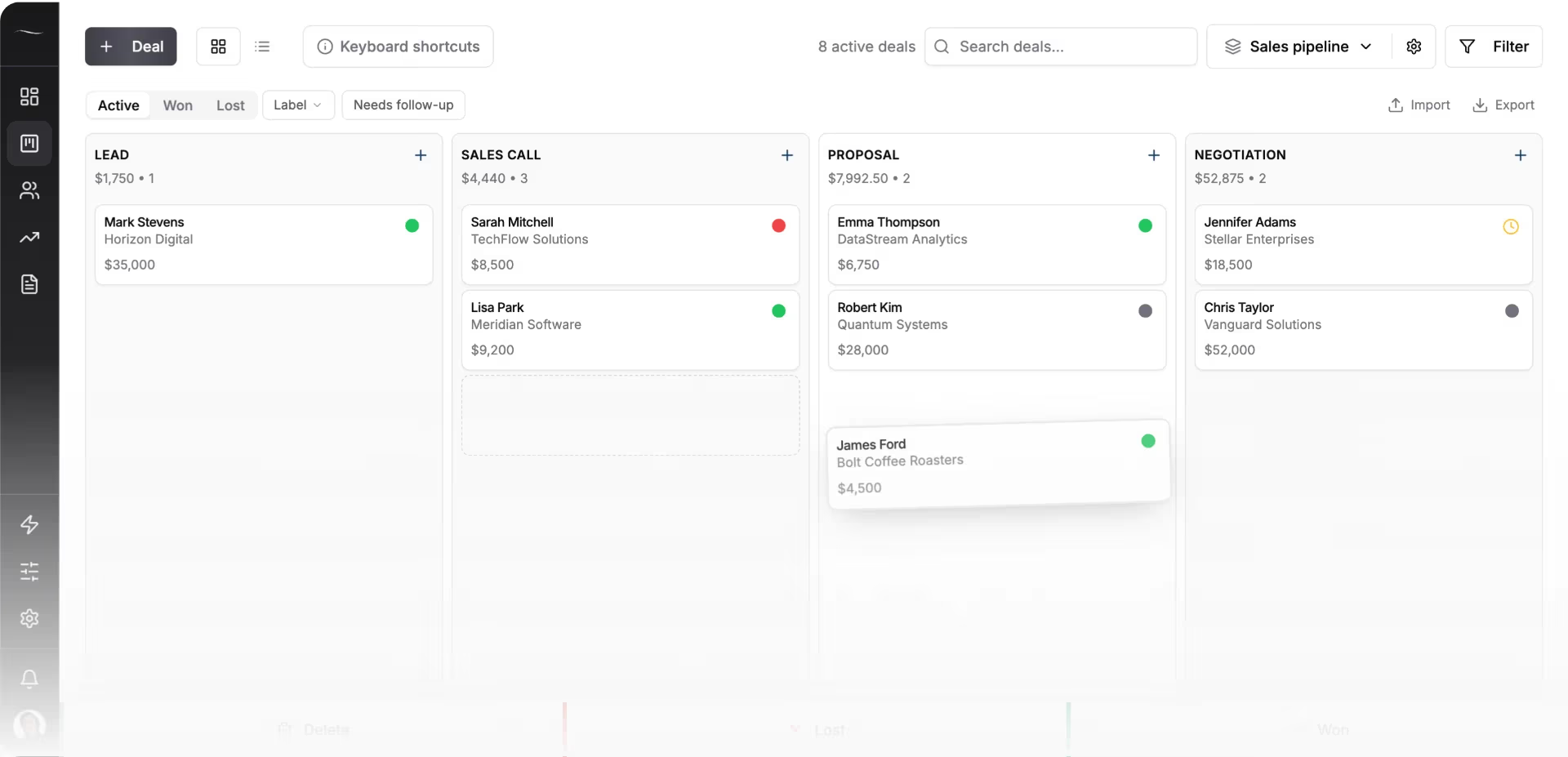
Fluid is not a quota or commission tool, though. It has no quota field per seller and does not calculate pay. Keep attainment in the calculator or a simple sheet, and use the CRM to keep the deals behind it moving.
When a Small Team Should Skip Quotas
Quotas are a tool for a team with enough deals for an average to mean something. Some teams do not have that, and a quota there does more harm than good.
Skip it if one or two people sell and the founder still closes most deals. Skip it if you close fewer than about five deals a quarter, because one deal slipping into the next quarter swings attainment by 20 points or more and teaches nobody anything.
A seller working alone needs a clear next step on every deal more than a target. Doland White, an executive coach and founder of DWC, tracks his prospects and clients in one pipeline and described the change like this.
“Fluid ended the wasted effort. I go faster, and I can plan my client actions with clarity.”
In those cases, set a monthly target for what a seller controls instead, such as new deals created or proposals sent. Bring in a revenue quota once a second or third seller is closing on their own.
Quota Attainment FAQ
QuotaPath recommends that 80% of sellers reach quota, but Bridge Group found 48% of account executives actually doing it. For a small team, aim for a quota most sellers reach in most quarters. If nobody reaches it two quarters running, lower it.
Add up the closed-won revenue of every seller and divide it by the sum of their quotas, then multiply by 100. Report the per-seller figures next to it, because a team total can hide one person carrying everyone else.
Bridge Group’s median for account executives is 4.6 times. A small B2B team should work its ratio out from what share of new revenue it can spend on sales pay. Paying 20% gives 5 times and paying 25% gives 4 times.
The usual rule is to count a deal on the date the client signs, because that is the part the seller controls. If your clients often cancel before paying, count paid invoices instead. Pick one rule and keep it for every seller.
What to Set Up Before Next Quarter Starts
Write down what counts as closed, track attainment per person every month and check pace at the halfway mark. Pick a quota-to-OTE ratio your margins can pay rather than the one a software company uses. If your deals are still spread across inboxes and spreadsheets, start with a CRM for small sales teams like Fluid CRM, so every deal has an owner and a date.
Start your 7-day free trial here, no credit card required.