

Most small teams already have a pipeline review, and it is the Monday meeting where each person reads their deals aloud while everyone else waits for their turn. Nothing gets decided, so the board looks the same on Tuesday. A useful review is shorter and it ends with a date on every deal you talked about.
A sales pipeline review is a 30-minute weekly meeting where a team of 2 to 10 goes through its open deals and decides, for each one that needs it, the next step, its date and its owner, or closes it as lost. One shared board in a tool such as Fluid CRM is all you need on screen.
What a Sales Pipeline Review Is and Who Should Be in the Room
Most advice on this topic is written for companies with sales managers. Salesforce, for example, tells managers to cancel the team-wide review and meet each rep one to one. That makes sense with 40 reps and it makes no sense with four people, because the team-wide review is the only one you have.
On a small team, do it together. Everyone who owns a deal is in the room, including the founder if the founder sells. One person keeps time and one person updates the board while you talk, and they can be the same person.
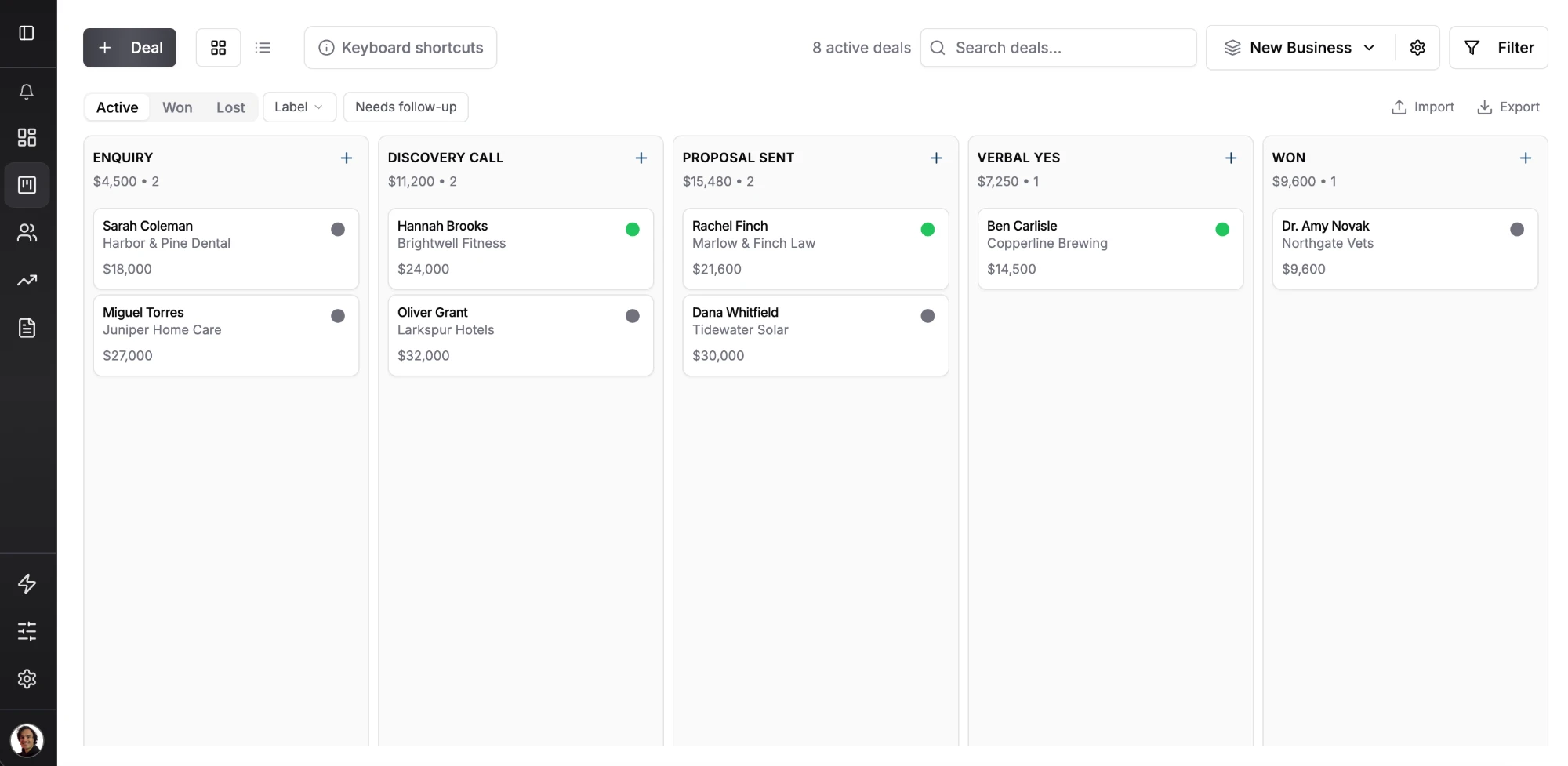
Doing it together has a second benefit that big teams do not need. When four people hear the story of every important deal once a week, any of them can pick up the phone if the owner is sick or on holiday. That shared view is the main thing a sales CRM for small teams is for.
It also helps to be clear about what the meeting is not. A pipeline review is not a forecast call, which asks how much money will come in and when, and our guide to sales forecasting for small teams covers that. It is not a performance review either, because people hide weak deals the moment the meeting starts to grade them.
Four Details Every Deal Needs and Five Ground Rules
A review only works if the board is roughly true before you sit down. That takes four details on every deal and no long form. I would treat them as a meeting rule and not as something the software forces.
- An owner. One name, even if two people are working the deal.
- A value. A rough number is fine, and a blank is not.
- A stage. The stage shows what the buyer last did.
- A next step with a date. “Follow up” with no date does not count.
A deal that is missing one of the four does not get discussed until its owner fixes it. Resist the urge to add a fifth and a sixth detail. Every extra box makes the daily update slower, and our post on CRM data entry shows how to cut the boxes you already have.
Stages need the same discipline. Everyone on the team should give the same answer when asked why a deal sits where it does. Here is a simple set of stages with one rule each.
| Stage | What has to be true |
|---|---|
| Enquiry | A real person asked about working with you |
| Discovery call | A call is booked with a date and a time |
| Proposal sent | The buyer asked for a proposal and has it |
| Verbal yes | The buyer said yes and the paperwork is not signed yet |
| Won | The contract is signed or the first invoice is paid |
If your stages need more thought than that, the full method is in our guide to sales pipeline stages. With the details and the stages agreed, five ground rules keep the meeting short.
| Rule | What it means on a small team |
|---|---|
| The board is the agenda | No slides and no spreadsheet export. You look at the live board |
| Update before, decide during | Each person spends two minutes on their own deals before the meeting |
| Only deals that need a decision | A deal with a next step booked for Thursday is skipped |
| Every deal leaves with a date | Or it leaves the board |
| Nobody is graded | A person who says “this one is dead” has helped the team |
If the board is never up to date when the meeting starts, I would look at the tool before I looked at the people. When an update takes a minute a deal, nobody does it, and that is one of the reasons in our post on why your team won’t use the CRM.
The 30-Minute Pipeline Review Meeting Agenda
Hold the review on the same day and at the same time every week. Monday morning works because the week’s reminders are still ahead of you. Here is the agenda, and you can copy it as it is.
| Minutes | What happens | What you leave with |
|---|---|---|
| 0 to 3 | Read back last week’s promises | Each one is done or not done, with no stories |
| 3 to 8 | Scan the board stage by stage | The week’s numbers and a short list of deals to discuss |
| 8 to 23 | Go through about five deals that need a decision | A next step, a date and an owner for each |
| 23 to 27 | Close dead deals as lost | A shorter and more honest board |
| 27 to 30 | Each owner reads back their next steps | Everyone has heard every promise |
Five deals in 15 minutes is three minutes a deal, and that is enough if you stick to the questions in the next section. The hard part is choosing which five. A deal earns a place on the list when one of these is true.
- It has no next step, or the date on its next step has passed.
- It has been in the same stage about twice as long as your deals normally take. If you do not know your normal yet, use two weeks as a rule of thumb.
- It should close this month.
- Its owner asks for help with it.
In Fluid CRM each pipeline is one board, so the board scan is a look at one screen. Every deal has an owner the team can see, and a dot on the card shows whether its reminder is due today or set for later. The deals view also has a “Needs follow-up” filter to help you build the short list.
16 Pipeline Review Questions to Ask of Each Deal
You will not ask all 16 of every deal. Pick the group that fits the reason the deal is on the list, and stop as soon as you have a next step, a date and an owner.
The wording matters, because a question about the seller’s feelings gets a hopeful answer and a question about the buyer’s actions gets a fact.
| Don’t ask | Ask instead |
|---|---|
| How is this one going? | What did the buyer last do, and when? |
| Is it still on track? | What date is the next step on? |
| Are they interested? | Have we spoken to the person who decides? |
| When will it close? | What has to happen before they can sign? |
Is this deal real?
- What did the buyer last do, and when?
- Have we spoken to the person who decides?
- Does the buyer have a reason to act by a certain date?
- Would we add this deal to the board today if it were not already on it?
What is the next step and its date?
- What is the next step, in one sentence?
- What date is it on?
- Who owns it?
- Does the buyer know about it too, or is it only in our heads?
What is stuck and why?
- How long has this deal been in its stage, and how long do our deals usually spend there?
- Is it waiting on us or on the buyer?
- What one thing would move it forward this week?
- Can someone else on the team help, for example with an introduction or a second opinion on the price?
What should be closed as lost today?
- Has the buyer ignored our last three attempts to reach them?
- Has the next step been pushed back more than twice?
- Has the buyer said no in softer words, such as “let’s talk next year”?
- What reason will we write down?
Closing a deal as lost feels like giving up, and it is the most useful four minutes of the meeting. A dead deal that stays open makes the pipeline look bigger than it is and takes up a place in every review until someone removes it.
What to Do in the 10 Minutes After a Pipeline Review
The meeting decides things and the 10 minutes after it make them stick. Do these four steps before anyone opens their inbox.
- Put every next step on its deal. Each deal you discussed gets its date before you leave the room.
- Mark the dead deals lost. Write the reason in the deal notes in a few words, such as “no reply after three tries” or “chose a cheaper agency”. Old deals that were never marked lost also distort your results, which our post on pipeline velocity explains.
- Send the list of promises. One message to the team with deal, next step, owner and date. It becomes minute 0 to 3 of next week’s meeting.
- Write down four numbers. A note or one row in a spreadsheet is enough.
In Fluid CRM a next step is a reminder on the deal with a date. A deal holds one reminder at a time and there are no task lists inside a deal, so the rule of one next step per deal fits the product as it is. Each person then gets a daily email digest of the reminders that are due.
Peter Duffy, who works in a small B2B team, described why that matters in his review. “It feels intuitive and quick to use, which makes keeping the CRM up to date far less of a chore.” A review depends on that more than on any agenda, because a board that is a chore to update is out of date by Friday.
The four numbers to write down each week
- New deals added. If this is zero two weeks in a row, the problem is not in the pipeline.
- Deals that moved forward a stage. This shows whether the board is alive.
- Deals won and deals lost, as a count and as a value.
- Open deals with no dated next step. The target is zero.
A five-check board score
Give the board one point for each line that is true, once a week.
- Every open deal has an owner.
- Every open deal has a next step with a date in the future.
- No deal has been in one stage more than twice the usual time.
- Every deal lost this week has a reason in its notes.
- Everyone updated their deals before the meeting started.
A score of 4 or 5 means the review can stay at 30 minutes. A score of 3 or less means the meeting is being used to do the updating, and that work belongs in the daily routine below.
| When | Time | What the team does |
|---|---|---|
| Daily | 2 minutes each | Update the deals you touched and set the next reminder |
| Weekly | 30 minutes plus 10 | The pipeline review and the steps after it |
| Monthly | 30 minutes | Look at four weeks of numbers and cut any stage or detail nobody uses |
How to Do a Pipeline Review Alone or as a Team of Two
If you sell alone, you still need the review, because nobody else will ask you the awkward questions. Block 15 minutes on the same day each week and treat it like a client call.
Go through the same four groups of questions, in the same order. Say the answers out loud or type them, since a deal you only think about tends to keep its place on the board. End by writing your promises in a note and reading last week’s note first.
With two people, take turns. One person asks the questions about the other’s deals and then you swap, which takes about 20 minutes.
Agencies that also track leads for clients need a slightly different version. Our post on the agency sales pipeline has a 15-minute review with five questions that covers both your own deals and each client’s leads.
FAQ
A pipeline review is a short, regular meeting where a sales team looks at its open deals and decides what happens next on the ones that need a decision. Each deal discussed leaves with a next step, a date and an owner, or it is closed as lost.
Once a week, on the same day and at the same time. A team with long sales cycles and few deals can do it every two weeks. Less often than that and the next steps you agreed are forgotten before you meet again.
Thirty minutes for a team of 2 to 10, plus 10 minutes afterwards to update the board. A person selling alone needs about 15 minutes. If the meeting keeps going over, too many deals are being discussed or the board was not updated beforehand.
A pipeline review asks what should happen next on each open deal. A forecast call asks how much revenue will come in and when. Small teams can hold them back to back, but mixing them turns the review into a debate about numbers.
No. Pick about five deals that need a decision, which means deals with no dated next step, deals stuck in one stage, deals due to close this month and deals the owner wants help with. A deal with a next step already booked is skipped.
Where to Hold Your First Pipeline Review
You can hold your first review this week with whatever you use today. Put the agenda in the calendar invite, agree the four details and the ground rules and bring the 16 questions.
My agency built 12M€+ in pipeline for 50+ B2B clients, and almost none of those teams had a CRM they liked. Most kept deals in Google Sheets that got messy fast, or paid for a big platform nobody opened, and a review cannot fix a board the team avoids.
The tool matters in one way, which is how long an update takes. Fluid CRM is a sales team CRM made for teams of 2 to 10, with one board per pipeline, a reminder on each deal, a daily digest, reports and a forecast with a 3-month projection. It is one plan at $16/seat/month or $144/seat/year.
Start your 7-day free trial here, no credit card required.