

folk is lovely for keeping track of people. The trouble starts when those people turn into deals with a value and a close date, or when you need a record type folk was never built for. Fluid CRM and five other tools cover those cases, each in a different way.
The best folk CRM alternative depends on what your folk cards are. Pick Fluid CRM or Pipedrive if they are deals, and Less Annoying CRM or Capsule if they are people you keep in touch with. Pick Attio or HubSpot if you need your own data model or marketing.
folk CRM Alternatives Side by Side
The table below shows the six folk CRM alternatives at a glance, with folk’s own two plans for reference. The 5-seat column uses monthly billing unless the cell says otherwise.
| Tool | Best for | What it charges for | Price per seat, annual / monthly | 5 seats a month | Main trade-off |
|---|---|---|---|---|---|
| folk Standard | Tracking people and LinkedIn prospecting | Seats | $24 / $30 | $150 | No deal records |
| folk Premium | Deals, sequences and the API | Seats | $48 / $60 | $300 | Twice the Standard price |
| Fluid CRM | Small teams whose cards are deals | Seats only, one plan | $144 a year / $16 | $80 | Reminders are on deals, not people |
| Pipedrive | A sales process with fixed stages | Seats, plus add-ons sold separately | Lite $14 / $24 | $120 | Email sync starts on Growth |
| Less Annoying CRM | A simple list of people at one price | Seats only, one plan | $15 per user | $75 | Plain to look at |
| Capsule | Service firms that think in contacts | Seats, with a contact ceiling per plan | Starter $18 annual | $90 on annual billing | One pipeline on Starter |
| Attio | Teams that want to design their own records | Seats, with a seat cap and email limits | Plus $35 / $44 | $220 | Someone has to build it |
| HubSpot | Sales and marketing on one database | Seats, plus onboarding on Professional | Starter $20 monthly | $100 | The heaviest setup here |
folk keeps deals as their own record on Premium, so a team that wants a deal pipeline in folk pays the Premium rate. The full plan breakdown is in folk CRM pricing, so this post sticks to what to move to.
Does Your folk Board Hold People or Deals?
Before you compare tools, look at the cards on your folk board. Each one is a person. The question is whether that person is the point, or a stand-in for a deal you are trying to close.
When did you last open a folk record because a deal moved, not because a person did?
Your cards are deals with a person’s name on them
You have a stage called Proposal and a stage called Negotiation. You know roughly what each card is worth, and you want a date when it should close. That is a sales pipeline that happens to be built out of contacts, and the startup CRM page shows what a simple first setup for one looks like.
After years of booking sales calls for clients at Fenixtal, I can tell you the call was rarely where a lead died. It died a week later, when the person sat in somebody’s contact list with no next step and no reminder attached to it.
If this is you, a deal-first tool fits better than any people-first one. Look at Fluid CRM or Pipedrive.
Your cards are people you keep in touch with
You track investors, partners, journalists or past clients. Most of them will never be a deal, and the value is knowing who said what and when to call again.
That is the work folk was built for, so be careful about leaving it. If you do leave, Less Annoying CRM and Capsule keep the person at the center and cost less to run.
Your cards need a record type folk doesn’t have
Maybe you need a record for a property, a fund or a project, linked to the people on it. Or marketing wants the same database for its emails. That is a different problem, and Attio or HubSpot are built for it.
The 6 folk Alternatives, One by One
Here are the six folk CRM alternatives, from the most deal-focused to the most flexible. Prices are per seat.
1. Fluid CRM, best when your folk cards are deals
Fluid CRM is a sales pipeline for small B2B teams. Every card is a deal with a contact, a company, a value and a reminder, and a daily digest email tells you which reminders are due.
You also get lead capture forms, custom fields, unlimited pipelines, 8 in-app automations, a REST API with webhooks and an MCP connector, so Claude or ChatGPT can read and update your deals. All of it sits in a single plan at $16/seat/month or $144/seat/year, so nothing is held back for a higher tier.
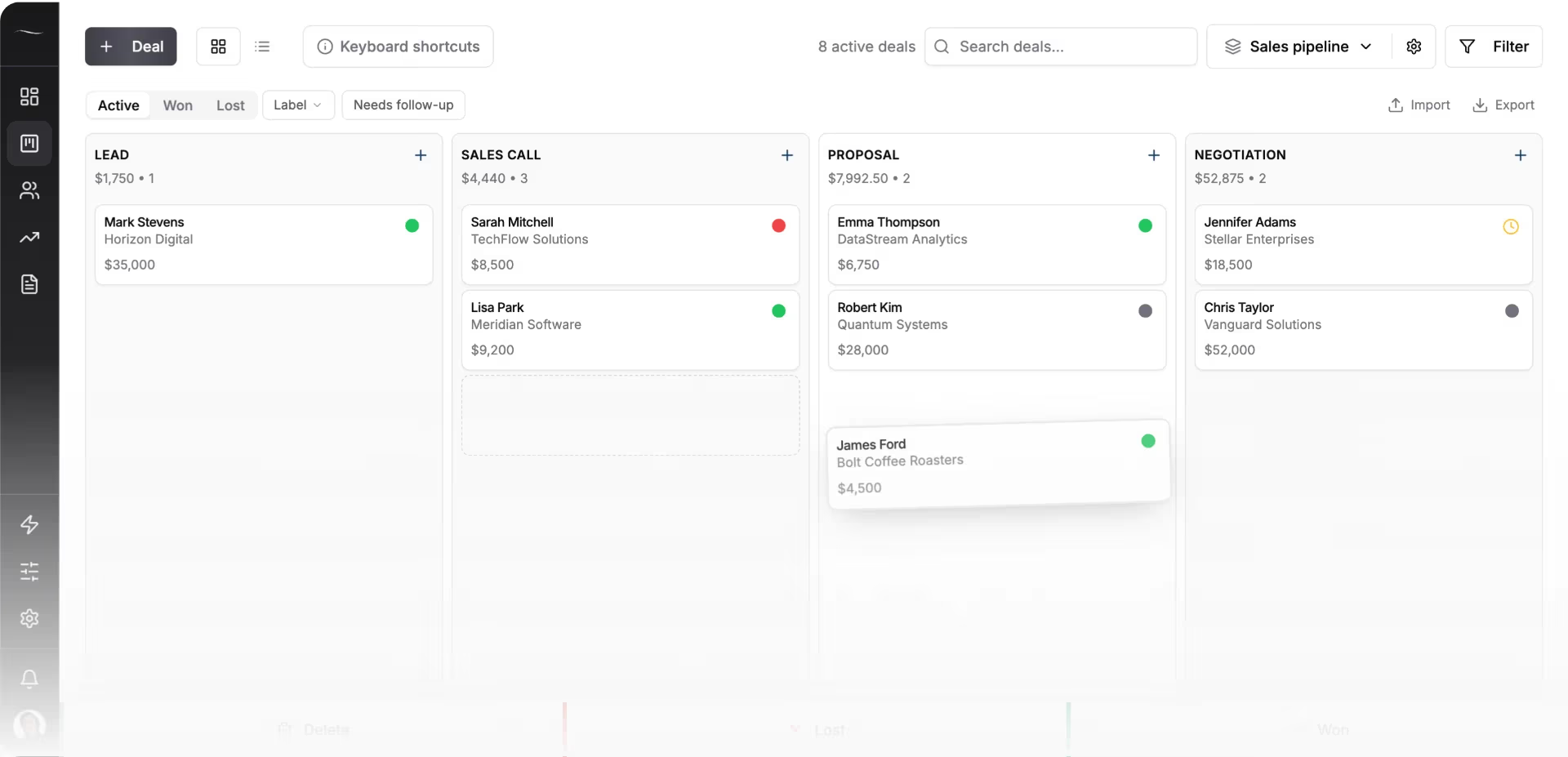
Coming from folk, reminders live on deals, not on people, so someone who isn’t a deal yet needs a card in a separate nurture pipeline. Email is logged by BCC.
One verified customer put it in measured terms.
“Early-stage CRM worth checking out. It’s simple and easy to navigate.”
Another verified customer noticed how often it changes.
“Omar (the app’s author) has been an absolute machine, shipping new feature after new feature.”
- Best for: a team of 1 to 10 whose folk board has turned into a deal pipeline
- Not for: LinkedIn-led prospecting, or a network of people with no deals attached
- Cost for 5 seats: $80 a month, or $720 a year on annual billing
2. Pipedrive, best when your folk stages have become a fixed sales process
Pipedrive puts every deal on a board and expects a next activity on each one. It suits a team that sells the same way every time and wants the tool to hold everyone to that process.
The Lite plan costs $14 per seat a month billed yearly or $24 billed monthly, with Growth at $39 or $49. Add-ons such as LeadBooster are priced on top of the seat, and the free trial lasts 14 days.
Pipedrive has more settings to learn than folk. Email sync sits on Growth, so compare that plan, not Lite, if your inbox matters.
3. Less Annoying CRM, best for a list of people at one price
Less Annoying CRM is a contact manager with pipelines, tasks and notes attached to each person. It has one plan at $15 per user per month, with unlimited pipelines and custom fields.
It keeps people at the center, which is why it is the most natural move for someone who used folk as a relationship list. The free trial lasts 30 days.
The trade-off is the look. It is plain on purpose, and there is no enrichment or LinkedIn capture to replace folkX.
4. Capsule, best for service firms that think in contacts
Capsule is a contact manager first and a sales tool second. That order suits consultancies and agencies where one client brings several projects over the years.
Starter is $18 a user per month on annual billing and holds 30,000 contacts. Workflow automation and more than one sales pipeline start on Growth at $36.
The free plan covers 2 users and 250 contacts. A team of 3 needs a paid plan from the first day.
5. Attio, best when you need records folk can’t model
Attio looks a lot like folk, but you design the data model yourself. You can add an object for funds, properties or partners and link people to it.
Plus is $35 a seat on annual billing and $44 monthly, for up to 10 seats. Pro is $79 on annual billing and $99 monthly. The free plan covers up to 3 seats and 200 outbound emails a month.
That freedom means somebody owns the setup, and in a small team that is usually the founder. If Attio is already on your shortlist, I covered the reasons people leave it in Attio alternatives.
6. HubSpot, best when marketing needs your contact list too
HubSpot is a platform with sales, marketing and service tools on one database. It makes sense when the people in your CRM also get your newsletter and your support replies.
The free tools cover up to 2 users. Starter is $20 a seat a month. Sales Hub Professional is $90 a seat on annual billing or $100 monthly, plus a required one-time onboarding fee of $1,500.
Setup is the heaviest on this list. On Professional, it often becomes part of one person’s job to keep HubSpot tidy.
What You Lose by Leaving folk
No folk CRM alternative does everything folk does in one place. Check this list before you export anything.
The LinkedIn capture
folkX, folk’s Chrome extension, saves a LinkedIn profile into a list in one click, and it is on every folk plan. Enrichment then finds the email, and an email campaign can send the first message. If your pipeline starts on LinkedIn every morning, that loop is the reason to stay.
WhatsApp next to email
folk syncs email, calendar and WhatsApp on every plan, and it has a mobile app. If half your conversations happen in WhatsApp, a CRM that only sees email will miss them.
Being people-first
Some work never becomes a deal. A VC tracking founders, a partnerships lead or a recruiter with a bench of candidates is already on the right tool with folk Standard. Paying for a deal pipeline you never fill is money spent on nothing.
Moving your data out of folk
Moving out of folk is a small job. Export your people and companies as a CSV, then rebuild the open opportunities as deals on the first day. If you are weighing Fluid CRM specifically, Fluid CRM vs folk puts the two side by side.
folk CRM Alternatives FAQ
For a team under 10 that mostly tracks deals, Fluid CRM or Pipedrive are the closest fit. For a team that mostly tracks people, Less Annoying CRM or Capsule fit better. The right one depends on whether your folk board holds deals or relationships.
Attio is the closest in look and feel, with a clean interface and email sync on every plan. It asks for more setup, because you design the records yourself. Capsule is the closest in purpose, since it also puts the person ahead of the deal.
Attio has a free plan for up to 3 seats with a limit of 200 outbound emails a month. HubSpot’s free tools cover up to 2 users, and Capsule’s free plan covers 2 users and 250 contacts. Fluid CRM has no free plan, but it has a 7-day free trial with no credit card required.
You can, but you would pay for two tools. folkX saves contacts into folk, so you would keep folk Standard for prospecting and move each person to the other CRM once they become a deal. For one person that works. A team usually ends up with two contact lists that don’t match.
Picking a folk Alternative by the Record You Open Most
Open the tool you use most and look at what the screen shows first. If it is a person, stay on folk or move to Less Annoying CRM or Capsule. If it is a deal, Fluid CRM gives you a board of deals with a reminder on each one, and the startup CRM page shows how early teams set it up.
Still comparing the wider field? The best CRMs for startups list compares nine tools and their prices for a young team.
Start your 7-day free trial here, no credit card required.