

Capsule usually works fine until you want a second pipeline, one automation or emails that log themselves. All three sit on Capsule Growth, not Starter, so the plan you started on stops fitting. Before you move anything, work out which of those limits you actually hit.
The best Capsule CRM alternative depends on the limit you hit. Fluid CRM adds pipelines and automations without a higher tier, and Less Annoying CRM keeps Capsule’s contact-first style at one price. Pipedrive suits deal-heavy teams, Insightly project delivery, Close calling and Bigin the lowest price.
| Tool | Best for | Starting price | 5 seats for a year |
|---|---|---|---|
| Fluid CRM | More pipelines and automations without a higher tier | $16/seat/month or $144/seat/year | $720 (annual) |
| Less Annoying CRM | Contact-first work at one price | $15/user/month | $900 |
| Pipedrive | Deal-heavy teams that want sales reports | $14/seat/month (Lite, annual) | $2,340 (Growth, annual) |
| Insightly | Running projects after the sale | $29/user/month (billed annually) | $1,740 (Plus) |
| Close | Teams that sell by phone | $9/month (Solo, 1 user, annual) | $2,100 plus calls (Essentials, annual) |
| Bigin by Zoho | The lowest price | Free for 1 user, then $7/user/month (annual) | $420 (Express) |
| HubSpot | A free plan with more contacts | Free for up to 2 users | $1,200 (Starter, billed monthly) |
| Capsule Growth, for comparison | The tier with multiple pipelines and automations | $36/seat/month (annual) | $2,160 |
When To Stay on Capsule CRM
Capsule is a well-made CRM, and a fair share of people reading this should keep it. It was built contact-first, so it holds people who will never be a deal without forcing them into a fake pipeline stage. Stay if your work looks like this:
- Your work is relationships more than deals: suppliers, referral partners, past clients you check in with twice a year.
- The Free plan still fits you. It covers 2 users, 250 contacts and 1 sales pipeline.
- You already use Capsule’s project boards to deliver the work, or its Marketing add-on, which starts from $11 a month.
- Your team opens it every day without being chased.
If that’s you, a switch costs a few weeks of setup and wins you nothing. For a straight two-tool comparison, Fluid CRM vs Capsule goes feature by feature, and if you mainly want something smaller still, there’s a separate list of the best lightweight CRMs.
What Capsule CRM Costs, and Which Plan Adds What
Capsule meters two things on every plan, how many contacts you can store and which features you get. Here is the full price sheet.
| Plan | Billed annually | Billed monthly | Contacts | What the tier adds |
|---|---|---|---|---|
| Free | $0 | $0 | 250 | Max 2 users, 1 pipeline, 5 custom fields |
| Starter | $18/user/month | $22/user/month | 30,000 | Email templates, shared mailbox, basic reporting |
| Growth | $36/user/month | $40/user/month | 60,000 | Multiple pipelines, workflow automations, email sync, reporting dashboards, team and access controls |
| Advanced | $54/user/month | $60/user/month | 120,000 | Up to 50 pipelines and 50 project boards |
| Ultimate | $72/user/month | $75/user/month | 240,000 | Account manager and custom training, for teams of 5+ |
A team of three is never going to store 30,000 contacts, so the ceiling is not what costs you money. The feature line is. Five things arrive together on Growth, and a small team often wants only one of them.
Why teams leave Capsule CRM
These are the usual reasons, and four of them trace back to that sheet:
- You need a second pipeline, and Starter has one.
- You need an automation, and workflow automations start on Growth.
- You want emails to log themselves, and email sync starts on Growth.
- A third person joins, and the Free plan caps at 2 users and 250 contacts.
- Your team sells deals all day, and Capsule is built around contacts.
- Your team sells by phone and wants the dialer inside the CRM.
How many pipelines do you run today, and how many would you add if the next one cost nothing?
Price the upgrade before you price a migration. For 5 seats on annual billing, Starter is $1,080 a year and Growth is $2,160.
If you need all five Growth features and your team likes Capsule, paying the difference is often cheaper than moving. If you only need one of them, keep reading.
7 Capsule CRM Alternatives, One per Reason
Seven tools, each picked for one Capsule limit: a second pipeline, contact-first work, deal volume, project delivery, phone selling, price and a bigger free plan.
1. Fluid CRM (best if the second pipeline is the reason)
Fluid CRM is a deal-first pipeline CRM for B2B teams of 1 to 10, with one plan and every feature in it. Unlimited contacts, unlimited pipelines, 8 in-app automations, lead capture forms and an MCP connector for Claude and ChatGPT are all there from the first seat. It suits a team that only needed one thing from Capsule Growth and not the rest of the tier.
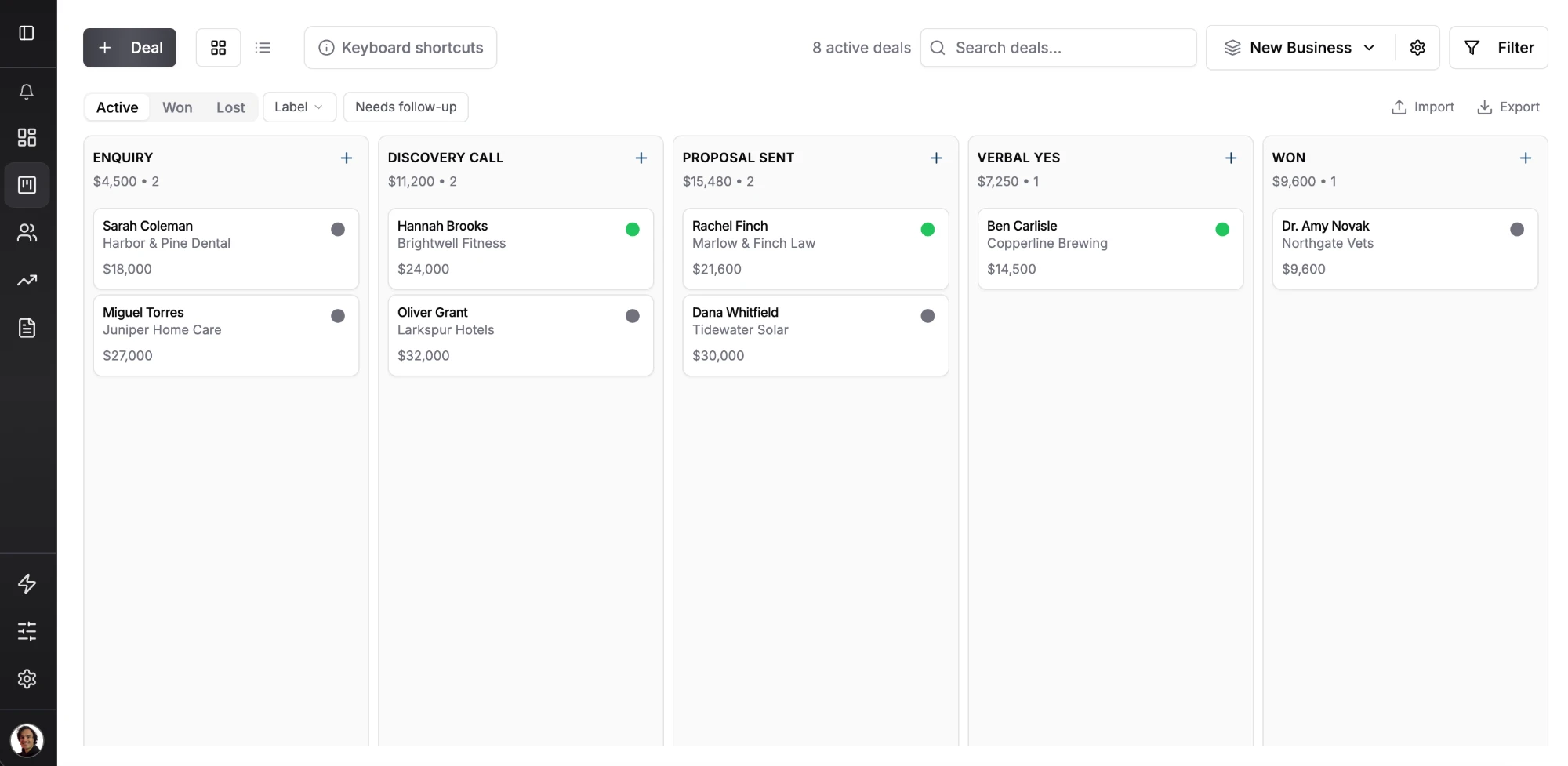
Each deal holds one reminder, and a daily digest email lists what’s due, so a deal with no next step shows up fast. Here’s how small teams use Fluid CRM as a simple CRM.
A verified customer put the first impression like this, “Easy to Use & Understand, Clean Interface, UI / UX, Intuitive & easy on the eyes!”
Two limits matter for a Capsule user. There’s no free plan, only a 7-day free trial, so it can’t replace Capsule Free at $0. Email logs by BCC, not by the automatic sync Capsule Growth has, so you copy in an address rather than connecting your inbox.
Best for: Small B2B teams that want several pipelines and a few automations without moving up a tier.
Not for: Anyone who needs a free plan or two-way inbox sync.
Cost for 5 seats: $80 a month billed monthly, or $720 for the year billed annually.
2. Less Annoying CRM (best if you like Capsule’s contact-first shape)
Less Annoying CRM is the closest thing to Capsule’s way of thinking. It’s built around contact records, with one plan at $15 per user per month and nothing locked behind an upgrade. Unlimited contacts, unlimited pipelines and automatic email logging from Gmail or Outlook are in that one plan, and the free trial runs 30 days.
Best for: Relationship-first businesses that need email sync or a second pipeline without moving up a tier.
Not for: Teams that want a deal board as the main screen. If you’re weighing it up, there’s a full list of Less Annoying CRM alternatives too.
Cost for 5 seats: $75 a month, or $900 a year.
3. Pipedrive (best if your team sells deals all day)
Pipedrive is the opposite of Capsule in shape. Deals and activities are the main screen, and the stages are ready before you set anything up.
Lite is $14 a seat a month, Growth $39, Premium $59 and Ultimate $79 on annual billing, or $24, $49, $79 and $99 billed monthly. Email sync and automations start on Growth, so Growth is the tier to compare with Capsule Growth. The two-vendor version of that decision is in Pipedrive vs Capsule CRM.
Best for: Teams whose Capsule contacts are almost all open deals and who want the pipeline as the home screen.
Not for: Teams leaving Capsule over cost, since Pipedrive Growth is a few dollars a seat above Capsule Growth.
Cost for 5 seats: $2,340 a year on Growth, annual billing.
4. Insightly (best if you use Capsule’s project boards)
Insightly is the pick when the part of Capsule you’d miss is what happens after the deal closes. Project management is included on every Insightly plan, so a won deal can turn into a project in the same tool.
Plus is $29 a user a month, Professional $49 and Enterprise $99, all billed annually. There’s a 14-day free trial and no free plan.
Best for: Service firms that sell a project and then deliver it, and want both in one login.
Not for: Teams that only need a sales pipeline and nothing after the sale.
Cost for 5 seats: $1,740 a year on Plus.
5. Close (best if your team sells by phone)
Close builds calling, SMS and email into the CRM, and calling comes with every plan. If you pair Capsule with a separate phone tool today, you can drop the phone tool.
On annual billing, Solo is $9 a month for one user and 10,000 leads, Essentials is $35 a user, Growth $99 and Scale $139. Billed monthly they’re $19, $49, $109 and $149. The power dialer and workflows start on Growth, and call minutes and phone numbers are charged on top of the seat.
Best for: Small outbound teams that spend the day on the phone.
Not for: Referral or email-first businesses, who’d pay for a phone system they won’t use.
Cost for 5 seats: $2,100 a year on Essentials, annual billing, plus calling.
6. Bigin by Zoho (best if price is the reason)
Bigin is Zoho’s pipeline-first CRM for small teams, and it has the lowest seat price on this list. It meters records and pipelines the way Capsule meters contacts, so check the cap on the tier you pick.
The free plan is for a single user with 500 records and 1 pipeline. Express is $7 a user a month billed annually or $9 monthly, with 3 team pipelines and 50,000 records. Premier is $12 or $15 with 5 pipelines, and Bigin 360 is $18 or $21 with 15.
Best for: Price-led teams that will live inside 3 or 5 pipelines.
Not for: Teams that keep adding pipelines, since each step up is a new tier.
Cost for 5 seats: $420 a year on Express, annual billing.
7. HubSpot (best if you want a free plan with more contacts)
HubSpot has a free plan that also stops at 2 users, but it holds 1,000 contacts against Capsule Free’s 250. It suits a pair who outgrew Capsule’s contact cap rather than its user cap.
Sales Hub Starter is $20 a seat billed monthly. Professional is $90 a seat on annual billing or $100 monthly, plus a required one-time onboarding fee of $1,500.
Best for: Two-person teams that want to stay free a while longer and may add HubSpot’s marketing tools later.
Not for: Teams that plan to stay small and cheap past the free plan, because the step from Starter to Professional is a big one.
Cost for 5 seats: $1,200 a year on Starter billed monthly, or $6,900 in year one on Professional with onboarding.
Turning Capsule Contacts Into a Deal Pipeline
Moving off Capsule is mostly a sorting job, because Capsule keeps people, opportunities and projects as separate things. Most of the tools above are deal-first, so the work is deciding which of your contacts are actually deals.
I saw why that step matters from the agency side, running Fenixtal, my old outbound agency. The leads I handed over mostly died because nobody on the client’s side tracked them, not because the buyer said no. So when you sort your export, the people you’re actively selling to are the ones who need a next step on a deal.
1. Export everything before you change a plan
Capsule’s account export emails you a ZIP of CSV files with your contacts and opportunities, including their notes and email history. You can also export any contact list to CSV, Excel or vCard from People & Organizations, as long as your user has the export permission switched on.
2. Decide which contacts are deals
Go through the contact export and mark the people you’re actively selling to. Those become deals. Referral partners, suppliers and past clients stay as contacts, and you don’t need to invent a stage for them.
3. Turn Capsule milestones into pipeline stages
Write down the milestones on your Capsule sales pipeline and recreate them as stages in the new tool, in the same order. If you ran more than one Capsule pipeline, check the new tool’s tier allows the same number before you import.
4. Import only your open opportunities
Bring over the opportunities that are still alive and leave the won and lost ones in the archive file. In Fluid CRM that’s a CSV upload of up to 10,000 rows per file, matched to your columns, and the contact and company are created with each deal.
Capsule CRM Alternatives: Frequently Asked Questions
Yes. Capsule Free covers 2 users, 250 contacts, 5 custom fields and 1 sales pipeline. A third user or a 251st contact means moving to a paid plan, which starts at $18 a user a month on annual billing.
Bigin by Zoho has the lowest paid seat price on this list, at $7 a user a month on annual billing for 3 pipelines. HubSpot and Bigin both have free plans, but HubSpot’s stops at 2 users and Bigin’s at 1. Price the tier that has the feature you left Capsule for, not the entry tier.
Insightly includes project management on every plan, from $29 a user a month billed annually. Capsule itself has project boards, with multiple boards from Growth up. Most pipeline-first CRMs track deals and not project delivery.
Yes. An account export sends a ZIP of CSV files to your email, and any contact list can be saved as CSV, Excel or vCard if your user has the export permission.
Which Capsule CRM Alternative To Pick
Name the Capsule limit you hit first, then pick from that row. If the reason is the second pipeline or a couple of automations, Fluid CRM gives you unlimited pipelines and 8 automations in its one plan at $16/seat/month, and a week of real deals is enough to tell whether it fits. Here’s more on how Fluid CRM works as a simple CRM.
Start your 7-day free trial here, no credit card required.