
HoneyBook bundles four jobs, from the first inquiry to the final payment. Many people use only part of it, so a one-for-one swap can send them to the wrong tool. We built Fluid CRM for one of those jobs, and this post shows which one.
The best HoneyBook alternative depends on the job you need done. Dubsado and Moxie replace proposals, contracts and invoices together, Pixieset suits photographers, FreshBooks suits people who mostly need to get paid and Fluid CRM fits people who only use the pipeline and sign contracts elsewhere.
Test Your Last Five Booked Clients Before Leaving HoneyBook
Pull up the last five clients who said yes. For each one, mark which of these four steps ran through HoneyBook.
- The inquiry came in through a HoneyBook lead form or sat in its pipeline
- The proposal and contract went out from HoneyBook and got signed there
- The invoice was sent from HoneyBook and the client paid through it
- An automation or the scheduler did something you would otherwise do by hand
If all four are marked on most clients, you need a full replacement or you should stay. If the proposal step is marked, with or without the invoice, one of the document tools below will do, and if only the invoice is marked, look at FreshBooks.
If only the inquiry step is marked, you need a sales pipeline, and a solopreneur CRM does that job with far less setup. The same applies to inquiries plus a few automations, as long as your documents live elsewhere.
Think about the last payment you received. Did the client pay inside HoneyBook, or did the invoice come from your accounting software anyway?
What HoneyBook costs and what its fees look like
HoneyBook has three plans at $29, $49 and $109 a month, billed yearly. Starter includes the customizable pipeline, proposals, contracts, invoices and up to 2 live lead forms. Automations and the scheduler start at Essentials, which also allows up to 2 team members, and Premium removes the team limit.
Payments cost extra on every plan. Card fees start at 2.7% + 10¢ and bank transfers cost 1.5%, so a $3,000 invoice costs you at least $81.10 by card or $45 by bank transfer. Switching tools won’t make card fees disappear, because someone still processes the card, so a move saves you subscription money and little else on that line.
HoneyBook alternatives compared
The lowest price among apps like HoneyBook often leaves out the feature you are switching for, so this table names the plan where it starts.
| Tool | Best for | Starts at, one user | Where the feature you want appears |
|---|---|---|---|
| HoneyBook | The whole path from inquiry to payment | $29 a month billed yearly | Automations and scheduler on Essentials, $49 billed yearly |
| Dubsado | The closest swap for client workflows | $335 a year | Automations and scheduling on Premier, $525 a year |
| Moxie | The same job at a lower price | $10 billed yearly, $12 monthly | Automations on Pro, $20 billed yearly, $25 monthly |
| Bonsai | Service firms that also track time and projects | $9 billed yearly, $15 monthly | Invoices and contracts on Essentials, $19 or $25. Deals pipeline on Premium, $29 or $39 |
| 17hats | Documents and payments with users included | Free plan, or $60 monthly | Free plan stops at four invoices a quarter. Contracts, invoices and payments in the $60 plan |
| Pixieset | Photographers and session-based work | Free plan, or $12 billed yearly, $15 monthly | Unlimited contracts on Plus. Free stops at 3 contracts |
| FreshBooks | Getting paid and keeping the books | $23 monthly | Proposals and e-signature on Plus, $43 monthly |
| Fluid CRM | A pipeline, with documents handled elsewhere | $16 per seat a month, $144 per seat a year | Every feature in the one plan, with no contracts or invoices |
| Pipedrive | Growing sales teams | $14 per seat billed yearly, $24 monthly | Email sync on Growth, $39 or $49 |
HoneyBook Alternatives If You Send Proposals, Contracts and Invoices
Dubsado, Moxie, Bonsai and 17hats come closest to HoneyBook, so they suit you if the proposal step of the test was marked. People who sell sessions can also read our CRM list for coaches, and studios have a separate best CRM for web designers comparison.
1. Dubsado (best for the closest swap)
Dubsado sends the proposal, contract and invoice in one go, then lets the client accept with one click. Both plans include client portals and invoices with payment schedules, and 3 additional users are free. The 21-day trial needs no credit card. If you came here looking for Dubsado alternatives instead, Moxie and Bonsai do the same job.
Best for: Service businesses with a repeatable client process that they want to run on its own.
Not for: Anyone planning to stay on the entry plan. Starter has no automated workflows or scheduler and allows one active lead form, so anyone who relies on HoneyBook’s automations would need Premier at $525 a year.
2. Moxie (best for the lowest paid plan with documents)
Moxie has the lowest paid plan here with proposals, contracts and invoices in it. Starter also includes a sales pipeline, meeting schedulers and a form builder, at $10 a month billed yearly or $12 monthly. Workflow automations start at Pro, and Teams covers up to five team members at $32 billed yearly or $40 monthly.
Best for: One-person businesses that want most of HoneyBook’s Starter plan for less money.
Not for: Anyone whose main reason for using HoneyBook is automations, unless they budget for Pro.
3. Bonsai (best if you also track time and projects)
Bonsai prices per user and aims at service firms running client work as well as selling it. Basic covers time tracking, tasks and projects, while invoices, payments, proposals, contracts and scheduling start at Essentials. The deals pipeline starts at Premium, at $29 per user billed yearly or $39 monthly.
Best for: Small firms whose work continues after the contract and needs tracking hour by hour.
Not for: Anyone comparing the $9 Basic price with HoneyBook. That plan has no invoices or contracts on its list.
4. 17hats (best for documents with users included)
17hats includes contracts, quotes, invoices, card payments and lead management at every level. It costs $60 a month on monthly billing, with 3 users included and extra users at $5 each. The free plan is limited to four invoices a quarter.
Best for: A small team that wants three logins without paying per seat.
Not for: Anyone expecting the free plan to run a real invoicing month.
HoneyBook Alternatives For Booking Sessions Or Getting Paid
Pixieset serves people who book dates and FreshBooks serves people who mostly send invoices, so each one fits a narrow kind of work.
5. Pixieset (best for photographers)
Pixieset offers Studio Manager, which covers a booking site, contracts, questionnaires, invoices and payment plans, plus mini sessions where you set a date and a number of spots. A visual board tracks each project by stage, and client galleries are a separate product. The free plan gives you unlimited invoices but only 3 contracts and 1 active session type, while Plus costs $12 a month billed yearly or $15 monthly and removes the contract limit.
Best for: Photographers who want booking and documents next to the gallery they already deliver in.
Not for: B2B service sellers, who would use little of what makes it good.
6. FreshBooks (best if getting paid is the job)
FreshBooks is accounting software first. Lite costs $23 a month with unlimited invoices and estimates for 5 billable clients. Proposals and e-signature start at Plus, which costs $43 a month and covers 50 billable clients, and each extra team member costs $11 a month.
Best for: People whose test showed only the invoice step, or anyone who wants the invoice and the books in one place.
Not for: Anyone who wants to manage leads before the invoice exists.
HoneyBook Alternatives If You Only Use the Pipeline
Some people pay for HoneyBook and only ever open the pipeline. Their contracts go out from another tool and their invoices come from their accounting software, so the rest of the bundle sits unused.
My old outbound agency, Fenixtal, booked 1,250+ sales calls for other businesses, and the leads I generated often went untracked in a messy spreadsheet or a CRM people hated using. A proposal template can’t help a lead nobody is tracking. For this group the question is whether you open the tool every day, and document features don’t change that answer.
7. Fluid CRM (best for service sellers who sign and invoice elsewhere)
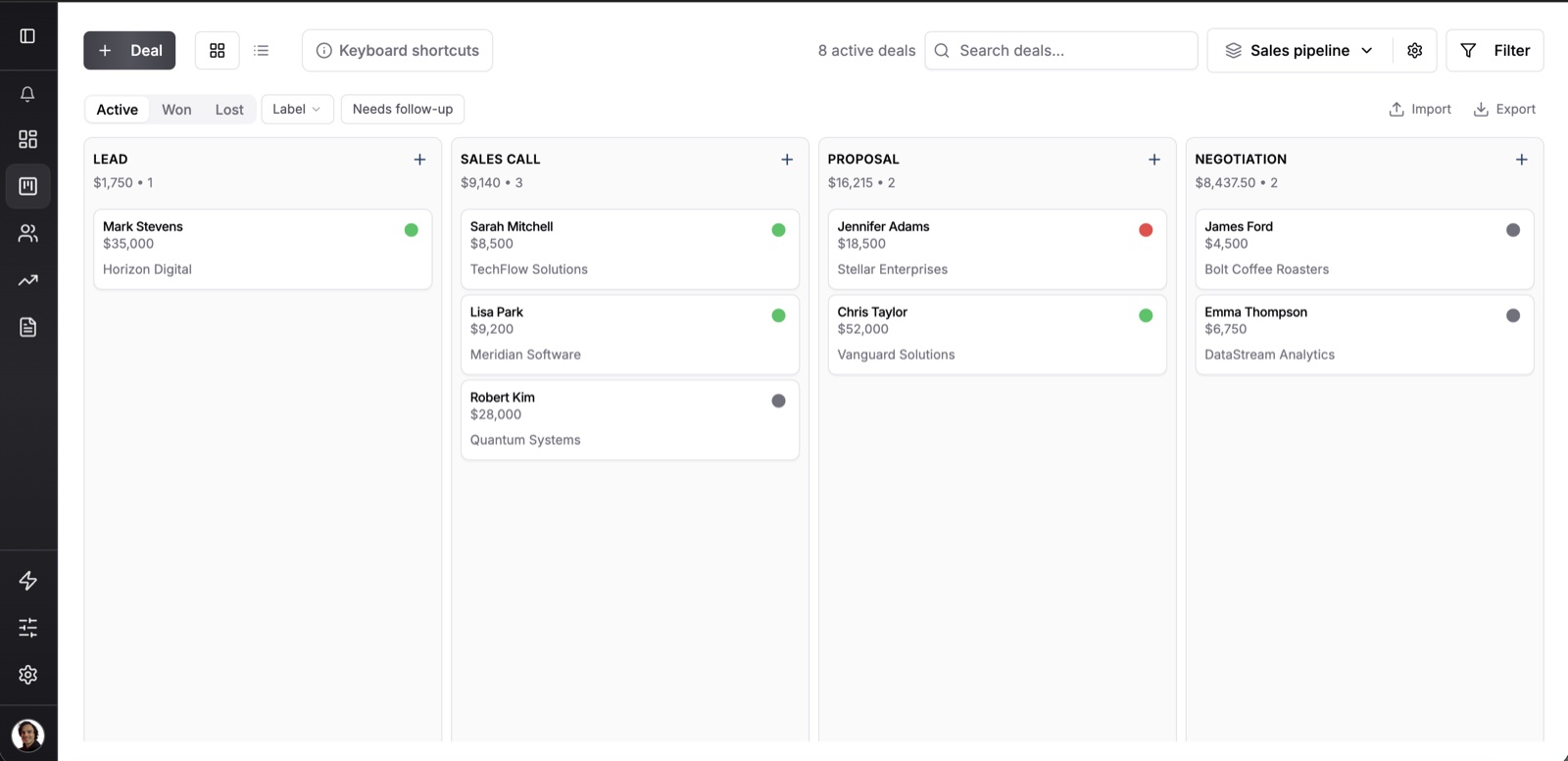
Fluid CRM covers HoneyBook’s inquiry and pipeline step plus 8 in-app automations, and leaves contracts and invoices to other tools. A lead capture form brings inquiries in, deals sit on a visual board and you set a reminder on each deal. Leads die on the days the CRM stays closed, so a daily digest email lists what is overdue and due today without you logging in.
The REST API and 16 webhooks let it pass data to the tools that hold your documents.
Hanna-Maria Ojala, CEO of the sales coaching business Menestyvä Myynti, came to Fluid CRM from Pipedrive: “It’s simple to see where each deal stands and what needs to happen next. My daily work is more focused now.”
Business psychologist Jaakko Sahimaa wrote this a short time into using it: “It’s made it much easier to keep track of customers, opportunities and follow-ups in one place.”
Best for: B2B service sellers of 1 to 10 people who already sign contracts and send invoices in other tools.
Not for: Anyone who wants contracts, invoices and payments in one login. Fluid CRM has none of them and is not the tool for it. There is also no free plan.
Cost for 5 seats: $720 a year on annual billing, or $80 a month. One seat costs $16 a month or $144 a year, with every feature in the one plan and a 7-day free trial.
8. Pipedrive (best for a growing sales team)
Pipedrive is a sales pipeline built for teams with several people selling. Lite costs $14 per seat billed yearly or $24 monthly, and full email sync with tracking starts at Growth, at $39 or $49.
Best for: Teams adding salespeople who need email logged automatically.
Not for: A one-person service business on Lite, which leaves out the email sync.
What a pipeline tool plus an invoicing tool really costs
Pairing tools can cost more than HoneyBook if you still need both halves. Fluid CRM on its yearly rate works out at $12 per seat a month, and FreshBooks Plus at $43 monthly brings the pair to $55, against HoneyBook Essentials at $49 a month billed yearly.
The pair gets cheaper with FreshBooks Lite at $23, which makes it $35, but Lite has no proposals and stops at 5 billable clients. Pairing makes sense when you already pay for the other half, or when you can stay within Lite’s limits.
When HoneyBook Is Still the Right Call
Leaving HoneyBook makes little sense if your clients sign and pay in the same file, because that single step is what the bundle does best. Splitting it across two tools adds a login for you and a second email for your client.
The same goes if your automations ran on most of your last five clients, or if replacing HoneyBook would leave you running three tools. Check those two things before you compare prices. Our list of the best CRMs for freelancers covers the wider market if you still want to move.
What to save before you cancel
Download your contacts first. HoneyBook’s help pages put this under Clients, then Contacts, then the three-dot menu and Download spreadsheet. The CSV holds names, emails, phone numbers, addresses and notes.
Then save the documents you may need later. Open each smart file in its project, choose Print file from the three-dot menu and pick Save as PDF as the destination. Finish any open payment schedules before you move, so no client gets invoices from two tools.
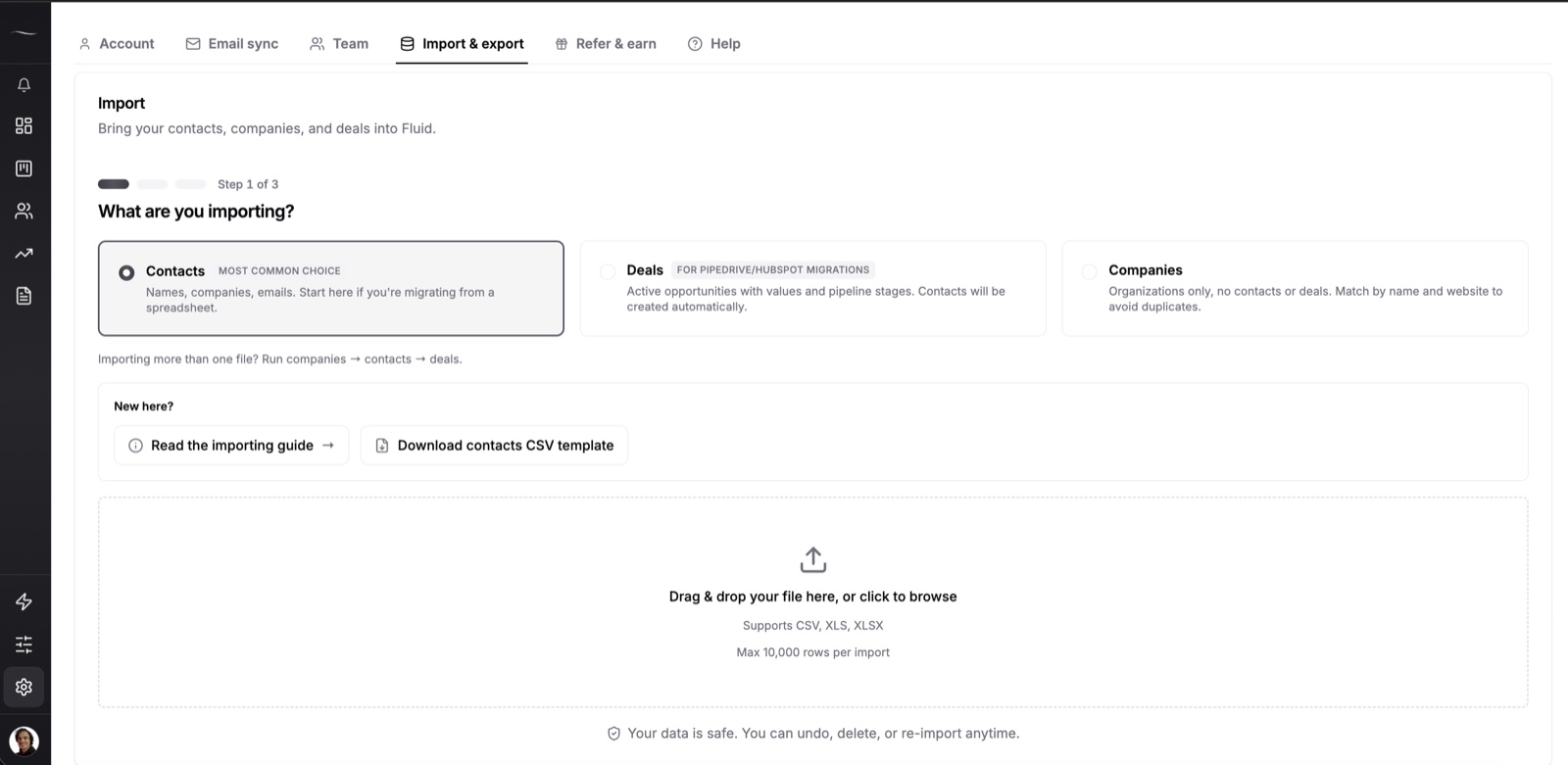
If you move to Fluid CRM, the import takes CSV, XLS or XLSX files of up to 10,000 rows and starts by asking whether you are bringing contacts, deals or companies.
HoneyBook Alternatives FAQ
Partly. HoneyBook includes a customizable pipeline and lead forms, but most of the product is built around proposals, contracts, invoices and payments. It is closer to a client workflow tool with a CRM inside it.
Dubsado is the closest match if you use the proposals, contracts and invoices together. Moxie has the lowest priced paid plan for the same job. If you only use the pipeline, a CRM such as Fluid CRM or Pipedrive is the better fit.
Yes, with limits. 17hats has a free plan that allows four invoices a quarter, and Pixieset has a free plan with unlimited invoices and 3 contracts. Fluid CRM offers a 7-day free trial rather than a free plan.
Slightly, on yearly billing. Dubsado Starter costs $335 a year against $348 for HoneyBook Starter, and Dubsado Premier costs $525 a year against $588 for HoneyBook Essentials. On both products, automations and scheduling start on the second plan.
Pixieset is the natural fit, because Studio Manager covers booking, contracts, invoices and mini sessions. Dubsado and Moxie also work for photographers who don’t need a gallery tool in the same place.
Which HoneyBook Alternative To Pick
The right HoneyBook alternative is the one that matches the steps your last five booked clients went through. If those were documents and payments, Dubsado and Moxie are the closest match, and if only the pipeline, Fluid CRM is a solopreneur CRM that works alongside the tools you already have.
Start your 7-day free trial here, no credit card required.