

You already have a sales pipeline. It is spread across your inbox, your phone and whatever you remember on a good day. It works until a busy week, when the person you promised a quote on Tuesday hears nothing and signs with somebody else.
A sales pipeline is the list of deals you could win right now, sorted by how far each has got, with a value and a next step on each. To build one, write down every live conversation, place it in a stage and date its next step. Fluid CRM keeps that list on one board.
What Is a Sales Pipeline? The Meaning in Plain English
A sales pipeline is a record of every sale that is still undecided. Each one is called a deal, and each deal sits in a stage that shows how close it is to a yes. When a buyer moves forward, the deal moves one column to the right.
A useful pipeline answers three questions about every deal, without anyone having to go and look:
- Who is it? The person, the company and how to reach them.
- How much is it worth? A rough dollar figure is enough.
- What happens next, and when? One action with one date.
The third question is the one people skip, and it decides what you do today. A list of names and values tells you what you hoped would happen. A dated next step tells you what to do this morning.
You will also hear the word used a second way. When a founder asks “how much pipeline do we have?” they mean the total dollar value of all open deals, so a team might say it has $66,000 in pipeline. Same word, and now it means a number instead of a list.
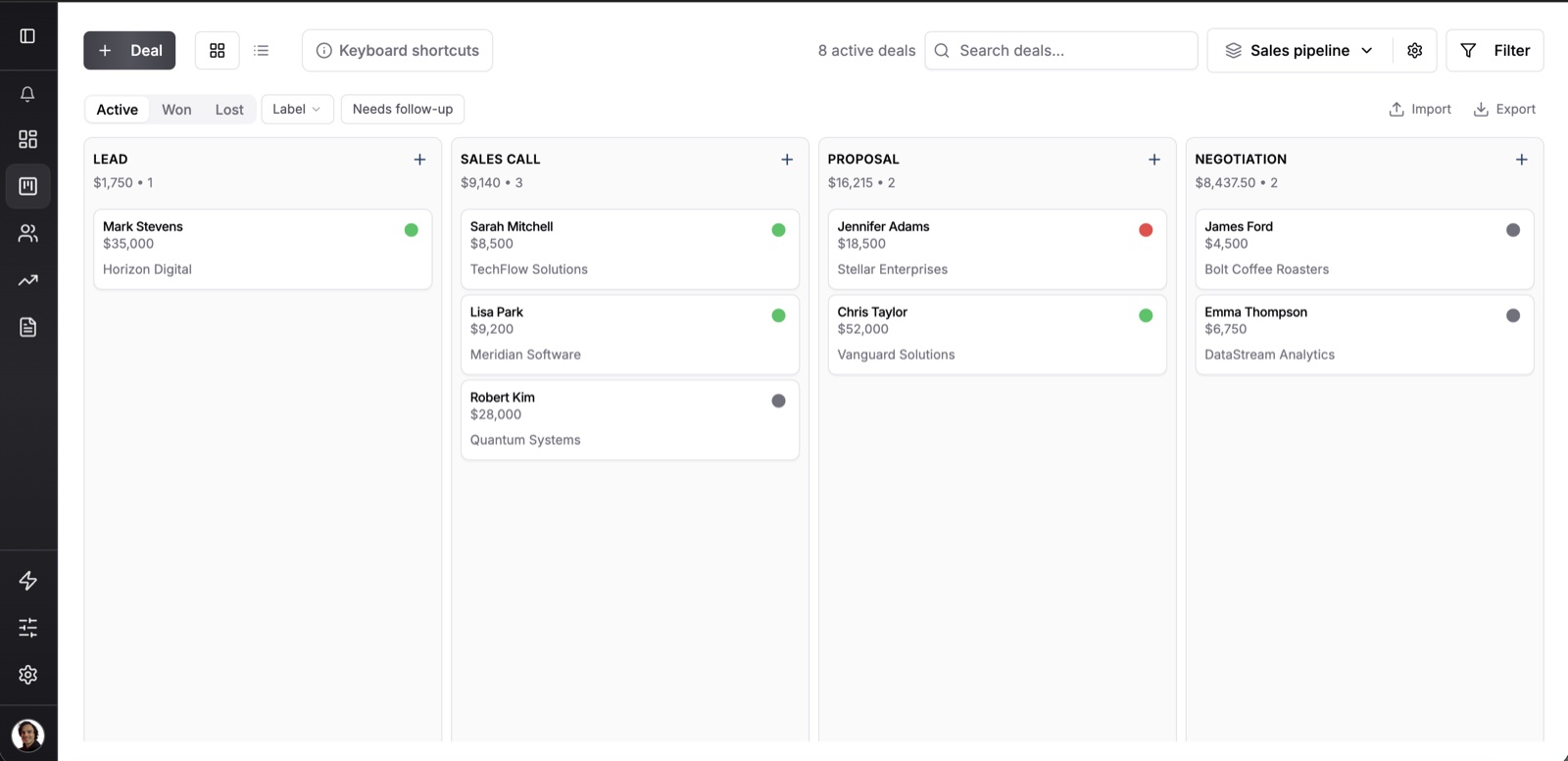
Most small teams keep this list as a board, where every column is a stage and every card is a deal. A sales team CRM draws it for you, and this is what the board looks like in Fluid CRM.
A Sales Pipeline Example: A Three-Person Bookkeeping Firm
Take a made-up firm of three people selling yearly bookkeeping contracts to local businesses. This is its whole pipeline on a Monday morning.
| Deal | Stage | Value | Next step | Due |
|---|---|---|---|---|
| Dental practice, 4 locations | Verbal Yes | $14,400 | Send the engagement letter | Monday |
| Roofing contractor | Proposal Sent | $9,600 | Call the owner about scope | Tuesday |
| Online furniture shop | Proposal Sent | $7,200 | None written down | None |
| HVAC company | Call Booked | $12,000 | Confirm the time | Monday |
| Physical therapy clinic | Call Booked | $8,400 | Hold the intro call | Thursday |
| Design studio | Call Booked | $6,000 | Hold the intro call | Wednesday |
| Law office, referred by a client | Inquiry | $4,800 | Reply with two call times | Monday |
| Landscaping firm | Inquiry | $3,600 | Ask for last year’s books | Friday |
Eight deals, $66,000 in open value, and it takes a few seconds to read. That $66,000 is not a revenue prediction, because some of these deals will be lost. It is the most this list could ever bring in.
The useful part is what you can see at a glance. The furniture shop has a $7,200 proposal out and nobody has decided what happens next, so that deal is the first call of the day. Three other jobs are due this morning and anyone on the team can see them, including the person covering for someone on vacation.
The columns change with the business, and the idea stays the same. Here is the firm’s own order, left to right, next to three other made-up businesses:
| Business | Columns on the board |
|---|---|
| Bookkeeping firm | Inquiry, Call Booked, Proposal Sent, Verbal Yes |
| Small software company | Trial Started, Demo Done, Pricing Sent, Contract Out |
| Solo consultant | Intro Call, Scope Agreed, Proposal Sent, Waiting on Signature |
| IT services firm | Inquiry, Site Visit, Quote Sent, Approved |
Won and lost deals leave the board at the end. They stay on record, which is how you find out later what you actually closed. Nonprofits run the same board for major donors and grants, and our list of the best CRMs for nonprofits has stages to copy.
Sales Funnel vs Pipeline: Same Deals, Different Question
A sales funnel counts how many people reached each step over a past period, and a sales pipeline lists the named deals open today. Both look at the same sales, and each answers a question the other can’t.
| Sales funnel | Sales pipeline | |
|---|---|---|
| What it counts | How many people reached each step over a period | Which named deals are open today |
| Time frame | A past month or quarter | Right now |
| Question it answers | Where do we lose people? | Who do we talk to today? |
| What you do with it | Change the offer, the list or the pitch | Make the call, send the quote |
| How often a small team reads it | A few times a year | Every working day |
A made-up three-person bookkeeping firm shows the difference. Its funnel for last quarter reads 40 inquiries, 14 calls, 8 proposals and 3 contracts won. Its pipeline this morning says the HVAC company needs its call time confirmed today.
The funnel shows that most people drop off between inquiry and call, which is a good reason to answer inquiries faster. It can’t tell anyone whom to phone today. The pipeline can, and it says nothing about why last quarter went the way it did.
A small team should run its week from the pipeline and read the funnel only when it wants to change something. With a few dozen leads a quarter, one lucky quarter moves the percentages a long way, so don’t read too much into them.
How to Build a Sales Pipeline From the Deals You Already Have
“Build a pipeline” means two different jobs. One is writing down the deals you have, which takes an afternoon or less, and the other is finding more deals, which never ends and has its own pipeline generation strategy. Do the first job first, or the new leads land in the same mess.
Step 1: Write down every live conversation
Open your sent mail, your phone, your LinkedIn messages and any notebook you use, then go back about 90 days. List every person who has shown real interest in buying and hasn’t said no.
Keep the test strict. Somebody who replied “sounds interesting, send me details” counts, and a person you met at a conference and never heard from again does not. A long list of people who never asked for anything makes the pipeline harder to trust.
Step 2: Pick four or five columns
Use the steps a deal really goes through in your business, and start with four or five. A team past three people may need more, and our guide to sales pipeline stages covers how many fit your size.
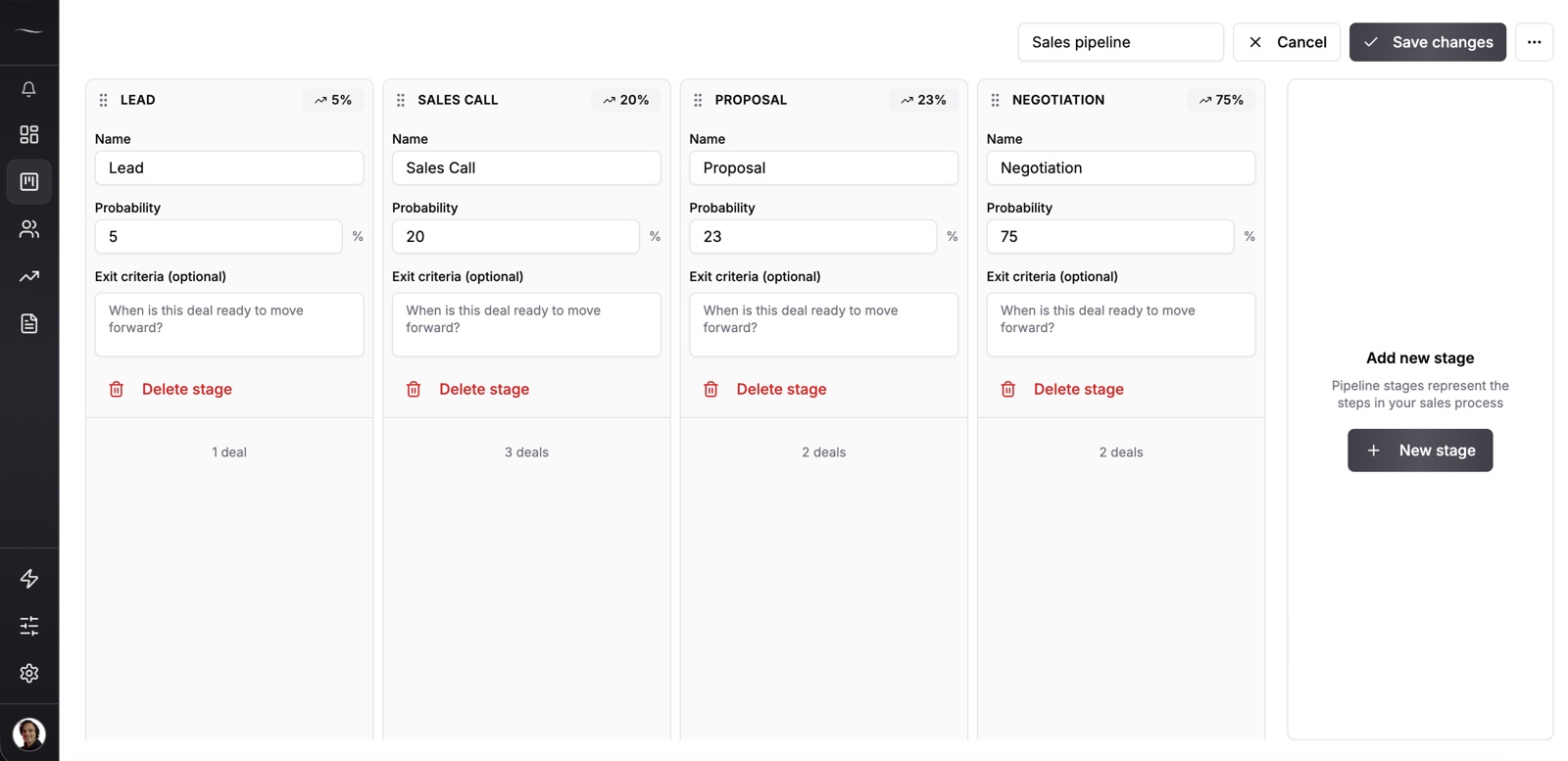
Give each column a one-line rule for when a deal may leave it, so two people would put the same deal in the same place. In Fluid CRM, each stage holds its name, a win probability and an optional exit rule.
Step 3: Place each deal by what the buyer last did
Ignore how good the call felt. If the buyer has a proposal and hasn’t responded, the deal is at Proposal Sent, even if you are sure they love it. That way the board records what happened instead of what you hope for.
Step 4: Add a rough value and a close month
Guess if you have to. A $5,000 estimate on a deal that turns out to be $6,000 is fine, and you can correct it when the proposal goes out. Without values you can’t tell a small job from the deal that pays for your year.
Add the month you expect each deal to close as well, so you can see what could land soon and what is months away.
Step 5: Date one next step on every deal
This is the step that turns a list into a working pipeline. Every deal gets one action and one date, even if the action is “ask whether this is still on”. A deal you can’t give a next step to is probably not a deal, so close it.
Fenixtal, my old outbound agency, got 1,250+ sales calls onto other companies’ calendars. A booked call is only a line on a calendar until somebody writes down what happens after it, and that note is the whole point of this step.
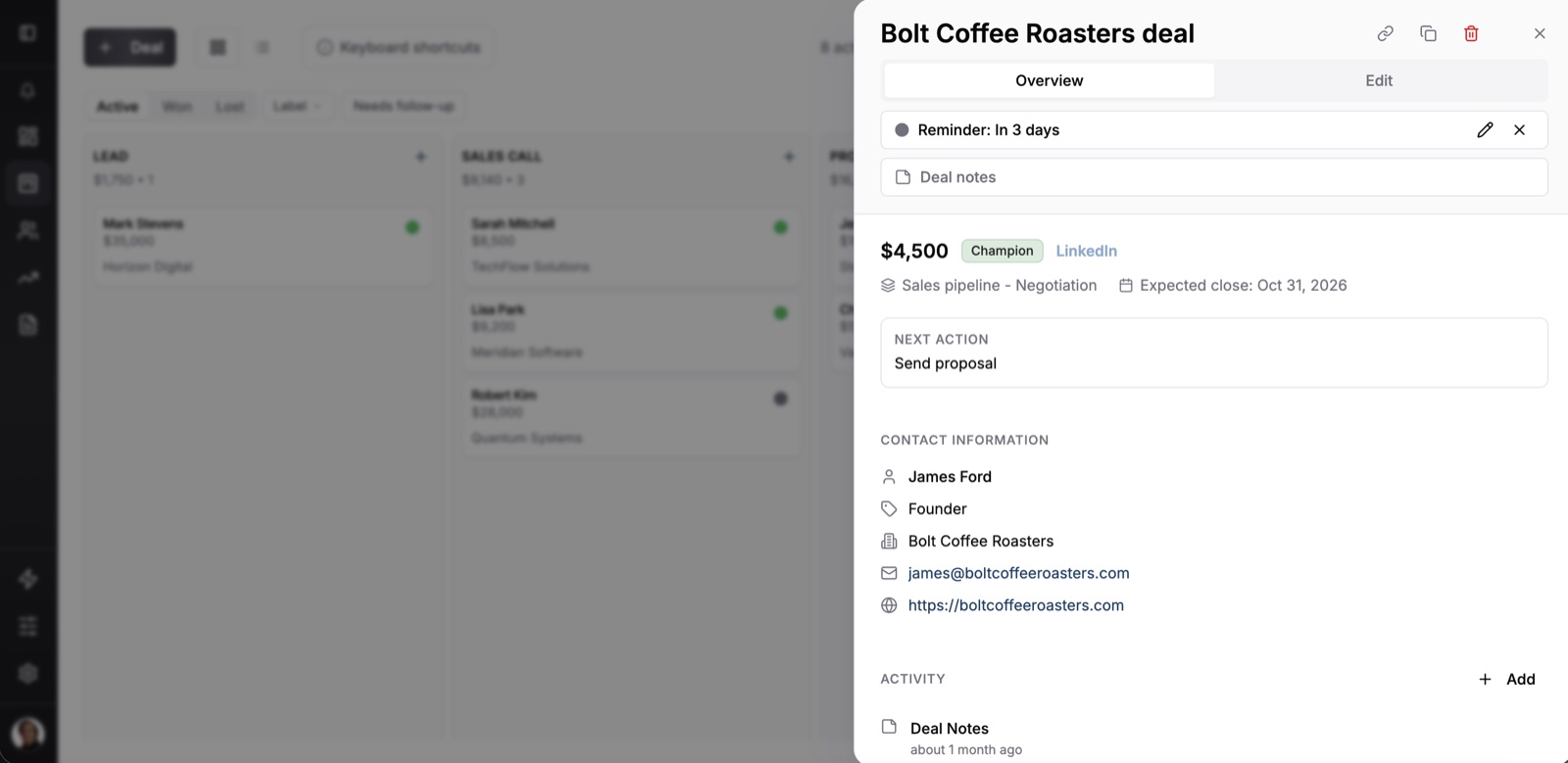
In Fluid CRM, each deal has a next action and one reminder with a date. A daily email then lists what is overdue and what is due that day.
Step 6: Compare the total with what you need
Add up the open value and set it next to your revenue target. Our sales pipeline calculator works out the pipeline a target needs. If you come up short, that is your signal to go and find more deals.
What Breaks a New Sales Pipeline in the First Month
New sales pipelines usually fail in one of four ways:
- Next steps with no date. “Follow up soon” never comes due, so nothing prompts anyone to act and the deal fades.
- Lost deals left open. The total looks healthy, you stop looking for new business and then a quiet month surprises you.
- One person doing all the updates. The moment that person is busy, everyone else stops trusting the board and goes back to asking in chat.
- Nobody ever looks at it together. A short sales pipeline review each week is often the first time a team spots any of the above.
To test yours, pick the biggest deal you have open right now. What is the next step, and what day does it happen? If you had to open three tabs to answer, the pipeline isn’t telling you enough yet. Our guide to sales pipeline management has a daily and weekly routine that keeps it current.
Once deals are moving reliably, a CRM dashboard keeps the main numbers on one screen and you can start measuring how fast they close. Our post on pipeline velocity covers that, but it is no use on a board that is only two weeks old.
Where a Small Team Should Keep Its Sales Pipeline
Start wherever you will actually keep it up. Google Sheets or Excel is fine for a first version, since you can build a table like the bookkeeping example in an afternoon or less. The sheet won’t remind you of anything unless you build that yourself, and our post on when to switch from Google Sheets to a CRM covers when the sheet stops working. If you pay for an all-in-one client tool and only use its pipeline, our list of HoneyBook alternatives sorts your options by job.
Austin Verner, founder of Cold Emailers, reached that point. His team was on Google Sheets and “managing pipeline was getting too difficult”, so they moved to something “without all of the unnecessary features that other CRMs have.”
Yannick, a verified customer, described what the search was for:
“I had been looking for a solution like this for a long time: something that is not overly complicated… and can be implemented quickly.”
Whatever holds your pipeline, deals die on the days nobody opens it. No feature list changes that, so the tool has to be quick enough that opening it is no effort.
We built Fluid CRM for that reason. It is a simple board that takes seconds to update, and if you use Claude or ChatGPT, the assistant can log a call or move a deal from outside the app through our MCP connector, which links the assistant to your CRM. It costs $16 per seat per month, or $144 per seat per year, with everything in one plan.
Two limits matter for someone starting out. Fluid CRM has no two-way email sync, so you log emails by copying in a BCC address, and it has no mobile app, though it works in your phone’s browser.
Sales Pipeline FAQ
No. A sales process is the set of steps your team follows to win a customer, and a sales pipeline is the live list of deals moving through those steps today. The process stays the same for months, and the pipeline changes every day.
A sales pipeline is the list of open deals and where each one stands. A CRM is software that stores that list together with contacts, notes and reminders. You can run a pipeline without a CRM, but almost every CRM has a pipeline at its center.
Yes, if you sell to more than a few people at once. Working alone means nobody else will notice when a quote goes unanswered. A short list with a next step on each deal is enough, and four columns will do.
It usually looks like a board with one column per stage, running left to right from first contact to a signed deal. Each card shows a person or company and a dollar value. Some teams prefer the same information as a table, with one row per deal.
Every open deal has a next step with a date, and nothing has sat untouched for longer than your normal sales cycle. The stages also hold a spread of deals rather than one crowded column. The total value should reflect deals that are still truly possible.
Where to Start on Your Sales Pipeline Today
Open your sent folder and write down the first ten people who are waiting on you, each with a value and a dated next step. That list is your sales pipeline, and it only needs somewhere to be kept. If you want it on a board with a daily email, Fluid CRM is a sales team CRM built for teams of 1 to 10.
Start your 7-day free trial here, no credit card required.