

You have a list of 40 numbers and a free Monday morning. Most templates online were written for full-time callers with a dialer and a manager behind them. They also stop at the opener, which is rarely where a small team loses the deal.
A cold calling script is a short plan for a call: the first 30 seconds written out, one question and the ask for a next step. For a small B2B team it fits on one page and ends with a date in the calendar. Fluid CRM is where that date and the call outcome get logged.
Promised a callback next week and lost track of who?
Fluid CRM keeps everyone you call in one place with the next date on each, and tells you each morning who to call back.
No card needed
What a Cold Calling Script Needs (and Why It Fits on One Page)
A good script has six parts, and only the first two are written word for word. Who you are and the reason you’re calling take about ten seconds. After that comes one line on why you picked them, one question about their situation, the ask with two time options and a fallback for when the answer is “not now”.
Write those first 30 seconds out in full and say them out loud until they sound like you. Everything after that should be prompts, not paragraphs. A caller reading a long script is easy to spot, and the person on the other end hangs up on the reading, not the offer.
The opener deserves the most care. In 2018, Gong studied 90,380 cold calls and found that “How have you been?” booked a meeting 10.01% of the time, against a 1.5% baseline. Saying “The reason for my call is” lifted success 2.1 times, while “Did I catch you at a bad time?” fell to 0.9%.
So drop the apology and give the reason early. People forgive a cold call far faster than a vague one.
My agency, Fenixtal, booked 1,250+ sales calls for clients through cold email and LinkedIn, not the phone, so these aren’t my old calling lists. They borrow the structure that carries over from a good cold email: a named reason, one question and a small ask.
That structure matters more on a small team, where the person calling is also the person selling and delivering. If that’s you, our sales team CRM page shows how the rest of the week fits around the calls.
A one-page cold call script template
Copy this, fill in the brackets and keep it next to your phone:
- Opener: “Hi [first name], this is [your name] from [company]. How have you been? To be upfront, this is a cold call.”
- Reason: “The reason for my call is [one sentence about a problem you solve].”
- Why them: “I saw [something specific: a job post, a new office, a service they launched].”
- Question: “How are you handling [that problem] today?”
- Ask: “Would 15 minutes on [day] or [day] work, or is this a waste of your time?”
- Fallback: “When would be a better week for me to try you again?”
The last two lines do most of the work. Every version below ends on one of them, because a call without a date is a call you’ll have to make again from scratch. Once a script works, put it in your sales playbook so everyone on the team opens the same way.
5 Cold Call Scripts for Small B2B Teams
The names and companies in these scripts are made up.
Each script below fits one situation. Swap the names and details for your own, and keep the reason to one sentence a 12-year-old would follow.
1. The first call to a decision maker
Use this when you have the owner or head of department on the line and they don’t know you.
- You: “Hi Dana, this is Sam from Northline. How have you been?”
- Them: “Uh, fine. Who is this?”
- You: “Fair question, this is a cold call. The reason for my call is that we help accounting firms stop losing new client inquiries during tax season. I saw you just opened a second office, so I guessed the phones got busier.”
- You: “How are new inquiries handled right now when everyone’s booked up?”
- You, after they answer: “That’s close to what we hear from other firms your size. Would 15 minutes on Tuesday or Thursday work, or is this a waste of your time?”
Naming it as a cold call lowers their guard, because you said the thing they were thinking. The question about their situation gives them something to talk about other than you.
2. Getting past the gatekeeper
An office manager or receptionist is doing their job by screening you. Treat them as the person who knows how the company works, because they usually do.
- You: “Hi, this is Sam from Northline. I’m hoping you can help me. Who looks after choosing new software for the team?”
- Them: “What is this about?”
- You: “We help firms keep track of new client inquiries. I’d like to ask the right person whether that’s a problem here at all, two minutes at most.”
- If they refuse: “No problem. What’s the best day to reach Dana directly, and is there an email you’d rather I use?”
A refusal still gives you a name, a day and maybe an email. Write all three down before you dial the next number.
3. The voicemail you leave
Keep it under 20 seconds and say your number twice. Nobody writes down a number they only heard once.
- You: “Hi Dana, Sam from Northline, 555 0142. I’m calling because we help accounting firms handle the extra inquiries that come in during tax season. I’ll send you a short email today so you have it in writing. Again, Sam, 555 0142.”
Then send that email within the hour, with the same reason in the first line. If nothing comes back, our post on the follow-up email after no response has wording for the next message.
4. The referral call
A real referral is the strongest opener you’ll ever have, so put the name in the first sentence. Only use it when that person actually told you to call.
- You: “Hi Dana, this is Sam from Northline. Priya Shah at Harbor Legal suggested I call you.”
- Them: “Oh, Priya, sure.”
- You: “We helped her team set up how they track new client calls, and she thought you might be dealing with the same thing after the move. Is that right, or did she get it wrong?”
Asking whether the referrer got it wrong sounds odd on paper. On the phone it gives the person an easy way to say what’s actually going on, and that answer is your whole call.
5. Calling back someone who filled in your form
This one isn’t strictly cold, but it’s the call small teams fumble most often. The person asked to hear from you, so call within minutes if you can, not tomorrow.
- You: “Hi Dana, it’s Sam from Northline. You filled in the form on our site about ten minutes ago, so I thought I’d call rather than send an email. Is now still a good time?”
- You: “You mentioned you’re losing track of inquiries. What happened that made you look this week?”
- You: “I can show you how other firms handle it on a 20-minute call. I have Wednesday at 10 or Thursday at 2.”
“What happened this week” usually brings out the real reason they reached out. Our speed to lead post covers how a team of three can make sure someone answers these fast.
How to End a Cold Call When the Answer Is “Not Now”
Most cold calls end on some version of “not now”. The opener gets all the attention in scripts, yet the last 20 seconds decide whether you ever speak to this person again.
Three answers come up again and again. Here is a closing line for each that leaves you with either a date or a clear no:
- “Just send me an email.” “Happy to. So I send the right thing, is the bigger issue [problem A] or [problem B]? And if it looks useful, could we pencil in 15 minutes next Thursday?”
- “I don’t have time right now.” “Understood, I’ll be quick to let you go. Is there a better week to try you, or should I leave it?”
- “Call me next quarter.” “Will do. Is the first week of [month] good, or later in the month?”
When someone gives you a month, ask for a week inside it. “Next quarter” is a polite no until it has a date, and with one it’s a real appointment you can keep.
For the deeper objections about price or a competitor, our list of common sales objections has full answers. If the call goes well and you book a meeting, the discovery call guide picks up from there.
What to Write Down in the Minute After the Call
Can you say right now who you promised to call back next week, and on which day? If the answer lives in your head or on a sticky note, part of the list you called last month has already been lost.
The fix takes about a minute per call, and it’s the same every time. Write the outcome, the next date and one line in their words.
| What happened | What you write | Next date |
|---|---|---|
| No answer | “No answer, tried at 10am” | Two days later, at a different time |
| Voicemail left | “VM left, email sent” | Three days later |
| Gatekeeper | The right name, best day, email | The day they named |
| “Not now” | Their reason in their words | The week they gave you |
| Meeting booked | What they said the problem is | The meeting date |
| Not a fit | Why, in one line | None, mark it lost |
In Fluid CRM, each person you call is a deal on the pipeline. Hover over the card, press A to log a call activity with your note, then press R to set the reminder for the next date.
The pipeline from this post
Every call, and the date it ends on
- To call
- Called
- Callback
- Meeting
- Won
Dana Reyes, Harbor CPA
Log each call on the deal and set the next date before you dial again. Each morning’s email lists your callbacks.
7 days free, no card
“I go faster, and I can plan my client actions with clarity.”
Doland White, founder of DWC
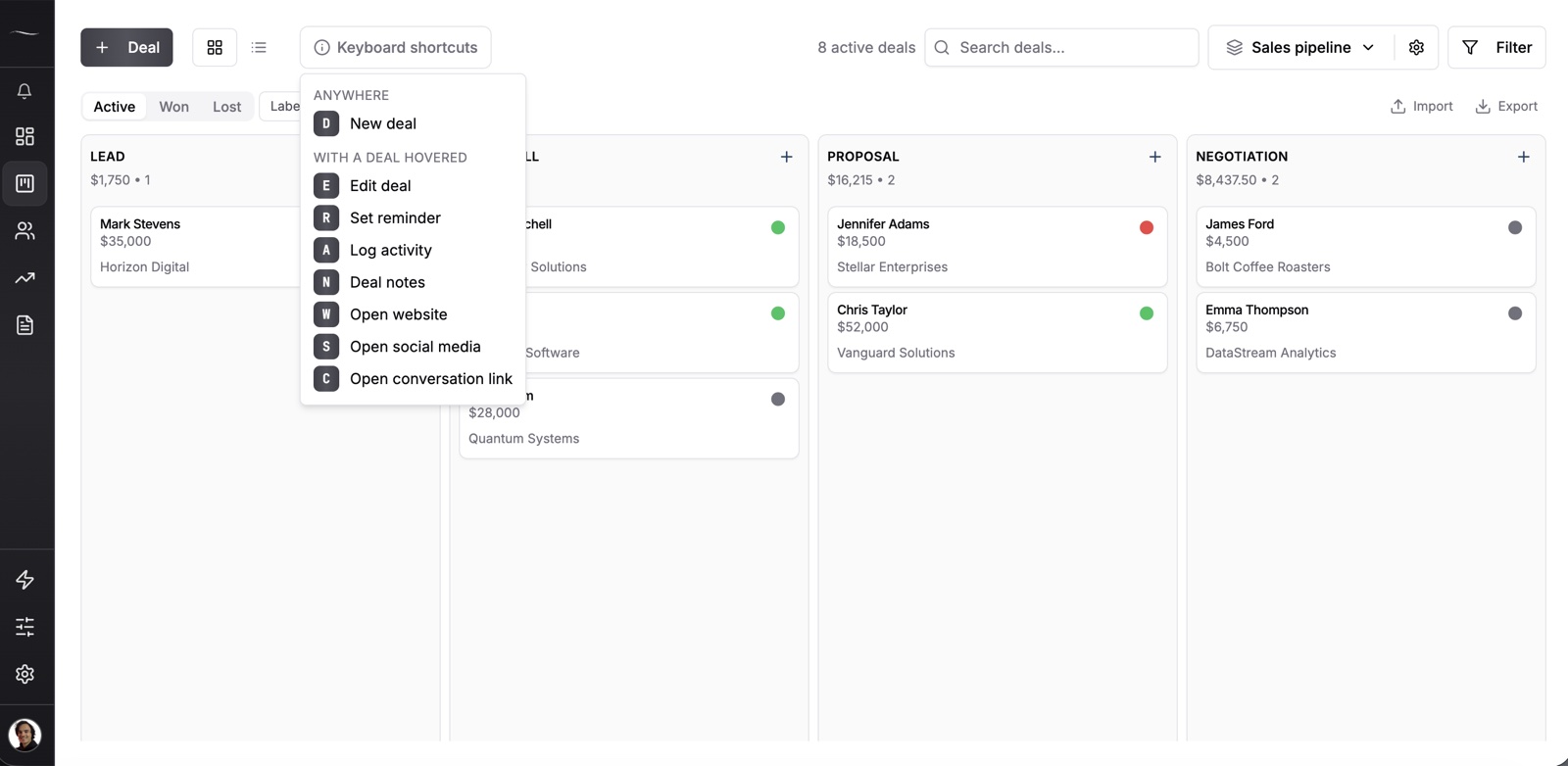
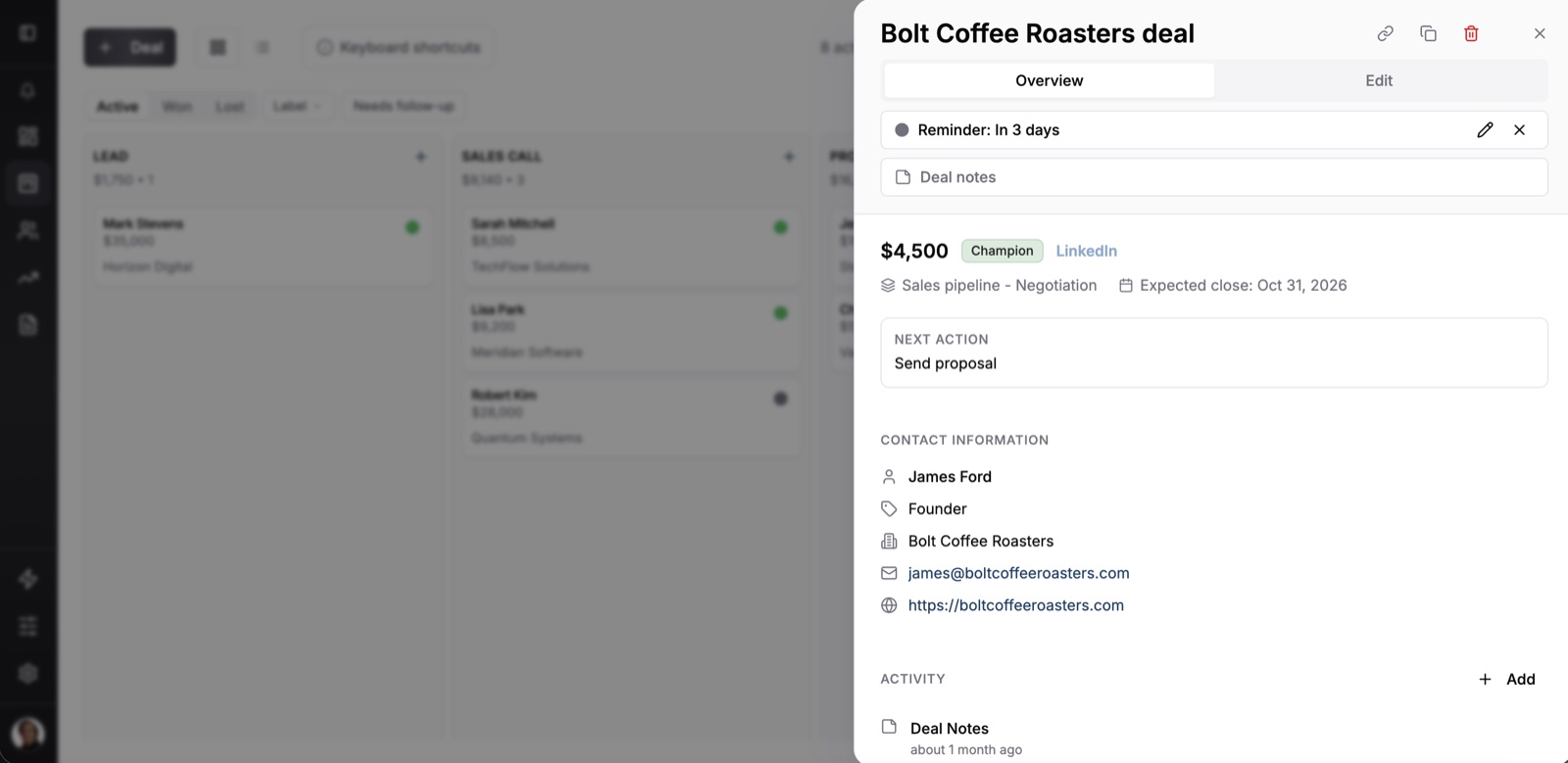
On the day that reminder comes due, the morning email lists it along with anything overdue, so you start the day with your callbacks in front of you. The deal panel shows the same reminder and the next action, so a teammate who picks up the deal knows what was promised.
Viktor Otterskog runs outbound and looked at HubSpot and Airtable before choosing Fluid CRM. His short review sums up what a caller needs from it:
“Reminders for action. Simplistic to ‘play the outbound game’.”
That’s the job here, a reminder that turns into the next call and nothing you have to study first.
Two limits matter for callers. Fluid CRM has no dialer and no call recording, so you dial from your own phone and type the note yourself. If your team makes 100 dials a day from one screen, Fluid CRM is not the tool for it.
Each reminder is also a date with no time of day. If someone says “call me at 4:30”, put the time in the note and keep your own calendar for it.
How Many Dials Before You Leave a Voicemail
Don’t leave a voicemail on the first try. A voicemail uses up your best chance at a first impression, and you’ll want to use it once you know the number reaches the right person.
A simple pattern works for most small teams. Dial twice at different times of day before you leave the voicemail from script 3. Mid-morning and late afternoon are the first two windows to test, since they sit outside the start-of-day rush.
If the same hour keeps going to voicemail, the problem is probably the hour, not the person. Move the next try to a different part of the day and note which one gets answered.
After the voicemail and its email, the deal gets its next reminder like any other. Our guide to sales prospecting covers the full weekly rhythm of who to call and when to rest a lead.
Cold Calling Script FAQ
Yes, in most cases. The FTC exempts most business-to-business calls from much of the Telemarketing Sales Rule, but since 2024 its ban on misrepresentation covers them too. If you call mobile numbers, the TCPA limits autodialers and prerecorded messages, so dial by hand and leave live voicemails. State rules and rules outside the US, such as the Corporate TPS register in the UK, differ, so check where your prospects are before you start.
One page at most. Write the first 30 seconds word for word, then keep the question, the ask and the fallback as short prompts. Anything longer turns into reading, and people can hear it.
Only the opener and the reason for the call. After that, listen and use the script as a checklist so you don’t forget the ask. Practice the opener out loud ten times before your first call so it sounds like you.
In Gong’s study of 90,380 cold calls, “How have you been?” did best, and saying “The reason for my call is” early also helped. “Did I catch you at a bad time?” booked only 0.9%, below the 1.5% baseline. Whatever you open with, give your real reason within the first ten seconds.
There is no single best hour that holds for every market. Try the same list at two or three different times of day for a week and note which ones get answered.
A cold call script is for someone who doesn’t know you yet, and its only goal is a next step. A sales call script covers a call the buyer agreed to, such as a demo or a discovery call, where you ask deeper questions and talk about price.
Your First Ten Cold Calls This Week
Before Fluid CRM, I booked 1,250+ sales calls for B2B companies at my outbound agency. Again and again, I saw small businesses struggle with messy spreadsheets and slow, overly expensive CRMs.
So we built Fluid CRM for the part after the call: every callback in one place, and a morning email that tells you who to follow up. One plan, $16 a seat a month, everything in it.
Omar Abdalla, founder of Fluid CRM
Start your free weekPick ten people, print the template above and make the calls in one sitting, so your opener gets better by call four. Log each outcome and next date before you pick up the phone again. A sales team CRM like Fluid CRM keeps those dates in one place and emails you the morning they come due, so the call that ended with “try me in March” happens in March.
Start your 7-day free trial here, no credit card required.