

Search “CRM for coaches” and you get a list of all-in-one platforms for scheduling, payments and course hosting. Good tools, most of them. But half aren’t really CRMs, and the ones that are won’t help you land the client before they sign. This post tells you which tool does which job.
The best CRM for coaches depends on which job you need done. For tracking leads and following up before a client signs, Fluid CRM gives you a clear sales pipeline at $16 a seat. For scheduling and payments after they sign, a delivery tool like Paperbell fits better.
For coaches who sell custom engagements
Prospects stall with no next step. Fluid CRM emails you who’s due.
No credit card required
When I ran cold email outbound and LinkedIn outreach for sales coaches and business consultants at Fenixtal, the pattern was always the same. Most either didn’t track their leads at all, or paid for a tool they never opened. The leads came in. The follow-up didn’t.
The Two Jobs a CRM for Coaches Has to Do
A CRM for coaches has to do one of two jobs, and most tools only do one of them well. The first job is sales. Track the people who might hire you, remember to follow up and move them from interested to signed. The second job is delivery. Once someone signs, you schedule sessions, take payment, share worksheets and host any courses you sell.
These are different problems with different tools. A scheduling-and-payment platform is brilliant at the second job and close to useless at the first. It assumes the client already said yes. The trouble is that most “coaching CRM” lists mix the two together and crown one all-in-one as the winner, which leaves you paying for course hosting when your real problem is that prospects drift away.
Nathan Shooter, a speaker and coach, looked at a specialized coaching tool before choosing something simpler. His reason was the one I hear most. Most coaching tools are “too complex, multiple clicks to get simple things done.” He wanted something a part-time assistant could use without relearning it every week.
So before you pick a tool, work out which job is actually breaking.
Do You Have a Sales Problem or a Delivery Problem?
Coaches split into two groups, and the split isn’t about team size or revenue. It’s about how you bill.
You have a delivery problem if:
- You sell packaged programs (6 sessions, 12 weeks, 90 days)
- Clients pay upfront for a set number of sessions
- You need to log session notes, homework and progress
- You’re certified (ICF, EMCC) and track coaching hours
- You run group programs, courses or masterminds
- You need a client portal for resources and scheduling
- Your sales cycle is short, so a discovery call turns straight into a package sale
You have a sales problem if:
- You sell custom engagements through proposals
- Deals have different values and close dates
- Several conversations happen before anyone signs
- You track leads, follow-ups and renewals separately
- You work on quarterly or annual retainers
- Your sales cycle is longer, running from intro call to proposal to close
Stop for a second and check yourself against both lists. Which one describes more than 70% of your business? That’s your category. Some coaches do both. If you’re 60/40, pick the tool for the bigger side and use a spreadsheet for the rest until one side takes over.
Here’s how the 12 tools sort out.
| Tool | Job it does | Best for | Starting price |
|---|---|---|---|
| Fluid CRM | Sales | Tracking leads and follow-up | $16/seat/mo ($144/yr) |
| Pipedrive | Sales | A sales-first pipeline alternative | $24/seat/mo ($14 annual) |
| HubSpot | Sales | High-volume marketing | $20/seat/mo |
| OnePageCRM | Sales | Coaches who work from a daily action list | $15/user/mo ($9.95 annual) |
| Salesflare | Sales | Coaches who sell from their inbox | $39/seat/mo |
| Paperbell | Delivery | Solo coaches who need scheduling and payments | $97/mo ($970/yr) |
| HoneyBook | Delivery | Client billing and experience | $36/mo ($29 annual) |
| Kajabi | Delivery | Coaches selling courses | $179/mo ($143 annual) |
| CoachAccountable | Delivery | Client progress and homework | $20/mo (2 clients) |
| Quenza | Delivery | Homework between sessions | $25/mo (5 clients) |
| Delenta | Both | A scaling practice | $29/mo |
| GoHighLevel | Both (agency) | Agencies running client funnels | $97/mo |
How I Ranked These 12 CRMs for Coaches
I ranked each coach CRM on fit for a solo or small coaching practice, honest pricing and whether it solves the sales job, the delivery job or both. Prices lead with monthly billing, with the annual rate in brackets where it changes the math. Each entry tells you who it suits and when to pick something else.
The 5 Best Sales Pipeline CRMs for Coaches
These tools track the people who might hire you. They have deal stages, follow-up reminders and a pipeline view. None of them schedule sessions or take payment.
1. Fluid CRM (best for tracking leads and your sales pipeline)
Fluid CRM does the sales job and nothing else, which is the point. You get a visual pipeline that shows every prospect and what stage they’re at, plus reminders so you follow up before a deal dies. Setup takes minutes, not a training call. See how it works as a CRM for coaches and consultants. Pricing is $16 a seat a month, or $144 a seat a year with 3 months free, and every feature is included on both plans with no upgrade tiers. It sits in the same family as the other lightweight CRMs I’ve compared, built to stay out of your way.
Jaakko Sahimaa, a business psychologist who runs more than one venture, picked it for the same reason most solo operators do. He liked “the simplicity and clarity of the system.” It tracks his customers, opportunities and follow-ups in one place without the overwhelm of a bigger tool.
Doland White, an executive coach, described the mess it replaced:
“The CRM serves me, not the other way around. Before Fluid, I was tracking prospects, clients and podcast guests across Google Contacts, LinkedIn, spreadsheets and marketing platforms. I was constantly updating information instead of focusing on the client.”
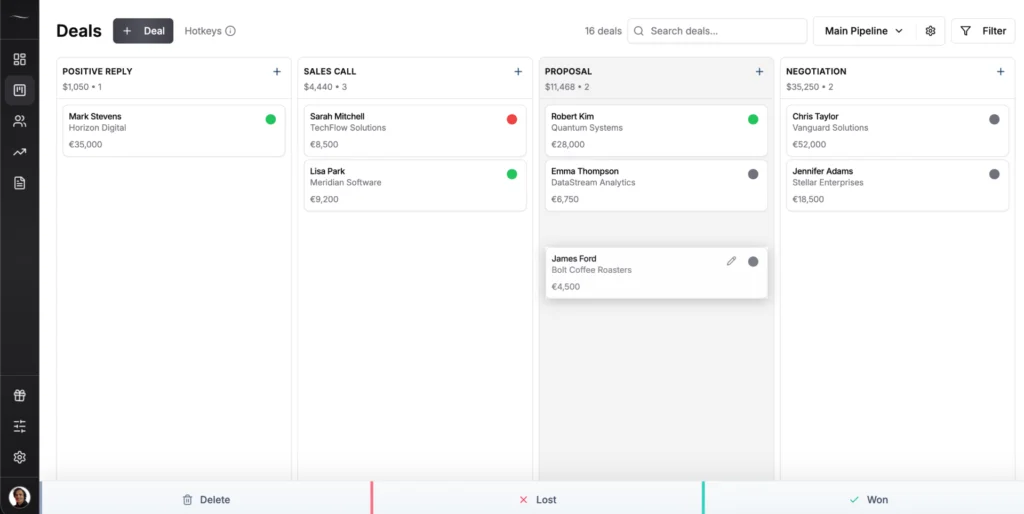
Where it falls short: No scheduling, no payments, no course hosting. Fluid CRM is a sales pipeline, not a delivery platform.
Use a delivery tool instead if you sell session packages and want booking and payment in the same place. Pair one with Fluid for the full picture.
2. Pipedrive (best sales-pipeline alternative)
Pipedrive does the sales job and does it well. It’s a visual pipeline CRM built for sales teams, with deal tracking, activity reminders and a clean interface. Pricing starts at $24 a seat a month on the Lite plan ($14 billed annually), with Growth at $49 ($39 annual). There’s a 14-day free trial and no permanent free plan.
Where it falls short: Email sync, automation and sequences start at the Growth tier, and add-ons like LeadBooster climb the bill faster than the sticker price suggests.
Use Fluid CRM instead if you want every feature included with no upgrade math, at $16 a seat.
3. HubSpot (best for high-volume marketing)
HubSpot does the sales job at scale and bolts on marketing automation most coaches won’t use. The free tier covers up to two users, Starter runs $20 a seat a month, and Professional jumps to $100 a seat a month plus a mandatory $1,500 onboarding fee. The features people buy HubSpot for, like sequences and forecasting, sit at Professional and up.
Doland White tried it and most of the others before walking away. His line on HubSpot was that “if you want to do something different, you have to buy more.”
Where it falls short: The tools a coach actually needs sit behind the $100 Professional tier, and the $1,500 setup fee lands before you’ve closed a single client with it. That’s a lot of CRM for a high-touch, low-volume practice. I broke down the full year-one math for a 2-person team if you want the numbers.
Use Fluid CRM instead if you have relatively few leads, high deal value and no need for marketing automation.
4. OnePageCRM (best for coaches who work from a daily action list)
OnePageCRM is built around one idea. Every contact gets one defined next step, and the app keeps pushing you to complete it. If you run your day off a to-do list, the tool matches how you already think. Pricing is $15 a user a month on Professional ($9.95 a user billed annually), with Business at $19.95 a user a month annual.
Where it falls short: The action-list approach is the whole product, not a setting you can turn off. If you’d rather see a stage-based pipeline, or you need separate pipelines for different client types, it fights you.
Use Fluid CRM instead if you want a visual pipeline with unlimited pipelines rather than one long list of next actions.
5. Salesflare (best for coaches who sell from their inbox)
Salesflare is built around Gmail and Outlook. It logs your emails automatically, pulls in contact details and cuts most of the typing other CRMs make you do. If almost every conversation with a prospect happens over email, it removes real work. Pricing is $39 a seat a month for Growth and $64 a seat a month for Pro, where workflows and email sequences live.
Where it falls short: It’s the most expensive entry price of the sales tools here, and the automation you’d want sits at $64. If you book most calls through LinkedIn, referrals or a podcast, you’re paying for inbox tracking you barely use.
Use Fluid CRM instead if your leads come from referrals and conversations rather than email threads.
The 5 Best Delivery Tools for Coaches
Delivery tools take over once a client says yes. They handle scheduling, payment, contracts, session notes and homework. None of them will help you chase a prospect who went quiet.
1. Paperbell (best all-in-one for solo coaches)
Paperbell handles the delivery job for solo coaches. It bundles scheduling, payments, contracts and a client portal into one tool built specifically for coaching, and it doesn’t take a cut of your revenue beyond standard Stripe or PayPal fees. Pricing is $97 a month or $970 a year, and coaches can start for free with a free account, no credit card required.
Where it falls short: It’s a delivery tool, not a sales tool. There’s no real pipeline for tracking prospects before they buy, so the people who said “maybe” still fall through the cracks.
Use Fluid CRM instead if your problem is landing clients, not delivering sessions to the ones you already have.
2. HoneyBook (best for client billing and experience)
HoneyBook does the delivery job for service businesses, coaches included. It covers proposals, contracts, invoicing and payments with a polished client-facing experience. Pricing runs $36 a month for Starter ($29 annual), $59 for Essentials ($49 annual) and $129 for Premium ($109 annual), with card processing fees of 2.9% plus $0.25 on every payment on top.
Where it falls short: It’s built for creative service businesses like photographers and planners, so the sales pipeline is thin and the transaction fees stack up as you bill more.
Use Fluid CRM instead if you need to track and chase leads, and use HoneyBook when the after-sale client experience is the priority.
3. Kajabi (best for coaches selling courses)
Kajabi is a course platform first. If your business is selling online courses, memberships and digital programs, it hosts the content, runs the email marketing and takes payment in one place. Pricing starts at $179 a month for Basic ($143 billed annually), climbs to $249 for Growth and $399 for Pro. Kajabi pulled its cheaper Kickstarter plan from public pricing in early 2026.
Where it falls short: It’s expensive and it’s overkill if you don’t sell courses. It’s also not a sales pipeline, so tracking one-to-one coaching prospects isn’t what it’s for.
Use Fluid CRM instead if your money comes from one-to-one coaching and your bottleneck is following up with leads.
4. CoachAccountable (best for client progress and homework)
CoachAccountable does the delivery job with a focus on what happens between sessions. It tracks client goals, assigns homework and worksheets, logs progress and handles scheduling and billing. Pricing is usage-based, starting at $20 a month for 2 active clients, rising to $70 for 10 and $400 for 100, with a 30-day free trial and no credit card needed.
Where it falls short: The bill scales with your active client count, so a growing practice pays more over time. And like the others here, it’s delivery, not sales.
Use Fluid CRM instead if you need to track prospects and follow-ups, then run CoachAccountable for the accountability side once clients sign.
5. Quenza (best for coaches who assign homework between sessions)
Quenza is built for coaches whose method depends on what the client does between sessions. You build exercises, reflections and activities, send them out and see who completed what. Life coaches, wellness coaches and therapists use it most. Pricing starts at $25 a month for up to 5 active clients, with extra blocks of 5 clients at $15 a month each.
Where it falls short: It’s a between-session delivery tool with no pipeline, no deal stages and no way to track someone who hasn’t hired you yet. The per-client pricing also means a busy month costs more than a quiet one.
Use Fluid CRM instead if your bottleneck is lead flow rather than client follow-through.
The 2 Best All-in-One Coaching Platforms
All-in-one platforms try to cover both jobs in one login. That works when you’re already busy on both sides, and it’s expensive overhead when you’re not.
1. Delenta (best all-in-one for a scaling practice)
Delenta tries to do both jobs. It bundles a CRM with scheduling, payments, group coaching and course creation, aimed at coaches who want everything under one roof. Pricing is $29 a month for Starter, $49 for Pro and $79 for Premium, with a free trial and no credit card required.
Where it falls short: It’s more tool than a solo coach with a light pipeline needs, and the all-in-one approach means a steeper learning curve than a focused tool.
Use Fluid CRM instead if you only need the sales side and would rather add a scheduling tool than learn a full platform.
2. GoHighLevel (best for agency-style automation)
GoHighLevel does both jobs and a dozen more. It’s an all-in-one built for agencies, bundling a CRM, funnels, email, SMS, calendars and course hosting. Pricing is $97 a month for Starter, $297 for Unlimited and $497 for SaaS Pro, with usage charges for SMS, email and phone billed separately on top. A 14-day free trial is standard.
Where it falls short: It’s built for agencies running client funnels, setup runs two to four weeks, and the usage fees add to the base price. For a solo coach it’s far more than the job needs.
Use Fluid CRM instead if you’re one coach who needs a pipeline, not an agency reselling software to clients.
CRMs to Avoid for Coaches
Three tools show up constantly in coaching content and fit almost nobody reading this. Here’s where to be careful.
Salesforce
Salesforce is built for enterprise sales teams. Setup takes weeks, real customization needs a consultant and the price climbs as you add anything. Half the marketing agencies I worked with at Fenixtal paid for Salesforce and never opened it. The same pattern hits coaches. Skip it unless you have a 10+ person team and someone whose job is running the system.
Monday CRM
Monday is a project management tool first and a CRM second. The CRM view is a spreadsheet with kanban styling on top. Proper deal stages, follow-up reminders and contact history all feel bolted on rather than built in. Skip it unless your whole business already runs on Monday and you want one less login.
Keap
Keap is marketing automation with a CRM attached. Pricing starts at $249 a month billed annually ($299 monthly) for 1,500 contacts and 2 users, plus a required implementation fee of $500 or more. The strength is email nurture sequences. If you’re not running those, you’re paying four figures a year for a contact list with reminders. If you already pay for it, our Keap alternatives guide prices year one for each replacement.
Best CRM for Life Coaches
Life coaches usually work with a smaller number of clients at higher touch, and the money often comes from session packages. The right tool depends on where the work piles up. If your whole business is selling and delivering packages, a solo all-in-one like Paperbell handles scheduling, payment and contracts in one place and saves you from stitching three tools together.
If the struggle is the front end, getting discovery calls booked and following up with people who said maybe, then you need a sales pipeline first. Fluid CRM tracks those conversations, shows you who’s gone quiet and reminds you to follow up before they drift. Add a scheduling tool when payments become the bottleneck. Most life coaches don’t need a $179 course platform to do either.
Best CRM for Business Coaches
The right CRM for a coaching business depends on deal length. Business coaches and executive coaches run longer sales cycles with bigger deals and fewer leads. One prospect might take three months and five conversations before they sign. That makes follow-up the thing that wins or loses the deal, not scheduling.
A clear sales pipeline keeps every prospect visible and tells you who to chase this week. When I ran outbound for business consultants at Fenixtal, the deals that closed were the ones where someone actually followed up on time. The leads were never the problem.
Fluid CRM is built for exactly that job, tracking a smaller set of high-value conversations without burying you in features. If you also sell structured programs with payment plans, pair it with a delivery tool rather than forcing one platform to do everything. And if your work leans further into consulting than coaching, my breakdown of the best CRMs for consultants covers the multi-pipeline setup that fits that work better.
When an All-in-One Coaching Platform Is Worth It
An all-in-one coaching platform is worth paying for when delivery is your bottleneck, not sales. The test is simple. If you sell session packages and you’re tired of duct-taping a calendar, an invoice tool and a contract app together, a platform like Paperbell or Delenta earns its price by putting all of it in one place.
If your problem is the other end, prospects drifting away because you forgot to follow up, then a $179 course platform won’t fix it and a simple pipeline will. The two-to-four-week setup on something like GoHighLevel is wasted if all you needed was to remember who to call back.
So ask yourself one question. What’s actually leaking, the leads before they sign or the admin after they do? Pay for the leak you have, not the one a vendor wants to sell you. For a lot of solo and small practices, a focused sales pipeline plus a separate scheduling and payment tool beats one bloated all-in-one on both price and clarity.
How to Pick a CRM for Coaches in 3 Filters
Three filters get you to an answer in about five minutes.
Filter 1: How you bill. Packaged sessions paid upfront points to a delivery tool. Custom proposals with different deal sizes points to a sales pipeline. This filter overrides the other two.
Filter 2: Lead volume. Under 20 active leads and a lightweight tool like Fluid CRM, OnePageCRM or Paperbell covers it. Between 20 and 100 leads with several stages and you’re looking at Pipedrive or HoneyBook. Above 100 with a team, HubSpot Professional starts to make sense.
Filter 3: Team size. Solo means flat-rate tools and entry-tier seats both work. At 2 to 5 people, check what sits behind the entry tier before you sign up. Past 5 seats, model the full year before you commit.
Run them in order. Most coaches land on a sales pipeline, under 50 active leads, one to three seats.
What to Do After You Pick a CRM
Picking the tool is 20% of the work. The other 80% is setup and habit. Coaches who quit a new CRM inside 60 days almost always skipped these three steps.
Clean the import
Don’t dump 800 contacts from Gmail into the new CRM on day one. Start with the 15 to 30 prospects you’re actually working, get those right and set a follow-up reminder on each. Import the historical contacts in batches once the live pipeline is running.
Set up two pipelines
Most coaches need one pipeline for new business (lead, discovery, proposal, close) and a second for existing clients (active, renewal due, renewed or churned). Don’t force both into one. They move at different speeds and the stages don’t match.
Block 10 minutes a day for follow-ups
Pick a time and keep it. Most coaches I know do this before their first session of the day. Open the CRM, look at what’s overdue, send the messages and mark them done.
A coach who does these three things in week one gets value straight away. A coach who imports everything, sets no reminders and checks the CRM “when I have time” has abandoned it by week six.
Frequently Asked Questions
Not every coach needs a CRM, but every coach needs a way to track who’s interested and follow up on time. If you have fewer than ten conversations going and you never miss a follow-up, a notebook works. Past that, leads slip and you don’t notice until the prospect goes quiet. A pipeline CRM exists to stop that from happening.
The best CRM for coaches depends on what you sell. For coaches selling packaged sessions like 6-session programs or group masterminds, Paperbell is the top pick at $97 a month flat. For coaches selling custom engagements like executive coaching or advisory work, Fluid CRM is the top pick at $16 a seat a month. Work out your billing model first, then pick the tool.
Coaching-specific tools like Paperbell, Delenta, HoneyBook and Quenza handle session tracking, packages, client portals and ICF hours. Sales CRMs like Fluid CRM, OnePageCRM, Pipedrive and Salesflare handle lead flow, proposals, follow-ups and renewals. Packaged sessions paid upfront means a coaching tool. Custom proposals with different deal values means a sales CRM.
HubSpot has a free tier for up to two users, and Capsule offers a free plan capped at 2 users and 250 contacts. Both are real products, though the features coaches lean on often sit behind paid upgrades. Fluid CRM doesn’t have a free plan. It runs a 7-day free trial, no credit card required, then $16 a seat a month with every feature included.
Some try. All-in-one platforms like Delenta and GoHighLevel bundle a CRM with scheduling, payments and course hosting. The trade-off is that doing everything tends to mean doing some of it shallow, and you pay for parts you may never touch. A lot of coaches get a cleaner result pairing a focused sales pipeline with a separate scheduling and payment tool.
On sticker price, HubSpot’s free tier costs nothing for up to two users and OnePageCRM is the cheapest paid option at $9.95 a user a month billed annually. Fluid CRM sits at $16 a seat a month, or $144 a seat a year, with every feature on both plans. Cheapest upfront isn’t always cheapest at month six, so check what’s gated before you commit.
Conclusion
The right CRM for coaches isn’t the one with the most features. It’s the one that fixes your actual bottleneck. If that bottleneck is tracking leads and following up before they sign, Fluid CRM gives you a clear visual pipeline without the bloat of an all-in-one.