

Search for the best CRM for independent sales reps and every list assumes you are the same person. You are not. Three very different jobs hide behind that job title, and one of them should not buy Fluid CRM at all. This post sorts you first, then hands you the tool.
The best CRM for independent sales reps depends on which kind of rep you are. Solo B2B closers and freelance sales contractors are best served by Fluid CRM at $16/seat/month with every feature switched on. Multi-line field reps need commission and route tools, so Moovago or ShowroomHQ fits them better.
The 3 Types of Independent Sales Reps (And What Each One Needs)
Independent sales reps fall into three groups, and the tool that fits one group will waste money for another. Every list I read while researching this post treats the job as one thing. It isn’t. Sort yourself into the right box before you sign up for anything.
I broke down the 12 best sales tools for sales reps in this article, if you want to improve your stack beyond a CRM.
1. The multi-line manufacturers rep
You carry lines for several principals. You drive a territory, you visit accounts in person and your income is commission split across the brands you represent. Your real work is knowing which principal owes you what, and which accounts you can hit in one loop of driving. If you are the manufacturer or distributor hiring those reps, our guide to the best CRM for manufacturers is written for you.
You need commission tracking per principal and route planning. Fluid CRM does neither, and no amount of custom fields will fake it. Go look at Moovago or ShowroomHQ instead. They were built for you, and I would rather send you there than sell you something that leaves you doing commission math in a spreadsheet anyway.
2. The solo B2B closer
You sell your own service or you run founder-led sales for your own book. Consultants, freelance service sellers and one-person B2B operations all sit here. Nobody hands you leads, so you find them, work them and close them. This is what Fluid CRM does at its core.
Your whole job is the pipeline and the follow-up. You do not need marketing automation, lead scoring or a project module. You need to open a tool, see who is waiting on you today and act. This is the reader this post is built for.
3. The freelance sales contractor
You sell on commission for 2 to 4 client companies. Each one has its own product, its own price list and its own buyers. The nightmare is bleed, where a deal for client A ends up parked in the same list as client B and you lose track of which book a conversation belongs to.
You need one pipeline per client, kept apart, without logging out and back in to switch. That is a real requirement and a surprising number of tools charge you extra for it. Fluid CRM has unlimited pipelines included and this is where it shines.
Stop for a second. Which of the three are you? If you answered type 1, close this tab and go look at Moovago. Everything below is written for types 2 and 3.
What an Independent Sales Rep Actually Needs From a CRM
The feature checklists on other CRM lists are useless for independent sales reps because they were written for teams. A rep working alone has no manager to please, no reporting to roll up and nobody to hand a lead to. Three questions decide the whole thing.
Can one seat do the whole job?
You are buying one seat. That means the cheapest plan is the plan you live on, so the only question that matters is what the cheapest plan can actually do. A tool that gets great at three seats is worthless to you.
Does it tell you who to touch today?
Open the tool. Without clicking anything, can you see who is waiting on a reply and who has gone quiet for two weeks? If the answer is no, you have bought a contact list with a nicer font.
Can you keep client books apart without a second login?
Type 3 reps need this and type 2 reps grow into it. Multiple pipelines, side by side, one login. Capsule and HubSpot both gate this. Check it before you buy, not after you have imported 400 contacts.
Everything else is optional. Dialers, AI summaries, enrichment and forecasting are nice, and none of them will save a deal you forgot to follow up on.
In 3 years running cold email at Fenixtal, I booked 1,250+ sales calls. The pattern with the independent reps and consultants among them was consistent. They were not paying for a CRM they never opened, which is the classic small-team failure. They were tracking nothing at all. Leads sat in an inbox and a notes app, and the ones that went quiet just stayed quiet.
I broke down my full pipeline generation strategy here, so be sure to check that out.
CRM Pricing for Solo Sales Reps: What One Seat Really Buys
CRM pricing for solo sales reps looks cheap at first glance because per-seat pricing always looks cheap at one seat. The trap is what the entry plan can do once you are on it. Here is the honest table, built on capability rather than sticker price.
| CRM | Entry plan (monthly) | Can it track deals? | Multiple pipelines? |
|---|---|---|---|
| Fluid CRM | $16/seat | Yes | Yes, unlimited |
| Close (Solo) | $19 | Yes | Essentials only |
| HubSpot (Free) | $0 | Yes | No, 1 pipeline |
| Capsule (Starter) | $21 | Yes | No, Growth only |
| Pipedrive (Lite) | $24 | Yes | Yes |
| folk (Standard) | $30 | No, Premium only | No |
Two numbers deserve a closer look.
folk Standard runs $30/seat/month monthly and $24 annual, and it has no deals module. Deal management starts at Premium, which is $60/seat/month monthly and $48 annual. A rep on folk’s entry plan is paying $30 a month for a contact list. That is a verified pricing fact, not an opinion, and it should decide the question for you if your job is closing deals.
Close Solo is the other one people get wrong. The $9 you see quoted everywhere is the annual rate. Month to month it is $19, and it is capped at a single user.
Fluid CRM is $16/seat/month or $144/seat/year, which works out to $12/seat/month with 3 months free. Every feature is included on both plans. Unlimited pipelines, reminders, automations, keyboard shortcuts and the API are on from day one, so the plan you buy at one seat is the whole product.
The 8 Best CRMs for Independent Sales Reps
These are the 8 CRMs worth an independent sales rep’s time in 2026, with an honest note on where each one falls short. The last two are for the multi-line field reps I sent away in the first section. They are the right answer for that job and I am not going to pretend otherwise.
1. Fluid CRM (best for solo B2B closers and freelance contractors)
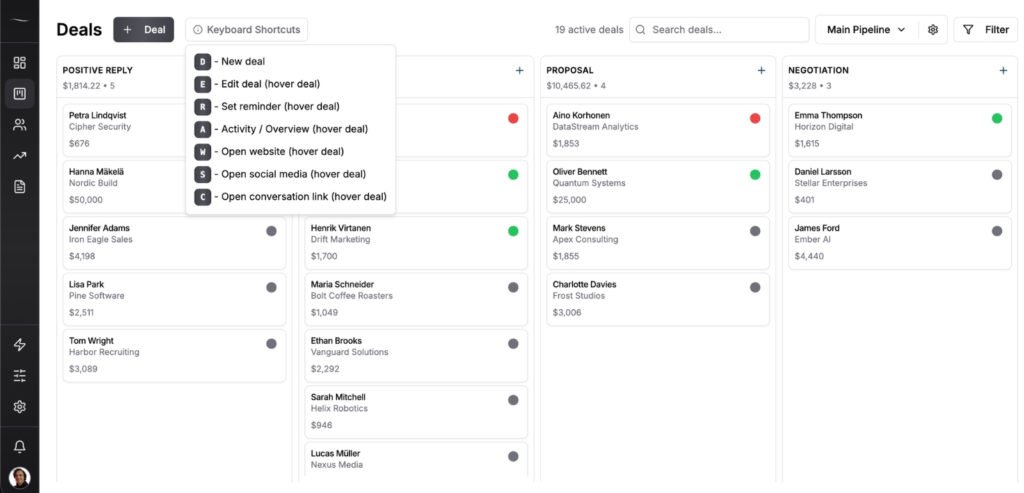
Fluid CRM is a visual pipeline built for people who sell alone or in a small team. One seat gets you unlimited deals, contacts and pipelines, reminders that go red when a deal has been sitting too long, 8 in-app automations and keyboard shortcuts for the repetitive work. A freelance contractor can run a separate pipeline per client company on one login, which is the exact requirement type 3 reps struggle to find. Here’s how it works as a CRM for solopreneurs.
Where it falls short: no commission tracking, no route planning and no dedicated field app. There is no native dialer and no marketing automation, so if you want nurture flows and lead scoring, this is the wrong tool. Pricing is $16/seat/month or $144/seat/year with everything included on both.
2. Pipedrive (best for the standard sales pipeline)
Pipedrive is the pipeline most reps picture when they picture a CRM, and it earned that. The drag and drop stages are clean and the activity reminders work.
Where it falls short: Lite is $24/seat/month monthly and $14 annual, and it has no email sync and no automation. Growth is $49 monthly and $39 annual. A solo rep who wants their inbox connected is looking at the Growth price, not the Lite one.
3. Folk (best for contact-first relationship work)
Folk is good at people. If your work is partnerships, recruiting or long relationship building where the contact record matters more than the deal, folk handles that well.
Where it falls short: Standard at $30/seat/month monthly cannot track a deal. Deal management is Premium only, at $60/seat/month monthly. If closing is your job, you are paying double or you are not tracking deals.
4. HubSpot (best free CRM, until it isn’t)
HubSpot‘s free tier is genuinely usable for one rep. Contacts, deal tracking, email tracking and Gmail or Outlook sync cost nothing, and for a rep with one book of business and a simple process it can carry you for months.
Where it falls short: the free plan gives you one deal pipeline, which rules it out for freelance contractors juggling client books. Starter is $20/seat/month monthly and $15 annual, and it takes you to two pipelines. Email sequences and workflow automation live on Professional at $100/seat/month plus a mandatory $1,500 onboarding fee. The free tier is real. The road out of it is expensive.
5. Capsule (best simple contact-led CRM)
Capsule is clean, easy to learn and the free plan covers 2 users, 250 contacts and 1 sales pipeline. For a rep with a short list and one process, that is enough to start.
Where it falls short: multiple sales pipelines, workflow automations and reporting dashboards all start at Growth ($38/seat/month monthly). Starter is $21 and stays single-pipeline. Same gate as HubSpot, one tier lower.
6. Close (best for reps who live on the phone)
Close puts calling, SMS and email inside the CRM. If your day is 60 dials and you are tired of copying numbers between a dialer and a deal record, Close removes that friction better than anything else on this list.
Where it falls short: Solo is one user at $19/month monthly ($9 annual) with no workflow automation, and multiple pipelines start at Essentials ($49 monthly, $35 annual). You are paying for the phone, so if you sell over email and LinkedIn, you are buying an engine you never start.
7. Moovago (best for multi-line field reps)
Moovago is built for the rep who drives a territory and carries lines for several principals. Route planning, visit tracking and commission per principal are the core of the product rather than a bolt-on.
Where it falls short: it is not trying to be a general B2B pipeline tool, so if you sell your own service from a desk, this is not your tool.
8. ShowroomHQ (best for multi-line wholesale reps)
ShowroomHQ serves the multi-line wholesale rep, particularly in apparel and similar categories where you represent brand partners and work a line sheet.
Where it falls short: same as above. Narrow by design, and that narrowness is exactly why it beats a general CRM for that job.
How Independent Sales Reps Actually Use a CRM Every Day
Independent sales reps do not use a CRM the way a sales team does. There is no pipeline review, no manager asking for an update and nobody to notice when a deal goes quiet. The tool has to run the follow-up discipline for you, and that happens through one small loop repeated every working day.
Viktor Otterskog is a solo outbound operator in Sweden who runs lemlist cadences and closes his own deals. He is reader type 2 exactly. He wrote his daily loop on a post-it and stuck it to his desk:
“1. Open deal and review. 2. Take action (call, email, LinkedIn). 3. Note activity. 4. Set new reminder.”
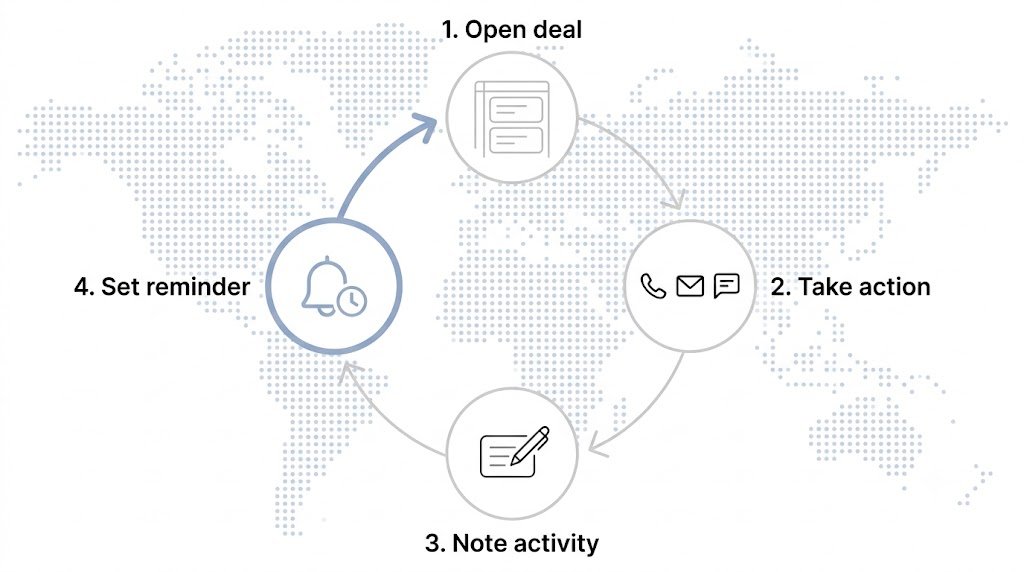
That is the whole system. Four steps, no software philosophy attached. The magic is in step 4, because a deal without a next reminder falls out of your working memory within a week and never comes back. Viktor’s take on that: “The reminders is a seriously smart thing.”
Run that loop against every deal that surfaces as due and you will never wake up wondering who you forgot. Skip step 4 once and that deal is gone.
Picture what skipping step 4 actually looks like. You have a good call on a Tuesday, the buyer says to check back after their board meeting, and you close the tab without setting anything. Nothing in the tool knows that conversation exists. Three weeks later you are scrolling your sent folder for a name you half remember, and the deal has died in a way that has nothing to do with your pitch. That is the entire failure mode for an independent rep, and it is why the reminder matters more than any feature on the pricing page.
For the loop to work, the pipeline stages have to match how you actually sell. Four or five stages is plenty for an independent rep. Something like New, Contacted, Meeting Booked, Proposal Sent and Won or Lost covers most B2B service selling, and you can build it in about 10 minutes.
Check this article next on my full playbook on how to build a sales process.
Frequently Asked Questions
If you carry more than about 15 live conversations, yes. Under that, a notes app survives. Past it, the follow-ups start slipping and you will not notice which ones, because the deals that die quietly are the ones you forgot rather than the ones you lost.
HubSpot’s free tier is genuinely $0 and tracks deals in one pipeline. Among paid tools, Fluid CRM at $16/seat/month gives you every feature with no upgrade tier above it, while Close Solo is $19/month monthly but caps you at one pipeline until you move up to Essentials at $49. Cheapest sticker price and cheapest real cost are not always the same tool.
Not in a standard sales CRM, and Fluid CRM does not do it. You can fake it with a custom field on the deal value, but if commission per principal is central to your job, use a tool built for it like Moovago or ShowroomHQ rather than bending a pipeline tool into a shape it was not made for.
It depends on whether you sell from a car or from a desk. Field reps visiting accounts all day need a real mobile experience, and that is another reason type 1 reps should look at the field-specific tools. Fluid CRM has no dedicated field app, though it runs in a mobile browser for quick checks and note-taking. If you close over email, calls and LinkedIn from a desk, mobile matters far less than the SERP suggests, and you will do the actual work sitting down. Test any tool on your own phone during the trial rather than trusting a feature list.
One per client company you sell for. If you carry 3 client books, that is 3 pipelines, kept apart so a deal for one never shows up in the view for another. Check the entry plan for this, because Capsule and HubSpot both gate multiple pipelines behind an upgrade.
HubSpot’s free tier, with one pipeline and no automation, is the most capable free option for a single rep. Capsule’s free plan covers 250 contacts and 1 pipeline. Both work until you need a second pipeline or a follow-up sequence, and that is when the pricing conversation starts.
Conclusion
The reason CRM lists fail independent sales reps is that they answer one question when there are three. Multi-line field reps should buy a field tool. Solo closers and freelance contractors need a pipeline, a reminder and a way to keep client books apart, and they should not pay $60 a month for the privilege of tracking a deal. If you are tired of leads going quiet because nothing reminded you to follow up, Fluid CRM gives you a clear visual pipeline with every feature on one seat.
Start your 7-day free trial here, no credit card required.