

Most CRM lists for manufacturers open with ERP integration. A small manufacturer or distributor usually loses money somewhere simpler, in quotes nobody chased and dealer accounts that stopped reordering without anyone noticing. Those quotes die on the days nobody opens the board, and that is the problem Fluid CRM and the five tools below are judged on.
For a small manufacturer or distributor whose ERP already handles orders and stock, Fluid CRM is the simplest way to track open quotes and reorders, at $16 per seat per month. If reps need live inventory and customer pricing inside the CRM, pick Odoo or Zoho CRM instead.
What a Small Manufacturer Actually Needs From a CRM
Your ERP or QuickBooks already knows what shipped, what was invoiced and what is on the shelf. It has no idea that a contractor asked for a price on 400 sheets of drywall on Tuesday and nobody called back. For a team of 2 to 10 reps, the CRM has two jobs: chase every open quote and catch the accounts that are overdue to reorder.
Think of the ERP as the warehouse ledger and the CRM as the whiteboard at the sales desk. The ledger records what already happened. The whiteboard shows what might happen this week if someone picks up the phone, and a ledger is useless for that no matter how many connectors you add to it.
| CRM | ERP | |
|---|---|---|
| What it tracks | Quotes, follow-ups, accounts | Orders, stock, invoices |
| When | Before the sale | After the sale |
| Who opens it daily | Reps | Operations and finance |
| The question it answers | Who needs a call today? | What shipped? |
Most readers fall into one of three groups, and each needs a different tool:
- You sell by quote and the ERP stays separate. A quote and reorder tracker is enough. This is where Fluid CRM fits, and our sales team CRM page shows how a whole team works from one board.
- Reps quote from live stock and customer price lists. You need a CRM that talks to inventory. Skip to Odoo or Zoho CRM below.
- Reps are in a truck all day. You need a native mobile app. Fluid CRM works in the phone browser but has no app, so look at Pipedrive, which has one. If your reps are independent manufacturer’s reps rather than employees, read our guide to the best CRM for independent sales reps instead.
At Fenixtal, my outbound agency, we booked sales calls for all kinds of B2B companies, construction companies among them. Almost none of them had a CRM they liked. They had a messy spreadsheet or a system nobody opened, and the leads we handed over died in both.
Before you book a single demo, check five things:
- Quote to order. Can you see every open quote on one screen, and when a quote is won, does the order reach your ERP or does someone retype it?
- ERP or accounting link. Does it connect natively, or only through an API someone has to build?
- Mobile. Is there a native app, or only a mobile browser?
- Contacts per account. A dealer account often has a buyer and an owner. Can one deal hold both?
- Price at five seats. Multiply the per-seat price by five and by twelve before you compare. Our guide to the best CRM for small sales teams does that sum for seven tools.
The 6 Best CRMs for Manufacturers and Distributors Compared
| CRM | Price per seat | Inventory or ERP | Cost for 5 seats |
|---|---|---|---|
| Fluid CRM | $16/month or $144/year | None, the ERP stays separate | $80/month or $720/year |
| Zoho CRM Professional | $23/month billed annually, $35 monthly | Inventory module and quote rules built in | $1,380/year or $175/month |
| Odoo Standard | $31.10/month billed yearly, $38.90 monthly | Full ERP suite | $1,866/year or $194.50/month |
| Pipedrive Growth | $39/month billed annually | Not built in, 500+ integrations | $2,340/year |
| HubSpot Sales Hub Starter | $20/month | Not built in | $100/month |
| Less Annoying CRM | $15/month | Not built in | $75/month or $900/year |
1. Fluid CRM
Fluid CRM is a visual pipeline for small B2B teams, and we built it for teams who want to open the board, see what is due and get back to selling. You get unlimited pipelines, so quotes and reorders each get their own board, plus a reminder on every deal and a daily digest email listing what is due today.
Custom fields, labels, CSV import up to 10,000 rows, 8 in-app automations, a REST API, webhooks and an MCP connector for Claude and ChatGPT are all in the one plan. There is no tier to unlock later.
Reps on the road open it in the phone browser, and a verified customer who works solo wrote that it holds up there: “Mobile version is also great (inside browser) and its very well optimized for it.”
- Best for: 2 to 10 rep teams that sell by quote and need every open quote chased, with the ERP handling orders.
- Not for: anyone who needs inventory, price lists, order sync, a native mobile app or several contacts on one deal.
- Cost for 5 seats: $80 a month or $720 a year.
2. Zoho CRM
Zoho CRM is the pick if you want products and quotes inside the CRM without buying a full ERP. The Professional plan adds inventory management for invoices, sales and purchase orders, products and vendors, plus CPQ with price rules for building quotes. Standard is $14 per seat per month billed annually if you don’t need inventory.
The catch is setup. Zoho can do almost anything, which means someone on your team will spend real hours configuring it before reps touch it.
- Best for: distributors who want quotes built from a product catalog with price rules.
- Not for: a team that wants to be working in it this afternoon.
- Cost for 5 seats: $1,380 a year on Professional, or $175 a month billed monthly. A free plan covers up to 3 users.
3. Odoo
Odoo is an ERP with a CRM inside it. The Standard plan includes every app, so CRM, sales, inventory, purchasing and accounting share one database, and a quote turns into an order and a stock movement without retyping.
The One App Free plan gives you a single app with unlimited users, which is a cheap way to try the CRM on its own. Connecting outside software through the external API needs the Custom plan, which lists at $61 per user per month billed yearly.
- Best for: a small manufacturer with no ERP yet that wants one system for everything.
- Not for: a team that only wants a quote board. Rolling out an ERP is a project with its own timeline.
- Cost for 5 seats: $1,866 a year on Standard at list price, or $194.50 a month billed monthly. Odoo discounts the first year for new users.
4. Pipedrive
Pipedrive is a deal pipeline with more than 500 integrations. Full email sync with tracking starts on Growth, and sending and tracking quotes, proposals and contracts with e-signatures comes with Premium.
It also has a native mobile app, which matters if your reps visit job sites and dealers all day.
- Best for: teams with field reps who want a mobile app and plan to connect other tools.
- Not for: teams that need quotes and e-signatures but don’t want to pay for Premium.
- Cost for 5 seats: $2,340 a year on Growth or $3,540 a year on Premium, both billed annually.
5. HubSpot
HubSpot makes the most sense for a manufacturer that wins business through its website, trade content and email marketing. The free plan covers up to 2 users, which is enough for an owner and one rep to test it properly.
Professional costs much more, at $90 per seat per month billed annually, or $100 monthly, plus a required one-time onboarding fee of $1,500.
- Best for: manufacturers with an inbound marketing engine feeding the sales team.
- Not for: a quote-driven team that does no marketing and only needs follow-up.
- Cost for 5 seats: $100 a month on Starter at its $20 per seat list price, or $5,400 a year on Professional plus the one-time $1,500 onboarding fee.
6. Less Annoying CRM
Less Annoying CRM is one plan at $15 per user per month with no tiers, and it comes with a 30-day free trial. It is built around contacts and accounts, which suits owners who think in terms of “who haven’t I talked to” rather than “which deal moves next”.
- Best for: an owner plus two or three reps who manage long-standing accounts by name.
- Not for: teams that want a visual quote board as the main screen.
- Cost for 5 seats: $75 a month or $900 a year.
How a Distributor Sets Up a Quote Pipeline in Fluid CRM
Here is the setup we would hand a five-rep building materials distributor quoting jobs from plans. One pipeline called Quotes, with four stages (RFQ in, quote sent, chased and negotiating), then mark each deal won or lost. Rename the default stages to match those steps.
If your website has a request-a-quote form, rebuild it as a Fluid CRM lead capture form pointed at the RFQ in stage, so every web RFQ lands on the board as a deal. Our guide to lead tracking software lists the fields to record on each one.
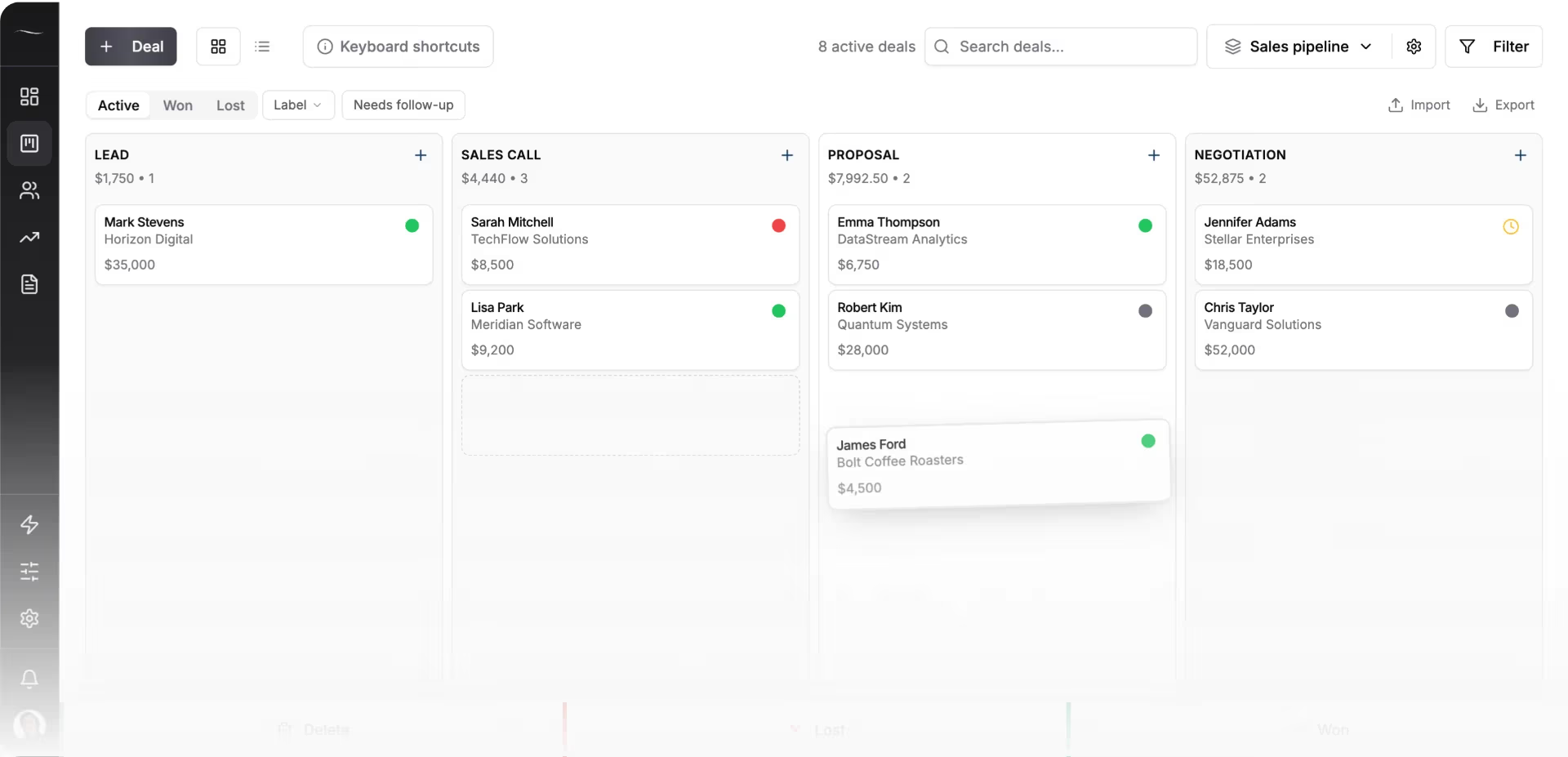
Each quote is a deal. Add a text field for the quote number and a date field for the quote expiry, then star both so they show on the deal card. Up to four starred fields show on the card, so a rep sees the number and the deadline without opening anything.
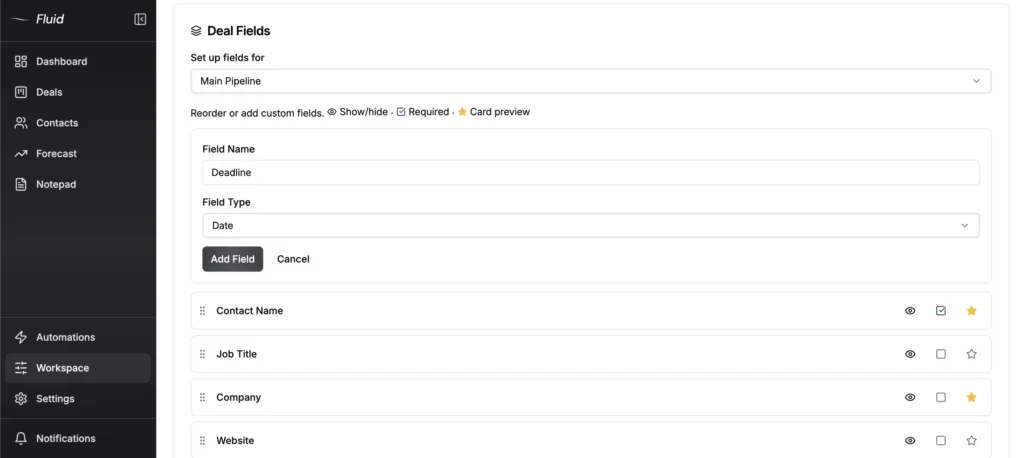
Use labels for the things you filter by. Account type (dealer, contractor, OEM) and product line work well as labels, because Fluid CRM has text, number and date fields but no dropdown field.
When a quote goes out, set the deal’s reminder for three business days later. The daily digest email lists every reminder due that morning, so a rep who never opens the app still sees which quotes need a call. If quotes go out from Outlook or Gmail, the rep BCCs the Fluid logging address to put the email on the deal, because there is no two-way email sync.
Can you name the five biggest quotes your team sent last month that nobody has chased yet? If that takes more than ten seconds, the quote stage is where your money goes.
Alejandra Andrade, a verified customer, is a travel agent rather than a distributor, but her review describes the quoting problem exactly:
“I would find myself quoting so many clients only to forget checking back on them after. Whenever I did remember, I usually would sell the trip.”
Swap “trip” for “truckload of lumber” and that is a distributor’s quote desk.
A Reorder Pipeline for Dealer and Distributor Accounts
A reorder pipeline in Fluid CRM catches dealer and distributor accounts that stop ordering. Make a pipeline called Reorders with four stages: ordering normally, reorder due, contacted and reordered.
Each active dealer or account gets a deal here. Add a date field called Next reorder and star it so it shows on the card. When an order lands, set the deal’s reminder to that date, and the daily digest lists every account due to reorder that morning.
Be clear on the limit. Fluid CRM has no ERP sync, so it does not know an order shipped. Either a rep moves the card when the order lands, or someone technical pushes order events in through the REST API and webhooks. There is no native Zapier or Make app, though both can talk to the API.
If you mainly want to see what each rep did this week rather than which accounts need a call, our roundup of the best sales tracking software covers that job.
When an ERP-Connected CRM Is the Right Call
Fluid CRM is the wrong tool for some manufacturers, and it is better to know that before the trial than after. Answer these six questions:
| Question | A quote-tracking CRM is fine | You need an ERP-connected CRM |
|---|---|---|
| Do reps check live stock before quoting? | No, they ask the warehouse | Yes, on every quote |
| Do customers have their own price lists? | A few, kept in the ERP | Many, and reps quote from them |
| Do reps need order history on a call? | Rarely | On most calls |
| Do you have several warehouses or branches? | One location | Several, each with stock |
| Do reps work offline in the field? | No | Yes |
| How many people use the CRM? | Under 20 | 20 or more |
If two or more answers land in the right column, buy Odoo, Zoho CRM with its inventory module or the CRM inside the ERP you already pay for, such as NetSuite or Acumatica. Putting a simple quote board next to a system your reps cannot quote without just adds a second place to type.
If you are the contractor or builder rather than the supplier, our guide to the best CRM for construction companies is written for you.
FAQ
Usually yes, for a different job. The ERP records orders, stock and invoices after the sale. A CRM tracks the quotes and conversations before it, which is where most small manufacturers lose deals.
An ERP handles the back office, meaning inventory, purchasing, orders and accounting. A CRM handles the front of the sale, meaning leads, quotes, follow-ups and account relationships. Small distributors often need both, but they rarely need them connected on day one.
Not natively. Fluid CRM has no built-in ERP or QuickBooks connector and no native Zapier or Make app. Someone technical can connect it through the REST API and webhooks, or through the MCP connector with Claude or ChatGPT.
On the tools above, five seats range from $720 a year on Fluid CRM to $5,400 a year on HubSpot Professional before its required one-time $1,500 onboarding fee. Odoo’s price also covers inventory and accounting, so compare it with your CRM and ERP bills together, not with a CRM alone.
Which CRM a Small Manufacturer Should Pick
If your ERP already handles orders and your problem is quotes nobody chased and accounts nobody called, Fluid CRM gives a small team both boards for $16 per seat per month. If reps cannot quote without live stock and price lists, choose Odoo or Zoho CRM and skip us. Our sales team CRM page shows how a whole team shares the boards.
Start your 7-day free trial here, no credit card required.