

Freshsales sells AI lead scoring to teams whose whole pipeline fits on one screen. The free tier pulls in small teams, then the features on the homepage turn out to live several tiers up. Here are 9 Freshsales alternatives, split by the question that actually matters: did you outgrow the tool, or did you overbuy it?
The best Freshsales alternative depends on which way you broke. Teams that outgrew it need HubSpot, Zoho CRM or Attio. Small teams that overbought need Fluid CRM, Bigin or Capsule. The AI features Freshsales advertises sit on Pro at $47 a month, not the $9 plan, so price by what you’ll use.
Why Small Teams Leave Freshsales
Freshsales attracts small teams with a free tier and a $9 headline price, and the disappointment starts when they climb the ladder. The free plan covers 3 users and works as a contact book with a built-in dialer. No workflows, no reports, no funnel view. Growth at $9 per user billed annually adds basic workflows and 1 pipeline. The features on the homepage, meaning Freddy AI, multiple pipelines and real sequences, sit on Pro at $39 per user billed annually or $47 monthly. That’s a 4.3x jump from the headline price to the advertised product.
The ladder shape isn’t unique to Freshsales. HubSpot runs the same free-to-Professional canyon with bigger numbers. What’s specific here is who falls in. The free tier attracts exactly the teams the paid features can’t help.
Because the deeper problem is arithmetic, not pricing. AI lead scoring earns its keep when 300 leads land every month and reps need to know which 30 to call first. That’s a real problem and scoring genuinely solves it. A 12-deal pipeline gives the model nothing to rank. You can order 12 deals yourself before your coffee cools, and you’d beat the algorithm doing it, because you were on the calls and it wasn’t.
I’ve run outbound for 50+ B2B clients at Fenixtal, and the pattern held across every niche. Half tracked deals in messy Sheets, the other half paid for a CRM the team never opened. What these teams needed was never scoring. It was a reminder that fires and a board you can see. The deals didn’t die unranked, they died forgotten.
Did You Outgrow Freshsales or Overbuy It?
Picking a Freshsales alternative starts with an honest answer about which direction you broke, because the 2 directions lead to opposite tools.
Direction 1: you outgrew it. Your team passed 5 reps, the reporting stopped answering your questions and you’re bumping against workflow limits weekly. You need deeper automation and analytics, and you should pay for that depth knowingly. Pipedrive, Zoho CRM, HubSpot, Attio and Close are your half of the list.
Direction 2: you overbought it. You’re a solo operator or a 2-4 person team paying for insight features your deal volume can’t feed. The dashboards are empty, the scoring ranks a dozen deals nobody needed ranked and the bill renews anyway. Your half of the list is Fluid CRM, Bigin, Capsule and folk, priced by what you’ll actually use this quarter.
Doland White is an executive coach who runs his business on word of mouth. Low lead volume, high deal value. He’s tried HubSpot, Salesforce, Capsule and more CRMs than he can list, and his verdict on the category was blunt: “None of them work for what I’m looking for, and they’re all clunky.” The pattern he kept hitting was the same everywhere. Sign up small, then find every feature you actually need sitting one tier up. A coach tracking a handful of high-value conversations has zero use for lead scoring. He needs to know who to call back next week.
Stop for a second and count your open deals right now. If it’s under 20, what exactly is the AI ranking?
9 Best Freshsales Alternatives Compared
Same convention as every comparison I publish: for each tool, the cheapest plan that runs a real sales pipeline with automation, because that’s the plan you’ll actually pay for. Prices are monthly billing per seat unless marked, verified against official pricing pages in July 2026.
| Tool | Best for | Cheapest plan with pipeline + automation | Catch to know |
|---|---|---|---|
| Freshsales (for reference) | Staying put | Growth, $9 (billed annually) | The AI, multiple pipelines and sequences on the homepage start on Pro at $47 |
| Fluid CRM | Small teams pricing by what they’ll use | Single tier, $16 | No AI scoring, and that’s the point |
| Bigin by Zoho | Budget option | Express, $9 ($7 annually) | Capped at 10 workflows |
| Capsule | Simple contact-first tracking | Growth, $38 | Entry tier lacks sync and automation |
| folk | Relationship-heavy work | Premium, $60 | Native automation is thin, teams add Zapier on top |
| Pipedrive | Growing sales teams | Growth, $49 | Add-ons stack on top |
| Zoho CRM | Freshsales-like depth for less | Standard, $20 | AI scoring sits 2 tiers up on Enterprise |
| HubSpot Sales Hub | Growing into a full suite | Professional, $100 + $1,500 onboarding | $1,500 onboarding is required, not optional |
| Attio | Flexible data models | Plus, $36 | Automation runs on capped credits |
| Close | Calling-heavy outbound | Growth, $109 | Dialer pricing for an email-first team |
Read the catch column top to bottom and a theme shows up. Advertised features and working features are different tiers on most of these tools. Only 2 tools here charge the price you first see for the plan that does the job: Fluid CRM and Bigin.
Best CRMs If You Overbought Freshsales
If your deal volume never fed the insight features, the fix is a tool priced for the job you actually have: tracking a small pipeline and never missing a follow-up.
1. Fluid CRM (best for small teams pricing by what they’ll use)
Fluid CRM gives small B2B teams, founders and agencies a clear visual pipeline to close more deals without the mess of spreadsheets or the bloat of traditional CRMs. It’s built around the 2 things a small pipeline actually needs: reminders that fire and a board you can see at a glance. See how teams of 2 to 10 use it as a CRM for small sales teams.
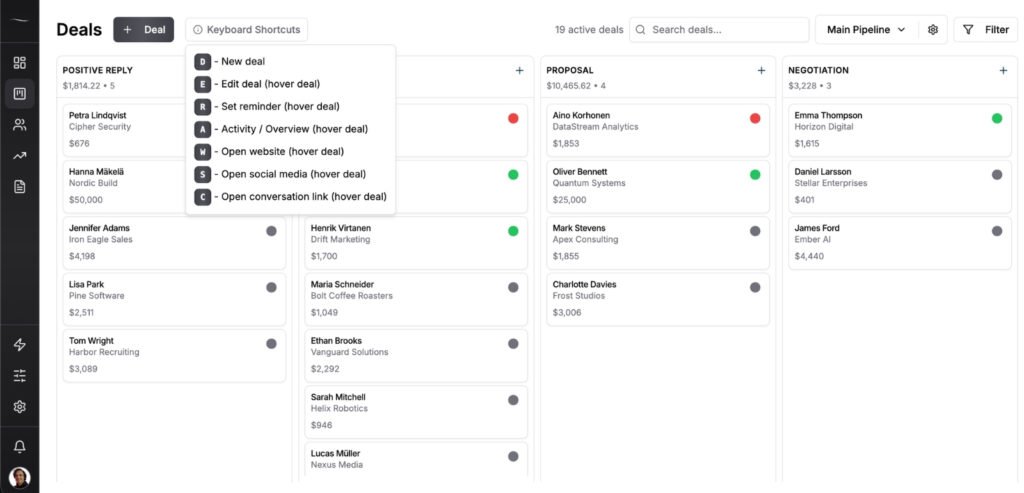
Pricing is $16 per seat per month, or $144 per seat per year (3 months free with annual). Every feature is included on both plans: unlimited deals, contacts and pipelines, reminders, BCC email-sync, 8 in-app automations, 7 keyboard shortcuts, API and webhooks. No upgrade traps, no ladder between the price you see and the product you read about. The full breakdown is at fluidcrm.io/blog/pricing.
Where Fluid CRM falls short: there is no AI lead scoring, no native dialer and no marketing automation, and for a small pipeline that’s the point rather than the compromise. If you genuinely have the lead volume for scoring to matter, you belong in the second half of this list. If you don’t, start the 7-day free trial, no credit card required.
2. Bigin by Zoho (best budget option)
Bigin is the cheapest working pipeline on this list. Express costs $9 a month per user, or $7 billed annually, with 3 pipelines, email integration and 10 workflow automations. The free plan covers 1 user with 500 records. Coming from Freshsales’ free tier, Express at $7 delivers more usable pipeline than Growth at $9 does.
Where Bigin falls short: the 10-workflow cap on Express is real, Premier at $15 ($12 annually) raises it to 30, and the Zoho ecosystem tends to add product subscriptions around it over time. It’s built as a stepping stone to Zoho CRM, so heavy users hit its ceilings by design.
3. Capsule (best simple contact-first tracking)
Capsule is a calm, contact-first CRM with a real free plan covering 2 users and 250 contacts. The capability tier is Growth at $38 a month, where two-way email sync, workflow automations and multiple pipelines unlock together. It suits low-volume relationship businesses that want tidy records more than sales machinery.
Where Capsule falls short: Starter at $21 logs inbound email through a manual forwarding address and skips automation, so it’s a contact book at that price. Budget for Growth from day one.
Full breakdown at Fluid CRM vs Capsule.
4. folk (best for relationship-heavy work)
folk puts contacts at the center instead of deals, which fits PR, partnerships and agency work where the relationship outlasts any single sale. The Chrome extension captures contacts straight from LinkedIn. The capability tier is Premium at $60 a month ($48 annually), where deals as custom objects, sequences, dashboards and API access unlock.
Where folk falls short: native workflow automation is thin at every tier, so automation-heavy teams bolt Zapier or Make on top, and Standard at $30 is a beautiful contact database without a real pipeline.
Full breakdown at Fluid CRM vs folk.
Best CRMs If You Outgrew Freshsales
If your team genuinely passed the point where Freshsales’ reporting and workflow limits pinch, these 5 give you the depth. The honest note up front: every one of them costs more than the tool you’re leaving, and that’s the correct trade when the volume is real.
5. Pipedrive (best for growing sales teams)
Pipedrive built the visual pipeline category and fits teams of 5 to 20 reps who need forecasting and team reporting. The capability tier is Growth at $49 a month, where workflow automation and full 2-way email sync unlock. Lite at $24 only gives one-way email via BCC.
Where Pipedrive falls short: add-ons for lead capture, docs and projects stack on top of the seat price, so the sticker number isn’t the final number.
Full breakdown at Fluid CRM vs Pipedrive.
6. Zoho CRM (best Freshsales-like depth for less)
Zoho CRM is the closest like-for-like replacement in this half of the list, with the same suite-style depth at lower prices. The capability tier is Standard at $20 a month ($14 annually), which includes multiple pipelines, scoring rules and basic workflow automation. Professional at $35 a month ($23 annually) adds Blueprint process management for teams with defined sales stages and quoting needs.
Know the ladder before you climb it. Zia’s lead scoring and predictions unlock on Enterprise at $40 annually ($50 monthly), 2 tiers above the entry plan. Same shape as the tool you’re leaving, so buy the tier for the features you’ll use, not the ones on the homepage.
Where Zoho CRM falls short: it’s famously fiddly to configure, and the real cost is implementation time rather than the seat price.
Full breakdown at Fluid CRM vs Zoho CRM.
7. HubSpot Sales Hub (best if you’ll grow into the full suite)
HubSpot‘s free tier covers contact management, deal tracking and email sync for up to 2 users, and Starter adds the basics at $20 per seat. The capability tier is Professional at $100 per seat plus a required $1,500 onboarding fee. For a 3-person team that’s $5,100 in year one.
Where HubSpot falls short: the canyon between free and Professional is the widest version of the ladder problem in this post. Buy it for where your company is going, not where it is.
Full breakdown at Fluid CRM vs HubSpot.
8. Attio (best for flexible data models)
Attio lets you build your own objects, attributes and views, which suits teams whose process outgrew a standard pipeline shape. The capability tier is Plus at $36 a month ($29 annually), where workflow automation runs on a capped monthly credit pool. Sequences and call intelligence sit on Pro at $86 ($69 annually). The free plan covers 3 seats and is genuinely usable.
Where Attio falls short: the flexibility costs setup time, and the credit system makes the real monthly bill harder to predict than a flat seat price.
Full breakdown at Fluid CRM vs Attio.
9. Close (best for calling-heavy outbound)
Close bundles calling, SMS and email into the CRM itself, which makes it the pick when your growth is phone-driven. The capability tier is Growth at $109 a month, where workflow automation and the Power Dialer unlock. Essentials at $49 covers the core CRM without automation.
Where Close falls short: email-first teams end up paying phone-team prices for a dialer they won’t touch, with calling minutes billed on top.
Full breakdown at Fluid CRM vs Close.
When You Should Stay on Freshsales
Some teams reading this should stay put, and there are 3 honest cases. First, you’re already on Freshdesk and the Freshworks bundle discount genuinely changes your math, because a stack discount you use beats a cheaper tool you have to migrate to. Second, you have the lead volume for scoring to mean something, meaning hundreds of inbound leads a month where ranking them is a real daily problem. Third, you’re a 5 to 30 rep team heading to Pro anyway, in which case the ladder was always your path and $39 per seat annually for that feature set is a fair price.
If none of the 3 fit, the free tier that pulled you in was the product, and everything since has been the upsell. Pick your direction from the framework above and move.
How To Switch From Freshsales
The migration is a half-day job done in the right order. The data moves fast. The habits take the week after.
Step 1: Export your modules to CSV
Freshsales exports contacts, accounts and deals module by module from the admin settings. Export everything, including the deals you stopped touching. You’ll decide what survives in the next step, with the full picture in front of you.
Step 2: Clean before you import
Merge duplicates, delete dead deals and standardize values to one currency. A pipeline that sat in a half-used CRM carries months of decay, and migrating the mess just gives it a new home.
Step 3: Import active deals first
Bring over the deals you’re working right now, set the stages and live in the new tool for a week before touching historical data. Keep the CSV exports for 90 days as a backup either way.
Step 4: Rebuild the workflows that actually fired
Check which automations ran last quarter, rebuild those and skip the rest. Teams that overbought usually find 2 or 3 rules carried the whole system, and that discovery alone tells you the switch was right.
Frequently Asked Questions
Yes, several. Zoho CRM’s free plan covers 3 users, HubSpot’s covers 2, Capsule’s covers 2 users with 250 contacts, Bigin’s covers 1 user with 500 records and Attio’s covers 3 seats. Fluid CRM has no free plan. It has a 7-day free trial, no credit card required.
Bigin Express at $7 per user billed annually is the cheapest, capped at 10 workflows. Fluid CRM at $16 per seat per month includes 8 in-app automations with every other feature and no caps. Zoho CRM Standard at $14 annually adds suite-style depth. All 3 undercut the $39 Pro tier where Freshsales’ advertised features live.
Usually not, and it’s arithmetic rather than opinion. Scoring models need lead volume to produce rankings that beat your own judgment, and a small pipeline doesn’t supply it. Low-volume teams lose deals to forgotten follow-ups, not to bad prioritization, so a reminder system returns more than a scoring model at a fraction of the price.
The free tier covers 3 users with contact management and a built-in dialer. It has no workflows, no reports and no funnel view, so it works as a contact book rather than a pipeline tool. The first real workflows arrive on Growth, and the advertised AI features arrive on Pro.
Freshsales exports each module (contacts, accounts, deals) to CSV from the admin settings, and any CRM on this list imports those files directly. The export takes minutes. Cleaning a half-maintained pipeline before import is the real work, so budget an hour for that.
Conclusion
Freshsales was never the villain. The mismatch was arithmetic, a scoring engine sold to pipelines too small to feed it, at a price 4.3x the headline by the time the advertised features unlock. Decide which way you broke, then price the fix by the plan you’ll use. If you overbought, Fluid CRM gives you a clear visual pipeline at $16 per seat with every feature included.
Start your 7-day free trial, no credit card required.