

Your agency is good at the work and most of your clients came from someone who already knew you. That holds up until a quiet month arrives and you find out there is no second source of clients.
Agency lead generation is how an agency wins its own clients, which is different from hiring a lead generation firm. Six channels work for teams of 1 to 10. Start with past clients and referrals, add one outbound channel and keep every reply in one pipeline in a tool like Fluid CRM, so each lead has a dated next step.
Before building Fluid CRM, I ran Fenixtal, an outbound agency that booked 1,250+ sales calls for its clients with cold email. Across cold email and LinkedIn, Fenixtal created 12M€+ in pipeline for 50+ B2B clients, and many of them were agencies with the same problem you have now.
Where Small Agencies Get Clients Today
Paddy Moogan and SparkToro surveyed 612 digital agency owners and consultants about where new business comes from. 66% named existing and past clients as their top source. Partner companies came second at nearly 13%, and outbound sales was the top source for just over 6%.
Referrals work, but you cannot turn them up when you need more, because they arrive when someone else decides to send one.
A later round of the same survey, with 376 respondents, shows where that leaves people. Only 14% said their sales pipeline was healthy and 32% said it was not very good.
There is a second problem. Once you add channels, leads arrive in five places at once, as email intros, LinkedIn DMs, cold email replies, website forms and comments in a Slack group. A small team needs one place for all of them, which is the whole job of an agency CRM.
6 Agency Lead Generation Channels Compared
The table ranks six channels by how soon each one tends to produce a first conversation, with 1 as the soonest. Effort describes the weekly work for a small team.
| Channel | What the work is | Effort | Speed rank | Number to track |
|---|---|---|---|---|
| Past clients and referrals | Messages to people who already trust you | Light | 1 | Intros received |
| Partnerships | A few calls with agencies that sell next to you | Light | 2 | Intros in each direction |
| Profile, connection requests, DMs and posts | Medium | 3 | Conversations started | |
| Cold email | Domains, inboxes, a lead list, copy and an inbox to manage | Heavy at first, lighter later | 4 | Positive replies |
| Communities | Answering questions where your buyers already talk | Medium | 5 | Private conversations started |
| Content and inbound | Case studies, search pages and a form | Heavy | 6 | Form leads |
1. Past clients and referrals
This comes first because the trust already exists and nothing has to be built.
The number to track is intros received each month. Write to each past client one at a time, name the kind of company you want to meet and ask for one introduction. The scripts for that message are in our guide on how to ask for referrals.
2. Partnerships
Find two or three agencies that sell to your buyer and do not sell what you sell. A web design studio and an SEO agency are the classic pair.
Agree who introduces whom and track intros in both directions, because a partnership where only one side sends leads does not last.
3. LinkedIn
LinkedIn rewards agencies that treat it as a place for conversations. In my own LinkedIn work I sort people into five levels of warmth: cold, profile visitor, post engager, lead magnet downloader and inbound message. The warmer the person, the easier the sales call.
Start with the warm ones and keep contacting cold prospects too, because they are the majority. The full method is in our guide on how to find clients on LinkedIn.
4. Cold email
In the 612-person survey, 60% of agencies had tried outbound. Of those, only 10% rated it very effective and 34% said it had not been effective at all.
That matches what I saw at Fenixtal. Cold email has four parts, which are the sending setup, the lead list, the copy and the handling of replies. If one of them is off, the results suffer.
The setup takes real work before the first email goes out. You need separate domains, inboxes that have been through a warm-up period, a verified list and a sequence of 2 to 4 emails. Our cold email outreach playbook walks through each step.
Two results from my agency clients show what it can do. An advertising agency got 17 sales calls in 29 days and paused its campaigns because the calendar was full. A creative studio whose clients had all come from referrals and word of mouth got 62 sales calls in 90 days.
Those campaigns were built by someone who did this full time, so an agency doing it alone for the first time should expect less.
5. Communities
Slack groups, founder forums and niche subreddits are where your buyers ask the questions you answer for a living. The work is to answer them well and in public, with no pitch attached.
People who like the answer will message you, so track the private conversations that start this way.
6. Content and inbound
Content is the slowest channel and the one that keeps bringing leads after you stop. For an agency that means case studies with real numbers, a few pages aimed at what buyers search for and one form.
A form that sends an email to a shared inbox depends on somebody noticing that email, while a lead capture form that is part of your CRM puts the lead in your pipeline.
How To Pick Your First Two Channels
Pick one warm channel and one cold channel, and stay with both for 90 days. Two channels done properly produce more than six done lightly.
The warm channel is past clients and referrals for almost everyone, and the cold channel depends on your buyer. If your buyer is active on LinkedIn and you sell to a few hundred companies, choose LinkedIn. If your market is thousands of companies, choose cold email.
A startup or a newer business with no client base usually has to lead with outbound, and our pipeline generation strategy guide covers that case. An agency is different, because it already has past clients who know what it can do.
Outbound is not weak, and I built a business on it. The first hour of an agency’s week is still better spent on ten people who already know the work than on a thousand who don’t.
When to stay on referrals alone
Some agencies should not add a channel yet.
Stay on referrals alone if you are at capacity and turning work away, or if you are one person with three good retainers who does not want to grow. Stay there too if your offer still changes every month.
In those cases Google Sheets with a name, a next step and a date is enough. Add a second channel when one client leaving would hurt your revenue badly.
What To Do After a Lead Replies
In my experience the reply is where small agencies lose the clients they worked to find.
Getting leads with nowhere to put the replies is like filling a bath with the plug out.
Stop for a second and try this. How many people replied to you in the last 30 days, across email, LinkedIn, forms and intros, and can you name the next step for each one without opening four tabs?
The four habits below work for a reply from any channel.
1. Answer within minutes
A person is most interested right after they write to you. My own rule is to answer a positive reply within 5 to 15 minutes when I can.
You will not always manage that, but faster is better and it matters more as the number of replies grows.
2. Offer two or three set times
When someone agrees to talk, do not send a calendar link and ask them to book. That adds a step for the buyer and fewer calls happen.
Suggest clear options instead, such as “Would Monday or Tuesday at 10:00 or 14:00 work for you?” A short answer books the call. What to ask once you are on it is in our discovery call guide.
3. Send the prospect a reminder before the call
Book the call by hand, then add it to a booking tool that emails the prospect 24 hours and 30 minutes before. That cuts the number of people who do not show up.
Those reminders come from the booking tool. Fluid CRM does not send messages to your prospects, and its reminders are for you.
4. Follow up until you get a clear yes or no
Once someone has shown interest, keep following up until they say yes or no. I have booked a sales call nine months after the first message.
Nobody remembers a nine-month follow-up on their own. Each lead needs a date for the next step, written somewhere you will see it. For the wording and spacing of those messages, see our guide to the cold email follow-up.
A short pipeline for agency leads
Four stages are enough for a small agency’s own sales, plus one place to park people.
| Stage | Who sits here |
|---|---|
| Lead | Anyone who replied, was introduced or filled in a form |
| Discovery call | A call is booked or has been held |
| Proposal sent | They have your offer and a price |
| Won | They signed |
| Not now | Interested but not ready, with a date to check back |
We explain stage design in more detail in sales pipeline stages, but for most agencies under ten people more stages only add upkeep. The rule for moving a deal from one stage to the next is in our post on the agency sales pipeline.
This is where Fluid CRM helps. Each lead is a deal on a board with one dated reminder and your sales notes on it. A daily email digest lists the reminders that are due.
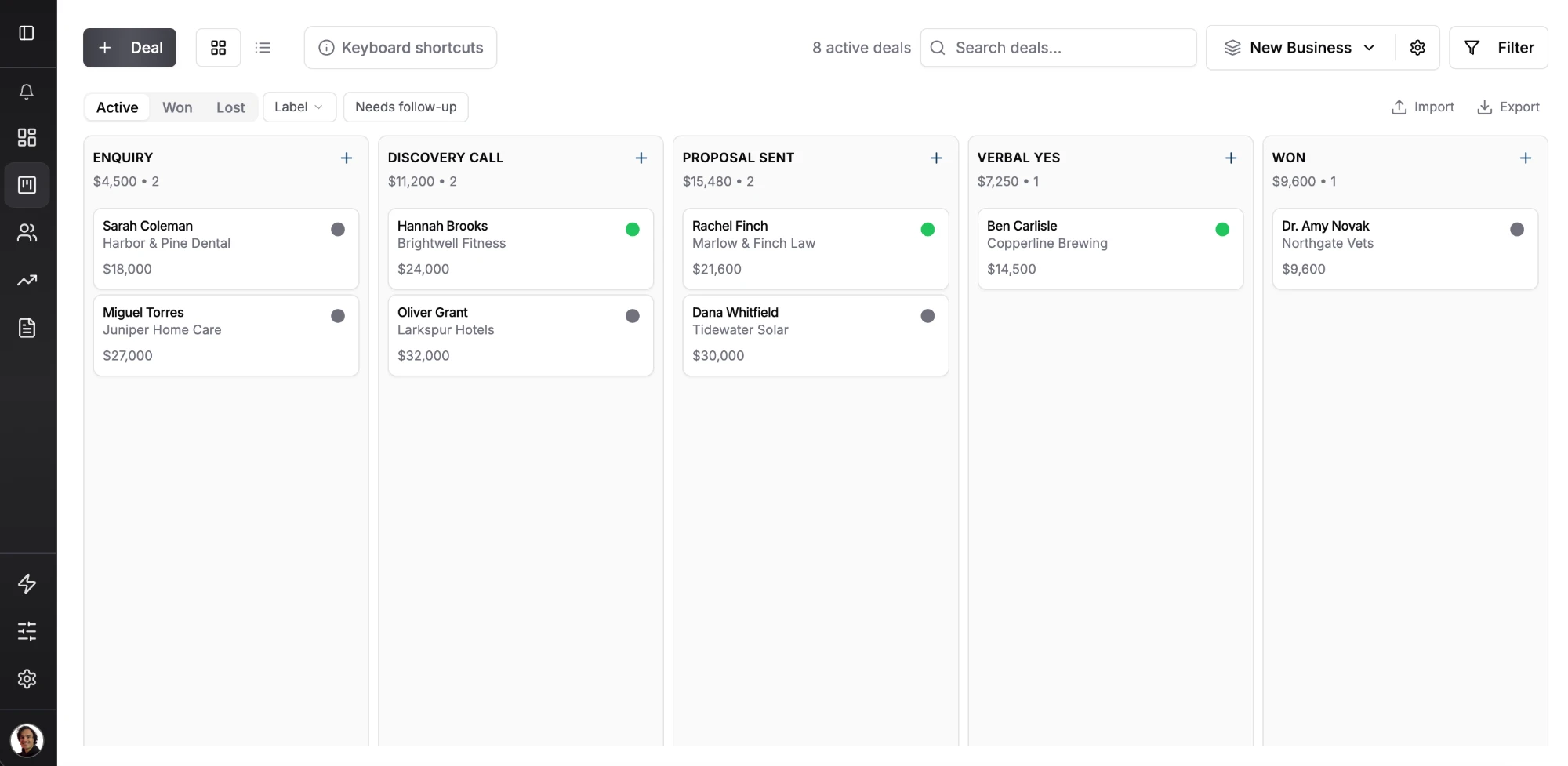
A small agency will not keep a complicated tool up to date. A verified customer who runs an agency put it this way. “My agency has used many CRM’s and most of them are bloated and super complicated… It is simple and super easy to use, and it doesn’t take hours to upload a lead.”
There are limits you should know before you try it. A deal holds one contact and email is logged by BCC, with no sync. Fluid CRM sends no email to your prospects.
There is no booking tool or calendar sync, and there are no proposals, invoices or email campaigns. You can keep a separate pipeline for each client’s leads, but separate workspaces for each client are not available yet.
3 Numbers To Check Every Week
At this size, three numbers tell you whether the channels are working.
1. New conversations by source
Count the people who replied or were introduced this week and note the channel each one came from. After a month you will see which of your two channels deserves the hours.
2. Days from reply to sales call
Measure the time between a person’s first reply and the call. If it is growing, the leads are fine and your answers are slow.
3. Sales calls held
A booked call is not a held call, so count the ones that happened. If many people do not show up, fix the reminders before you go looking for more leads.
Agency Lead Generation FAQ
Agency lead generation is the work an agency does to start sales conversations with possible clients for its own services. The same phrase is also used for firms that sell lead generation as a service, which is a different topic.
Write to people who already know your work, such as former colleagues, past employers and past clients. Add LinkedIn or cold email once those conversations are under way.
It works when the list, the offer and the handling of replies are all in good shape. In a survey of 612 digital agency owners and consultants, 60% had tried outbound and 10% of those rated it very effective.
Work it out backwards from your own numbers. Decide how many new clients you want a month, then divide by the share of proposals you win and by the share of calls that turn into proposals. That gives you the number of sales calls you need, which is a more useful target than a number of leads.
It can make sense when your offer is proven and you have time for the calls it produces. An outside firm can start conversations for you. Answering fast, booking the call and following up for months stays with you, so sort that out first.
Where To Start This Week
A plan for agency lead generation fits in five steps for a team this size.
- List every past client and write to five of them this week.
- Pick one cold channel, either LinkedIn or cold email, and commit to it for 90 days.
- Set up one pipeline with the stages Lead, Discovery call, Proposal sent and Won, plus Not now.
- Put every reply from every channel into that pipeline on the day it arrives, with a date for the next step.
- Check your three numbers every Friday.
Steps 3 and 4 are the ones that get skipped, and they are the reason leads you worked for go elsewhere. If you want a simple place to keep them, Fluid CRM is the agency CRM we built for teams of 1 to 10.
Start your 7-day free trial here, no credit card required.