

Put any small-team CRM through the standard ROI formula and you get several hundred percent or more. The math is right, but the subscription is so small next to one B2B deal that the number tells you almost nothing. What matters is how many deals the CRM must save to pay for itself, and whether your team still uses it in month three.
CRM ROI is the gross profit a CRM adds minus everything it costs, divided by that cost. Count recovered deals at your margin and only the hours that go back into selling. With Fluid CRM at $16 per seat a month, one recovered $4,000 deal at 50% margin covers a five-person team’s first year.
This guide gives the formula, the costs to include, a full worked example for a team of five and a one-page business case you can hand to a partner or co-founder.
What CRM ROI Means and How to Calculate It
CRM ROI compares what a CRM earns you with what it costs you, over a set period. Use one year, because that is how long it takes for setup costs to wash out and for a few recovered deals to show up.
CRM ROI = (gross profit added − total cost) ÷ total cost × 100
Use gross profit, not revenue. If you win an extra $4,000 project and delivering it costs you $2,000 in time and contractors, the CRM earned you $2,000. Using revenue instead makes the result look bigger than it is, and at a 50% margin it doubles it.
For a small team the percentage always comes out huge. A tool that costs a few hundred dollars a year and helps you win one extra deal shows an ROI of several hundred percent, and that is true of almost any CRM you look at. So the percentage cannot help you choose.
A better number is break-even in deals, which is your total year-one cost divided by the gross profit of one average deal. If the answer is less than one, a single deal you would otherwise have lost pays for the whole year.
To model the win-rate side with your own lead volume and deal size, use our free CRM ROI calculator.
The Costs a CRM Business Case Has to Include
The subscription is the cost everyone counts and usually the smallest one. A full business case lists six lines. For the subscription line, our guide to CRM cost lists what 21 CRMs charge per seat.
- Subscription. Price it per seat for the seats you will actually fill, monthly or yearly. On bigger platforms, check which plan has your features, whether add-ons cost extra and whether paid onboarding is required. If HubSpot is on your list, is HubSpot worth it breaks down its plans. AI CRMs that meter work in credits need a line for those too, as our Lightfield CRM review shows.
- Setup hours. Somebody has to import contacts, set the pipeline stages and add the fields. For a small team on a simple CRM that is an afternoon. On a bigger platform it can be weeks.
- Training. Count each person’s time to learn it, at their hourly cost.
- Typing time. Every deal update takes a minute or two. Count it as a cost unless it replaces typing your team already does in a spreadsheet. Our guide to CRM data entry covers how to cut it down.
- Integrations. If you need a paid connector or a developer to link the CRM to your other tools, it goes here. A team that imports a CSV once usually pays nothing.
- Maintenance. Someone cleaning up stages, fields and old deals each month. Close to zero hours on a small tool, real hours on a platform with an admin role.
Setup is where small tools save the most. A G2 reviewer in marketing and advertising put it this way.
“I was up and running in minutes and it couldn’t have been easier.”
Where the Return Comes From: Recovered Deals and Hours Back
A CRM pays you back in three ways, and for most small teams only one of them carries the case.
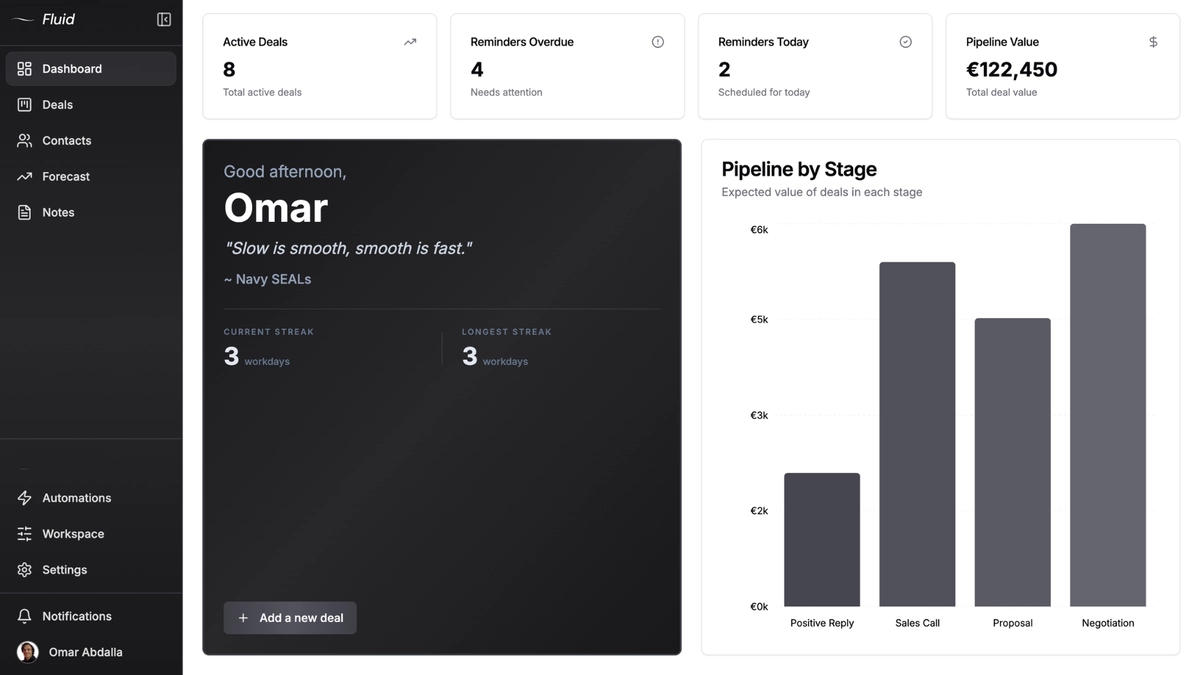
Recovered deals are the big one. These are deals you would have lost because nobody followed up, not because the buyer said no. Austin Verner, founder of the cold email agency Cold Emailers, used to track his pipeline in Google Sheets. After the move to Fluid CRM, he summed up the change better than any study.
“We’re capturing 100% of our interested leads.”
Those leads had already said they were interested, so every one that got lost in a spreadsheet was a winnable deal missing nothing but a check-back. That is exactly what a CRM fixes, and it is the number your business case rests on.
Hours back come from no longer chasing status. Think of the weekly pipeline meeting spent asking “where is this one at?”, or the owner messaging three people to find out if a quote went out.
Doland White, founder of the executive coaching firm DWC, used to keep prospects and clients spread across Google Contacts, LinkedIn and spreadsheets. “Fluid ended the wasted effort. I go faster, and I can plan my client actions with clarity.”
Count these hours only if they go into selling. An hour saved and then spent on email is not a return.
Retention counts if you sell to the same clients again, such as retainers or yearly renewals. A CRM that reminds you about a renewal three months early can save a client you would have lost. Leave it out if most of your revenue is new projects, because you would be counting a gain you cannot measure.
At Fenixtal, my outbound agency, we booked 1,250+ sales calls, and I got to see which of them ever turned into revenue. The leads that died after those calls rarely died from a no. They sat in spreadsheets that got messy fast, or in CRMs the client’s team hated opening.
Before you buy anything, write down a baseline.
How many quotes went out last quarter with no follow-up? How long does your weekly pipeline check take? Without those two numbers, you will never know whether the CRM earned its cost.
A Worked CRM ROI Example for a 5-Person Team
Here is a made-up five-person agency selling projects at an average of $4,000. Every input is an assumption, so replace each one with your own number.
| Input | Value |
|---|---|
| Seats | 5 (the owner plus 4 people who sell and deliver) |
| Average deal | $4,000 |
| Gross margin | 50%, so $2,000 gross profit per deal |
| Quotes last quarter with no follow-up | 6 (the baseline) |
| Recovered deals assumed per year | 2 |
| Owner’s hourly cost | $75 |
| Team hourly cost | $40 |
Two recovered deals a year is a deliberately cautious guess when six quotes a quarter get no follow-up at all.
Year-one costs
| Cost line | Amount |
|---|---|
| Fluid CRM, 5 seats at $144 per seat a year | $720 |
| Setup, the owner, 4 hours at $75 | $300 |
| Training, the other 4 people, 30 minutes each at $40 | $80 |
| Typing time | $0, it replaces the spreadsheet they already update |
| Integrations and maintenance | $0, one CSV import and no connectors |
| Total | $1,100 |
On monthly billing at $16 per seat, the subscription is $960 and the total is $1,340. Our guide to the best CRM for small sales teams prices six other tools for 5 and 10 seats. If this team had no spreadsheet at all, typing time would become a real cost line and you would add it here.
Year-one gains and the ROI
| Gain | Amount |
|---|---|
| 2 recovered deals at $2,000 gross profit | $4,000 |
| Weekly pipeline check 30 minutes shorter for 5 people over 46 weeks, the owner’s 23 hours at $75 and the team’s 92 hours at $40, only if those hours go into selling | $5,405 |
Counting recovered deals only, the ROI is ($4,000 − $1,100) ÷ $1,100 = 264%. That is the number to put in the business case. Adding the hours back gives ($9,405 − $1,100) ÷ $1,100 = 755%, but only if those hours really turn into selling.
Break-even is $1,100 ÷ $2,000 = 0.55 of a deal, so the first recovered deal pays for the year.
The downside case
Now say the team stops using the CRM in month three. The gains are zero, and the loss is the full $1,100 on yearly billing. On monthly billing the team would cancel after three months and lose $240 plus the $380 of setup and training, so $620.
That is the real risk in this business case. The risk is that nobody opens it, not the price, which is why monthly billing for the first few months makes sense when you are unsure.
The business case on one page
Put five lines in front of whoever signs off.
- The problem in numbers. Six quotes last quarter got no follow-up, $24,000 in quoted work.
- Year-one cost. $1,100 all in, or $1,340 billed monthly.
- Break-even. 0.55 of a recovered deal.
- The day-90 check. Quotes with no follow-up should be close to zero, and every open deal should have a next step.
- The cancel condition. If fewer than four of five people update it weekly by day 90, cancel and go back to the spreadsheet.
Why Most CRM ROI Never Shows Up
The research on CRM returns comes in lower than the figure most pages quote. Nucleus Research’s 2023 analysis of 63 case studies found CRM returns $3.10 per dollar spent, down 37% from $4.90 a decade earlier. Published figures range from $3.10 to $8.71 per dollar, and the $8.71 still quoted on many pages is a Nucleus number from 2014. Our CRM statistics roundup has more figures like this, each traced to its source.
Bad data is part of why. In Validity’s 2025 survey of 602 CRM users and admins, 76% said less than half of their CRM data is accurate and complete, and 37% said they lose revenue because of poor data quality.
My reading of both numbers is the same. A CRM only returns anything on the days somebody opens it and updates a deal, and a half-filled one returns very little.
A CRM works like a gym membership. The fee never decides whether it was worth it, because the visits do.
Paying less helps, and showing up three times a week matters far more.
So ask yourself one question. Who on your team updated the pipeline last Friday, and would you bet the business case on them doing it every week? That is why we built Fluid CRM so a deal update takes seconds, because a CRM people open every day is the only kind with a return.
When the Business Case Says Wait
A CRM does not pay back for every small business. Here are three cases where the math does not work.
- You have fewer than about 10 open deals and you work alone. A spreadsheet you check every morning will do the job, and do I need a CRM walks through where that line sits.
- Your work is delivery, not sales. If you need tasks, timelines and client projects, a sales CRM is the wrong tool and a project tool will return more.
- Nobody will own it. If no one is responsible for keeping deals current, the downside case above is the likely case, so fix the ownership first.
If none of those fit and you lost even one winnable deal last quarter to a missed check-back, the business case is already made.
FAQ
Take the gross profit the CRM adds in a year, subtract everything it costs in that year and divide by the cost. Multiply by 100 for a percentage. Include setup and training time in the cost, and use gross profit rather than revenue in the gain.
Nucleus Research’s 2023 average was $3.10 back for every dollar spent, against $8.71 in its 2014 study. For a small team, break-even in deals is a more useful test than a percentage. If one recovered deal covers the year, the CRM is a good investment as long as the team uses it.
For a small team on a low-cost CRM it usually pays for itself with the first deal it saves. That can happen in the first month or two if you already have quotes waiting on follow-up. Bigger platforms with paid onboarding and long setups take longer.
Yes, if you have more open deals than you can track in your head and you lose some of them to missed follow-ups. No, if you work alone with a handful of deals or your work is mostly project delivery. Write down your baseline first and the answer usually becomes obvious.
Compare your baseline with the same numbers after 90 days. Count quotes that got no follow-up, deals won that had stalled and the time your weekly pipeline check takes. If those numbers have not moved, the CRM is not being used enough to pay back.
Check the Break-Even Before You Commit
Work out your year-one cost, divide it by the gross profit of one deal and decide whether your team can save that many deals. If the answer is under one, a simple CRM your team will open every day is an easy case to make. Bill monthly until day 90 if you are not sure the team will stick with it.
Start your 7-day free trial here, no credit card required.