

Most small sales teams buy a CRM built for a company with an admin, then nobody keeps it current and deals die on the days nobody opens it. This list judges each tool on what a team of 3 to 15 reps with no sales ops person needs, and prices it for 5 and 10 seats for a year.
The best CRM for small sales teams is the one every rep keeps current without being chased. Fluid CRM ($16 per seat a month) fits teams that want one shared board with an owner and a reminder on every deal. Pipedrive fits teams that need email sync and HubSpot fits teams already on it.
The 7 Best CRMs For Small Sales Teams At A Glance
Each yearly price is on annual billing, on the plan a small team would actually use. That is often not the cheapest plan, so the table shows the starting price too and each review says why the plan was picked. We built Fluid CRM, and it is priced the same way as the others.
| CRM and plan priced | Best for | Per seat a month, plan priced | 5 seats a year | 10 seats a year | Starting price per seat a month |
|---|---|---|---|---|---|
| Fluid CRM, one plan | A team of 3 to 10 with no admin that wants one shared board | $16, or $12 on annual billing | $720 | $1,440 | $16, one plan |
| Pipedrive, Growth | A team that sells all day and wants email sync and automations | $49, or $39 on annual billing | $2,340 | $4,680 | $14 (Lite, annual billing) |
| HubSpot, Sales Hub Starter | A team whose marketing already runs on HubSpot | $20 list price | $1,200 | $2,400 | Free up to 2 users, then $20 |
| Zoho CRM, Standard | A team that wants a free start for 3 users and other Zoho apps later | $20, or $14 on annual billing | $840 | $1,680 | Free up to 3 users, then $14 |
| Freshsales, Pro | A team that wants sequences and territories | $39 on annual billing | $2,340 | $4,680 | $9 (Growth, annual billing) |
| Capsule, Growth | A team that also tracks delivery work after the sale | $40, or $36 on annual billing | $2,160 | $4,320 | Free up to 2 users, then $18 |
| Less Annoying CRM, one plan | A team that works contact by contact | $15 | $900 | $1,800 | $15, one plan |
HubSpot Starter is priced at its $20 list price and Less Annoying CRM, which has no annual plan, at twelve monthly payments. Every other yearly number is the annual price.
The entry plan is often not where a team of five ends up, because the second pipeline, the forecast or the permissions it needs are on the next plan up. Fluid CRM is not the cheapest seat either, since Freshsales Growth costs less for five ($540 a year), and none of the free plans reaches five people.
The bigger cost is the one no table shows. A CRM that reps stop updating costs you every deal that dies on the days nobody opens it, whatever the seat price was. Our guide to CRM ROI shows how to put a number on that.
At Fenixtal I booked 1,250+ sales calls for other people’s sales teams. The leads we sent over often died afterwards, because the client tracked them in a messy spreadsheet or in a CRM nobody liked opening.
What A Small Sales Team Without A Sales Ops Person Needs
A small sales team here means 3 to 15 people selling, with a founder or a team lead running the pipeline on top of their own deals. Nobody’s job is to look after the CRM. That is the reader our sales team CRM is built for, and it is who this list is priced for.
If you are two people, our guide to choosing a CRM for a 2-person team fits better. If you mainly want the smallest tool that works, start with our list of simple and lightweight CRMs. Every tool below was judged on five things.
1. One shared pipeline everyone trusts
Every deal is on one board that the whole team sees. If two reps keep their own lists, the board is wrong by Wednesday and the Monday meeting turns into a status round.
Peter Duffy works in a small B2B team, and the board was the first thing he named in his review of Fluid CRM: “The visual pipeline makes it easy to see exactly where every opportunity stands.”
2. An owner on every deal
Can you say who owns your three biggest open deals right now, without asking anyone? On a team of five, a deal with no owner is a deal everyone assumes someone else is working. The same rule applies before a lead becomes a deal, which our guide to lead tracking software covers.
3. A reminder on every deal and a daily list per person
A pipeline only moves when each person knows what is due today. Check whether each rep gets their own list of what is due without opening the app to look for it.
4. Reports nobody has to build
A team lead needs to see what is open, what is likely to close and what moved this week. If that takes building a dashboard, nobody builds it, and the forecast stays in someone’s head.
5. A new rep working by the end of day one
Small teams hire one person at a time, and every hire needs to pick up deals from someone else. A CRM that needs a week of training costs you a week of that person’s selling.
In the same review, Peter put the whole list in one line: “Fluid focuses on the features a small B2B team actually needs, without burying them beneath endless menus, settings and unnecessary complexity.”
The 7 Best CRMs For Small Sales Teams, Reviewed For 5 And 10 Seats
Each review has the same six lines, so you can compare them side by side.
1. Fluid CRM (best for a team with no admin that wants one shared board)
Fluid CRM is a sales CRM with one plan at $16 per seat a month or $144 per seat a year. Every seat gets every feature, and there is a 7-day free trial with no credit card required.
- Best for: a team of 3 to 10 that sells by conversation and wants a board everyone keeps up to date without a sales ops person.
- Not for: a team that needs a built-in dialer, email sequences or two-way email sync. Also not for a team heading past about 15 reps.
- Cost for 5 seats: $80 a month, or $720 a year on annual billing.
- Cost for 10 seats: $160 a month, or $1,440 a year on annual billing.
- What a small team gets: one board where every deal shows its owner and its next reminder, and overdue reminders turn red. Each person gets a daily digest email of what is due. Reports and a revenue forecast with a 3-month projection are included, along with unlimited pipelines, required custom fields, lead capture forms and a connection to Claude and ChatGPT.
- Where it falls short: email is logged by adding a BCC address, with no two-way sync, and there is no mobile app, so reps use it in the phone browser. Each deal has one contact and one reminder. Team roles are owner and member, with no detailed permission rules.
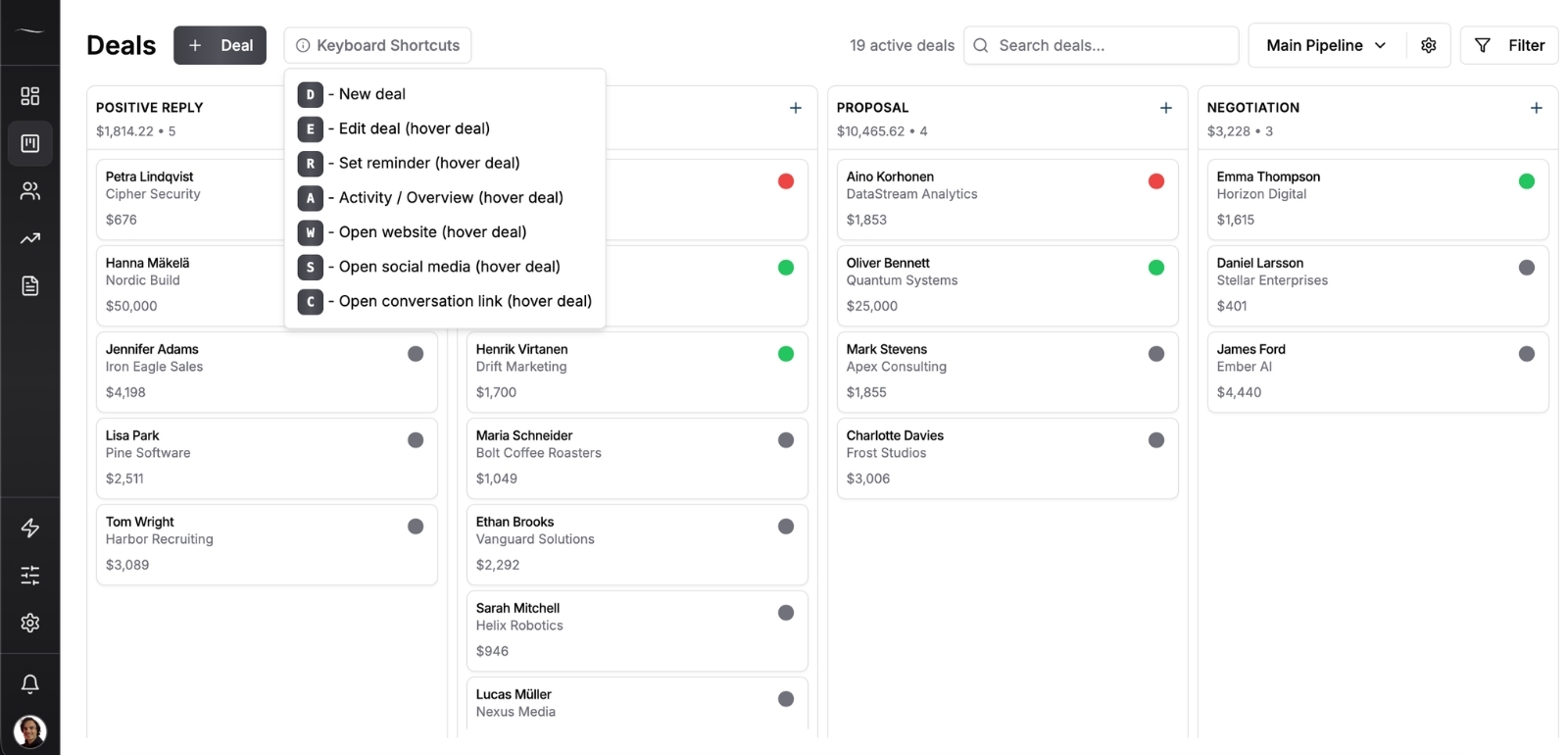
Kon T. runs a small business on Fluid CRM and gave the honest version in his G2 review. He likes that “managing deals, contacts, reminders and pipelines takes very little effort”, and he also wrote that “some parts of the interface still require more clicks and navigation than they should.”
In the same review he called these “normal gaps in a young product rather than fundamental problems.”
2. Pipedrive (best for a team that sells all day and wants email sync)
Pipedrive is a sales CRM built around a visual pipeline, with four plans and no free plan. The trial is 14 days and needs no credit card.
- Best for: a team where selling is the whole job and email sync and automated follow-ups matter.
- Not for: a team that wants every feature on the plan it starts with.
- Cost for 5 seats: Growth is $39 per seat a month on annual billing, which is $2,340 a year, or $49 a month billed monthly.
- Cost for 10 seats: $4,680 a year on Growth with annual billing.
- What a small team gets: Growth adds full email sync with tracking, automations and forecast reports to what Lite ($14 per seat on annual billing) offers. That is why Growth is the plan priced here.
- Where it falls short: group and individual permissions, required fields and lead routing are on Premium, at $59 per seat on annual billing. The LeadBooster add-on for capturing leads starts at $32.50 a month on annual billing.
3. HubSpot (best for a team whose marketing already runs on HubSpot)
HubSpot has a free CRM for up to 2 users. A team of five starts on a paid Sales Hub plan from day one.
- Best for: a team whose website forms, emails and marketing are already in HubSpot.
- Not for: a team with nobody to look after the setup as it grows.
- Cost for 5 seats: Sales Hub Starter lists at $20 per seat a month, which is $100 a month or $1,200 over a year.
- Cost for 10 seats: $2,400 a year on Starter at that list price.
- What a small team gets: sales and marketing records in one system from a vendor most new hires already know.
- Where it falls short: the next step up, Professional, is $90 per seat a month on annual billing or $100 monthly. Professional requires a one-time onboarding fee of $1,500 and Enterprise one of $3,500, so 5 Professional seats come to $6,900 in year one.
4. Zoho CRM (best for a free start and other Zoho apps later)
Zoho CRM has a free edition for up to 3 users and four paid editions. It is part of a large family of Zoho business apps.
- Best for: a team that wants to start free with up to 3 users and may add other Zoho business apps later.
- Not for: a team that wants to be set up by lunch with nobody configuring anything.
- Cost for 5 seats: Standard is $14 per user a month on annual billing, which is $840 a year, or $20 a month billed monthly.
- Cost for 10 seats: $1,680 a year on Standard with annual billing.
- What a small team gets: Standard includes multiple sales pipelines, sales forecasting and standard reports. Professional, at $23 on annual billing, adds automation, AI and unlimited reports.
- Where it falls short: the free edition stops at 3 users, so a team of five pays from the start. Zoho also sells Bigin, which it describes as a simple CRM for first-timers, so check which of the two fits before you set one up.
5. Freshsales (best for a team that wants sequences and territories)
Freshsales is the sales CRM from Freshworks. Its cheapest paid seat is the lowest on this list.
- Best for: a team that wants email sequences, contact scoring and territory management in the CRM itself.
- Not for: a team that needs forecasting without paying for the top plan.
- Cost for 5 seats: Pro is $39 per user a month on annual billing, which is $2,340 a year. Growth is $9 on annual billing, or $540 a year for five.
- Cost for 10 seats: $4,680 a year on Pro, or $1,080 on Growth.
- What a small team gets: Pro adds sales sequences, territory management, contact scoring and custom fields to Growth, which is why it is the plan in the table.
- Where it falls short: forecasting insights and field-level permissions start on Enterprise, at $59 per user a month on annual billing.
6. Capsule (best for a team that also tracks delivery work)
Capsule is a contact and pipeline CRM that also has project boards for work after the sale. The free plan allows 2 users, so a team of five starts on a paid plan.
- Best for: a team that sells and then delivers, and wants both in one tool.
- Not for: a team that wants several pipelines on the entry plan.
- Cost for 5 seats: Growth is $36 per user a month on annual billing, which is $2,160 a year, or $40 a month billed monthly.
- Cost for 10 seats: $4,320 a year on Growth with annual billing.
- What a small team gets: Growth adds multiple sales pipelines, workflow automations, advanced sales reporting, reporting dashboards and email sync.
- Where it falls short: those features are why Starter ($18 on annual billing, $1,080 a year for five) is not the plan priced here. Capsule’s Ultimate plan, at $72, is the one its own page labels for teams of 5 or more.
7. Less Annoying CRM (best for a team that works contact by contact)
Less Annoying CRM has one plan at $15 per user a month, with no tiers and nothing kept for a higher plan. The free trial is 30 days with no credit card.
- Best for: a team whose day starts from a contact list and a task list rather than a deal board.
- Not for: a team that wants to save by paying a year ahead.
- Cost for 5 seats: $75 a month, or $900 over a year.
- Cost for 10 seats: $150 a month, or $1,800 over a year.
- What a small team gets: unlimited pipelines, user permissions, email logging, tasks and unlimited custom fields on the one plan.
- Where it falls short: there is no annual price, so a year costs twelve monthly payments. We compared the two one-plan tools in more detail in Fluid CRM vs Less Annoying CRM.
How To Get A New Rep Working In One Day
A small team hires one rep at a time, and that rep inherits deals from someone who is busy or leaving. The CRM decides whether day one is spent selling or spent asking questions. The steps below work in any tool on this list.
1. Invite them and give them their deals
Send the invite before they start, so the login works at 9 a.m. Then change the owner on every deal they take over, so the board shows their name on day one and nobody else keeps chasing those deals.
2. Let the deal history do the handover
Each inherited deal should already hold the last calls, emails and notes. If it does, the new rep reads the history instead of booking a handover meeting for each deal. Yannick, a verified customer, picked Fluid CRM because it “can be implemented quickly.”
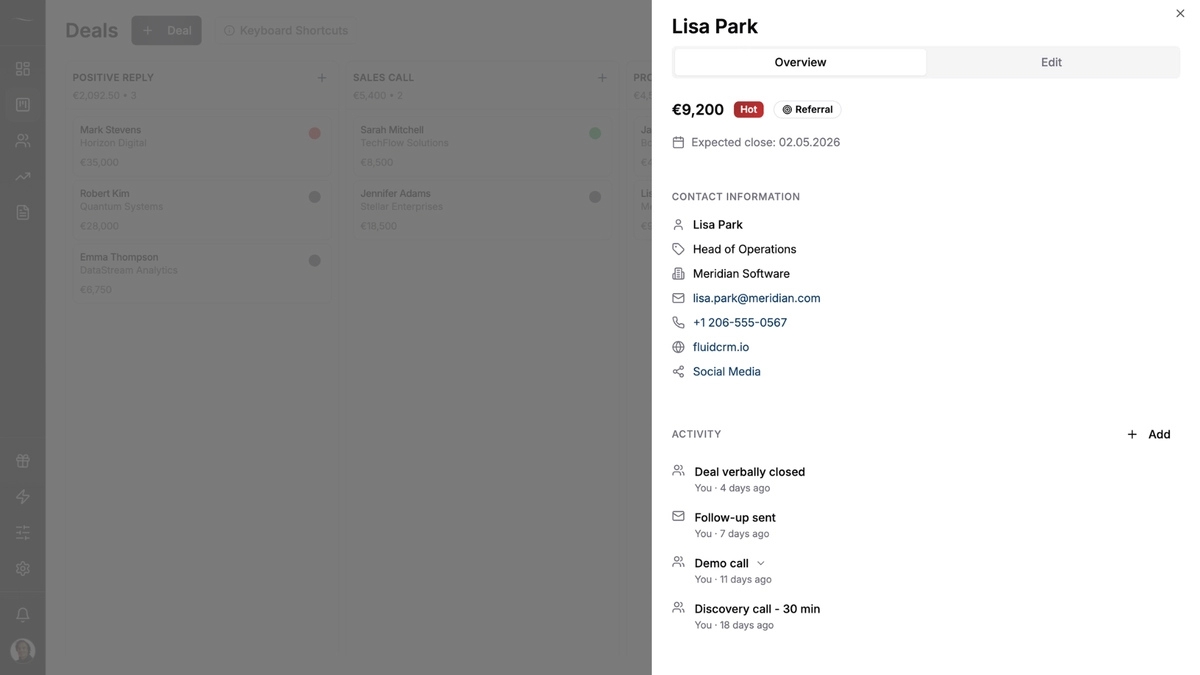
3. Put a reminder on every inherited deal
Before lunch, the new rep sets a next date on each deal they own. Anything without one gets a reply that day or gets moved to lost, so the board they start with is a true one.
4. Sit in on one pipeline review
At the end of the first day, walk the board together for 30 minutes. Our sales pipeline review agenda keeps it to deals that need a decision.
When A Small Team Needs Something Bigger
Some teams of 8 or 12 outgrow every tool in the simpler half of this list. That is fine, and it is cheaper to admit it before the trial than after the migration.
Pick a bigger platform if any of these is true:
- You split leads by territory or region. Freshsales Pro has territory management.
- You need permissions by group or by field. Pipedrive Premium has group permissions, and Freshsales Enterprise has field-level permissions.
- Reps send email sequences from the CRM. Pipedrive Growth and Freshsales Pro both include them.
- You make calls from the CRM all day. A tool with a built-in dialer saves the switching.
- You are past about 15 reps. At that size someone usually becomes the CRM owner, and an admin-heavy tool stops being a cost.
Fluid CRM is the wrong pick for every team on that list. It has no dialer, no sequences, no territories and no detailed permission rules. For a longer comparison of the bigger options, see our guide to the best CRM for small B2B sales pipelines.
Frequently Asked Questions
For a team with no admin that wants one shared board, Fluid CRM gives every deal an owner and a reminder for $16 per seat a month. Pipedrive fits a team that needs email sync and automations. HubSpot fits a team whose marketing already runs on it.
On the plans priced here, between $720 and $2,340 a year for five seats. Fluid CRM is $720 a year, Zoho CRM Standard $840 and Less Annoying CRM $900. Pipedrive Growth and Freshsales Pro are both $2,340 on annual billing.
Usually not. HubSpot’s and Capsule’s free plans stop at 2 users and Zoho CRM’s free edition stops at 3. A team of five needs a paid plan with any of them.
Yes, once more than one person owns deals. The team lead needs to see what is open and what is likely to close without asking each rep. Look for a forecast that comes from the pipeline itself rather than a dashboard someone has to build.
One day for a team without a sales ops person. If the deal history is complete and every deal has an owner and a next date, a new rep can take over deals on the first day. A tool that needs a week of training is built for a bigger team.
Which CRM Your Team Should Start With
Start with Pipedrive or Freshsales if your reps send sequences and work from their inbox all day. Start with HubSpot if your marketing is already there, and with Zoho CRM if you want to begin free with three users.
If you want one board that a team with no admin keeps current, start with Fluid CRM. You can see how our sales team CRM works for a team of 3 to 10, or load your open deals and invite the team this afternoon.
Start your 7-day free trial here, no credit card required.