

The call went well, the buyer liked what they heard and you promised to send something over. Now it is five in the afternoon and the email is still unwritten, because you are not sure what it should say.
A sales follow-up email template needs three things, which are what was agreed, the next step with its date and one question the buyer can answer in a word. Send it the same day as the call, demo, proposal, verbal yes or “not now” it belongs to. In Fluid CRM that date is a reminder on the deal.
This post covers the email you send right after a real sales moment. If the thread has already gone quiet, use these templates for a follow-up email after no response instead. Prospects who never answered your first cold email are a different job, and I covered it in cold email follow-up.
Three Rules for a Sales Follow-Up Email
A good sales follow-up email is the last step of the meeting and not a separate chore. It puts in writing what both of you already said out loud, while both of you still remember it.
One moment per email
Each email belongs to one thing that just happened. An email that confirms the call, attaches a case study and asks about budget gives the buyer three things to think about and no clear thing to answer.
Send it the same day
The buyer walks out of your meeting and into four others. By tomorrow afternoon they remember that the call was good and very little of what was agreed, so the email has to arrive while the details are still theirs.
One ask that takes one word to answer
End on a single question the buyer can answer with yes or no from their phone. “Did I get that right?” takes ten seconds to answer, and “let me know your thoughts” gets saved for later.
At my outbound agency Fenixtal we booked 1,250+ sales calls for B2B clients. A good call with no date agreed for the next conversation is the easiest deal to forget.
That gets harder with more people. In a team of two to ten with no sales ops person, nobody checks that the email went out, which is the reason a sales CRM for small teams puts an owner and a next step on every deal.
Four openers are worth dropping from every template you own.
| Leave out | Write instead |
|---|---|
| I hope this email finds you well | Their name, then the first real sentence |
| Just checking in | The thing you promised to send |
| Touching base or circling back | What was agreed and the date |
| Quick question | The question itself |
When To Send Each Sales Follow-Up Email
Use this table to find your moment, then go to the matching template in the next section.
| Moment | Send it | Must be true first | The one ask |
|---|---|---|---|
| After a sales call | Same day | The next call is booked | Did I get that right? |
| After a demo | Same day | You know the one question still open | Does that answer it? |
| After a meeting with several people | Same day, one email to everyone | You know who decides | [Name], can I send the proposal to you? |
| When you send a proposal or quote | With the document | They told you the date they decide by | Are you still deciding by the 14th? |
| After a verbal yes | Within the hour | Scope, price and start date were said out loud | Should the agreement go to you? |
| After a “not now” | Same day | They named when | Is it fine if I come back the first week of [month]? |
| After a trade show or event | The next morning | You wrote down what they asked about | Want me to send it? |
7 Sales Follow-Up Email Templates by Moment
Copy the one you need and replace everything in square brackets. Each one is under 100 words. Your signature goes under [Your name], and our free email signature generator makes a clean one if you need it.
1. After a sales call
Send it: the same day, before you close your laptop.
Must be true first: the next call is in both calendars. If it is not, skip this template and send one question that books it, such as “Does Thursday at 10 work for the next call?”
Subject line: [Day] at [time]
Hi [Name],
It was good talking today. I’ll send [what you promised] by [day], so that you have it before we speak again on [date] at [time].
The part I wrote down as most important was [their main point, in their words]. Did I get that right?
[Your name]
When the next call is already booked, this short email is enough. A full recap is for the times when other people who were not on the call need to read it, and the discovery call post has that longer email.
2. After a demo
Send it: the same day.
Must be true first: you know the one question you could not fully answer during the demo, you have the answer now and the next call is booked.
Subject line: Your question about [topic]
Hi [Name],
You asked today if [their question, in their words], and I said I would come back with a proper answer.
The answer is [yes or no]. [Two plain sentences on how it works for a team like theirs.]
I’ll also bring [what they wanted to see next] to our call on [date]. Does that answer your question?
[Your name]
Answer one question and stop there. A demo follow-up that lists every feature you showed reads like a brochure, and the buyer already sat through the real thing.
3. After a meeting with several people
Send it: the same day, as one email to everyone who was in the room.
Must be true first: you know which person decides, and you wrote down what each of the others cared about.
Subject line: What we agreed today
Hi all,
It helped a lot to hear from all of you in one room today.
[Name 1] needs [their point], [Name 2] wants to be sure that [their point] and [Name 3] asked about [their point]. I’ll answer [Name 3]’s question by [day], and the proposal will cover the other two.
[Decision owner’s name], can I send the proposal to you?
[Your name]
Naming each person next to their own point shows nobody was ignored. Putting the ask to one named person matters even more, because a question sent to five people is answered by none of them.
4. When you send a proposal or quote
Send it: together with the document, ideally right when you finish walking them through it.
Must be true first: they told you the date they will decide by and who else will read it. If you have no decision date, ask for one before you send anything.
Subject line: Proposal for [project]
Hi [Name],
The proposal is attached, and it matches what I walked you through today. The price is [amount] and we could start on [date].
You said [colleague] will read it too, so page [number] is the one written for them.
Are you still deciding by [their date]?
[Your name]
A proposal sent without a decision date leaves you guessing from the first day. If that date passes and you have heard nothing, the emails for that are in the post on the follow-up email after no response.
5. After a verbal yes
Send it: within the hour.
Must be true first: the scope, the price and the start date were all said out loud. If one of them was not, that is your one question.
Subject line: Next steps for [project]
Hi [Name],
I’m glad we’re doing this. To make sure we heard the same thing, we agreed on [scope in one line] for [price], starting on [date].
I’ll send the agreement today, and once it’s signed I’ll book the kickoff for [date].
Should the agreement go to you?
[Your name]
A spoken yes is the moment a deal feels finished and is not. Until the agreement is signed it stays an open deal with a next step, so keep the date on it.
6. After a “not now”
Send it: the same day.
Must be true first: they told you when they can look at this again. If they did not, use the second version below. For answering the objection while you are still on the call, my post on common sales objections has the scripts.
Subject line: Picking this up in [month]
Hi [Name],
That makes sense, and I’d rather you do this once [what they are waiting for] is done than squeeze it in now.
You said [month] is when you can look at this again. Is it fine if I come back to you the first week of [month]?
[Your name]
Their yes to that question turns a polite refusal into an appointment. Write their reason in the deal notes word for word, so that your first sentence in [month] can pick up from where they left it.
If they did not say when
Subject line: So I know where this stands
Hi [Name],
That’s fair, and it helps me to know which kind of “not now” this is.
Is it the timing that’s off, or is this not a priority for you this year?
[Your name]
If the answer is timing, ask which month and send the first version. If it is not a priority, close the deal and write the reason in the notes. When they name no month at all, I set the reminder about three months out, which is my own judgement and not a rule. What to send in the months in between is in our guide to simple lead nurturing for a small business.
7. After a trade show or event
Send it: the next morning.
Must be true first: you wrote down what they said at the stand and the one thing they asked about, and that thing exists and is ready to send.
Subject line: [Event name] and the [thing] you asked about
Hi [Name],
We spoke at the [event] stand yesterday about [their problem, in their words], and you mentioned that [a detail only they told you].
You asked about [the thing]. I have it ready, and it shows [what it shows] so that you can share it with [their colleague or team].
Want me to send it?
[Your name]
Everyone they met at the event will email them this week, and nearly all of those emails will say it was great to meet. The detail only they told you is what proves the email comes from the person they talked to.
How To Make a Template Sound Like You Wrote It
A template is a skeleton, and the buyer should never see it. Three edits take a minute each and change how the email reads.
- Put their words in the first lines. If they called the problem “a mess in the handover”, write that and not “handover inefficiencies”.
- Add one detail only someone in the room would know. A name, a number they mentioned or the thing that made them laugh is enough.
- Read it out loud before you send it. Cut every sentence you would not say to the same person across a table.
If you would not send this email, word for word, to a friend who happened to be a client, it still sounds like a template and needs one more pass.
Keep the seven in one shared document so that everyone on the team starts from the same wording. For other stages, such as asking for a meeting, answering an objection or asking for a referral, our free sales email templates page has more.
How a Small Sales Team Keeps Follow-Ups From Depending on Memory
A template helps you write the email. It does nothing about remembering to send it, and in a team without a sales ops person nobody else will notice that it never went out.
One next step with a date on every deal
Every open deal has an owner and exactly one next step with a date. The date is the one you wrote in the email, such as the next call, the date they decide by or the first week of the month they named.
In Fluid CRM that next step is a reminder on the deal, and each deal has an owner. If you sell projects, the stage rules in my post on the agency sales pipeline show what the next step should be at each stage.
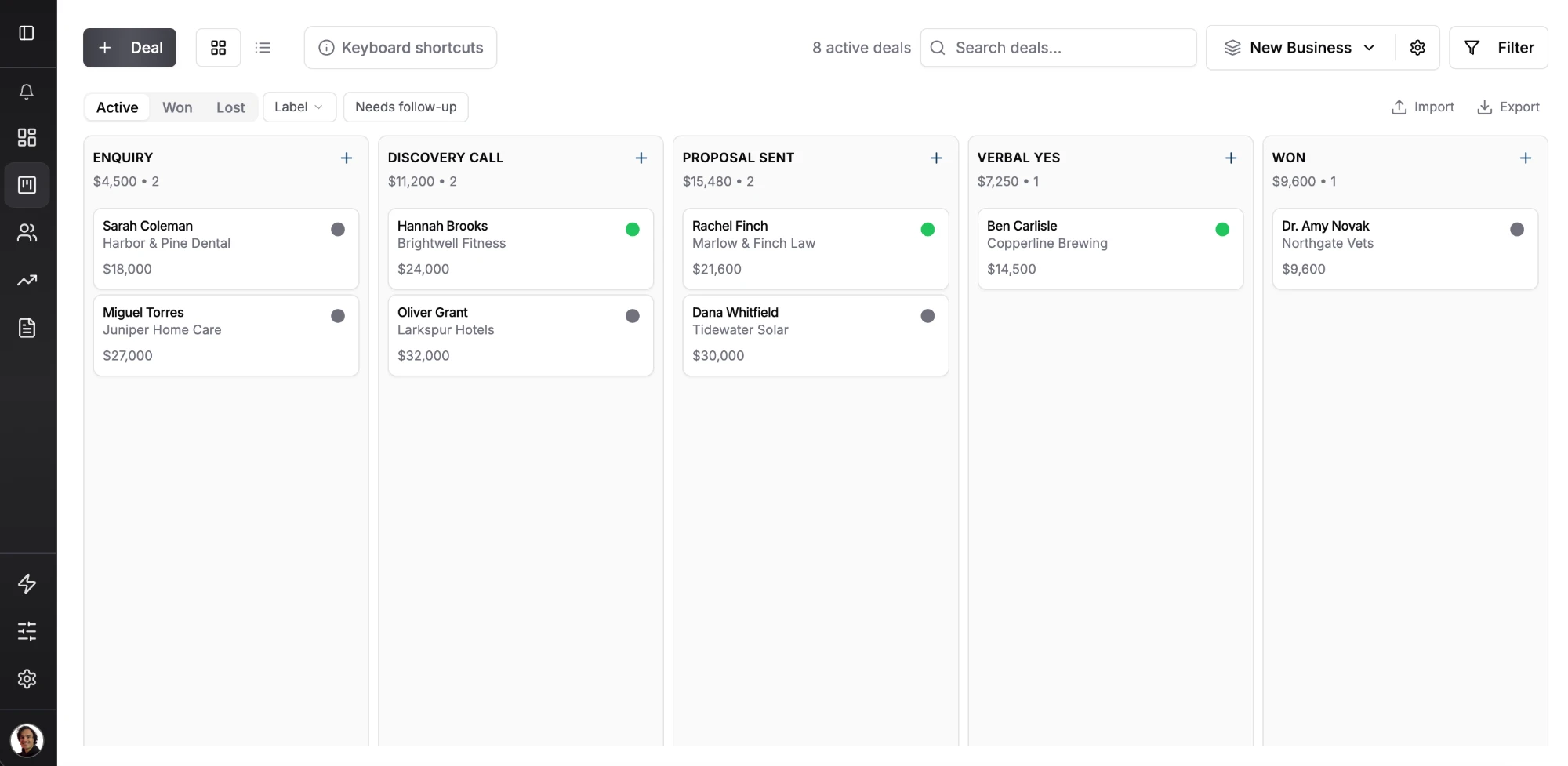
A daily email with the reminders that are due
Fluid CRM sends a daily email with the reminders that are due. You open it in the morning, see which deals need an email today and send the matching template from this post.
James, a small business owner who works with one external salesperson, wrote this in his review of Fluid CRM. “I’ve only had it for a few weeks but it’s already made a significant impact in the way in which I’m interacting with my prospects and clients.”
A weekly look at deals with no next step
Once a week, look at the board together and find every deal that has no reminder on it. Each of those deals either gets a date and an owner or gets closed. The full agenda for that meeting is in our post on the sales pipeline review.
You still send the email yourself
Fluid CRM does not send these emails for you, and it has no email sequences. You send each one from your own inbox and add your Fluid CRM address in BCC, which saves a copy with the deal’s history. A deal also holds one reminder at a time, so set the next date when you finish the current one.
If you write your emails with Claude or ChatGPT, you can connect it to Fluid CRM and ask it to log the note and set the reminder.
FAQ
Send it the same day, before you close your laptop. The buyer still remembers what was agreed, and so do you.
Use the next step or the thing you promised, such as the day and time of the next call or the topic of their question. A subject line that names something the buyer already agreed to gets opened, because it looks like their own business and not a sales email.
Short enough to read on a phone without scrolling, which is usually three or four short paragraphs. Confirm what was agreed, say what you will do and by when, then ask one question. If it needs to be longer, send the fuller recap from the discovery call instead.
Do not send a recap and hope. Send one short email with a single question that books the next step, such as asking if Thursday at 10 works for the next call. Once that is answered, you have a date to put on the deal.
Set the Next Step Before You Send the Next Email
Before your next sales call ends, agree on the next step and its date out loud. Send the matching template the same day, end it on one question and put the date on the deal before you do anything else.
When a whole team works this way, nobody has to ask who is following up on what. That is the job of a sales CRM for small teams, and it only works if updating it takes seconds.
Start your 7-day free trial here, no credit card required.