
HubSpot’s partner code says partners “should never use one portal for more than one client.” GoHighLevel sells the opposite, one agency account with unlimited client accounts inside and your logo on the login screen. Decide who should hold the account before you compare a single price.
GoHighLevel vs HubSpot comes down to who holds the account. GoHighLevel is a flat agency fee for running many clients, with resale, while HubSpot is per seat for one company and each client keeps its own portal. Fluid CRM only fits the agency’s own sales pipeline.
Who Holds the Account in GoHighLevel and HubSpot
GoHighLevel, which now calls itself HighLevel, is sold to the agency. HubSpot is sold to the company whose customers sit in the database, and its partner rules follow from that.
| GoHighLevel | HubSpot | |
|---|---|---|
| Sold to | The agency, which adds clients as sub-accounts | One company, with one portal for each client |
| What the fee counts | Your plan, then usage and per-client add-ons | Seats, plus marketing contacts on Marketing Hub |
| Users and contacts | Unlimited on every plan | Paid seats, except free view-only seats |
| Who contracts with the vendor | You do | The client, or a partner placing the order in its own name |
| How you get in | You own the top-level account | A free Partner Seat in the client’s portal, for eligible partners |
| Whose logo the client sees | Yours, since the desktop web app can be white-labeled | HubSpot’s |
| Reselling | SaaS Mode on the $497 plan | A Solutions Partner can contract with HubSpot and set its own price, and each subscription stays with the end user it was bought for |
| Commitment | Month to month | Professional is an annual commitment even when paid monthly |
| Free option | 14-day trial, no free plan | Free plan for up to 2 users |
HubSpot’s code also says the first user in a client portal, and the user with the most access, “should always be a client user.” That rule binds its Solutions Partners rather than every agency, but it shows how HubSpot pictures the relationship. The client holds the portal and you work inside it.
There is a third situation that is easy to forget. If the only deals you want to track are your own, that is an agency CRM question, and neither of these is built for it.
Client Delivery and Your Own Sales Are Two Different Jobs
Agencies shopping for HubSpot vs GoHighLevel often write one list of requirements when they have two. One list is what your clients need from you, and the other is what you need to win your next client.
| The job | What your clients need | What your own new-business pipeline needs |
|---|---|---|
| Reaching people | Texts, emails and calls at volume from their own number | A record of who replied and what you owe them |
| Capturing leads | Funnels, landing pages and ad tracking | One form on your site that creates a deal |
| Booking | A calendar for their customers | The booking link you already have |
| Reputation | Review requests and listings | Nothing |
| Logging in | A login for each client, ideally with your logo | Your own team only |
| Follow-up | Automated workflows for each client | One next step and one date on every deal |
| Reporting | Results that justify your retainer | Pipeline value, forecast and why deals were lost |
| Earning from the software | Resale with a margin | Nothing |
I ran Fenixtal, an outbound agency, and getting 1,250+ sales calls onto client calendars was delivery work. Knowing which of your own prospects is waiting on a proposal is a separate job, and a platform set up for client delivery does not answer it.
So which column are you buying for? Can you name the three deals your agency most needs to close this month, and the date of the next step on each, without opening a client account?
What GoHighLevel and HubSpot Cost Per Client and Per Seat
The two vendors price different units, so no single number compares them. Here are the list prices, and then the same money counted per client and per seat.
The plans side by side
| Plan | Price | What you get |
|---|---|---|
| GoHighLevel Starter | $97 a month or $970 a year | 3 sub-accounts, unlimited users and contacts, no rebilling |
| GoHighLevel Unlimited | $297 a month or $2,970 a year | Unlimited sub-accounts, phone and email rebilled with no markup, basic API |
| GoHighLevel Founder (its FAQ calls it Pro) | $497 a month or $4,970 a year | SaaS Mode and rebilling with your markup |
| HubSpot Free | $0 | Up to 2 users |
| HubSpot Sales Hub Starter | $20 per seat on monthly billing, with a lower promotional rate on annual | Up to 15 pipelines and 50 restricted workflows |
| HubSpot Sales Hub Professional | $90 per seat annually or $100 monthly, plus $1,500 onboarding once | Up to 100 pipelines and 300 custom workflows |
| HubSpot Sales Hub Enterprise | $150 per seat, plus $3,500 onboarding once | Forecasting across team hierarchies |
| HubSpot Marketing Hub Professional | $800 a month annually or $890 monthly, plus $3,000 onboarding once | 3 seats, 2,000 marketing contacts, extra seats from $45 |
Per client, at 1, 5 and 15 accounts
GoHighLevel bills usage on top of the plan, so the table needs an assumed client. Ours sends 1,000 texts ($7.47), pays $3.50 to $5.00 in carrier fees, sends 5,000 emails ($3.38), makes 200 outbound call minutes ($3.32) and rents a local number ($1.15).
That comes to about $20 a client each month. Our breakdown of GoHighLevel pricing lists the rest of the usage rates and add-ons.
| Clients | GoHighLevel plan | Plan plus usage a month | Per client |
|---|---|---|---|
| 1 | Starter | $117 | $117 |
| 5 | Unlimited | $397 | $79.40 |
| 15 | Unlimited | $597 | $39.80 |
| 15, reselling | Founder | $797 | $53.13 |
On the HubSpot side, each client gets one portal, as the partner code asks. The Starter column assumes 2 seats on monthly billing. That portal has no texting.
| Clients | Sales Starter portals a month | Marketing Pro portals a month, before any SMS | Marketing Pro onboarding, once, unless a partner replaces it |
|---|---|---|---|
| 1 | $40 | $800 | $3,000 |
| 5 | $200 | $4,000 | $15,000 |
| 15 | $600 | $12,000 | $45,000 |
“GoHighLevel is cheaper” turns out to be only half right. Against bare Starter portals, GoHighLevel costs more until about 15 clients, and until about 9 if you take texts and carrier fees out of its usage, since a Starter portal cannot text.
What you are buying with that money is the texting, funnels and white label. The moment a client needs HubSpot’s marketing tools to get something similar, the gap is $12,000 against $597 a month at 15 clients. HubSpot’s onboarding adds $45,000 once, unless you are a Solutions Partner and deliver the onboarding yourself, which lets you waive the fee.
Different people also pay the bill. On GoHighLevel the agency pays HighLevel and decides what to charge back. When a HubSpot client pays HubSpot directly, a partner earns a revenue share on Professional and Enterprise but nothing on Starter alone.
A Solutions Partner can also contract with HubSpot itself and set its own price, but it then guarantees the fees for that client’s HubSpot products. Partner status costs $400 a month unless your own HubSpot subscriptions reach that amount.
Per seat, for your own team of 3 or 5
Now take the clients away and price the tools for your own staff. GoHighLevel’s flat $97 only undercuts Sales Hub Starter’s seat price from 5 seats, at $97 against $100 a month, and that is before GoHighLevel’s usage.
| Plan and billing | 3 seats, year one then year two | 5 seats, year one then year two |
|---|---|---|
| GoHighLevel Starter, annual, before usage | $970, then $970 | $970, then $970 |
| HubSpot Sales Hub Starter, monthly | $720, then $720 | $1,200, then $1,200 |
| HubSpot Sales Hub Professional, annual | $4,740, then $3,240 | $6,900, then $5,400 |
| HubSpot Marketing Hub Professional, annual | $12,600, then $9,600 | $13,680, then $10,680 |
Year one includes the onboarding fee, which is why the Professional rows fall in year two. Two users can stay on HubSpot’s free plan, so the first paid decision arrives with your third person. Our guide to HubSpot pricing covers what each seat type unlocks.
If you run your agency’s own deals inside GoHighLevel, remember that a sub-account for yourself uses one of Starter’s three.
What somebody has to build for each client
Neither GoHighLevel nor HubSpot works on the day you pay for it, and the list of work repeats for every client.
| Step, per client | GoHighLevel | HubSpot |
|---|---|---|
| Account | Create a sub-account, ideally from a Snapshot, HighLevel’s pre-built account copy | The client’s portal, with your access added |
| Required fee | None on the plan | None on Starter, then $1,500 on Sales Pro or $3,000 on Marketing Pro for each portal, unless a Solutions Partner replaces HubSpot’s onboarding with its own |
| Texting | US registration, $22.50 once and $1.50 to $10 a month on the common low-volume and standard campaigns, charged on submission | Marketing SMS add-on or a Marketing Pro or Enterprise plan, business registration and US-based numbers only |
| Pages and funnels | Built in its funnel builder | Landing pages in Marketing Hub |
| Automations | Workflows, reusable through Snapshots | Built inside that client’s portal, within its plan’s limits |
| Money | Wallet, rebilling and any markup to set up | Billing stays between the client and HubSpot, unless you contract as a partner |
| Training | Your clients learn your branded app | Your clients learn HubSpot |
Here is an example with made-up hours. Say a client takes 8 hours to set up on either platform, valued at $75 an hour. That is $600 a client and $9,000 at 15 clients, about three times a year of GoHighLevel Unlimited on annual billing.
On HubSpot Marketing Pro, that $9,000 comes on top of $45,000 in onboarding fees. If you waive those fees as a Solutions Partner, the onboarding work becomes yours, so raise your hours. Your number will differ, so swap it in before you compare anything else in this post.
HighLevel’s own page says its AI features need setup, configuration and ongoing human oversight. Budget for someone who owns that work after launch, because a broken client workflow is your problem on a retainer.
Where GoHighLevel and HubSpot Each Win, Job by Job
GoHighLevel wins the client-delivery jobs and HubSpot wins the in-house sales jobs, and this table also says who each win matters to.
| Job | Winner | Who that matters to |
|---|---|---|
| Funnels and websites | GoHighLevel | Agencies building pages as part of the retainer |
| Texting | GoHighLevel | Local-service clients who rely on SMS |
| Booking calendars | GoHighLevel, in the base plan | Appointment-setting offers |
| Review and reputation tools | GoHighLevel | Local businesses |
| White label and resale | GoHighLevel | Anyone selling software under their own brand |
| Sequences for a sales team | HubSpot | Reps sending one-to-one email, available from Starter |
| Forecasting and reporting depth | HubSpot | A sales manager running one team’s numbers |
| Integrations | HubSpot, with the larger marketplace | Companies with a stack to connect |
| Free start | HubSpot | Two users who want to try it at no cost |
| Contacts at scale | GoHighLevel | Big lists, since HubSpot’s marketing contacts move you up a tier |
Your clients need texting and funnels under your logo
Pick GoHighLevel. It is the only one of the two designed for this, and the client list can grow without a new plan fee once you are on Unlimited. Read the usage and per-client add-ons carefully, and if you later want a different setup, our list of GoHighLevel alternatives sorts them by which part you use.
Your client sells B2B with its own team and keeps its own data
Pick HubSpot, and let the client hold the portal. A sales manager inside that company gets deeper reports, a larger app marketplace and a tool its next hire may already know. Your agency keeps access as a partner, and the CRM stays with the client if you part ways.
Moving from HubSpot to GoHighLevel
HighLevel has a HubSpot importer for contacts, companies, deals, pipelines, custom fields, emails, notes and tasks. Imported emails are read only, notes can’t attach to companies, recurring tasks aren’t supported and a deal with no contact won’t import.
Workflows and landing pages don’t come across in the importer, so they get rebuilt, by hand or with HighLevel’s concierge migration team at no additional cost. Budget time to test that rebuild when you compare the first year.
Where Fluid CRM Fits: Your Agency’s Own Pipeline
An agency’s own new-business pipeline needs far less than a client platform, namely a record of who replied plus one next step and one date on every deal. Deals die on the days that record goes out of date, and your own deals are easy to forget inside a platform full of client work.
We built Fluid CRM for that job only. It gives your team a visual pipeline, one reminder per deal, a daily email of what is due, lead capture forms, lost reasons and a revenue forecast. Claude or ChatGPT can update it through our MCP connector.
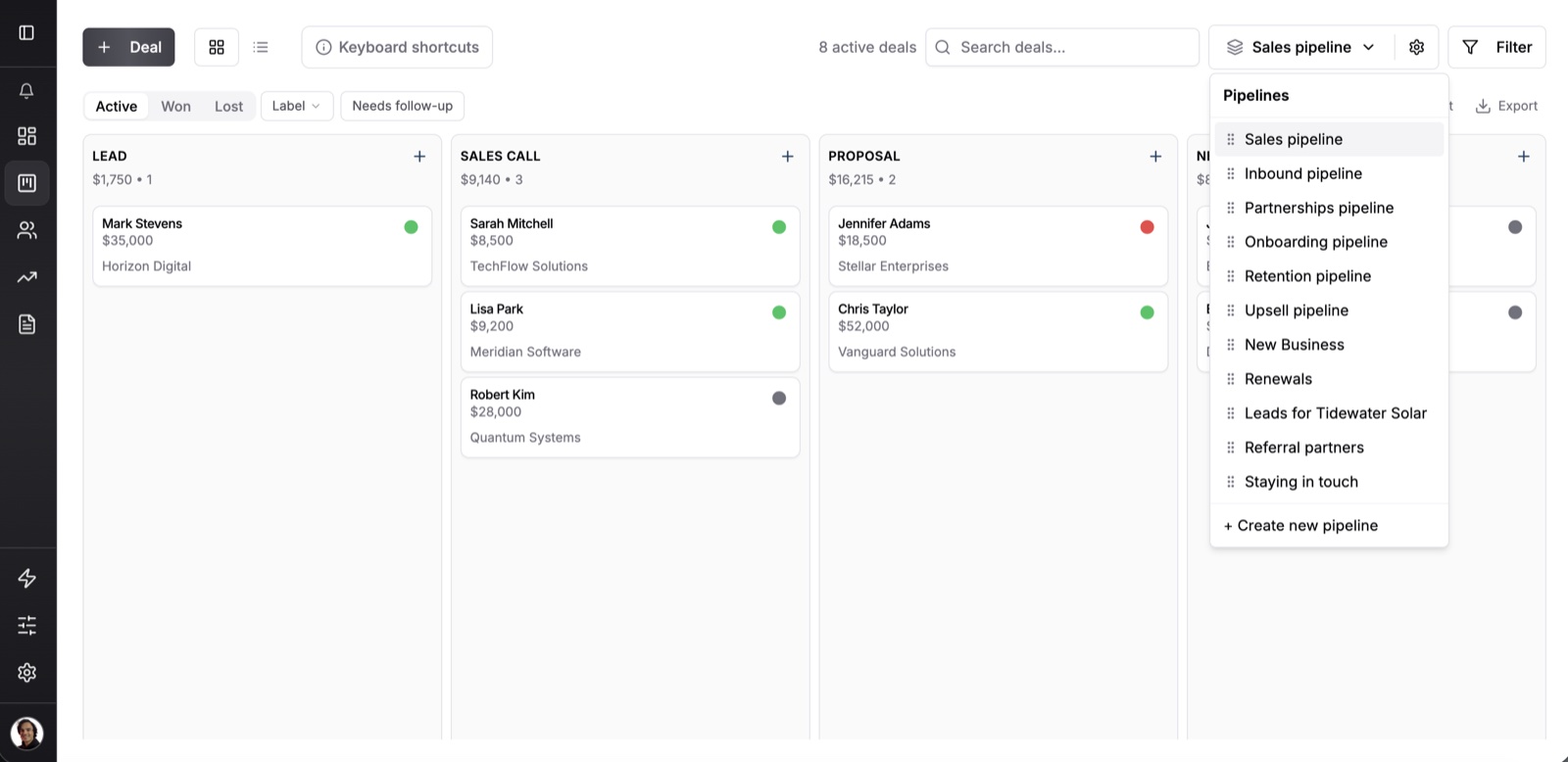
An agency might keep New Business and Referral partners side by side, plus a pipeline such as Leads for Tidewater Solar for the leads it hands to a client. Your team works those boards and the client does not log in. Our guide to the agency sales pipeline covers the stages to use.
Every feature is in one plan at $16 per seat per month or $144 per seat per year, so 3 seats are $48 a month and 5 seats are $80 a month or $720 a year.
Andy, a freelance web designer who had a HubSpot account before us, wrote that Fluid CRM is for “the little businesses.” He described them as “those of us with a handful of clients at a time.”
A verified customer who owns an agency said that with Fluid CRM “it doesn’t take hours to upload a lead.”
Two limits matter for this choice. If you want to resell software to clients, Fluid CRM is not the tool for it, since it has no client sub-accounts or white label.
It also has no SMS or funnels, which means it does not replace what you deliver to clients. Use it next to whichever platform does.
GoHighLevel vs HubSpot FAQ
It depends on what you compare. Bare HubSpot Sales Starter portals with 2 seats cost less than GoHighLevel Unlimited until about 15 clients, or about 9 with texting taken out of the GoHighLevel usage. Once clients need marketing automation, GoHighLevel is far cheaper, since HubSpot Marketing Hub Professional starts at $800 a month per portal, plus $3,000 onboarding unless a Solutions Partner replaces it.
HubSpot’s plans list no white-label option, so expect clients to see HubSpot’s name. A Solutions Partner can resell HubSpot at its own price or earn a revenue share, but a subscription may be used only for the end user it was purchased for. GoHighLevel lets you white-label the desktop web app and offers a white label mobile app for $497 a month.
It can for a simple sales process, since CRM and pipelines are part of every plan. A team that depends on forecasting, deep reporting or a wide set of connected apps will usually be better served by HubSpot. The price of GoHighLevel also includes a lot of marketing software that a sales team may never open.
HubSpot has a free plan for up to 2 users. GoHighLevel has no free plan and offers a 14-day free trial on each plan. GoHighLevel billing starts automatically when the trial ends, and usage fees can apply during the trial.
Yes, with the Marketing SMS add-on or a Marketing Hub Professional or Enterprise plan. HubSpot only sends SMS from US-based numbers, and your business has to be registered and approved first. HubSpot says 10DLC approval can take six to eight business days.
GoHighLevel or HubSpot: Who Should Hold the Account?
Answer two questions in order and the choice is usually clear.
- Does a client need a login at all? If no, you are not shopping for either tool. You need an agency CRM for your own deals, and Fluid CRM is built for that.
- If yes, should the account be yours or theirs? Yours, with your logo and your margin, means GoHighLevel. Theirs, with their team and their reports, means HubSpot.
Keep your own pipeline separate from that decision, whichever way it goes. The agency that closes the next client is the one that can still see its own deals.
Start your 7-day free trial here, no credit card required.