
You had a real conversation. They replied, took the call or asked for the proposal, and then the thread went quiet. Now you are staring at a draft that says “just following up” and wondering if it makes you look desperate. It does not make you look desperate, it makes you look forgettable, and there is a better way.
Wait three business days, then send a follow-up that gives them a new reason to reply: a result, a deadline or an easier next step. Never send a naked “just following up”. Three emails and a breakup is enough. Fluid CRM users put a reminder on every open deal so no thread depends on memory.
One boundary before the templates. This post is for threads where a real conversation already happened. If you are chasing cold prospects who never replied at all, that is a different game with different math, and I wrote about it separately in cold email follow-up.
Why Prospects Go Silent (It Is Usually Not a No)
A silent thread feels like rejection, so most people either stop or send something apologetic. Both reactions misread what happened. People go silent because your email arrived in a bad week, because the decision needs a colleague who is on holiday, or because they flagged it for later and later never came.
I booked 1,250+ sales calls for 50+ B2B clients at my old outbound agency, and a large share of those calls arrived on a follow-up touch rather than the first email. Not because the follow-ups were clever. Because timing is most of the game, and a follow-up is another roll on timing.
The deals that actually died in silence were usually ours to blame. Nobody sent anything, the thread decayed for three weeks and the prospect solved the problem somewhere else. Silence kills more deals than the word no does.
The One Rule: Never Send a Naked Bump
A naked bump is any follow-up whose entire content is that you exist. “Just following up”, “circling back on this” and “bumping this to the top of your inbox” all ask the prospect to do the work of remembering why they cared.
Each follow-up has to carry a new reason to reply. That can be a result you got for someone like them, a piece of information that changes the picture, a deadline that is real, or a smaller ask than the one they ignored. If you cannot name what is new in your follow-up, you have not written one yet.
The bar is lower than it sounds. One sentence of new substance is enough to turn a bump into a reason.
The 3-Email Revival Sequence
Three emails, widening gaps, then a clean exit. Day 3, day 9, day 20. Every template below assumes a first name and a thread that already exists, so reply in the same thread and keep the original subject line.
Email 1, day 3: the nudge with something new
Hi Sara, adding one thing since my last note. [New piece: “We wrapped the rollout I mentioned, the client cut their quoting time from 4 days to 1.”] Still happy to walk you through how that would look on your side. Does Thursday or Friday work?
One new fact, one easy question. No apology and no summary of the whole deal, the thread below the email does that job.
Email 2, day 9: the different angle
Hi Sara, one thought that might matter more than the demo. [Angle switch: “You mentioned the team ignores the current system. That is usually a tooling problem, not a discipline problem, and it is fixable in a week.”] If that is the sticking point, I can show you exactly how we handle it in 15 minutes.
The second follow-up should not be the first one rephrased. Pick the objection you suspect is actually in the way and speak to it directly.
Email 3, day 20: the breakup
Hi Sara, I will stop here so I am not adding noise to your inbox. If the timing is wrong, no problem at all, and if it makes sense to pick this up next quarter I am easy to reach. Either way, thanks for the conversation so far.
Breakup emails get replies at a rate that surprises people, because a clean exit is the easiest email in the thread to answer. Send it without bitterness and mean it.
Templates by Situation
The three-email revival sequence covers the default case. These five templates cover the threads where the silence started at a specific moment.
After you sent a proposal
Hi Sara, checking whether the proposal raised any questions I should answer before you take it further internally. One thing I would flag: the onboarding slot we discussed is held until the 22nd, after that the next opening is about three weeks out. Want me to hold it?
A real deadline beats an invented one. If you do not have one, offer to walk their colleague through the proposal instead, because a stalled proposal usually means an unconvinced second reader.
After you sent a quote
Hi Sara, has anything changed on your side since I sent the numbers? If the price is the sticking point, tell me straight, there is usually a version of the scope that fits. If it is timing, that is fine too, I would just rather know than guess.
Inviting the objection by name gets more replies than pretending it does not exist. When the answer comes back, common sales objections covers what to say next.
After a call that ended warm
Hi Sara, when we spoke you said the spring rollout was the natural moment for this. Is that still the plan? If yes, working backwards from April we would want to start scoping by mid-February, so I wanted to get ahead of it rather than chase it late.
Quote their own words back to them. A warm call that went silent almost always contains a stated next step someone forgot to schedule.
After “sounds interesting” and then nothing
Hi Sara, you mentioned this sounded interesting, so rather than send another wall of text I made it smaller: here is a 3-minute video of the exact workflow we discussed. If it holds up, worth a real call. If not, tell me and I will close the file.
Shrink the ask. Someone who said “interesting” and vanished was not lying, they were busy, and a 3-minute commitment restarts things a 30-minute one cannot.
After a demo that seemed to go well
Hi Sara, since the demo I keep coming back to the reporting question you asked, so I recorded a 2-minute walkthrough of that exact screen with numbers closer to yours. If the rest of the team wants to see it live, I will happily run the same session for them, that is usually the fastest way to a decision.
A demo that went well and then went silent almost always means the person you showed it to failed to sell it internally. Do not follow up on the demo, follow up on their internal conversation. Offering to repeat the session for the team takes the hardest part off their plate.
One more thing about all five situations. When the reply finally comes, answer it the same day, even if the answer is only “good question, full reply tomorrow”. You spent three weeks earning that reply, and a revived thread that then waits four days on you is a special kind of self-inflicted loss.
How Many Follow-Ups After a Warm Conversation Goes Quiet
Three follow-ups plus the breakup, on the day 3, day 9, day 20 rhythm. After that, the thread moves to long-term and you touch it quarterly with something genuinely new, a result, a feature, a relevant change in their world.
Switch channels before you give up. A LinkedIn message or a short call after email 2 often revives a thread that email alone cannot, because inbox silence and person silence are not the same thing. Keep it light: reference the thread, do not restart the pitch.
And respect the diminishing returns. The first follow-up does the heaviest lifting, the fifth mostly damages the relationship. If four touches across three weeks got nothing, more emails are not the missing ingredient.
The Part Templates Cannot Fix
You did not need this post because you cannot write an email. You needed it because a thread went silent and nothing in your system noticed.
How many deals in your pipeline right now have gone more than a week since the last touch? If you cannot answer without checking three tabs, the templates above will save this one thread and lose the next ten quietly.
Alejandra Andrade, a solo travel agent, described the cost of running follow-up from memory: “I would find myself quoting so many clients only to forget checking back on them after. Whenever I did remember, I usually would sell the trip.” Read that second sentence again. The deals were winnable, the follow-up just never happened.
The fix is structural. Every open deal gets a next action and a date, and something reminds you when the date arrives. In Fluid CRM that is a reminder on the deal card, set in about five seconds when you archive the last reply, and the day it fires you send the template from this post instead of composing guilt at 11pm.
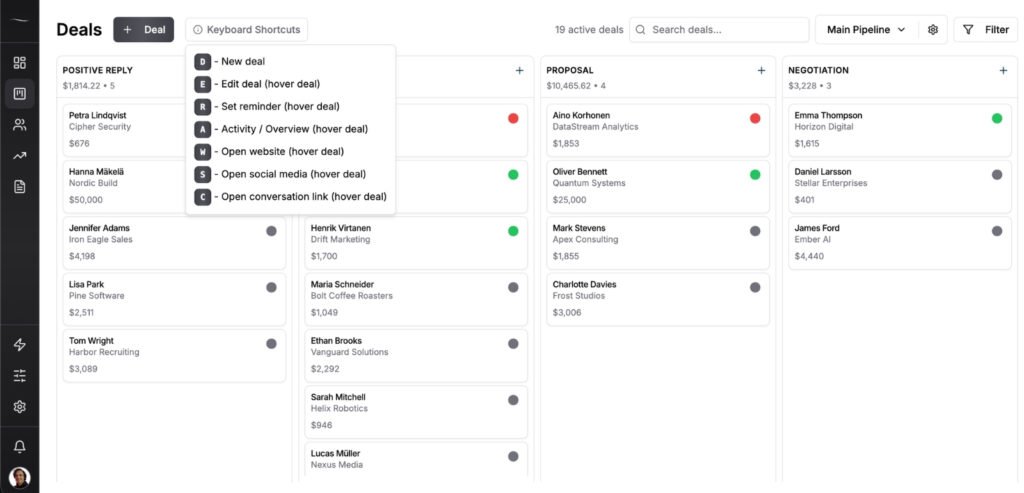
Jaakko Sahimaa, a business psychologist, put it simply. “It’s made it much easier to keep track of customers, opportunities, and follow-ups in one place.” That is the whole trick. Not better memory, fewer things that depend on it.
For the emails themselves, the sales email templates page has 8 more, organised by deal stage.
Frequently Asked Questions
Three business days after a normal email, same day or next morning after a call with a promised next step. Waiting longer than a week for the first follow-up lets the conversation decay past the point where a nudge works, and you end up needing to re-pitch instead.
After a real conversation, three follow-ups plus a breakup email is the practical ceiling. Past that you are trading long-term goodwill for short-term inbox noise. Move the contact to a quarterly rhythm instead of deleting them, because timing changes.
Yes. It replies better than a fourth nudge, it leaves the relationship clean and it forces a decision, which is what a stalled thread needs. Just keep it genuinely warm, a passive-aggressive breakup email is worse than none.
Same thread, same subject line, for the whole sequence. The thread is your context, it saves the prospect from re-reading anything. Start a new thread only for the quarterly long-term touches, when the old context is stale enough to be noise.
The Follow-Up Email To Send Today
Pick the situation above that matches your quietest thread, steal the template and send it before the end of the day. Then set a reminder on every deal now sitting in silence, because the next thread will not die from a bad email. It will die from no email.
Start your 7-day free trial here, no credit card required.