

“An engineer but not an engineer at the same time.” That is how a Reddit thread describes the GTM engineer, and as a GTM engineer myself, I’d say it’s pretty accurate. The job title keeps turning up in sales job ads, and that line is closer to the truth than it sounds.
A GTM engineer is a go-to-market engineer, a person who builds the systems that find, reach and track customers, in place of doing that work by hand. Most lean toward one of three areas: outbound, systems or revenue operations. Pay in the US is far above pay in Europe.
Where The GTM Engineer Job Came From
GTM stands for go-to-market, which is everything a company does to get its product in front of buyers. A GTM engineer builds the machinery for that. Lead lists, data, outreach and the links between sales tools are the raw material.
The word “engineer” throws people. Many GTM engineers never studied software, and came up through sales or marketing. What makes them engineers is that they build a system once and let it do the work a hundred times.
Clay and the GTM engineer title
Clay, a data and automation tool for sales teams, says it coined the term “GTM engineering” in 2023. Clay also says about 100 job listings with the title now go live every month. Both are Clay’s own claims.
I have used Clay for almost three years. I started with it at Fenixtal, my outbound agency, when I was among the first people in Finland to use it. I still use it today in my GTM engineering job, and you can connect with me on LinkedIn.
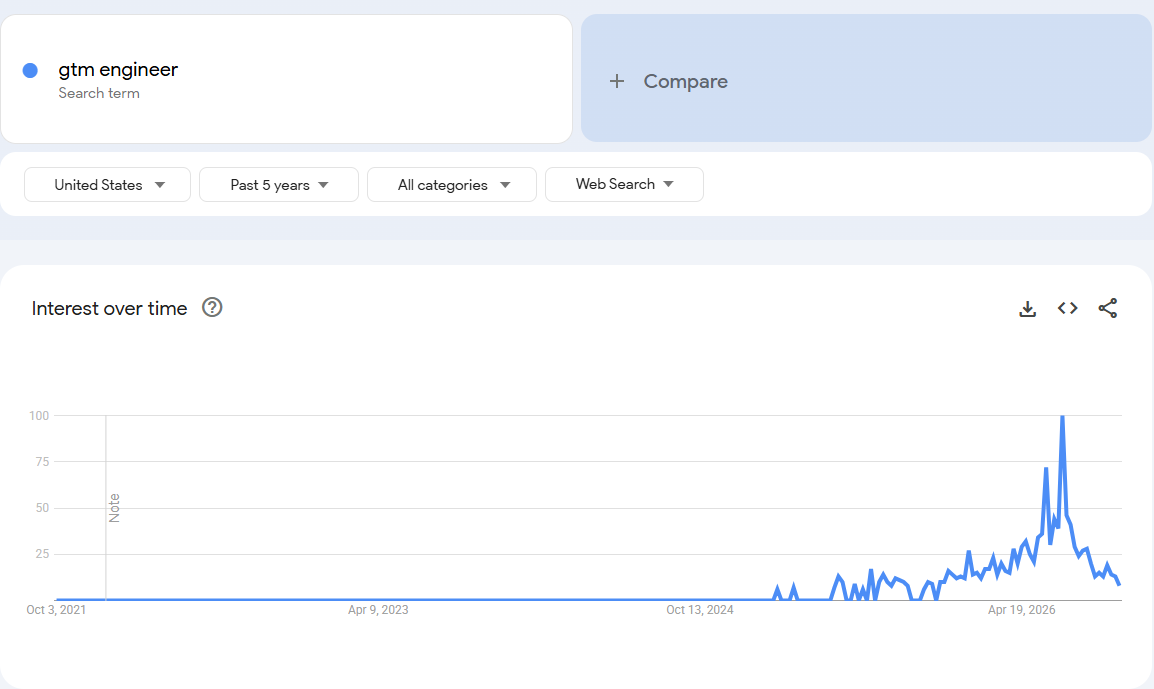
The chart above is Google Trends for “gtm engineer” in the US. It shows interest on a scale of 0 to 100, and those are not search counts. The line sits at zero until late 2024, climbs through 2025, peaks in the middle of 2026 and has come down from that peak since.
The Three Kinds Of GTM Engineer
A job ad for a GTM engineer can describe three quite different people. Knowing which one you are reading about saves a lot of confusion, for the person hiring and for the person applying.
The outbound and marketing kind
This is where I started. This person builds lead lists, writes the outreach and sets up the sending. Their work is judged by replies and booked sales calls.
They know what makes a list good, how to keep emails out of spam and which message fits which buyer. They are close to a marketer who can build things. The two channels they lean on most are covered in my cold email outreach playbook and my guide on how to find clients on LinkedIn.
The systems kind
This one is the nearest to a developer. They work with APIs, which let two apps exchange data, and with webhooks, which are messages one app sends to another the moment something happens. They also set up MCP servers, and I explained those in what an MCP server is. The CRMs that have one are compared in the best MCP CRMs for AI agents.
Their tools look like a programmer’s. They write SQL, the language for asking a database questions, and keep company data in a database such as Supabase.
Many now build internal tools with Lovable and Claude Code, two AI tools that write the code with them, and keep that code in a GitHub repository. They connect everything with n8n, a tool that passes data from one app to the next.
The RevOps kind
RevOps is short for revenue operations, the work of keeping a sales team’s tools and numbers in order. This person knows a CRM, the app where a team tracks its customers and deals, inside out. HubSpot is the common one.
They build the forecast and they are strict about keeping the data clean. A lot of that math is in our free sales calculators.
They are the reason a sales manager can trust the dashboard on Monday morning. Less of their work is outreach and more of it is structure.
The senior GTM engineer does all three
In practice the three overlap, and most working GTM engineers do some of each. My own days are a mix of all three, and the balance shifts with what the business needs that month.
A senior GTM engineer is strong in all three. That is rare, because each area takes years to learn well.
Most companies don’t need all three in one hire. A company with no leads needs the first kind, and a company with five tools that don’t talk to each other needs the second. Which of the three is your team missing?
The GTM Engineer Tool Stack I Use
A GTM engineer’s stack is the set of tools they connect into one system. Here is mine, with what each tool does.
The last tool in my own stack is the one we built, Fluid CRM. Every lead that replies with interest ends up there as a deal.
| Tool | What it does in my stack |
|---|---|
| Apollo | A large database of companies and people, used to build the first list |
| Prospeo | Finds email addresses for the people on the list |
| CSVgo | Verifies every email address before anything is sent, so bad addresses never reach a campaign |
| Clay | Adds data to every row of a list and decides what happens to it next |
| Instantly and Smartlead | Send cold email from many inboxes at once |
| HeyReach | Automates LinkedIn outreach |
| n8n | Connects the tools, so a reply in one creates a record in another |
| Supabase | A hosted database that can act as a data warehouse, one place for all the lead and customer data |
| Lovable and Claude Code | AI tools for building internal tools, scripts and SQL without a developer |
| GitHub | Keeps the code for those tools online in a repository, with every change saved |
| Fluid CRM | Where a positive reply becomes a deal that a person follows up |
Nobody needs all of these on the first day. A list tool, a sending tool and a CRM are enough to start, and the rest earn their place when the volume grows. I compared the options in the best sales tools for startups and the best cold email software, and Fenixtal keeps a directory of 150+ sales and marketing tools.
The CRM is the piece every other tool has to write into, and it is often chosen before the GTM engineer arrives. I compared seven of them on that point in the best CRMs for GTM engineers.
What GTM orchestration means
GTM orchestration means one system decides who gets contacted, through which channel and when. Without it, five tools each do their own thing and the same buyer gets three messages in a day. Clay made the idea popular, and many stacks are now built around it.
GTM Engineer vs Sales Rep vs RevOps: Who Does What
A sales rep and a GTM engineer want the same result, which is revenue. They get there in different ways, and good teams have both.
| Sales rep | GTM engineer | |
|---|---|---|
| Measured on | Deals closed | Sales calls and open deals the system creates |
| A normal day | Calls, emails and meetings with buyers | Building and fixing lists, data and automations |
| Talks to buyers | All day | Rarely |
| What they leave behind | Relationships | A system that keeps working |
| Main tools | The CRM, a phone and an inbox | Data tools, automation tools and the CRM |
The rep does the part that needs a human. They listen and they earn trust. The GTM engineer makes sure the rep spends the day on that, and not on finding email addresses.
One does not replace the other. A system that books 30 sales calls a month is worth nothing if nobody takes the calls well.
GTM engineer vs RevOps
RevOps came first. It is the job of looking after a sales team’s process, its CRM and its forecast. The shortest way to tell them apart is that a GTM engineer builds new systems and RevOps keeps the whole operation steady.
| RevOps | GTM engineer | |
|---|---|---|
| Main job | Keep the sales process, the CRM and the forecast in order | Build new systems that find and reach buyers |
| Typical output | Reports, rules and a clean CRM | Working lists, automations and data flows |
| Measured on | Accurate numbers the team trusts | Sales calls created and hours saved |
| Writes code | Rarely | Sometimes, more on the systems side |
The two overlap, which is why the RevOps kind of GTM engineer exists. In a small company one person does both jobs. In a larger one, RevOps sets the rules and the GTM engineer builds inside them.
How To Become A GTM Engineer
I came in through outbound. At Fenixtal the job was booking sales calls for clients, and every tool I picked up was a way to do that faster. That is still the route I’d suggest.
1. Start with one real campaign
Pick a real business, yours or a friend’s. Build a list, verify the emails and send a small campaign. You learn more from 200 real emails than from any course.
2. Learn one data tool properly
Clay is the usual choice. Take one list and add data to it until you can explain why each company is on it. Depth in one tool beats a little of five.
3. Connect two tools
Make a reply in your sending tool create a deal in your CRM. n8n is a good place to learn this. The first working connection is where the job starts to feel like engineering.
4. Learn the basics of programming
You don’t need a software degree. Knowing the basics of programming is what makes me comfortable in Claude Code, the terminal and Supabase, and with SQL and APIs. Learn those basics first, and the AI tools become far more useful.
5. Keep proof of what you built
Save a short record of each system and the result it produced. A hiring manager trusts a working example over a list of tools.
GTM Engineer Salary In The US And Europe
The GTM engineer title is new, so salary data is thin. Treat every number here as a rough guide.
| Where | Figure | Source |
|---|---|---|
| United States | $140,000 median total pay. A quarter earn under $110,000 and a quarter earn over $285,000 | Levels.fyi, from 26 reported salaries |
| United States | $100,000 to $180,000 base salary | Multiplier’s salary guide, September 2026 |
| United States, junior | $90,000 to $130,000 | ZoomInfo’s GTM engineering guide |
| United States, mid-level | $127,000 to $160,000 | ZoomInfo’s GTM engineering guide |
| United States, senior | $180,000 to $220,000 and up | ZoomInfo’s GTM engineering guide |
| Europe | €60,000 to €110,000 for most roles, highest in London and Amsterdam | Multiplier’s salary guide, September 2026 |
The gap is large, with the low end of the US range sitting close to the top of the European one.
My own read on why is simple, and it is an opinion. The title was born in US software companies, and they budget for it as a technical role. In much of Europe the same work is still done under a sales or marketing title.
Frequently Asked Questions About GTM Engineers
Not in the software sense. A GTM engineer builds systems out of existing tools, and only the systems kind writes much code. The name fits because the work is building, testing and fixing.
A GTM engineer builds the systems that find and reach customers. On a normal day that means building lead lists, adding data to them, setting up outreach and connecting sales tools so data moves between them. The aim is more sales calls with less manual work.
An SDR, or sales development rep, books sales calls by reaching out to buyers one at a time. A GTM engineer builds the system that does the finding and the first outreach for many buyers at once. Many GTM engineers started as SDRs who automated their own work.
Search interest in the title climbed from late 2024 and has come off its mid-2026 peak. The title is young and may change. The skills are useful under any job title, because the work of building sales systems will be needed either way.
Which Kind Of GTM Engineer To Hire First
Hire for the gap you have today. If the team has no leads, hire the outbound kind. If the leads exist and get lost between tools, hire the systems kind.
If the team is past ten salespeople and nobody trusts the numbers, hire the RevOps kind. And if you are a founder doing all of it yourself, you are already the first one.
Whoever you hire will need a CRM that their tools can write to and that the sales team wants to open. We built Fluid CRM for that, with an API, webhooks and an MCP server in one plan. The AI CRM page shows what Claude and ChatGPT can change in it.
Start your 7-day free trial here, no credit card required.