
Put Attio and HubSpot on a feature table and both seem to do everything. The useful question for a team of 1 to 10 is a different one. Who sets the thing up, and who keeps it tidy six months from now?
Attio vs HubSpot comes down to build it or unlock it. Attio is a flexible database you shape yourself, free for 3 seats, then $35 per seat a month. HubSpot is a ready-made suite you pay to unlock, from $20 per seat to $90 plus $1,500 onboarding. Fluid CRM is the simple pipeline for teams of 1 to 10.
Attio vs HubSpot at a Glance
Attio is a workshop with good tools, and HubSpot is a furnished house with some of the rooms locked. In the workshop you arrange things your own way, as long as somebody on the team likes doing that. In the house you can move in today, and you pay as each door opens.
| Attio | HubSpot | |
|---|---|---|
| What it is | A flexible CRM database you shape around your business | A sales, marketing and service suite with a CRM at the centre |
| Who does the setup | You, or an expert you hire | HubSpot, for a required fee on Professional and Enterprise |
| Free plan | Up to 3 seats | Up to 2 users |
| First paid plan | Plus, $35 per seat a month billed annually | Starter, $20 per seat a month |
| Where the bill jumps | At Pro, $79 per seat, or when credits run out | At Professional, $90 per seat plus $1,500 onboarding |
| Custom objects | Pro and Enterprise, from $79 per seat | Enterprise only, from $150 per seat |
| Extra meter | Credits for AI and workflows | HubSpot Credits for AI |
| Best for | A small team with someone who enjoys building the system | A team that wants sales and marketing in one place |
The custom objects row tells you the most about how each company thinks. A custom object is a record type you invent yourself, such as a project, a property or a subscription. Attio includes them on Pro at $79 per seat, and HubSpot keeps them for Enterprise, from $150 per seat plus onboarding.
What Attio and HubSpot Each Charge You For
Both tools sell seats, and that is where the likeness ends. Attio charges for how far you take the build and how much its AI and automations do for you. HubSpot charges for the step up to the plan where the sales features live.
Attio charges for seats, objects and credits
Attio Free covers 3 seats, 3 objects (People, Companies and one more, such as Deals), 200 emails a month and 250 workspace credits. Plus is $35 per seat a month billed annually or $44 billed monthly, and it stops at 10 seats. Pro is $79 billed annually or $99 billed monthly, with no seat limit.
Each step also raises the ceilings. Objects go from 3 to 5 to 12, reports from 3 to 15 to 100 and monthly workspace credits from 250 to 1,500 to 10,000.
Pro is also where Attio’s plan grid first ticks custom objects, email sequences and call recording. So the plan that lets you invent your own record types costs $79 per seat, more than twice the price of Plus.
Credits are the meter that catches people out, because workflows and AI features draw from the same pool. An extra 5,000 credits a month costs $70 on annual billing and $85 on monthly. We go through the caps one by one in our Attio pricing breakdown.
HubSpot charges for the jump to Professional
HubSpot is free for up to 2 users and 1,000 contacts. Starter is $20 per seat billed monthly, and our HubSpot pricing guide walks through every plan for teams of 3 to 10.
Starter is a fine place to track deals. The sales forecast and automated follow-up sequences are both on Sales Hub Professional, which is $90 per seat a month on an annual commitment or $100 paid monthly.
Professional also carries a required, one-time onboarding fee of $1,500. On Enterprise, from $150 per seat, that fee is $3,500. Starter has no onboarding fee at all.
What Attio and HubSpot cost for 5 seats
A 5-person team pays $175 a month on Attio Plus on annual billing and $100 a month on HubSpot Starter paid monthly. The plans with email sequences cost $395 a month on Attio Pro billed annually and $450 a month on HubSpot Sales Hub Professional on an annual commitment. HubSpot also adds its required, one-time $1,500 onboarding fee to that plan.
| Plan | 5 seats, per month | One-time fee | Year one |
|---|---|---|---|
| Attio Plus, billed annually | $175 | None | $2,100 |
| Attio Pro, billed annually | $395 | None | $4,740 |
| HubSpot Starter, billed monthly | $100 | None | $1,200 |
| HubSpot Sales Hub Professional, annual commitment | $450 | $1,500 | $6,900 |
HubSpot is the cheapest of the four and the most expensive of the four, depending on which plan your team needs. If email sequences are the reason you are buying, compare Attio Pro with HubSpot Professional. For the same math on other team sizes, see what 3 and 5 HubSpot seats really cost.
Who Does the Setup Work in Attio and in HubSpot
Seat prices are easy to compare, so most comparisons stop there. The bigger cost for a small team is the work of getting the CRM into shape and keeping it there. Attio and HubSpot split that work in opposite ways.
What you build yourself in Attio
A new Attio workspace always starts with two record types switched on, People and Companies. Deals is a third one, and if your signup answers did not switch it on, an admin activates it in the workspace settings.
After that the design choices are yours. You decide which objects to switch on, add your own fields, build a list for each workflow and set up the table or board view your team will look at. A sales pipeline in Attio is something you assemble from those parts, and record types of your own start on Pro.
For the right person this is the whole appeal. For everyone else it is a project with no end date, because each new idea means another change to the model.
Matthew, a customer who has tried more than ten CRMs in 15 years, was on Attio when he reviewed us. “Attio is great, but 10-second tasks take 5 minutes.”
What you unlock and pay to install in HubSpot
HubSpot starts you with a ready sales pipeline of seven deal stages, from “Appointment scheduled” to “Closed lost”. You can add a deal in the first minute without designing anything. A second pipeline needs a paid plan.
The work in HubSpot is of a different kind. You learn which feature lives on which plan, you switch on the parts you need and you tidy away the parts you don’t. We cover that side in is HubSpot too complicated.
Here is a question to answer honestly. Who on your team will still be looking after this system in month six?
Paid setup help is required on HubSpot and optional on Attio
Both companies sell help, and the terms are not the same. HubSpot makes onboarding a condition of Professional and Enterprise, so the fee is on the bill whether you want the help or not.
Attio makes it a choice. Its site has a directory of Attio experts who design data models, set up workspaces and move data across, and Attio has a free migration service on its paid plans.
HubSpot’s fee is heaviest for the smallest teams. A single Professional seat costs $1,080 for the year, and the onboarding to switch it on costs $1,500.
Where Attio Wins and Where HubSpot Wins
Attio and HubSpot are each better at something real.
Where Attio wins
- Custom objects one plan earlier. Attio includes them on Pro, and HubSpot on Enterprise.
- Workflows from the free plan. Attio’s plan grid lists workflows on every plan, inside each plan’s credit limit.
- A free plan with a third seat. Attio Free takes 3 people, where HubSpot’s free tools take 2.
- A smaller step between plans. Going from Plus to Pro adds $44 per seat a month on annual billing. Going from HubSpot Starter to Professional adds $70 per seat and the onboarding fee.
Where HubSpot wins
- A working pipeline before you design anything. The default stages are there when you log in.
- Marketing in the same system. Marketing Hub sits on the same contact records as your deals. Its Professional plan starts at $800 a month, so it is a real budget line.
- Phone support. Sales Hub Professional and Enterprise include email and phone support, and Starter includes email.
- More connections. HubSpot lists over 2,000 apps and web services that plug into it.
Attio or HubSpot for a Team of 1 to 10
Attio is the better pick for a small team with one person who enjoys building the system. HubSpot is the better pick when sales and marketing have to share one system, or when you want a pipeline that works before you design anything.
Solo or 2 people
Start on a free plan and pay nothing until you hit a wall. HubSpot’s free tools give you a pipeline that is ready now. Attio Free gives you a third seat for later and one object beyond People and Companies.
3 to 10 people with someone who likes building
Pick Attio. Plus covers up to 10 seats at $35 each on annual billing, and the person who enjoys the data model will make it fit your process. Custom objects need Pro at $79 per seat, so price that if you plan to invent your own record types.
3 to 10 people who only need to track deals
HubSpot Starter at $20 per seat does this without a design phase. Go in knowing that the forecast and sequences are one plan up, at $90 per seat plus onboarding. If you expect to need them within a year, price Professional now.
Sales and marketing in one system
Pick HubSpot and budget for Professional on both sides. This is the job the suite was built for, and Attio is a sales and relationship tool.
When to stay on Attio
Stay if one person owns the workspace and enjoys it, if the lists and views you built match how you sell and if your credits last the month. Switching would cost you a system that already fits.
When to stay on HubSpot
Stay if marketing and sales share the same records, if you have already paid for onboarding and if your team uses the forecast and sequences. You bought the suite and it is doing its job.
Attio rewards a builder and HubSpot rewards a budget. If your team has neither, both tools will cost you more attention than they give back. If that sounds like you, the best Attio alternatives are grouped by why people leave.
Attio vs HubSpot FAQ
It depends on the HubSpot plan. Attio Plus is $35 per seat a month billed annually, which is more than HubSpot Starter at $20 per seat. Attio Pro at $79 per seat is less than Sales Hub Professional at $90 per seat plus a required $1,500 onboarding fee.
HubSpot is quicker on day one because it starts with a ready pipeline of seven deal stages. Attio starts with People and Companies and asks you to choose which objects to switch on and to build your own fields, lists and views. Attio gets easier once that structure is in place, and HubSpot gets harder as you add plans and features.
Yes, on the higher plans. Sales Hub Professional has a required, one-time onboarding fee of $1,500 and Sales Hub Enterprise has one of $3,500. The free tools and Starter have no onboarding fee.
Yes, Attio offers a free migration service on its Plus, Pro and Enterprise plans that moves companies, people, deals, custom objects, notes, tasks and files from HubSpot. A workspace admin has to start it. You can also import your data as a CSV file.
For tracking the agency’s own new business, Attio Plus at $175 a month for 5 seats on annual billing suits a team with someone who likes building. HubSpot Starter at $100 a month suits a team that wants a ready pipeline. An agency that also wants marketing tools in the same system should pick HubSpot and budget for Professional. Custom record types for clients, projects or retainers start on Attio Pro, at $395 a month for 5 seats billed annually.
When Neither Attio nor HubSpot Fits
Some teams read all of this and want neither a build project nor a suite. That is the team we built Fluid CRM for. It is a sales pipeline with deals, contacts, reminders and custom fields that works the day you open it. If you’re an early team, here’s what it looks like as a CRM for startups.
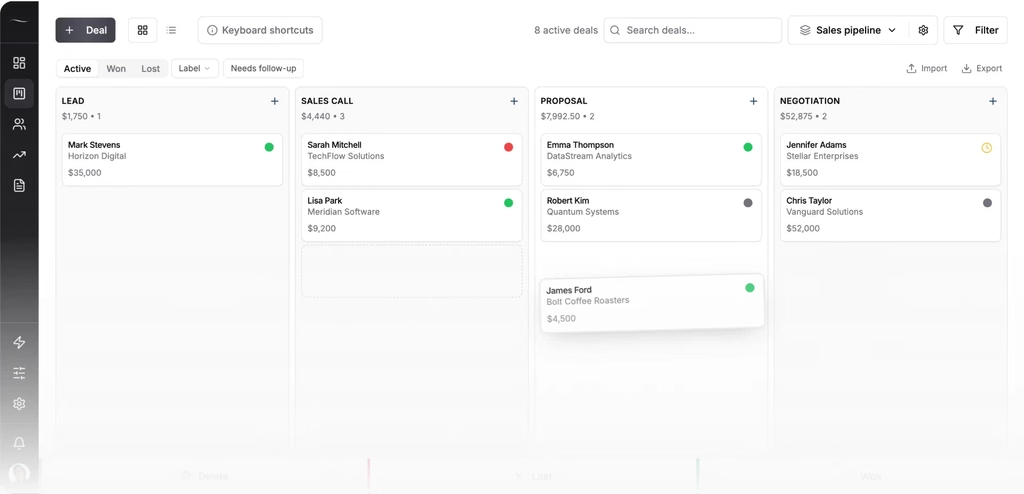
Viktor Otterskog does cold outreach and looked at HubSpot and Airtable first. He wrote this a few days into using it.
“I looked at HubSpot, Airtable and stuff like that. Glad I came across this one… It really has that speed, no bells and whistles, just does what it’s supposed to do.”
I saw the same thing from the other side when Fenixtal, my outbound agency, was booking sales calls for its clients. Almost none of those clients had a CRM they liked. Some had a big tool nobody used, and the rest had a spreadsheet that got messy fast.
Fluid CRM has clear limits. There are no custom objects, no marketing automation, no free plan and no two-way email sync, only email logging by BCC. We built it for teams of 1 to 10, and it works best under 20 people.
There is one plan with every feature in it, at $16 per seat a month or $144 per seat a year. Pick Attio if you have a builder, pick HubSpot if you need the suite and try Fluid CRM if you want your deals in one place with nothing to design.
Start your 7-day free trial here, no credit card required.