

Most agency pipelines have too many stages and no rule for moving between them, so every deal sits wherever someone last dragged it. A working agency sales pipeline is four stages with one rule each. If you also generate leads for clients, you need a second pipeline, and that is the one agencies tend to skip.
An agency sales pipeline is the set of stages a deal moves through from first enquiry to signed client, for a small agency usually Lead, Discovery call, Proposal sent and Won. Agencies that generate leads for clients also need a second pipeline per client. Fluid CRM keeps both as separate pipelines in one workspace.
What An Agency Sales Pipeline Is And When An Agency Needs Two
An agency sales pipeline is a short list of stages, in order, that every new client passes through before they sign. Each deal sits in exactly one stage, so you can see what is early, what is waiting on a proposal and what is about to close.
This post is only about agencies. For the general theory, the seven standard sales pipeline stages are explained in their own post.
Agencies differ from other small businesses in one way. Many of them sell leads or booked calls as the service itself, so they have their own deals to track and their clients’ leads too. We built Fluid CRM with that in mind, and it is why we describe an agency CRM as a tool with two jobs.
The first job is winning your own clients. The second is tracking the leads you generate for them, and it only applies if leads are what you deliver. A cold email agency, a paid ads agency and an appointment setting agency need both pipelines, while a web studio or a branding agency needs only the first.
The Four Stages Of An Agency Sales Pipeline And The Rule For Each
One rule keeps a pipeline accurate. A stage is something the buyer did, never something you hope or something you did on your own. “Sent a proposal” only counts because the buyer asked for it on a call.
1. Lead
A lead is a real person at a real company who has shown interest in hiring you. They filled in your form, replied to an email or got referred by a client. A name on a list you plan to contact is a prospect, and it does not belong in the pipeline yet. How to get more leads is covered in our guide to agency lead generation.
2. Discovery call
The deal moves here when a call is on the calendar with a date and a time, so “they said they would love to chat” is still a lead.
3. Proposal sent
The deal moves here when you have sent an offer with the scope and a price, and the buyer asked for it. Before you end the discovery call, agree the date you will talk it through together. A proposal with no agreed next step is where most agency deals stop moving.
4. Won
The deal is won when the contract is signed. A verbal yes stays in Proposal sent until the signature arrives. A deal that ends without a signature goes to Lost, with one line in the notes saying why. Once a deal is won, the work moves to your client onboarding checklist.
| Stage | What has to be true | Your next step |
|---|---|---|
| Lead | They showed interest and fit the clients you take | Reply and offer a call |
| Discovery call | A call is booked with a date | Hold the call, agree a date to go through the proposal |
| Proposal sent | They have an offer with the scope and a price | Follow up on the agreed date |
| Won | The contract is signed | Hand over to delivery |
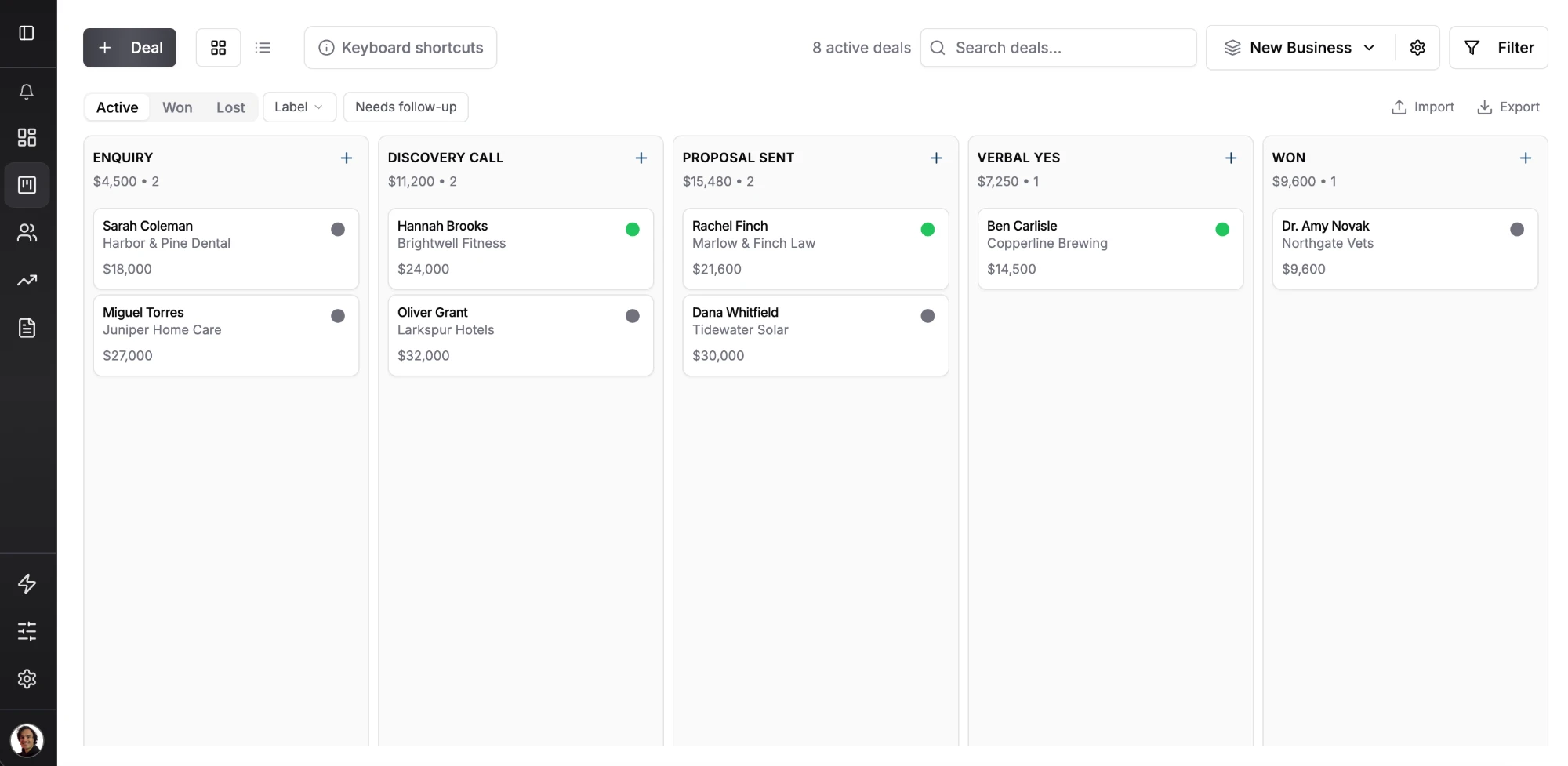
Austin Verner, founder of the cold email agency Cold Emailers, kept his agency’s pipeline in Google Sheets before moving it to Fluid CRM. “Before Fluid we were managing our pipeline in Google Sheets and it was getting cumbersome. The simplicity is what sold us.”
What to record on every deal
Six fields are enough for an agency deal, because anything more gets skipped on a busy day.
| Field | Example |
|---|---|
| Company | Northwind Dental |
| Contact | The practice manager (one person per deal) |
| Service | SEO retainer |
| Value | $2,500 a month |
| Source | Referral from an existing client |
| Next step and date | Proposal call, Thursday |
When to add or cut a stage
Four stages suit most agencies of one to ten people, and six is the ceiling. Add a stage only when it changes what you do next. A web studio that takes a deposit before starting has a real extra step, so Deposit paid is worth adding.
For a small agency, negotiation is a week of emails inside Proposal sent, and giving it its own column mostly gives stalled deals somewhere to sit unnoticed. If a stage has held the same deals for a month, cut it or merge it.
Agency Sales Pipeline Templates By Agency Type
Copy the list closest to your agency and rename anything that sounds wrong for your clients.
Marketing or SEO retainer agency
- Enquiry
- Discovery call
- Audit presented
- Proposal sent
- Won
Many retainer agencies do a short audit before they price the work. The deal moves to Audit presented only once you have walked the buyer through the findings on a call.
Outbound or cold email agency
- Replied
- Discovery call
- Proposal sent
- Pilot agreed
- Won
Outbound clients often start with a short paid pilot before a longer contract. Pilot agreed means the pilot is signed and paid, and Won means they stayed on after it. If you do not sell pilots, delete that stage and you are back to four.
Web design or creative studio
- Enquiry
- Brief received
- Discovery call
- Quote sent
- Deposit paid
Brief received means the buyer has written down what they want, even if it is five lines. Deposit paid is the Won stage here, because a signed quote without a deposit can still disappear.
How To Track The Leads Your Agency Generates For Clients
The second pipeline follows the leads you produce for a client, from the first sign of interest to the client closing the deal. It is how you prove the work paid off.
At my old outbound agency we booked 1,250+ sales calls for clients. I handed over the leads and too many of those clients did not track what happened next, because they had a messy spreadsheet or a CRM people hated using. Without that record, nobody can say how many booked calls turned into revenue.
Four stages cover it, and you agree them with the client before the first campaign goes out.
- Interested. The lead replied or enquired and wants to hear more.
- Meeting booked. A call with the client is on the calendar.
- Showed up. The lead attended the call.
- Closed. The client signed them.
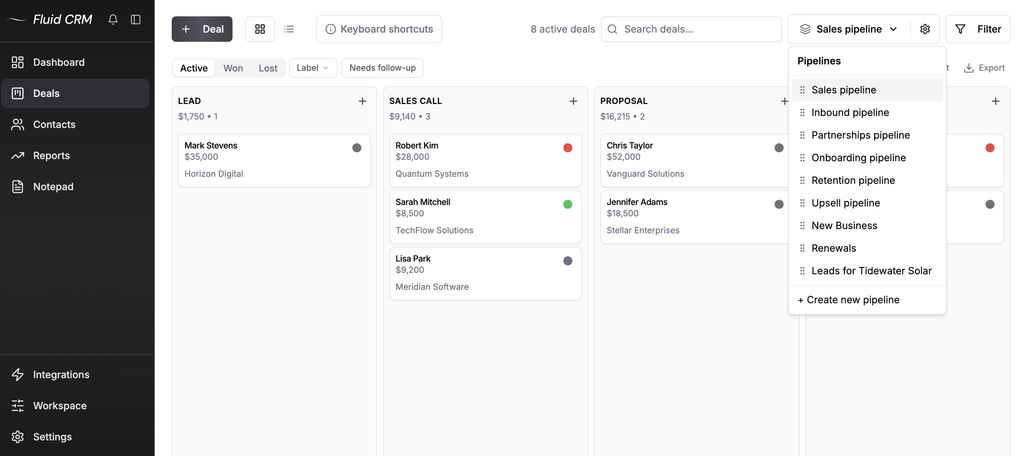
Create one pipeline per client so their leads never mix with yours or with another client’s. A lead that misses the call gets a note saying no-show and a new date, and a lead the client rejects is marked lost with a note saying why.
Interested replies do not have to be typed in by hand. There are four ways to connect Instantly or Smartlead to a CRM, and the wider tool question is covered in the guide to the best CRM for cold email agencies.
In Fluid CRM each client gets a separate pipeline inside one workspace, because separate workspaces per client are not available yet. Everyone you invite sees the same contacts and there is no client login, so your own team does the tracking. A deal holds one contact.
Where Agency Deals Stall After The Proposal
Most agency deals die in Proposal sent, in the weeks after a document went out with no date attached to it, and far fewer die on the discovery call.
How many deals are sitting in Proposal sent right now, and how many of them have a date on the next step? If most of them have no date, the stage list is fine and the follow-up is the problem.
The rhythm I use after a proposal goes quiet is day 3, day 9 and day 20. Each message adds something new, such as a result for a similar client or an offer to walk a colleague through the scope. The wording is in my post on the follow-up email after no response.
Following up works far more often than it feels like it will. In a study of 12 million outreach emails by Backlinko and Pitchbox, a single follow-up message lifted replies by 65.8%. That study measured outreach and not proposals, but the lesson carries over to any thread where the other person went silent.
After the day 20 message, move the deal to Lost with “no reply” in the notes. A pipeline full of proposals from last quarter makes your forecast look better than it is.
The 15-Minute Weekly Agency Pipeline Review
A pipeline only stays accurate if someone reads it on a fixed day. Fifteen minutes every Monday is enough for a small agency. Go through these five questions in order.
- Does every open deal have a next step with a date?
- Which deals have not moved stage in two weeks, and why?
- Which proposals are past day 20 and should be marked lost?
- Which new leads from last week have not had a reply yet?
- For each client pipeline, how many leads were booked, showed up and closed?
Then write down three numbers for your own sales, which are new leads, proposals sent and deals won. After two months you will see which number stops moving first.
In Fluid CRM the next step is a reminder on the deal, one at a time, with a date. Reports and forecasting are included on the one plan.
FAQ
Most small agencies need four: Lead, Discovery call, Proposal sent and Won. A deal that does not close goes to Lost with a short reason. Some agency types add one stage, such as Audit presented for retainer agencies or Deposit paid for web studios.
Four to six. Each stage should stand for something the buyer did and should change what you do next. If two stages lead to the same next step, merge them.
No. Your own sales and each client’s leads have different stages and different people who care about them. Keep one pipeline for your own deals and one pipeline per client, so the two never mix.
Not yet. Today each client gets a separate pipeline inside one workspace, and everyone on your team sees the same contacts. It works when your own team does the tracking, and it does not give clients a login of their own.
Where To Keep Both Agency Pipelines
Google Sheets or Excel can hold four stages for a while. The sheet stops working once you add the second pipeline and the follow-up dates, because a spreadsheet never reminds you that a proposal is on day 9.
Fluid CRM gives you unlimited pipelines, each with its own stages and fields, on one plan at $16/seat/month or $144/seat/year. It does not write proposals, send invoices or sync your inbox, and email is logged by BCC. If you are still comparing tools, start with the best CRM for small agencies.
The stage lists above work in any tool. If you want both pipelines in one place that takes seconds to update, that is what our agency CRM is for.
Start your 7-day free trial here, no credit card required.