
The price on monday’s pricing card is per seat, but monday doesn’t sell you one seat at a time. You buy a bundle of seats, then pick the plan that holds the feature you came for. Those two choices decide the bill far more than the sticker does.
monday CRM costs $12, $17 or $28 per seat a month billed annually for Basic, Standard and Pro, or $18, $25 and $41 billed monthly. Ultimate is priced on quote. Seats come in buckets that start at 3, so a team of 4 pays for 5. There is no free plan, only a 14-day trial.
monday CRM Plans and Prices Per Seat
monday CRM has four plans. Three have a public price and the fourth, Ultimate, is the old Enterprise tier under a new name and is priced by the sales team.
| Plan | Billed annually | Billed monthly | Contacts and deals | Automations a month |
|---|---|---|---|---|
| Basic | $12/seat/month | $18/seat/month | 1,000 | None listed |
| Standard | $17/seat/month | $25/seat/month | 10,000 | 250 |
| Pro | $28/seat/month | $41/seat/month | 100,000 | 25,000 |
| Ultimate | Custom | Custom | Unlimited | Enterprise scale |
Annual billing is paid up front for the whole year. On Standard that works out to $204 per seat for the year, against $300 per seat if you pay month to month.
Basic also caps each board at 5 columns and gives you one dashboard. A deal board with name, company, value, stage, owner and next step already needs six columns, so Basic is tight from the first afternoon.
Is there a free monday CRM plan?
No. monday CRM starts with a 14-day trial, and monday’s help center says the trial runs on the Pro plan. The free plan you may have seen belongs to a different product, monday work management (now sold as the monday AI work platform), which is free for up to 2 seats.
That product is a general board tool for tasks and projects, and its paid plans start at $9 per seat a month billed annually. You can build a deal board there, but the CRM features covered below, such as Gmail and Outlook integration, quotes and sales forecasting, are sold with monday CRM.
If your team uses both, each product is billed on its own plan and its own seat count. The only thing they share is the billing cycle, so both are monthly or both are yearly.
How monday Seat Buckets Work
monday sells seats in fixed groups. The seat picker on the CRM pricing page offers 3, 5, 10, 15, 20, 25, 30, 40, 50, 100 and 200+ seats, and nothing in between.
monday’s own plans and pricing help article calls this bucket pricing. Its example is a team of 4 picking the 5-seat option and a team of 6 picking the 10-seat plan.
The price per seat stays the same in every bucket. What changes is how many seats you pay for compared to how many people log in.
Two more rules matter once you are paying. You can’t choose a bucket smaller than the number of active users in the account, so shrinking means deactivating people first. Guests are counted separately from member seats, which helps if clients only need to view a board.
What monday CRM Costs For 3, 5 and 10 Sellers
Three, five and ten are bucket sizes, so a team of exactly that size pays for no empty seats. This table is the full yearly bill on each plan.
| Team size | Basic, annual | Basic, monthly | Standard, annual | Standard, monthly | Pro, annual | Pro, monthly |
|---|---|---|---|---|---|---|
| 3 sellers | $432 | $648 | $612 | $900 | $1,008 | $1,476 |
| 5 sellers | $720 | $1,080 | $1,020 | $1,500 | $1,680 | $2,460 |
| 10 sellers | $1,440 | $2,160 | $2,040 | $3,000 | $3,360 | $4,920 |
The smallest possible monday CRM bill is $432 a year, which is 3 seats of Basic paid annually. Month to month, the same 3 seats cost $54 a month.
For a team of 5 on Standard, paying yearly saves $480 against paying monthly. Monthly makes sense only while you are still unsure who stays on the team.
If you are still deciding what a small team needs from a sales team CRM at all, settle that before you pick a bucket. The plan choice below changes these numbers more than the billing cycle does.
Team sizes that land between buckets
Most teams are not exactly 3, 5 or 10 people. Here is what happens to a team that falls between buckets, using Standard on annual billing at $204 per seat a year.
| Sellers | Seats billed | Empty seats | Standard bill a year | Paid for empty seats |
|---|---|---|---|---|
| 1 | 3 | 2 | $612 | $408 |
| 2 | 3 | 1 | $612 | $204 |
| 4 | 5 | 1 | $1,020 | $204 |
| 6 | 10 | 4 | $2,040 | $816 |
| 7 | 10 | 3 | $2,040 | $612 |
| 8 | 10 | 2 | $2,040 | $408 |
| 11 | 15 | 4 | $3,060 | $816 |
Six sellers is the size that feels it most. Spread over the six people who use it, Standard works out to about $28 per person a month, which is the sticker price of Pro.
The empty seats are not wasted if you are about to hire. A team of 6 that will be 9 by spring has already paid for those seats.
So count before you buy. How many people on your team would open the CRM every week, not just once at launch?
Which monday CRM Plan a Sales Team Ends Up On
The per-seat price is only half the decision. The other half is which plan holds the feature your team needs, and monday spreads sales features across its plans.
Here is what each plan adds, from monday’s own feature table.
- Basic: boards, unlimited pipelines, 1,000 contacts and deals and 20 quotes and invoices a month. The feature table ticks lead management and deal management only from Standard up.
- Standard: two-way Gmail and Outlook integration, lead and deal management, 250 automations a month, 1,000 API calls a day and calendar, timeline and map views.
- Pro: email templates, email tracking, mass emails, sequences, Google Calendar sync, sales forecasting, sales analytics, private boards and integrations such as Docusign, Aircall, PandaDoc and Mailchimp. Automations rise to 25,000 a month.
- Ultimate: lead scoring, mandatory fields, duplicate warnings, team goals, advanced analytics, the Salesforce integration and single sign-on.
A team that wants to send and receive email from the CRM starts on Standard. A team that wants a sales forecast, tracked emails or sequences lands on Pro, and that moves a 5-seller team from $1,020 to $1,680 a year.
The trial makes this easy to miss. It runs on Pro, so for 14 days your team works with forecasting, sequences and email tracking. Buy Standard on day 15 and those features disappear the first day you pay, often after someone has already built a habit around them.
Before buying, write down the three features your sellers actually used during the trial. Then find the cheapest plan that has all three.
When monday CRM Is Worth the Price
monday CRM earns its price when your company already runs delivery, projects or operations on monday boards. Sales then lives next to the work it creates, and a deal can hand over to a project without a second tool.
It also fits a team that fills its bucket and likes building its own setup. monday is built to be shaped, and a team with someone who enjoys making boards and automations gets a lot from Pro.
It fits less well at the small end. Two people paying for three seats, or a team that only needs a pipeline, a next step and a reminder on each deal, are buying room they won’t use. Our list of monday CRM alternatives covers what else small teams pick.
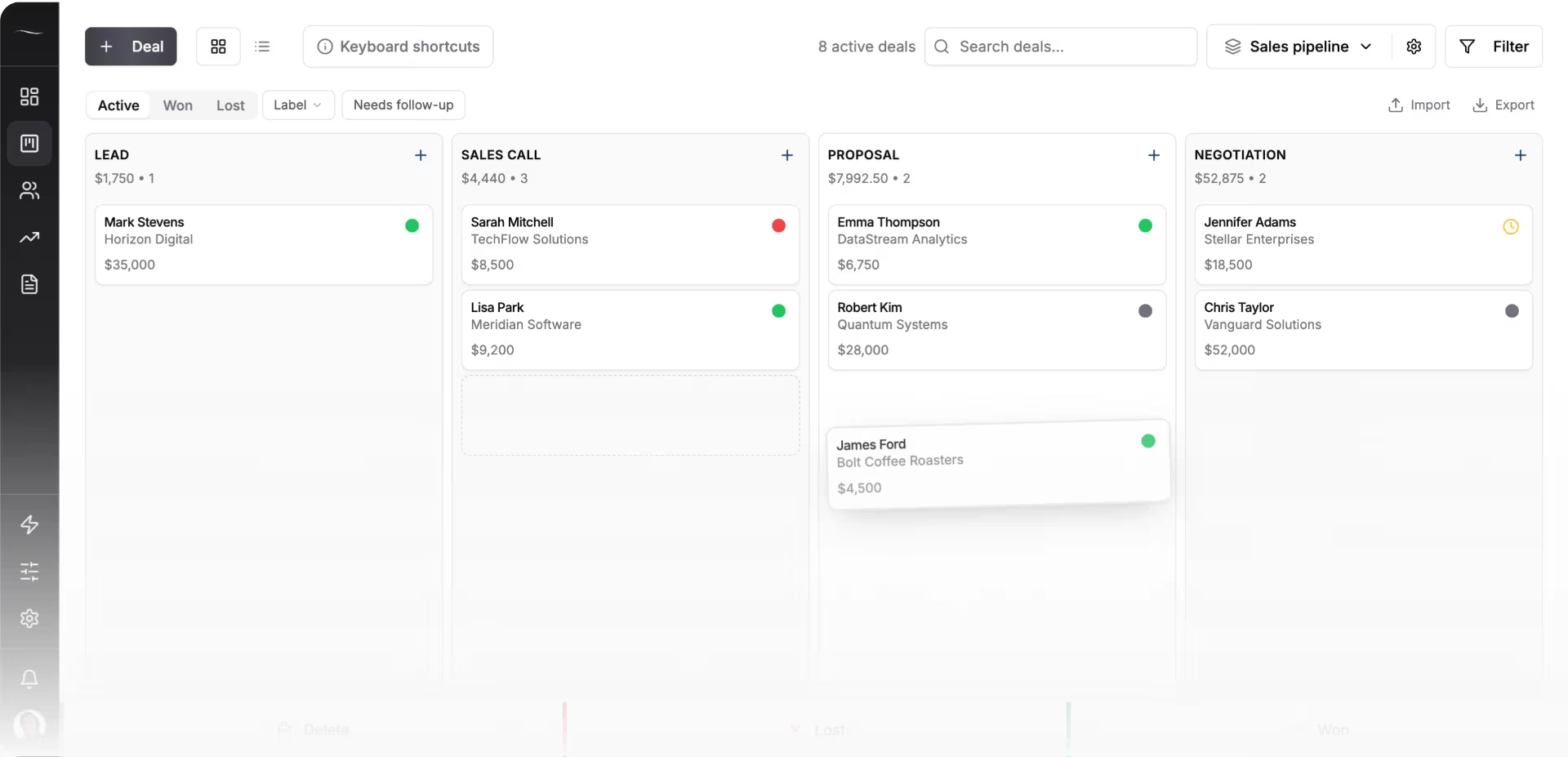
We built Fluid CRM the other way, with one plan. It costs $16 per seat a month or $144 per seat a year, and you pay for the exact number of people on the team.
Every feature is in that plan, including these:
- A visual pipeline with a reminder on every deal
- Lead capture forms that create the deal for you
- 8 in-app automations
- The REST API and webhooks
- The MCP connector for Claude and ChatGPT
A G2 reviewer in information technology and services titled their review of Fluid CRM “Everything I want in a CRM and nothing I don’t”. They added, “I’d much rather use something that goes deep on what it does well than something that checks a long list of feature boxes without much depth behind them.”
Fluid CRM won’t match monday on two points that matter in this choice. Email is logged by BCC rather than synced both ways with Gmail or Outlook, and there is no native mobile app, only the phone browser. Our Fluid CRM vs monday CRM comparison puts the two side by side.
If you are pricing other per-seat CRMs at the same time, our Pipedrive pricing breakdown, Close CRM pricing guide and folk CRM pricing guide work through their plans the same way.
Frequently Asked Questions
monday CRM costs $12 per seat a month on Basic, $17 on Standard and $28 on Pro when billed annually. Billed monthly, the same plans cost $18, $25 and $41 per seat. Ultimate is priced on quote.
No. monday CRM offers a 14-day trial that runs on the Pro plan. The free plan for up to 2 seats belongs to monday work management, which is a separate product. Email integration and sales forecasting are sold with monday CRM.
The minimum is 3 seats, so the smallest bill is $432 a year on Basic billed annually. After 3, seats come in buckets of 5, 10, 15 and up, so a team of 4 pays for 5 and a team of 6 pays for 10.
Two-way Gmail and Outlook integration starts on Standard. Email templates, email tracking, mass emails, sequences and Google Calendar sync start on Pro.
Yes. Standard costs $17 per seat a month on annual billing against $25 monthly, so a team of 5 saves $480 a year. The annual plan is paid in one payment up front.
How Many monday CRM Seats To Buy
Count the people who will open the CRM every week, round up to the next bucket and price that number on the plan holding your three must-have features. For most small sales teams that is Standard for email or Pro for forecasting. If you would rather pay for the exact team you have, see how Fluid CRM works as a sales team CRM.
Start your 7-day free trial here, no credit card required.