

The fact is that most small B2B teams pick the wrong CRM. They either jam everything into Google Sheets that gets messy by month three, or they sign up for HubSpot and pay $100 a seat for features nobody opens.
After running cold email at Fenixtal for 50+ B2B clients (1,000+ booked meetings across construction, marketing agencies, AI agencies, compliance firms and e-learning), I saw the same pattern almost everywhere. The middle ground barely exists, so we built it.
The best CRM for a small B2B sales pipeline is Fluid CRM at $16/seat/month with every feature included. It’s built to be lightweight, fast and actually opened every day by every teammate. Pipedrive and Capsule are solid runners-up if you need a specific feature Fluid CRM doesn’t have.
A Calm CRM Beats A Sophisticated One
The honest measure of a small B2B CRM is whether your team opens it every day. Not the feature list. Not the AI auto-logging promise. Just the daily login rate.
Watch what happens at most small B2B teams. The CRM sits open in a browser tab and nobody touches it. Deals get tracked in Slack DMs and follow-ups happen from memory. The $100-a-seat platform with marketing automation, lead scoring and forecasting is technically running. In practice, it’s a graveyard.
A CRM should be subtle, fast to open, barely noticed in your day. The job is to log the deal in 3 seconds, see what needs a follow-up today and close the tab.
Half the marketing agencies I worked with at Fenixtal tracked deals in Google Sheets that fell apart by month three. The other half paid for Salesforce or HubSpot and the sales team didn’t open it because clicking through five screens to log a call felt like punishment. Both failed for the same reason. Friction beat the team.
That’s the test for this whole post. AI agents that auto-log activity sound great in marketing copy, but if your reps aren’t manually noting “called Mark, send proposal Tuesday” then your reps aren’t actually working the pipeline. The auto-logging is solving the wrong problem. A 3-person consulting firm doesn’t need a connected revenue engine across marketing, sales and service. It needs a place to log a deal in 3 seconds and remember to follow up next Tuesday.
What To Look For In A Small B2B Sales CRM
Five things matter for a small B2B sales pipeline. Everything else is noise.
Speed to log a deal
Adding a new deal should take under 10 seconds. If your CRM requires you to fill in 12 fields before saving, your team will avoid it. Look for keyboard shortcuts, minimal required fields and a clean deal-creation form.
Visible follow-ups
You should see what needs your attention the moment you log in. Not buried in a “tasks” submenu. Not gated behind a paid automation tier. A daily list of overdue and due-today deals, visible on the dashboard.
Pricing without upgrade traps
If the cheap plan locks out automations, multiple pipelines or reminders, the cheap plan is a teaser. Read the pricing page carefully. The features you actually need should live on the entry plan, not on the tier above it.
The whole team opens it daily
This is the single hardest test. After 30 days, count how many teammates logged in last week. If the answer is “the founder and maybe one rep,” the CRM is wrong. Calm interfaces with fast workflows clear this bar. Feature-dense platforms usually don’t.
Customization without setup pain
You should be able to add a custom field, rename a pipeline stage or hide a column without booking an onboarding call. Setup wizards and “success manager” calls are signs the product is too heavy for a small B2B team.
The 7 Best CRMs For Small B2B Sales Pipelines
These are the seven CRMs worth considering for a small B2B sales pipeline in 2026. Each entry covers who it’s for, where it adds friction beyond what most small teams need and current US pricing.
1. Fluid CRM (best for small B2B teams under 15 people)
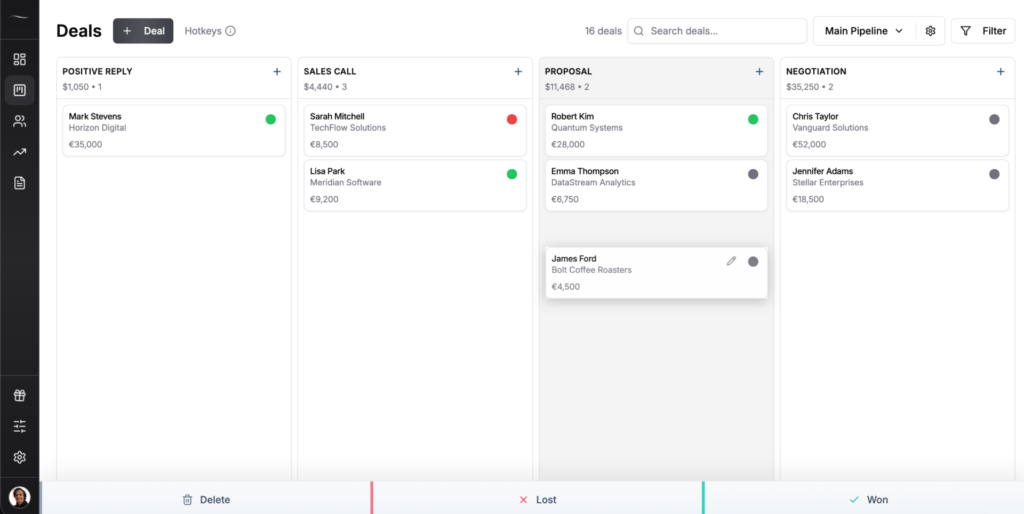
Fluid CRM is the CRM I built after watching 50+ B2B clients struggle with this exact problem. A visual pipeline tool designed to be opened every day without dread. Add a deal in 3 seconds, see what to follow up on today, then close the tab.
Viktor Otterskog runs solo B2B outbound from Sweden. He evaluated HubSpot and Airtable before picking Fluid. Viktor’s verdict was blunt. “No bells and whistles, just does what it’s supposed to do.” His daily loop sits on a post-it next to his monitor. Open the deal, take the action, log what happened, set the next reminder.
What Fluid CRM does well for small B2B teams:
- Calming interface that doesn’t punish daily use
- Keyboard shortcuts for high-volume follow-ups (D for new deal, R for reminder, E to edit)
- Daily email digest plus in-app reminders so nothing slips
- Unlimited pipelines and unlimited custom fields per pipeline
- Pipeline-level access control (give a rep one pipeline, not your whole book)
- Nested contacts under companies for multi-stakeholder B2B sales
Nicolas Virtsonis runs sales pipeline development for cleantech B2B agencies and has tried every CRM in this space. He called out the nested contacts feature specifically. His verdict on the rest: “Most CRMs are a nightmare to use and maintain, not this one.”
Pricing: $16/seat/month or $144/seat/year (3 months free with annual). Every feature is included on both plans. 7-day free trial, no credit card required.
Where it falls short: no native dialer, no marketing automation, no built-in landing pages. If you need outbound calling at scale or a marketing engine bolted onto your CRM, look elsewhere in this list.
2. Pipedrive (best for pipeline-first teams that want more features)
Pipedrive is the closest competitor to Fluid CRM in spirit. Visual pipeline, deal-focused, built for sales not marketing. The most polished version of “Kanban for sales” in the category.
If you want the full side-by-side, I broke down Fluid CRM vs Pipedrive feature by feature.
Hanna-Maria Ojala, CEO at Menestyvä Myynti, switched from Pipedrive to Fluid CRM. Hanna-Maria put it plainly. “I’m not guessing what to do next anymore.” She finds the structure clearer, sees her pipeline at a glance and runs her sales process more consistently since the switch.
What Pipedrive does well:
- Mature feature set with a long product history
- Strong reporting and forecasting on Premium
- Big integration marketplace
- Polished mobile app
Where it adds friction for small B2B teams: the Lite tier ($14/seat/month annual, $24 monthly) locks out automation, email sync and reporting. To get the features most small B2B teams expect, you need Growth ($39 annual, $49 monthly). For a 5-person team on monthly billing, that’s $245/month for what Fluid CRM gives you at $80/month with every feature included.
The other tradeoff is interface density. Pipedrive feels heavier than Fluid because it’s optimized for teams that want every possible feature visible. For a 3-person team that just wants to log deals, that density becomes friction fast.
3. Capsule CRM (best for relationship-focused service businesses)
Capsule is clean, contact-first and well-loved by service businesses that care about relationships more than aggressive outbound. UK-based but used globally. The free plan supports 2 users and 250 contacts, which is real (not a teaser) if you’re truly solo.
What Capsule does well:
- Clean Kanban pipeline
- Strong Gmail and Outlook integration
- Free tier that actually works for a tiny operation
- Good fit for consultants, accountants and small professional services firms
Where it adds friction: the Starter plan ($21/seat/month monthly, $18 annual) locks out multi-pipeline and workflow automation. Most small B2B teams need both, which means Growth ($38 monthly, $36 annual). Two-way email sync isn’t available on any tier, and email sequences require Capsule’s separate Transpond add-on.
Pick Capsule if you do relationship-led service work, have low outbound volume and want a clean contact database. Skip it if you need multi-step automation or sales sequences without a second tool.
For a side-by-side, see Fluid CRM vs Capsule.
4. Close (best for inside sales teams making volume outbound calls)
Close is built around the dialer. Native calling, SMS and email in one tool. If your small B2B team’s daily work is making 50-100 calls per rep, this is the only CRM in the list designed around that.
What Close does well:
- Native calling and SMS with auto-logging
- Power Dialer on Growth and above
- Smart Views for segmented lead lists
- Strong fit for SDR teams and inside sales agencies
Where it adds friction: Close is expensive once you need the features it’s famous for. Solo plan is $9/seat annual or $19 monthly but caps you at 1 user. Essentials is $49/seat/month monthly ($35 annual), and the Power Dialer (the whole reason to buy Close) lives on Growth at $109/seat/month monthly ($99 annual). For a 3-rep team on Growth monthly, that’s $327/month before any add-ons.
If you’re not making volume calls, Close is overkill. For a B2B team running cold email and LinkedIn outreach (not phone), Fluid CRM plus a separate calling tool is usually cheaper and faster.
Full breakdown in Fluid CRM vs Close.
5. Folk (best for relationship-led work like PR and partnerships)
Folk is contact-first rather than deal-first. Cleaner than most CRMs at managing a network of relationships, with LinkedIn capture via the folkX Chrome extension as a standout feature.
What Folk does well:
- Beautiful, lightweight contact management
- LinkedIn integration via Chrome extension
- Email campaigns and basic sequences on Premium
- Strong fit for PR, partnerships and influencer outreach
Where it adds friction for small B2B sales pipelines: Folk’s deal pipeline is functional but secondary. Email sequences and dashboards are Premium-only ($48/seat/month annual, $60 monthly). For a sales-led B2B team, that’s $300/month at 5 seats for a tool that’s still primarily a contact database.
Pick Folk if your revenue comes from warm relationships and intros. Skip it if you’re running structured outbound and need a deal-focused pipeline.
6. Less Annoying CRM (best for sole traders and micro-businesses)
Less Annoying CRM is the simplest tool on this list. Flat $15/user/month, no tiers, every feature included. 30-day free trial. Built for sole traders, freelancers and tiny operations that need contacts and tasks more than a structured sales pipeline.
What it does well:
- Single transparent price
- Easy setup
- Genuinely friendly support
- Works fine for 1-10 person operations
Where it adds friction: the interface is dated and the pipeline view is basic. There’s no native email sync, limited automation and customization options that feel constrained by 2026 standards. If you’ll be 5 people in 12 months, you’ll outgrow it.
Pick Less Annoying if you’re a sole trader who wants the absolute simplest thing. For most small B2B teams running structured outreach, Fluid CRM gives you the same calm experience plus the room to grow.
7. HubSpot Sales Hub (only if you genuinely need marketing, sales and service connected)
HubSpot Sales Hub is on this list for honesty, not because it’s the default answer for small B2B teams. The free tier supports 2 users with basic features. Starter is $20/seat/month monthly ($15 annual). The features small B2B teams actually associate with HubSpot (sequences, automation, reporting) live on Professional at $100/seat/month with a mandatory $1,500 one-time onboarding fee.
That $1,500 is the single number that proves the thesis of this post. A 3-person team on HubSpot Professional pays $300/month plus $1,500 upfront. Year-one cost: $5,100. The same team on Fluid CRM annual pays $432 for the year. For a deeper teardown, see Fluid CRM vs HubSpot.
Doland White, a US-based executive coach, has tried HubSpot, Salesforce and Capsule looking for something that fit. Doland’s take on the upgrade pattern was direct. “What starts off small gets bigger, bigger, bigger, bigger.”
Where HubSpot adds friction for most small B2B teams: the upgrade pressure is constant. Every feature you actually want is one tier up. Onboarding is mandatory on Professional. The tool is built for teams big enough to assign someone to manage HubSpot. If that’s not you, you’re paying enterprise-flavored prices for complexity you’ll never use.
Pick HubSpot only if you genuinely need the connected suite. For 90% of small B2B teams I’ve worked with, that wasn’t true.
If you’re specifically a 2-person team weighing HubSpot, I went deeper on that question separately.
Small B2B CRM Pricing Compared In 2026
Small B2B CRM pricing in 2026 sits in a tight band for the useful tools. Side-by-side monthly billing for the smallest useful plan at each tool, with annual savings noted where they materially change the math.
| CRM | Smallest useful plan | $/seat/month (monthly) | $/seat/month (annual) | One-time fees |
| Less Annoying CRM | (single tier) | $15 | $15 | None |
| Fluid CRM | (single product) | $16 | $12 (3 months free) | None |
| HubSpot Sales Hub | Starter | $20 | $15 | None at Starter |
| Capsule | Starter | $21 | $18 | None |
| Pipedrive | Lite | $24 | $14 | None |
| Folk | Standard | $30 | $24 | None |
| Close | Essentials | $49 | $35 | None |
| HubSpot Sales Hub | Professional | $100 (annual only) | $100 | $1,500 onboarding |
| Close | Growth | $109 | $99 | None |
For most small B2B teams, the real comparison is the $15-30 row. Above $50/seat/month, you’re paying for features (marketing automation, predictive dialing, AI lead scoring) that most small B2B teams don’t use enough to justify.
When A Small B2B CRM Stops Fitting
Small B2B CRMs stop fitting once your business outgrows them. Most posts won’t tell you who their product isn’t for. This one will.
Fluid CRM (and most of the picks above) stop fitting once you cross these thresholds:
- More than 15 sales reps in one team
- Multiple sales processes running side by side, with one team handling inbound, another running outbound and another working channel partners
- Granular role permissions across marketing, sales, customer success and ops
- Native marketing automation with multi-touch attribution
- Heavy phone-based outbound at 100+ calls per rep per day (consider Close instead)
- Mature ABM operation needing tight integration with intent data tools
Cross any of those and you’re in HubSpot Professional, Salesforce or a vertical-specific tool. That’s fine. Right tool for the right stage. The mistake is buying for where you’ll be in three years instead of where you are today. Small B2B teams that buy HubSpot “to grow into” almost always grow into never logging in.
Frequently Asked Questions
Fluid CRM is the best fit for most small B2B sales teams under 15 people. $16/seat/month with every feature included on both plans, fast to log a deal, visible follow-ups on the dashboard and pipeline-level access control for teammates. Pipedrive is the strongest alternative if you specifically need its mature reporting and bigger integration marketplace.
No, not for most small B2B teams. HubSpot Sales Hub Professional costs $100/seat/month plus a mandatory $1,500 one-time onboarding fee, which makes year-one cost roughly 10x what a lightweight visual CRM costs. Pick HubSpot only if you genuinely need marketing automation, sales sequences and service tickets in one connected platform.
Switch when you’re missing follow-ups every week, when a second person needs to see the pipeline or when you cross 30 active deals. Below those thresholds, a Google Sheet is fine. Above any one of them, you’re losing deals you can’t trace. The migration itself takes most solo founders 1-4 hours including cleanup.
Most useful small business CRMs sit between $15 and $30 per seat per month. Less Annoying CRM is $15, Fluid CRM is $16, HubSpot Starter is $20, Capsule Starter is $21 and Pipedrive Lite is $24. Above $50/seat/month you’re paying for marketing automation and AI features that small B2B teams rarely use enough to justify.
The Bottom Line
Calm beats sophisticated for small B2B sales pipelines. The CRM that wins is the one your team opens every day, not the one with the longest feature list. AI auto-logging sounds great in the marketing copy, but if your reps aren’t manually noting what happened on each deal, your reps aren’t working the pipeline.
Open the deal, take the action, note what happened, set the next reminder. That’s the entire job of a small B2B CRM. Everything else is friction wearing a feature badge.
If your CRM feels like a second job, Fluid CRM keeps it simple. See the full feature list or pricing page. Visual pipeline, no upgrade traps, $16/seat/month with every feature included. Start your 7-day free trial here, no credit card required.